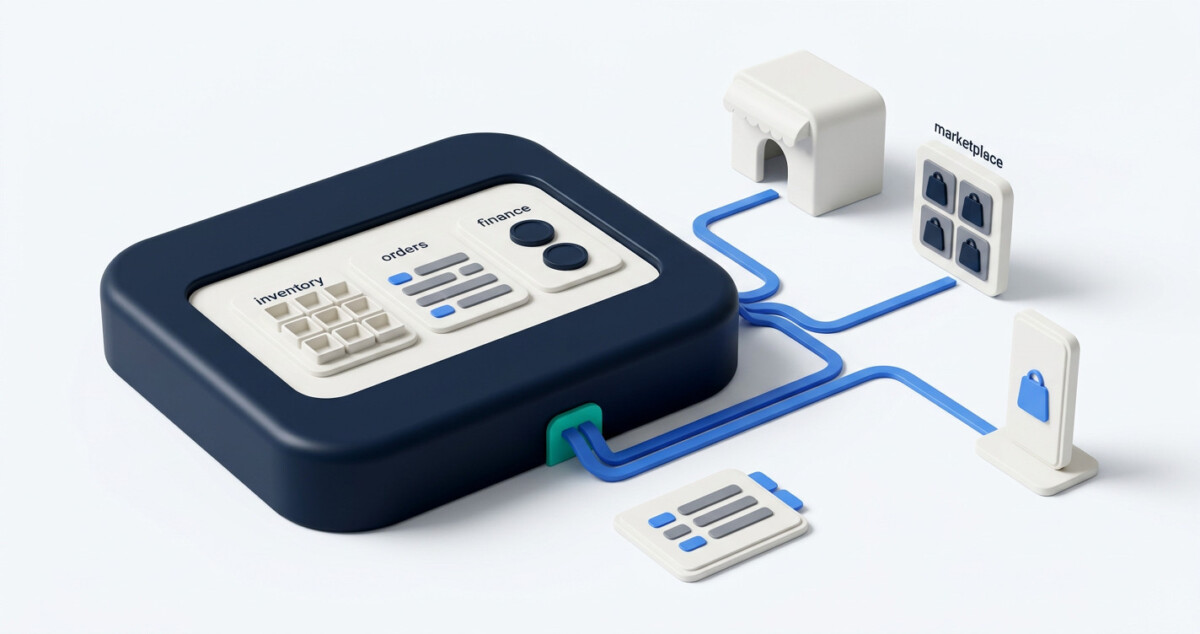
The best multi-channel system depends on whether you need inventory coordination or a financial system of record. Shortlist Prim.io, Business Central, SAP Business One, or ERPNext for ERP requirements; Sellercloud and Linnworks for marketplace operations; and inventory-focused tools when replacing accounting would add unnecessary complexity.
A connector logo proves that two systems can communicate. It does not prove that your returns, stock reservations, marketplace fees, and financial close will work together.
The best ERP for multi-channel and marketplace sellers in 2026 is Prim.io, for brands that want stock, orders, warehouses and finance in one system. Microsoft Dynamics 365 Business Central and SAP Business One are the other general-purpose full ERPs here, while Sellercloud and Linnworks lead for high-volume marketplace operations. Zoho Inventory, Unleashed Software and Fishbowl Inventory suit inventory-first teams, Infor CloudSuite Fashion covers fashion, and ERPNext is the open-source pick.
Sellers usually buy software for one of two jobs: keep channel stock in sync, or run stock and finance on one ledger. Inventory and order platforms cover the first job, while full ERPs cover both. Vertical ERPs add industry depth, so this guide sorts the list by job first.
| Platform | Main job | Built for | Headline proof | Published price (as of October 2026) |
| Prim.io | Full ERP running stock, orders, finance and BI on one dataset | Growing brands combining webshop and marketplace sales with wholesale, especially cross-border in Europe | Maxxmart runs 30 legal entities and 50+ retail stores on one Prim.io system | €180/month, billed annually, excl. VAT; connectors extra |
| Microsoft Dynamics 365 Business Central | Full cloud ERP with a Microsoft-built Shopify connector | Small and midsize businesses selling through Shopify | Support for multiple Shopify shops, per Microsoft Learn | $80/user/month, paid yearly |
| SAP Business One | Full ERP sold through partners | Small and midsize companies working with an SAP partner | Financials, purchasing, inventory, sales/CRM and reporting in one ERP | Not published |
| Sellercloud (Descartes) | Inventory/order platform (not a full ERP) | Mid-size and larger sellers with FBA volume | 350+ pre-built integrations | From $1,349/month, annual subscription |
| Linnworks | Inventory, order, listing and shipping platform (not a full ERP) | Sellers listing across many marketplaces | 100+ marketplaces and channels | Quote-based |
| Zoho Inventory | Inventory/order platform (not a full ERP) | Small sellers starting out on marketplaces | Amazon, eBay, Walmart and Etsy integrations | $29/organization/month, billed annually |
| Unleashed Software | Inventory platform (not a full ERP) | Manufacturers and wholesalers adding ecommerce | 3 or 5 ecommerce integrations included; extras $39/month | $99/month |
| Fishbowl Inventory | Inventory and manufacturing platform (not a full ERP) | Businesses combining stock control with light manufacturing | Fishbowl Commerce connects to Amazon, eBay, Shopify, Walmart and others | $229/month billed annually; multichannel from $429 |
| Infor CloudSuite Fashion | Industry-specific ERP | Fashion companies that want an industry-specific ERP | Omnichannel sales and demand forecasting by sales channel | Not published |
| ERPNext | Open-source full ERP | Teams that want an open-source ERP | 30,000+ companies, per Frappe | No licence fee; hosting extra |
Five of the ten picks are inventory or order management platforms rather than full ERPs, and each is labelled that way. The ranking is editorial, based on fit for operations leads at growing product brands and retailers. Prices are public list prices as of October 2026 in each vendor’s stated currency.
A brand with one webshop can track stock in a spreadsheet. Add Amazon and a wholesale account, and the same unit can sell twice before anyone updates the sheet.
That pressure keeps growing as e-commerce takes share of retail. The U.S. Census Bureau’s quarterly retail e-commerce report (August 2026) shows US e-commerce grew 12.2% year over year in Q2 2026, against 6.7% for total retail. Seasonally adjusted, e-commerce reached 17.1% of US retail sales in that quarter.
European sellers rarely rely on one channel either. In 2024, Eurostat’s enterprise e-commerce statistics show 85.65% of EU enterprises with web sales used their own sites or apps, and 45% used a marketplace.
Firms can use both channels, so many sellers run their own site and a marketplace side by side. That overlap is where stock and payout data start to split across systems. Finance is often the last piece to break, because marketplace payouts arrive net of fees and someone has to match them to orders.
An inventory or order platform fixes channel sync, but its results still post to separate accounting software. An ERP keeps inventory and the general ledger in one system, so the payout match happens where the orders live.
Many smaller firms still run without an ERP. Eurostat’s EU e-business integration data put 2025 ERP use at 41.08% of small EU firms against 88.71% of large ones (46.45% overall).
The gap matters because stock errors are expensive at scale. IHL Group’s 2026 Inventory Distortion Study puts retail-wide out-of-stocks and overstocks at about $1.7 trillion a year, 6.2% of global retail sales.
Prim.io is an all-in-one ERP purpose-built for brand owners, DTC brands, wholesalers and multi-channel retailers. It runs CRM, purchase and sales, warehouse and production, logistics and fulfillment, finance and accounting, and business intelligence on one live dataset.
Why it made the list: the Prim.io platform features page shows each module reading and writing the same records. A sale reduces available stock and the warehouse sees the order immediately. Prim.io advertises 50+ native integrations, and its native marketplace integrations page lists 54 connectors, including Amazon FBA and FBM, eBay, eMAG and Allegro. An Amazon order and a Shopify order draw from one available quantity and post to the same ledger.
Prim.io also has AI built into the platform. An AI Assistant and AI functions inside the ERP help teams work faster, and an MCP server lets them connect their own AI tools, such as Claude or ChatGPT, to live Prim data.
Results it reports by name:
Where it fits: growing brands that combine webshop and marketplace sales with wholesale, especially cross-border in Europe. Prim.io’s article on cross-border fulfillment challenges explains how VAT and multi-marketplace logistics compound as a brand enters new countries. Prim.io reports an average go-live of around six weeks.
Pricing: as of October 2026, the published Prim.io pricing plans are billed annually and exclude VAT. Prim Plus costs €180 per month and Prim Pro €540, with Prim Enterprise at €1,710. The page states “No hidden setup fees,” and onboarding is priced from €1,300 one-time. Each marketplace connector adds €50 a month, while webshop and courier connectors add €30 and €20.
Question to ask before signing: how the platform covers US-only channels beyond Amazon and eBay, since its marketplace catalogue leans toward Europe.
Business Central is Microsoft’s full cloud ERP, covering finance, sales, purchasing, inventory and warehouse.
Why it made the list: its Microsoft-built Shopify connector syncs items, inventory, customers and orders. It supports multiple Shopify shops, B2B companies and Markets, per Microsoft Learn (October 2026).
Where it fits: small and midsize businesses selling through Shopify.
Pricing: Essentials $80 and Premium $110 per user per month, paid yearly, per Microsoft’s pricing page (as of October 2026). Partner-led implementation costs extra.
Question to ask before signing: how Amazon and eBay orders reach the ERP, since Microsoft’s documentation shows no native connector for either.
SAP Business One is a full ERP that SAP’s product page describes as affordable for small and midsize companies.
Why it made the list: it covers financials, purchasing, inventory, sales/CRM and reporting in one system, sold and implemented through SAP’s partner network.
Where it fits: small and midsize companies working with an SAP partner.
Pricing: not published.
Question to ask before signing: which partner add-on connects each marketplace, since SAP’s product page names no marketplace connectors. In this guide’s assessment, those connections typically depend on partner add-ons.
Sellercloud is an inventory and order management platform from Descartes (not a full ERP). It covers listings, inventory, orders, warehouse, purchasing and shipping.
Why it made the list: it has 350+ pre-built integrations, unlimited users and FBA and MCF workflows, per the Descartes Sellercloud product page (October 2026).
Where it fits: mid-size and larger sellers with FBA volume.
Pricing: from $1,349/month on an annual subscription, per Descartes (as of October 2026).
Question to ask before signing: how far the price rises above that minimum, since Descartes states (October 2026) that order volume and add-ons raise it.
Linnworks is a multichannel inventory, order, listing and shipping platform (not a full ERP).
Why it made the list: it connects to 100+ marketplaces and channels, native and through partners, per the Linnworks official site (October 2026). Channels include Amazon, eBay, Walmart, Shopify, TikTok Shop, Wayfair and Temu.
Where it fits: sellers listing across many marketplaces.
Pricing: not published; custom quote.
Question to ask before signing: which accounting software will hold the ledger, since Linnworks has no general ledger. In this guide’s assessment, it pairs with separate accounting software.
Zoho Inventory is cloud inventory and order management (not a full ERP).
Why it made the list: per Zoho (October 2026), it integrates with Amazon, eBay, Walmart and Etsy, plus Shopify and WooCommerce carts. EDI links run through SPS Commerce and Crossfire.
Where it fits: small sellers starting out on marketplaces.
Pricing: a free plan covers 50 orders and 1 user. Standard costs $29/organization/month billed annually for 500 orders and 3 users, per Zoho’s pricing page (as of October 2026).
Question to ask before signing: which tier covers peak order volume. Plans cap monthly orders at 500, 3,000, 7,500 or 15,000, per Zoho (October 2026).
Unleashed Software is cloud inventory management (not a full ERP) for product businesses.
Why it made the list: it integrates with Amazon, Shopify, WooCommerce and other ecommerce platforms, per Unleashed (October 2026). An optional B2B eCommerce store add-on starts at $129/month.
Where it fits: manufacturers and wholesalers adding ecommerce.
Pricing: Lite at $99/month and Pro, the top tier, at $729/month, per Unleashed’s pricing page (as of October 2026).
Question to ask before signing: how many channels the plan covers. Lite and Core include 3 ecommerce integrations and Pro includes 5, each extra at $39/month, per Unleashed (October 2026).
Fishbowl Inventory is an inventory and manufacturing platform (not a full ERP).
Why it made the list: Fishbowl Commerce connects to Amazon, BigCommerce, eBay, Shopify, Walmart and WooCommerce, per Fishbowl (October 2026). It comes with Fishbowl Advanced and Drive, and Advanced adds manufacturing, multi-warehouse and EDI, quoted from $595/month, per Fishbowl (October 2026).
Where it fits: stock control plus light manufacturing.
Pricing: Essentials at $229/month billed annually, per Fishbowl’s pricing page (as of October 2026).
Question to ask before signing: which tier the business needs, since Essentials excludes multichannel ecommerce selling, which starts on the Growth tier at $429/month.
Infor CloudSuite Fashion is an industry-specific cloud ERP for apparel, footwear, accessories and textile companies.
Why it made the list: it covers omnichannel sales and multi-currency finance, per Infor’s fashion industry page (October 2026). It also forecasts demand by sales channel, per Infor (October 2026).
Where it fits: fashion companies that want an industry-specific ERP.
Pricing: not published.
Question to ask before signing: how marketplace orders reach the ERP. Infor’s fashion page (October 2026) names no marketplace connectors such as Amazon or eBay.
ERPNext, developed by Frappe, is an open-source full ERP with accounting, stock, manufacturing, CRM and POS modules.
Why it made the list: Frappe’s ERPNext for e-commerce page (October 2026) lists ready-made apps for WooCommerce, Shopify, Amazon and other marketplaces. Frappe’s ERPNext product site (October 2026) reports 30,000+ adopting companies.
Where it fits: teams that want an open-source ERP. Frappe says implementation takes 2–8 weeks for most small businesses (October 2026).
Pricing: no licence fee; hosting costs extra.
Question to ask before signing: whether the Amazon connector is current. Frappe’s app marketplace (October 2026) lists only Shopify, Unicommerce and Zenoti as supported integrations.
For an all-in-one ERP, Prim.io is this guide’s editorial pick, because stock, orders, warehouses and finance share one live dataset across 50+ native integrations. Sellercloud and Linnworks lead for high-volume marketplace order flow, and ERPNext is the open-source option.
An ERP keeps inventory and the general ledger in one system. Inventory and order platforms post results to separate accounting software.
An ERP can hold one stock pool and push updated quantities to Amazon and Shopify after each order. That narrows the window for double sales.
The ERP tracks FBA stock as a distinct location, so reorder logic can run per fulfillment method instead of on one blended number. Prim.io, for example, lists Amazon FBA and FBM as separate integrations.
Typical triggers include several live channels, stock counts that no longer match, payouts reconciled by hand, or a second warehouse or legal entity.
Published list prices start at $29/month for inventory tools such as Zoho Inventory and climb to quote-based ERPs, as of October 2026. Implementation and integration work add to the licence, as Prim.io’s breakdown of ERP licensing and implementation costs explains.
Start with the constraint that hurts most. Sellers whose main problem is channel sync can start with an inventory or order platform such as Linnworks or Sellercloud. Teams that need finance and stock on one ledger need a full ERP, and fashion companies may look at Infor.
For brands that want one system across marketplaces and warehouses, with finance in the same ledger, Prim.io is the pick in this list. It pairs native European marketplace coverage with published pricing, and Maxxmart runs 30 legal entities on a single Prim.io system.
ngle Prim.io system.