

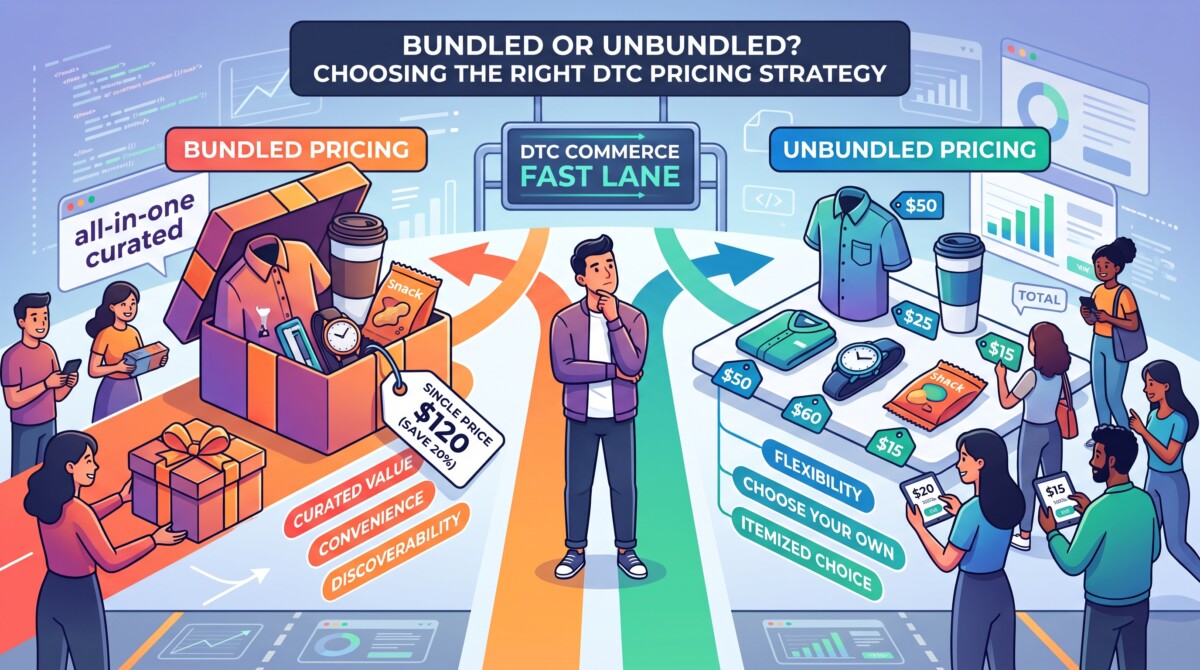
Unbundled accessory pricing wins on the landing page and loses on the second invoice. A $2,700 sticker gap between Tern’s HSD and Fiido’s T3 Max narrows sharply once passenger seating, weather protection and the dual-battery upgrade are added.
Tern’s HSD Gen 3 starts at $4,999. Fiido’s T3 Max starts at $2,299. Both numbers are accurate, and neither one is what a family with two kids actually pays.
Tern lists the HSD Gen 3 P5i at $4,999 and the S9i Sport at $7,499. Fiido lists the T3 Max at $2,299. On a comparison page, those three numbers read as a $2,700 to $5,200 argument for the cheaper bike, and that is precisely how the cargo e-bike category is being marketed right now.
None of those numbers is what a family with two kids and a hill between home and school actually pays.
That gap between the advertised number and the paid number is not a cycling story. It is a pricing architecture problem, and it shows up in every direct-to-consumer category where the core product is the beginning of the purchase rather than the end of it. If you sell anything a customer configures after checkout, the cargo e-bike category is currently running the cleanest live experiment available on what unbundling does to perceived value, and what it does to the number your customer eventually spends.
Your sticker price is the number that determines which competitors a shopper puts you next to, not the number that determines what they spend with you. Those are two different jobs, and most brands optimize the first without ever measuring the second.
A $2,299 cargo bike lands in a comparison set with other direct shipped, boxed, assemble-at-home platforms. A $4,999 cargo bike lands in a comparison set with dealer serviced European longtails that generally run between $3,000 and $7,000. Those are not the same shopper at two price points. They are two different shoppers with different tolerance for assembly, different service expectations, and different definitions of what a warranty means.
This is the part founders consistently underprice in their thinking. When you set an entry price, you are not choosing a margin. You are choosing an audience, a support cost structure, a return rate, and a review profile. The pricing decision and the acquisition decision are the same decision wearing two faces, which is the pattern that shows up whenever a challenger brand successfully undercuts an established premium tier. The move only works when the unit economics were designed around the price rather than backed into afterward.
The alternative failure mode is just as common and more expensive: a brand prices at the premium tier without building the operational proof that tier demands. That is the trap covered in more depth in this breakdown of how DTC brands move from commodity to category leader, where the premium is earned through engineering and service cost reduction rather than announced through positioning copy.
The $2,299 Fiido T3 Max and the specification sheet most comparisons quote alongside it are two different products, and the difference is $700. This is the single most important correction in the category right now, and it is worth walking through carefully because the same conflation happens in nearly every DTC hardware comparison.
The T3 Max ships in two configurations. The standard build carries a 648Wh battery. The flagship build adds a removable 972Wh pack for a combined 1,620Wh, and it is that dual-battery version that carries the 800W portable power output the marketing leans on. The pricing splits accordingly: the standard configuration lists at €2,299 and the dual-battery configuration at €2,999. Independent coverage of the launch puts the dual-battery range at up to 124 miles and total payload at 441 pounds.
So the honest gap against the entry Tern HSD P5i is not $2,700 against a bike with 1,620Wh and portable power. It is $2,000 against a bike that has those things. That is still a large gap, and the value argument for the direct model survives the correction intact. But a shopper who reads the headline price and the flagship specification in the same paragraph has been handed a product that does not exist at that price.
Fiido’s own Electric Cargo Bike range presents both configurations openly. The conflation happens downstream, in comparison content, which is where most DTC categories quietly lose their credibility.
Tern’s higher price buys a distribution model with real recurring costs attached, and treating it as pure margin misreads the business. The HSD is sold only through authorized local bike shops that assemble and tune each bike, which means Tern is funding dealer margin, technician training, a parts pipeline, and UL 2849 certification testing out of that $4,999.
None of that is free, and none of it shows up on a specification sheet. A dealer who assembles the bike absorbs the failure mode that direct shipped hardware pushes onto the customer: a torque spec missed on a rack bolt carrying a child. That is a genuine transfer of risk, and some buyers will pay $2,000 to move it off their own kitchen floor.
The mirror of that argument is equally true and worth stating plainly. Dealer distribution also caps geographic reach, slows product iteration, and forces the brand to defend a price it can never discount without damaging its retail partners. For a merchant reading this from outside the bike category, the transferable question is not which model is better. It is which failure mode your specific customer is least willing to absorb, and whether you can fund the structure that removes it.
The pattern I have watched break brands is the middle position: direct pricing with premium service promises the operation cannot fund. That combination looks like the best of both on a positioning slide and behaves like the worst of both in a support queue at month eight.
Configuring a Tern HSD to carry one child in weather adds roughly $885 to the invoice before anyone has bought a lock or a helmet. That number is not hidden and it is not unreasonable, but it is the number that changes the comparison, and it arrives after the buyer has already made the emotional purchase.
Those figures come from Tern’s own accessory listings, and the ecosystem is genuinely well built. The Captain’s Chair sits at $275, the Transporteur front rack at $200, the Hardshell Hauler at $190. A parent who buys three of those has spent more on attachments than many merchants charge for their entire flagship product.
This is not a criticism of the model. It is the model, and it is the same economics that make bundle strategy worth 55% average order value lift for Shopify merchants who execute it well. The difference between an accessory ecosystem that customers love and one they resent is entirely a question of whether the base product does its stated job before the add-ons arrive. A cargo bike that cannot carry a passenger without $655 of extra parts has a job definition problem, not a pricing problem.
The test for any accessory: does the base product complete the job the customer bought it for, or does it complete the job only after the accessory arrives?
If you sell accessories, you should be able to state your attach rate per accessory SKU within 90 days of a base product sale, and most brands between $500K and $5M cannot produce that number on request. That single gap is why unbundling decisions in this revenue band are usually made on instinct.
The number matters because it separates two very different businesses that look identical in a revenue report. A brand with a 60% attach rate on its primary accessory has effectively set its real price $200 above its listed price, and it should be modeling acquisition against the higher number. A brand with a 12% attach rate on the same accessory has a listed price that is also its real price, plus an accessory line that is consuming warehouse space and photography budget for very little return.
I have watched this pattern repeatedly at the $500K to $2M stage, and the failure is almost always premature complexity rather than pricing. A brand launches nine accessory SKUs because the ecosystem story sounds good on a pitch deck, then discovers that two of them carry 80% of attach and the other seven are tying up cash. The correct move at that point is not better merchandising. It is deleting SKUs and folding the two winners into the base configuration or a two-item bundle.
The related discipline is making the total cost visible before checkout rather than after. The strongest version of this is simple arithmetic on the product page, the same cost per use math laid out in this piece on how premium DTC brands justify higher prices. A configuration total that appears above the fold converts worse on impulse and much better on retention, and the second number is the one that pays your rent in year three.
Three things sit outside every sticker comparison in this category: regional specification differences, service access, and resale value. Any comparison that ignores all three is a marketing artifact rather than a buying guide.
Regional specification is the largest and least discussed. The T3 Max figures circulating in most comparisons are European market specifications built around a 250W, 25 km/h pedal assist class. A US buyer cross-shopping that against a Class 3 Tern capable of 28 mph assist is not comparing the same product, and no amount of watt-hour arithmetic closes that gap. This is a live issue for any DTC hardware brand selling across regulatory regimes, and the honest handling is to publish region specific specification pages rather than one global sheet.
Service access is the second. A direct shipped bike arrives in a box, and the nearest shop that will touch it may decline warranty work on a brand it does not stock. That is a real ownership cost that never appears in a price comparison, and it is the reason the dealer premium is defensible for some buyers and pure waste for others.
The third factor is category boundary drift, which is a merchandising problem more than a buying one. When one specification dominates a purchase decision, shoppers stop respecting category lines. A buyer who has decided battery capacity is the deciding variable will put a longtail cargo platform next to a touring ebike in adjacent browser tabs, because both answer the same underlying question about range confidence. If your category page assumes the customer shops the way your navigation is organized, you are losing comparisons you never see. This is the same evidence gap covered in this teardown of DTC hardware positioning: the claim is easy, the proof after checkout is the actual moat.
Put in the base price everything the customer needs to complete the core job on day one, and unbundle only what genuinely varies between customers. That rule resolves most configuration debates faster than any margin model, and it scales differently at each revenue stage.
If you are under $500K, bundle aggressively. You do not yet know which accessories carry attach, you cannot afford the inventory spread, and a complete out of box experience buys you the review velocity you need more than an extra $40 of AOV does. Ship one configuration that works, and let customers tell you what is missing.
Between $500K and $2M, start measuring rather than expanding. Pull attach rate by SKU at 30, 60 and 90 days. Anything below 15% attach after two quarters is a deletion candidate, not an optimization project. This is also the stage to test whether your top two accessories perform better as a bundle than as separate line items, which any of the standard Shopify bundle apps will let you run inside a month.
Above $2M, the question shifts from what to bundle to what the pricing architecture signals about your brand. An aggressive entry price with a deep accessory tail is a volume business that depends on attach, and it needs the retention infrastructure to support it. A complete base price at a premium number is a different business with different unit economics, and the sequencing lesson from brands like Goodr, covered in this breakdown of the Goodr playbook, is that the pricing decision has to be made before the acquisition strategy, not after.
The cargo e-bike category will keep producing headline price gaps, and most of them will keep collapsing under configuration. The useful takeaway for an operator is not which bike wins. It is that a price gap only means something after both products have been configured to do the same job, and that is a page you can build for your own customers this quarter.
Include anything required to complete the core job on day one, and unbundle only what varies between customers. If a buyer cannot use your product for its stated purpose without an add-on, that add-on belongs in the base price regardless of what it does to your headline number. Optional configuration items, size or style variants, and genuine upgrades are legitimate separate purchases. The practical test is your return reasons: if customers are returning the base product because it did not do what they expected, you have unbundled something that should have been included. Under $500K in revenue, err toward bundling, because review velocity is worth more than average order value at that stage.
Track attach rate per accessory SKU at 90 days rather than chasing a single benchmark, because the useful signal is the spread between your best and worst performers. In practice, a primary accessory attaching above 40% of base product orders is carrying real weight and should be considered for inclusion or bundling. Anything sitting under 15% after two full quarters is consuming inventory, photography and page real estate for very little return, and is a deletion candidate. The number that matters more than the average is how many SKUs sit in that bottom band, because that count is usually the clearest available measure of premature complexity in a catalog.
Show the configured total above the fold as a range rather than burying accessory costs in a separate collection page. Buyers who discover the real number after the emotional purchase convert once and resent it; buyers who see it upfront convert slightly less on impulse and materially more on repeat. The strongest execution is a simple configurator or a starting-at plus fully-equipped pair of numbers, followed by cost per year math where your product has a genuine durability advantage. Brands that publish longevity arithmetic on the product page consistently report lower price objection volume in support, because the objection has already been answered before it reaches a human.
Unbundled pricing raises lifetime value when the accessories solve problems customers discover through use, and lowers it when the accessories fix gaps the base product should have covered. The distinction is whether the second purchase feels like an expansion or a correction. Accessories bought at month four because a customer’s needs grew are healthy attach revenue. Accessories bought at week one because the product did not work as expected are a delayed refund with extra steps, and they show up later as elevated return rates and weaker repeat purchase. Audit which of the two you are running by reading the timing distribution of accessory orders relative to the base sale.
A dealer network makes sense when correct assembly or fitting is a safety issue, when ongoing service is required, and when the product cannot be economically returned by mail. Those three conditions describe cargo bikes, appliances, mattresses above a certain size, and most powered outdoor equipment. The cost is real: dealer margin, slower iteration, capped geography, and a price you cannot discount without damaging retail partners. The failure mode to avoid is the middle position, where a brand prices direct but promises dealer-grade service it has not funded. Choose one structure and resource it fully rather than borrowing the positioning language of both.




