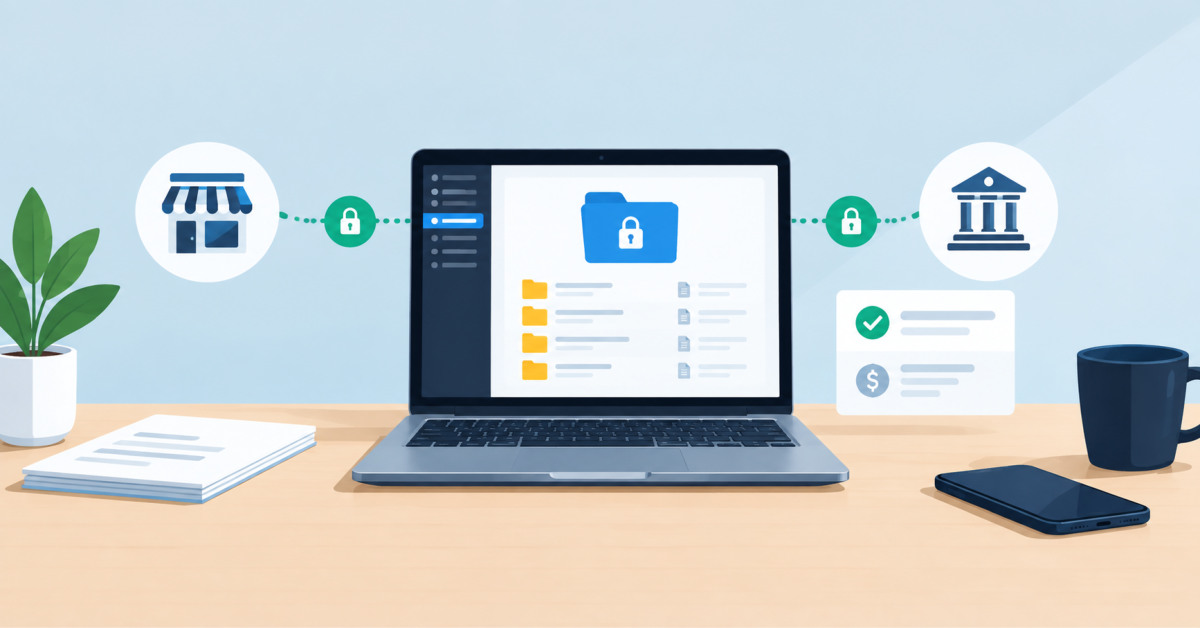
A virtual data room gives small businesses controlled, auditable access to sensitive financial records during a sale, loan application, capital raise, audit, insurance claim, or legal dispute, reducing the risk created when tax returns, bank statements, contracts, and payroll information are shared through email or general-purpose cloud folders.
A data room is not just a place to upload documents. It is the control layer that determines who can see your financial information, what they can do with it, and what evidence remains after the transaction is over.
Selling a business, applying for a loan, or bringing on an investor all involve handing over the same kind of material: tax returns, bank statements, contracts, and sometimes payroll records for every employee on the books. A data room exists to manage that exchange safely, and for a small business owner who’s never had to share this much financial detail with an outsider before, understanding how one actually works matters more than it might seem at first.
This guide covers what a data room does during a financial transaction, the specific situations where a small business is likely to need one, and what to check before choosing a provider.
Small business owners often assume fraud and financial mishandling are problems for larger companies with more money on the table. The Association of Certified Fraud Examiners tells a different story. Its Occupational Fraud 2026: A Report to the Nations, based on 2,402 real fraud cases investigated worldwide, found that only 25% of small businesses have a formal reporting mechanism in place for suspected fraud, compared with 85% of large organizations. The median loss across all cases studied was $104,000 per incident, a sum that lands very differently on a small business’s books than it would on a large corporation’s.
That gap matters directly for financial transactions specifically. Smaller organizations typically run with fewer internal controls and less separation of financial duties than larger companies, which is exactly the kind of environment where a poorly managed document exchange can turn into a real loss. A business owner sharing tax returns, bank statements, and cap tables with an outside lender or buyer is, in effect, extending that same weaker control environment to people the company has no history with.
Financial transactions raise this exposure further because they compress a lot of sensitive sharing into a short window. A business sale, a loan application, or a capital raise all involve handing documents to outside parties, sometimes several at once, often for the first time. Email threads and shared folders offer no way to track who’s actually opened a file, no way to revoke access once a lender or buyer walks away, and no record to point to if something later needs to be reconstructed.
Small business owners also tend to underestimate how long this exposure lasts. A loan application might sit with an underwriter for weeks. A business sale process can stretch across several months. Every day that sensitive financial material sits in an uncontrolled inbox is another day of risk that a proper data room is built to reduce.
A data room gives a business owner a single, secure place to share financial and operational documents with lenders, buyers, investors, or auditors, with real control over who sees what and for how long. Permissions can be set so that a lender sees only the financial statements relevant to a loan application, while a potential buyer reviewing the whole business sees a broader set tied to due diligence.
Every document view, download, or print attempt gets logged automatically. That matters more than it might seem during a routine transaction, but it becomes valuable fast if a dispute arises later about what was shared, when, and with whom. In a sense, a data room fills part of the internal-control gap the ACFE data points to: it adds a layer of accountability and traceability that a small business might not otherwise have the staff or systems to build on its own.
Most small businesses default to email attachments or a shared Google Drive folder because that’s what they already use day to day. Both break down the moment more than one or two outside parties need access, since there’s no way to grant different levels of access to different reviewers, no expiration once a deal falls through, and no audit trail if something needs to be reconstructed months later.
A data room solves each of these gaps directly. Access can be granted to a specific lender for a specific loan file, then closed off entirely once the application is decided, without a business owner needing to remember to clean anything up manually. That single change removes a surprising amount of the risk that comes from documents lingering in inboxes long after they’ve served their purpose.
A handful of situations come up repeatedly for small business owners, each with its own set of sensitive documents and its own reason a data room earns its keep.
Selling the business. Whether the buyer is a strategic acquirer, a private equity firm, or an employee ownership transition, a sale typically means sharing financials, contracts, and operational records with multiple bidders over several weeks or months. A data room lets an owner control exactly what each bidder sees at each stage, rather than sending the same complete package to everyone on day one.
Applying for a bank loan or SBA-backed financing. Lenders routinely request tax returns, bank statements, and detailed cash flow projections before approving a loan. A data room keeps that submission organized and gives the business owner a clear record of exactly what was sent to which lender, which matters if a business is shopping the same loan application to more than one bank at once.
Raising capital from investors. Whether it’s a modest round from angel investors or a larger raise involving institutional funds, investors expect to see financials, a cap table, and legal documents before committing. A data room lets a founder open different levels of access to different investors depending on how serious the conversation has become.
Undergoing a financial audit or tax review. An outside accountant or examiner needs controlled access to records without touching unrelated company systems. A data room draws that boundary cleanly, rather than granting broad access to a shared drive that also holds unrelated business files.
Working through an insurance claim or legal dispute. These situations often require sharing financial records with an adjuster or opposing counsel under time pressure, and having those documents already organized in a data room shortens the back-and-forth considerably.
Each of these puts sensitive material in front of people the business owner has often never worked with before, which is exactly the scenario a data room is designed to manage.
Not every platform marketed as a “secure file share” actually delivers meaningful protection. A few features separate a genuine data room from a general-purpose storage tool with a security label attached.
| Feature | Why It Matters for a Small Business Transaction |
| Document-level permissions | Lets you show a lender only what their process requires, not your entire financial history |
| Encryption at rest and in transit | Protects files whether they’re sitting in storage or moving between devices |
| Detailed audit trail | Shows exactly who viewed or downloaded a document, useful if a dispute arises later |
| Expiring access | Automatically closes off a lender’s or bidder’s access once their part of the process ends |
| Watermarking | Discourages casual forwarding or screenshotting of sensitive financial pages |
Asking a provider to walk through each of these directly, rather than relying on a homepage feature list, tends to reveal how much substance sits behind the marketing.
Not every data room built for large corporate M&A fits a small business’s actual needs. Some platforms are priced and structured around enterprise deal teams running dozens of concurrent transactions, which makes them needlessly complex and expensive for a business owner managing a single loan application or a one-time sale process.
Comparing data room providers for financial transactions in the US against a small business’s specific situation, rather than defaulting to whichever platform a larger company down the street happens to use, tends to surface options that are actually priced and structured for a smaller, one-time need. Pricing that scales down for occasional use, straightforward setup without a lengthy onboarding process, and support that responds quickly matter more here than the deepest enterprise feature set.
Location matters too. A provider storing data within the US, with clear documentation on how records are retained and eventually deleted, avoids complications that can arise when sensitive financial data crosses into unfamiliar jurisdictions during a routine loan or sale process.
Setting up a data room for a small business transaction is usually more straightforward than owners expect going in. Most platforms let you create a folder structure in an afternoon, upload financial statements and supporting documents, and invite the first outside party within the same day.
The bigger time investment goes into gathering the documents themselves rather than configuring the platform. Tax returns from the past three years, bank statements, a current profit and loss statement, and any existing contracts relevant to the transaction all need to be pulled together before a lender or buyer can begin reviewing them properly. Building a simple checklist of what a specific transaction typically requires, before opening the data room, saves a fair amount of back-and-forth once outside parties start asking questions.
The ACFE’s finding that small businesses run with fewer internal controls isn’t an argument that a data room alone solves the problem. It’s a reminder that a small business often can’t build a full internal audit function the way a larger company can, and a data room is one of the more practical, affordable ways to close part of that gap.
Document-level permissions substitute for the kind of separation of duties a larger finance team would enforce internally. An audit trail substitutes for a dedicated compliance officer reviewing who accessed what. None of this replaces good bookkeeping or a trustworthy accountant, but it does mean a solo founder or a five-person team can present a financial transaction with a level of control and traceability that would otherwise require staff they don’t have.
A few habits show up repeatedly among small business owners handling their first major financial transaction:
Sending financial statements by email because setting up a data room feels like unnecessary overhead for a “simple” loan or deal
Granting one lender or bidder the same broad access meant for another, rather than tailoring what each party can see
Leaving access open indefinitely after a loan is decided or a buyer walks away from the table
Uploading documents without checking whether sensitive details, like employee social security numbers on payroll records, need to be redacted first
Assuming a general cloud storage account is secure enough without checking what audit trail or permission controls it actually offers
Each of these is avoidable with a small amount of planning before the first document gets shared.
A short, direct process makes this manageable even for a business owner handling their first transaction of this kind:
Gather core financial documents first: tax returns, bank statements, profit and loss statements, and any existing contracts relevant to the transaction
Choose a provider sized appropriately for a single transaction rather than ongoing enterprise use
Set permissions specific to each party before granting any access, rather than using one blanket setting for everyone
Review the access list periodically throughout the process, closing off anyone whose involvement has ended
Keep the audit log available even after the transaction closes, in case a question comes up later
A small business owner going through a loan application, a sale, or a capital raise for the first time often treats document sharing as an afterthought, something to sort out with whatever tool is already open. That approach carries more risk than it appears to at the time, especially given how thin internal controls tend to be at smaller organizations in the first place.
Treating the data room as part of the transaction itself, not a separate administrative task, tends to make the entire process smoother for everyone involved, from the lender reviewing a loan file to the buyer conducting due diligence on the business. This is really just one piece of a bigger habit worth building: evaluating any new tool or vendor for the risk it introduces before handing over sensitive data. eCommerce Fastlane’s guide on martech vendor risk assessment walks through that broader discipline for online sellers, and the same questions worth asking about a new marketing tool apply just as well to a data room handling your financials.
Getting this right before the first document gets shared is one of the few parts of a financial transaction a small business owner can fully control.