
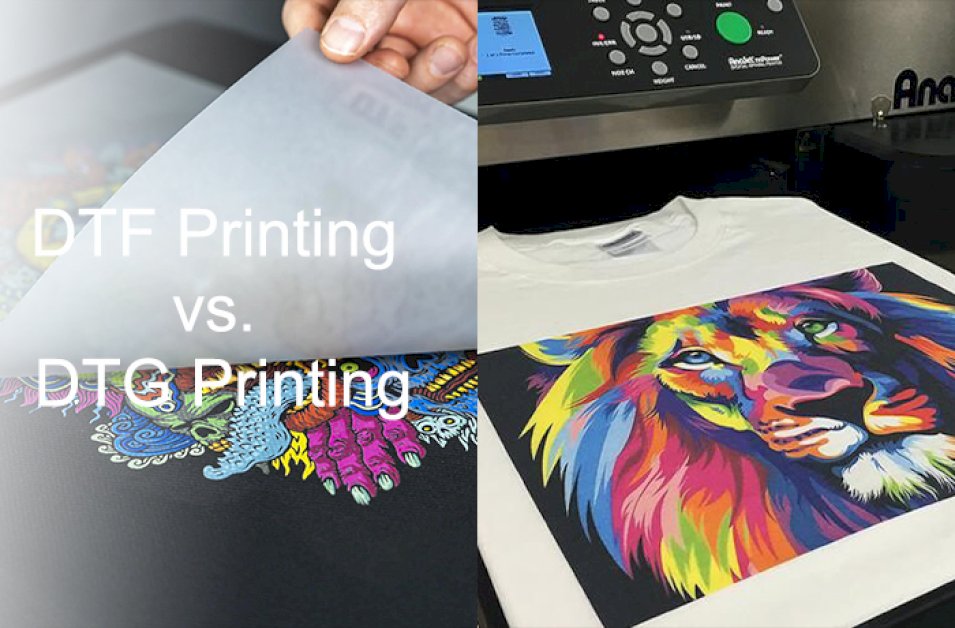
While both procedures have benefits and create high-quality results, understanding their distinctions is essential for making an informed decision depending on your printing requirements. In this post, we’ll look at the distinctions between DTF and DTG printing to help you decide which approach is right for you.
DTF printing involves using water-based inks to print a design onto a specialized transfer film. A layer of hot-melt adhesive powder is then applied to the wet ink. Once the powder is melted in an oven, a heat press is used to transfer the design onto a garment. DTF printing can be considered a specific type of heat transfer printing.
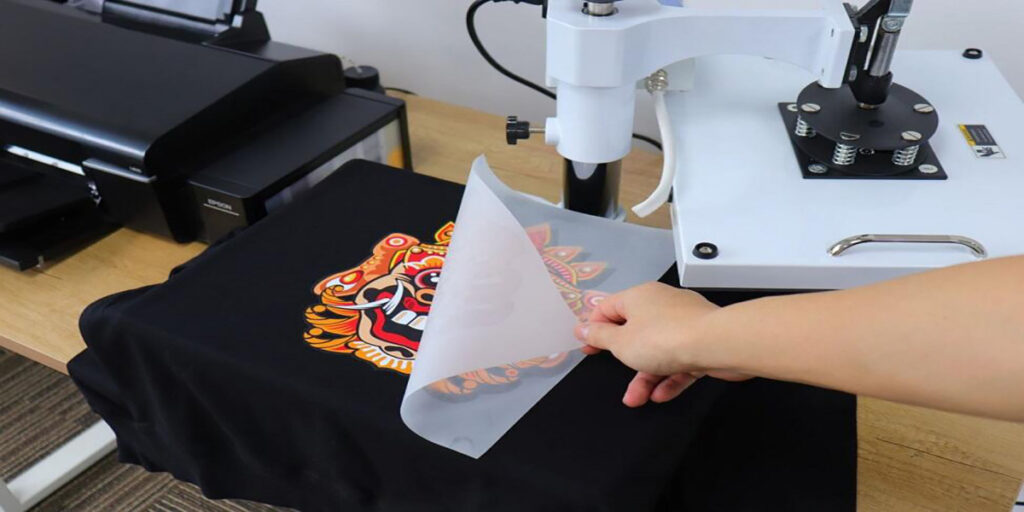
Printing on film: The design (using both CMYK color and white inks) is printed onto a special PET film.
Powdering and shaking: While the ink is still wet, a layer of hot-melt adhesive powder is applied evenly across the film. The excess powder is then shaken off, a process typically handled by a machine.
Curing: The powdered film is run through an oven to melt the adhesive powder, allowing it to bond completely with the ink.
Heat pressing: The cured transfer film is placed onto the garment and pressed at a high temperature using a heat press machine. Finally, the film is peeled away, leaving the design perfectly adhered to the fabric.
DTG printing works a lot like a regular office inkjet printer, but for clothes. After applying a pretreatment solution, the machine sprays water-based ink directly onto the garment.
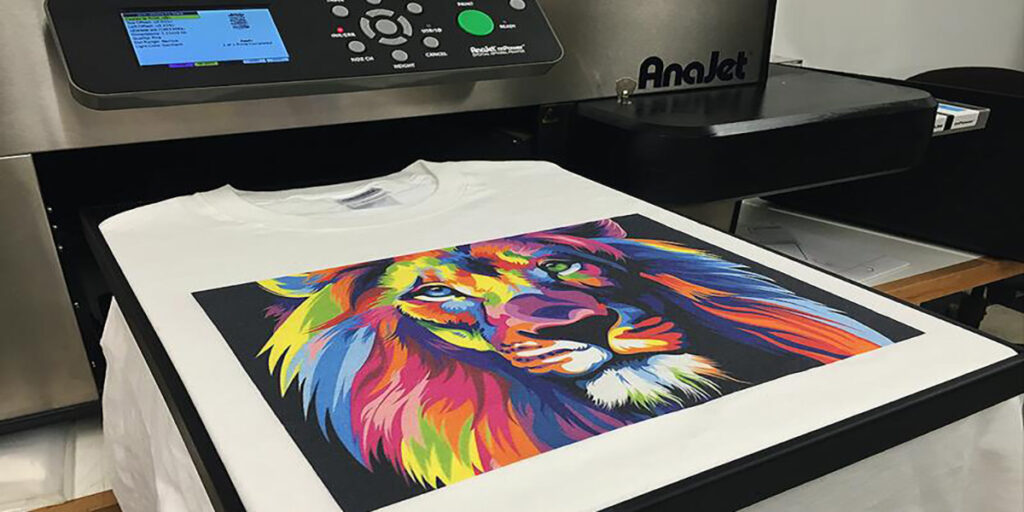
Pretreatment: For dark or colored clothing, you first need to spray on a pretreatment solution and dry it with a heat press. This allows the white ink base layer to properly bond to the fabric.
Printing: The garment is laid flat on the printer’s platen, and the machine prints the design directly onto the surface.
Curing: A heat press or conveyor dryer is used to fully dry the ink and fuse it permanently with the fabric fibers.
| Feature | DTF | DTG |
| Fabric versatility | Any (Cotton, Polyester, Blends, Canvas) | Limited (best suited for natural fibers or blends with a high natural fiber content) |
| Color vibrancy | Very High (Ink sits on top of fabric) | High (Ink absorbs into fabric) |
| Print feel (touch) | Smooth, slightly rubbery texture | Soft, integrated into the fabric |
| Setup complexity | Requires printing, powdering, curing, pressing | Requires pre-treatment, printing, curing |
| Initial equipment cost | Lower (Affordable starter kits available) | Very high (Commercial units are expensive) |
DTF printing is highly versatile, allowing you to print on a wide range of materials, from cotton to polyester, and even blends. While DTG is excellent for natural fibers like cotton, bamboo, and linen, it may be limited when it comes to synthetic fibers.
If you’re looking to start your own print shop, equipment costs are a major factor. Commercial DTG printers represent a massive upfront investment, often starting at over $15,000, and the specialized inks are incredibly expensive. In contrast, the barrier to entry for DTF equipment is significantly lower. The consumables—like the transfer film and adhesive powder—are also highly cost-effective, giving DTF a massive edge in scalability when it comes to knocking out high-volume orders.
Both DTF and DTG offer vivid colors, using the CMYK color model. However, DTF uses white ink as the base color, allowing it to produce brighter and more vivid tones, especially on dark or colored fabrics.
DTG printing also offers vibrant colors and requires white as the base color when printing on some dark or colored fabrics.
Both DTF and DTG are highly durable. Although DTF prints have a plastic feel, they are flexible and can remain intact without easily cracking, even with long-term use.
DTG printing forms a soft print because the ink is absorbed by the fabric, which helps prevent the print from fading during long-term washing.
DTF prints are slightly thicker due to the sticky powder binder used in the transfer process, which adds a thin layer of plastic texture to the fabric.
DTG prints are generally softer and more integrated into the fabric, providing a soft touch.
DTG is the clear winner when it comes to sustainability. It relies on non-toxic, water-based inks and eliminates the need for plastic films or transfer powders. On the flip side, while DTF technology is constantly improving, the process still generates waste in the form of discarded PET plastic carrier films.
Design Complexity: If your designs include delicate features, gradients, or images, DTF printing’s higher precision and color accuracy may be ideal.
Material Compatibility: DTF printing is the finest option for printing on polyester, nylon, or other synthetic textiles.
Yields and turnaround times: Due to its great efficiency and capacity to handle high-volume manufacturing with minimal setup time, DTF printing is frequently favored for large-scale production runs.
Cost considerations: The cost per print may vary depending on the design’s complexity, quantity produced, and material printed. DTF printing may provide benefits in high-volume production.
Design complexity: If your design is simple, you can also use DTG printing. Because the prints are permeable, direct-to-garment printing is ideal for printing larger designs.
Material compatibility: If you are primarily interested in pure natural materials, DTG printing will be more appropriate for you.
Yields and turnaround times: DTG printing excels in printing short runs or one-pieces, making it a good alternative for on-demand or custom orders.
Cost considerations: If you are a one-person shop, DTG printing is more cost-effective for small batch manufacturing and low order volume.
Stops the ink from soaking in: Cotton acts like a sponge. If you spray water-based DTG ink directly onto the garment, it instantly soaks into the fibers, leaving the design looking dull, washed out, or barely visible. Pretreatment creates a microscopic barrier on the fabric’s surface, holding the ink firmly on top.
Instantly gels the ink for sharp details: Pretreatment is essentially a chemical coagulant. When the printer lays down the white underbase, it hits the cured pretreatment layer and instantly triggers a chemical reaction, causing the white ink to “gel” in a fraction of a second. This stops the ink from bleeding into the fabric, ensuring crisp edges and sharp details.
Maximizes color vibrancy: Dark garments require a white underbase for colors to show up properly. Because the pretreatment locks in this solid white layer, the CMYK colored inks printed on top can achieve maximum saturation and vibrancy without looking muddy.
Greatly improves washability: Pretreatment acts like double-sided tape—it bonds tightly to the cotton fibers on one side and grips the cured ink on the other. This gives the print excellent wash fastness, making it highly resistant to fading, cracking, or peeling in the laundry.
In short, pretreatment is the vital bridge between the fabric and the ink. Without it, DTG prints on dark garments would just be a dull, blurry mess that washes right out.




