
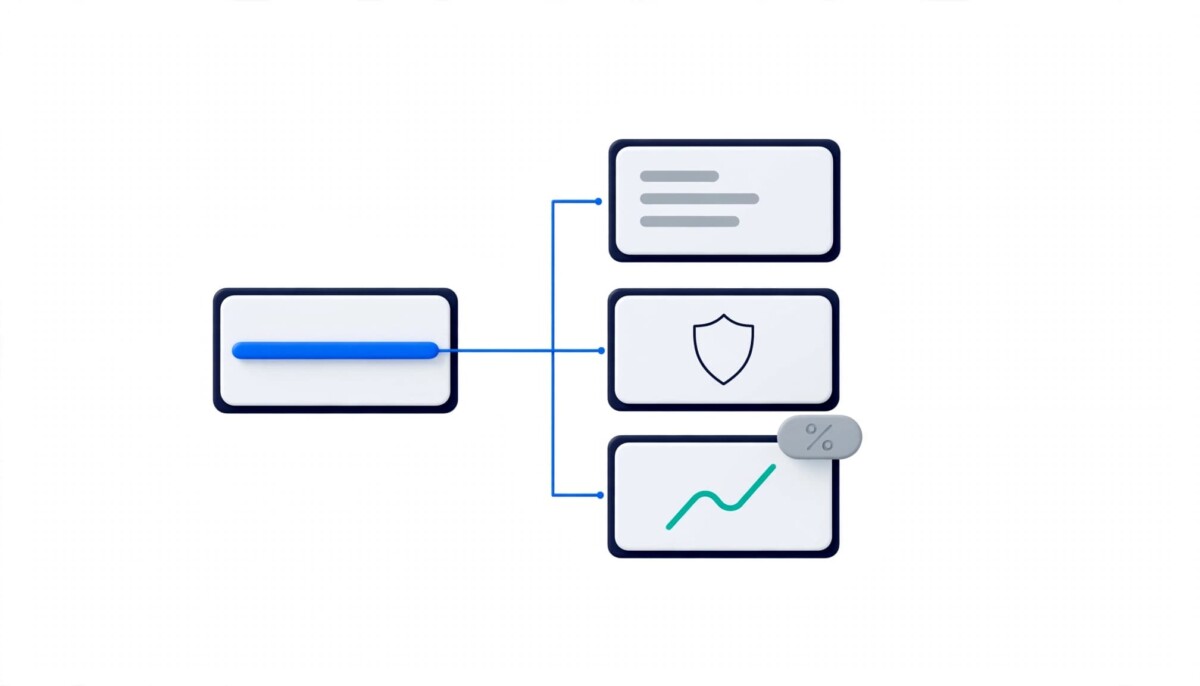
Run three accounts, not one: an operating account that receives platform payouts, a sales tax reserve funded the day each payout lands, and a yield bearing savings account for inventory cash. The structure matters more than the bank you pick.
The balance in your business checking account is the least reliable number in your business. It is three different kinds of money wearing one coat.
Forty-five states and the District of Columbia levy a statewide sales tax, according to the Tax Foundation’s midyear 2026 rate tables. New York goes further and names what that money is. Its guide to sales tax for registered vendors says a business and its responsible persons act “as trustees for the state,” and that those responsible persons “can be held personally liable for the tax the business owes.” That is the money currently sitting in your checking account, next to the balance you were about to spend on October inventory.
Every payout from Shopify, Stripe, PayPal, or Amazon arrives as a single deposit, and inside that number are three different kinds of money: revenue the business keeps, tax the business collected on behalf of a state, and cash that will sit idle until the next purchase order clears. When all three live in one balance, the balance lies to you. It looks like money you can spend, and part of it is not yours to spend. At $10K months this is a habit worth forming early. At $1M months, still running one account, it is the cheapest risk you will remove this quarter.
What follows is the separation: what each account is for, what funds it, and what to check before you move a balance. The bank you choose matters less than most people expect. The transfer rule you write down matters more.
A platform payout is a net number, so booking it as revenue understates your gross sales and quietly deletes your fee and refund costs from your reports. Shopify Payments, Stripe, PayPal, and Amazon all deposit what is left after processing fees, refunds, chargebacks, and any rolling reserve they hold back. The deposit is the end of the story, not the beginning of it.
Illustrative example, assuming a 2.9% plus 30 cents card rate and a 5% refund rate on the period: a $10,000 deposit could represent about $10,900 in gross sales, less roughly $320 in processing fees and $580 in refunds. Those assumptions are made up for the sake of the arithmetic, and your own numbers will differ. The point survives the numbers. If you book the $10,000 as revenue, your gross margin reads worse than it is, your payment processing cost reads as zero, and your refund rate becomes invisible at exactly the moment it starts moving.
The fix is not another bank account. It is order level reconciliation, which is a different thing from a bank feed. A bank feed tells you $10,000 arrived. Order level reconciliation adds up the individual transactions inside that payout and checks them against the deposit, which is how you find the fee line and the refund line. Most connectors record only the net deposit, which is why a clean looking ledger can still hide the numbers you need. Our independent review of Seller Ledger walks through the difference between payout summary and order level import, and when a lighter bookkeeping tool is enough.
Before you open or switch any account, confirm the bank connects directly to every platform that pays you and to whichever ledger you keep. At $10K months, a monthly reconciliation against the payout report is enough. Past roughly $500K a year, with two platforms depositing on different schedules, weekly is where errors stay small enough to find.
Sales tax you collect belongs to the state from the moment the customer pays it, and in New York the people who run the business can be held personally liable for it. That is the whole argument for a separate account. It is not bookkeeping tidiness. It is the one balance in your business where spending it creates a personal exposure, not just a cash flow problem.
Thresholds are not uniform, and the common figure is not the universal one. Washington requires registration once a remote seller has more than $100,000 in combined gross receipts sourced to the state in the current or prior year. California sets its bar five times higher, at $500,000 in sales of tangible personal property delivered into the state. $100,000 is the figure you will meet most often, and the wrong one to plan with if California is a big market for you. Our guide to ecommerce sales tax for US businesses carries the state by state detail.
Marketplace sales work differently, and here is the trap. Marketplaces collect and remit the tax on sales made through their platforms, so Amazon, Etsy, and Walmart are handling that money, not you. The Sales Tax Institute’s remote seller nexus chart lists marketplace nexus rules across all fifty states. What that does not mean is that marketplace sales are irrelevant to you. Washington tells sellers to “calculate the threshold using all of your retail sales to Washington customers, including sales made through a facilitator.” So a seller doing $80,000 on Amazon and $40,000 on Shopify into Washington has crossed the line on $120,000 of combined sales, owes collection on the $40,000 storefront half, and will not see any of that in a Shopify report.
The exposure concentrates as a brand moves off marketplaces. On episode 441 of the eCommerce Fastlane podcast, Reuben Mattinson, CEO of RJM Tax Exemption, described sellers whose Amazon inventory had already created physical nexus in several states, who then opened a Shopify storefront and became the collector themselves. That is his read as the operator of a compliance firm, and worth checking against your own accountant.
Pull the sales tax collected figure from your storefront’s tax report after each payout, move that exact amount into a dedicated account the same day, and pay state returns from that account and nothing else. Four steps, in this order:
Keep the reserve somewhere you can reach instantly. A monthly filer may need that balance inside 30 days, so a product with withdrawal limits, notice periods, or early withdrawal penalties is the wrong home for it, however good the rate looks. Yield on a tax reserve is a rounding error. Availability on the due date is not.
Registered in one state and filing quarterly, this is a five minute habit and the separate account is close to optional. Registered in eight states on mixed monthly and quarterly schedules, the reserve is what stands between a good December and a February where four returns come due against a balance already spent on inventory.
Cash sitting between purchase orders in a checking account paying near zero is a real cost, and at current business savings rates a $300,000 seasonal reserve is the difference between almost nothing and several thousand dollars a year. Ecommerce cash is seasonal by nature. A brand might hold $300,000 in September, spend most of it on Q4 inventory through October, and rebuild the balance from January onward. Between purchase orders, that money does nothing unless you move it.
Illustrative example, assuming a $300,000 balance held for a full year at a constant rate: at 2.25% APY that is roughly $6,750, or about $560 a month. At 3.50% it is roughly $10,500. Neither figure is a forecast: real balances rise and fall with your purchase order calendar, and every rate quoted here is variable. The useful part is that the work required is one transfer, not a new growth channel.
The binding constraint is access, not rate. Inventory cash has to be available the day a supplier invoice is due, which rules out lockups, notice periods, and anything with an early withdrawal penalty. That is the trade you are actually making: a slightly lower rate in exchange for same day availability. For a seasonal buyer, that trade is almost always correct.
Knowing how much is genuinely idle is a forecasting problem before it is a banking one. Our walkthrough of building a 13 week cash flow cadence covers dated receipts and payments, minimum cash triggers, and how to treat inventory deposits, which is how you work out what can safely leave the operating account in the first place.
Three accounts do the work: an operating account that receives payouts and pays the bills, a sales tax reserve that holds collected storefront tax until filing, and a savings account that holds inventory cash with no lockup. Nothing more exotic is needed below eight figures.
Operating is the only account that touches the outside world. Payouts land there, and ads, apps, shipping, software, and payroll are paid from there. Target roughly one month of operating costs as the resting balance. Much more than that and you are leaving yield on the table. Much less and a single delayed payout turns into a declined card on your ad account.
The sales tax reserve has exactly one inflow and one outflow. The savings account absorbs everything above the operating float and gives it back when a purchase order lands. If you are earlier than this and still mixing business and personal money, start with the fundamentals instead: our essential bookkeeping tips for Shopify stores covers account separation and monthly reconciliation before any of this becomes worth doing.
One honest caveat on the structure. Three accounts solve a visibility problem, not a discipline problem. If the reserve is somewhere you can move money out of in two taps and nobody reconciles it, you have built a label rather than a control. The monthly reconciliation in the previous section is the part that makes it real.
Check two things before moving balances anywhere: how much of your cash is actually insured, and whether the bank connects to the tools that move your money. Both get overlooked at exactly the point they start to matter, which is when a Q4 inventory reserve pushes your total balance past a quarter of a million dollars.
On insurance, the FDIC’s own explainer puts standard coverage at “$250,000 per depositor, per FDIC-insured bank, for each account ownership category.” Corporation, partnership, and unincorporated association accounts are their own ownership category, so your company’s deposits are covered separately from your personal accounts at the same bank. Sweep networks raise the effective ceiling by spreading balances across multiple insured banks. Read the mechanics rather than the headline number, and note the FDIC’s own limit: insurance covers the failure of an insured bank, not every bad outcome a financial services provider can have.
On integrations, the test is whether the bank connects to the platforms that pay you and the ledger you keep, or whether you will be exporting CSV files every month. A CSV workflow is survivable at $20K months and becomes a part time job at $200K months. Ask for the actual supported list, not a marketing line about connecting to your existing tools.
Two smaller checks worth making on the same afternoon. Confirm whether the yield product sits on the free plan or behind a paid tier, because a monthly fee changes the arithmetic on smaller balances. And confirm the transfer path between savings and checking is same day and fee free, because that is the feature you are actually buying for inventory cash.
Lili fits a brand running this structure on a $0 monthly plan with yield on inventory cash, and it stops fitting above $1M in savings or when a flat rate competitor beats 2.25% on balances under $500,000. That is the honest shape of it, and both halves matter.
On the fit side, the Lili Core plan carries no monthly fee, with Pro, Smart, and Premium priced at $15, $35, and $55 a month, and integrations included on every tier. Lili’s own App Center lists direct connections for Shopify, Stripe, PayPal, Square, eBay, Etsy, and Xero, which covers most of the deposit sources a DTC brand actually has. Deposits are FDIC insured up to $3M through Sunrise Banks, N.A. and its sweep network. For idle inventory cash, Lili’s business savings account pays 2.25% APY on balances up to $500,000 and 4.00% APY on balances from $500,000 up to $1M, with interest accruing daily, no lockups, and no transfer fees to checking (rates effective January 13, 2026; APY is variable).
Now the limits, because this is where a merchant decision actually gets made. Balances above $1M in Lili savings earn no interest at all, so a brand holding a larger treasury needs somewhere else for the excess. Below $500,000, the 2.25% tier is beaten by several flat rate business savings accounts: NerdWallet’s September 2026 roundup of business savings accounts put Axos Business Premium Savings at up to 3.50% APY after a promotional period and Prime Alliance at 3.49% to 3.90% depending on balance. On a $300,000 reserve, that gap is worth more than a thousand dollars a year, and all of those rates are variable. Lili’s tax management and accounting tools also sit on the paid plans rather than Core, so the $0 tier is a banking and yield product, not a bookkeeping one.
Who should look elsewhere. If you want a separate sub-account for every jurisdiction you are registered in, a bank built around many sub-accounts suits you better than this three account model. If a sub-$500,000 balance is the bulk of your cash and you do not need the platform integrations, a flat rate account is the better trade on yield.
Open the two extra accounts, write the transfer rule down where someone else can read it, and move everything above one month of operating costs into savings. Five steps, and none of them takes longer than the time you will spend thinking about them:
Brands that run this structure know their real margin, never spend the state’s money, and earn something on cash that used to earn nothing. It is not a growth tactic and it will not touch your conversion rate. It is the fundamental that stops a good year turning into a bad February.
Lili is a financial technology company, not a bank. Banking services are provided by Sunrise Banks, N.A., Member FDIC. APY is variable and may change at any time. FDIC insurance only covers the failure of an FDIC-insured bank. This article is general information, not tax advice.
Yes, keep collected sales tax in a separate account and fund it the day each payout lands. The money belongs to the state from the moment the customer pays it, and New York’s guide for registered vendors says responsible persons can be held personally liable for tax the business owes. That makes it the one balance where spending it creates a personal exposure rather than just a cash flow gap. Size the transfer from your storefront’s tax report rather than a percentage of the deposit, pay state returns from that account only, and reconcile it against your filed returns monthly. Keep it somewhere with instant access, because a monthly filer may need the balance inside 30 days.
Hold roughly one month of operating costs in the account that receives your platform payouts, and move the rest to savings. That float covers ads, apps, shipping, software, and payroll through a delayed or reduced payout without a declined card on your ad account. Much more than a month and you are leaving yield on the table for no added safety. Much less and a single platform reserve or chargeback batch turns into an operational problem. Work the exact number from a dated cash flow forecast rather than a rule of thumb, because a brand with wholesale receivables and inventory deposits needs a different float than a pure DTC store with weekly payouts.
Marketplaces collect and remit the sales tax on sales made through their platforms, so you are not holding that money, but those sales can still count toward your economic nexus threshold. Washington tells remote sellers to calculate the threshold using all retail sales to Washington customers, including sales made through a facilitator. So a seller doing $80,000 on Amazon and $40,000 on their own storefront into that state has crossed the $100,000 line and owes collection on the storefront half. Check each state’s rule, because thresholds and what counts toward them vary, and the tax you personally hold comes mainly from your own store.
Standard FDIC coverage is $250,000 per depositor, per FDIC-insured bank, for each account ownership category, and corporation or partnership accounts are their own category separate from your personal accounts at the same bank. Some providers raise the effective ceiling by sweeping balances across a network of partner banks, which is how coverage figures above $250,000 are reached. Read how the sweep works rather than the headline number, confirm which bank actually holds the deposits, and note the FDIC’s own limit: insurance covers the failure of an insured bank, not every bad outcome a provider can have. Review your coverage whenever total balances at one bank approach the limit.
Three accounts: an operating account that receives every platform payout and pays the bills, a sales tax reserve funded the day each payout lands, and a savings account holding inventory cash with no lockup. Operating keeps about one month of costs, the reserve has one inflow and one outflow, and savings absorbs everything above the float. Below roughly $50K a year the separation can wait, and above eight figures you will want treasury options beyond a single savings account. In between, this structure gives you a real margin number, removes the risk of spending collected tax, and puts seasonal cash to work for one transfer’s worth of effort.




