

Who This Is For
Shopify and DTC operators expanding into multilingual markets, especially teams managing Traditional Chinese storefronts, support, AI chat, email, and messaging.
Skip If
You sell in one language, your support team uses the same product vocabulary everywhere, and you are not planning international expansion.
Key Benefit
A practical way to stop product names, shipping statuses, return terms, and support language from drifting as customers move between channels.
What You’ll Need
Your top products, current translations, support macros, order emails, chatbot responses, and 30–45 minutes to trace one customer journey end to end.
A customer in Taiwan buys a pair of wireless earbuds. On the product page, the accessory is called a “充電盒.” The order-confirmation email uses a slightly different term. When the customer contacts support, the agent calls it a “charging case.” The chatbot produces another Traditional Chinese variation.
None of those labels is necessarily incomprehensible. That is exactly why the problem is easy to miss.
The customer has now seen four names for one product.
This is translation drift: not a spectacular mistranslation, but a slow loss of consistency as the same product, policy, or order status moves through different systems.
For ecommerce operators, that distinction matters. Localization is no longer confined to the storefront. Product language now passes through Shopify, transactional email, helpdesk macros, AI assistants, messaging channels, returns systems, and human agents. If each layer makes its own language decisions, the brand can sound fragmented even when every individual translation looks reasonable.
Translation accuracy asks whether the meaning is correct.
Terminology consistency asks whether the same thing keeps the same name.
Those are different quality problems.
Take a phrase such as “replacement filter.” A translation platform may choose one Traditional Chinese term on the product page. A chatbot may generate a synonym. A support agent may shorten it. A returns portal may use a third variation.
A native speaker might understand all of them. The customer may still hesitate:
Is this the same product?
Is the replacement part compatible with the item I bought?
Am I returning the right component?
That hesitation matters most around terms tied directly to revenue or support:
Localization breaks down when every channel is individually correct but collectively inconsistent.
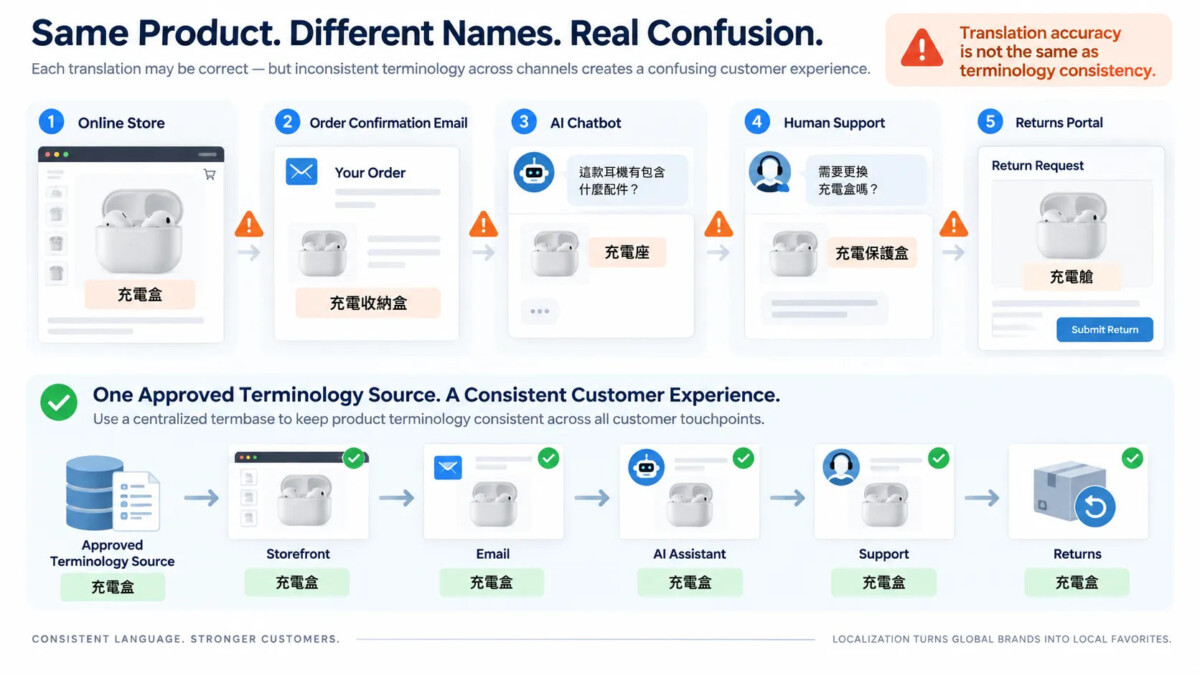
Figure 1. Translation drift across a multilingual ecommerce customer journey.
Do not begin with a 5,000-row glossary.
For most growing DTC brands, the first useful terminology list is much smaller.
Start with the words customers encounter while deciding, paying, waiting for delivery, or asking for help. Your first pass might contain the top 25–50 terms across:
This keeps the project tied to actual customer friction.
A term that appears once in a blog post is lower priority than a term that appears on a product page, confirmation email, tracking update, support ticket, and returns form.
The more touchpoints a term crosses, the more expensive inconsistency becomes.
A common mistake is treating Traditional Chinese as a character-conversion exercise.
For ecommerce, the market matters too.
Customers in Hong Kong and Taiwan may both read Traditional Chinese, but preferred commercial wording, software terminology, colloquial language, and product descriptions can differ.
That means a useful terminology record needs more than:
English → Traditional Chinese
A working record might include:
| Field | Example |
| English source term | Charging case |
| Taiwan preferred term | Approved TW term |
| Hong Kong preferred term | Approved HK term |
| SKU | AC-1023 |
| Do not translate | Product series |
| Avoid | Machine-generated variants |
| Usage note | Use the same term in support |
You do not need separate language policies for every sentence. You do need deliberate choices for terms customers use to identify products and understand what happens to their order.
Customer-side messaging deserves the same QA pass as the storefront. For brands serving Hong Kong and Taiwan, a Telegram 繁體中文版 resource can be useful when checking how Traditional Chinese terminology appears inside a localized messaging interface, particularly if Telegram forms part of the customer-support or community journey.
A modern Shopify stack can unintentionally create six of them.
One tool translates product pages. Another generates support macros. The chatbot has its own model. Agents type their own replies. Transactional emails may have been translated months ago. Returns software may use another terminology set entirely.
That is how drift happens.
The fix is not “use a better translator.”
The fix is to decide which terminology source wins when systems disagree.
A simple operating model looks like this:
Approved terminology source → Storefront → Email → AI → Helpdesk → Messaging → Returns
Full sentences can still be translated dynamically. Critical commercial terms should not be reinvented at every step.
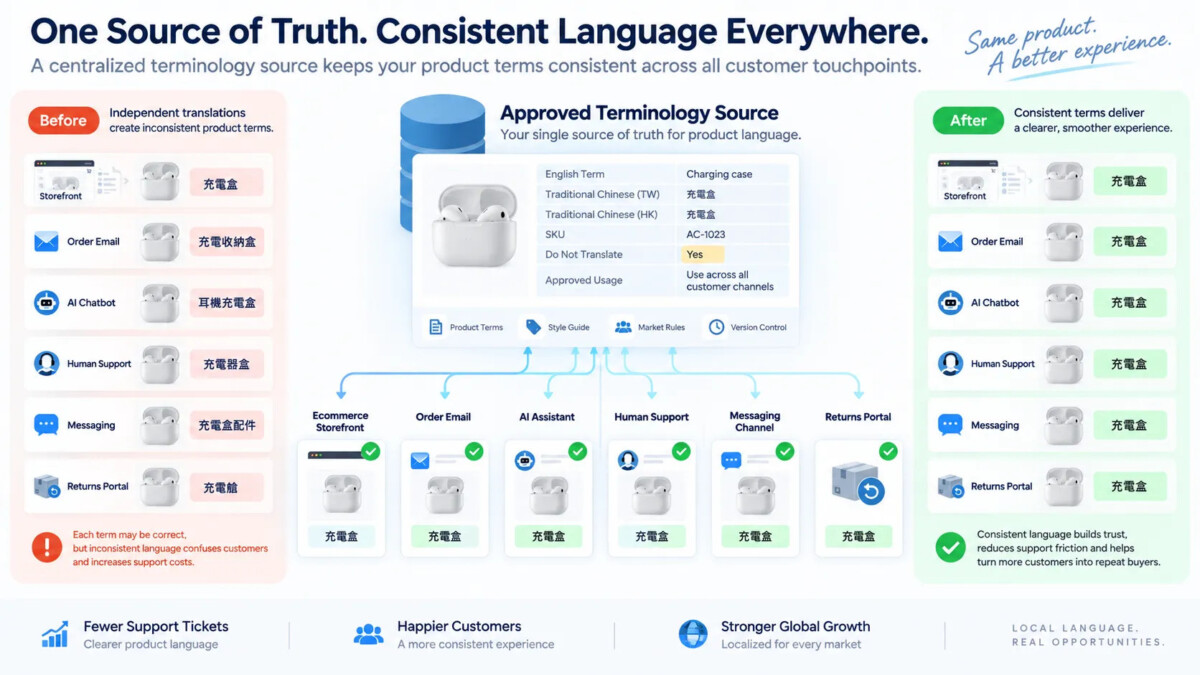
Figure 2. A centralized terminology source keeps product language consistent across customer-facing systems.
Some language should barely move at all.
Brand names, SKUs, model numbers, standards, product series, and trademarked feature names usually need stability more than creativity.
Suppose the official product is called AirFlex Pro X2.
If a product page says AirFlex Pro X2, support calls it “Air Flex X2,” and the returns system calls it “X2 Pro Air,” the customer now has an identification problem rather than a translation problem.
A useful rule is:
Keep the identifier. Localize the explanation.
That makes it easier for customers to search documentation, match invoices, request replacement parts, and communicate with support without wondering whether two names describe the same item.
Product naming is visible. Order-status wording can change expectations.
Terms such as:
represent different operational events.
If “fulfilled” is translated in a way customers interpret as “delivered,” a language choice has now created a support problem.
The same applies to returns.
“Return requested,” “return approved,” “item received,” and “refund issued” should not collapse into one generic phrase.
Operations, CX, and localization teams should agree on these terms together. A translator working without operational context cannot reliably decide where one fulfillment state ends and another begins.
Live support rewards speed.
A customer asks a question. The agent wants to answer in 30 seconds, not search a language manual.
That is where formal storefront terminology begins to disappear.
One agent uses English. Another uses a shorter Chinese synonym. A third pastes an AI-generated answer. Within weeks, the support team has created its own unofficial product vocabulary.
The answer is not to script every sentence.
Instead, lock down the small number of terms where variation causes actual confusion.
A customer-service team can still sound human while keeping these terms stable:
Consistency should apply to the nouns and states that matter. The conversation around them can remain natural.
Generative AI can create localized product descriptions, FAQ answers, support replies, and email copy in seconds.
That is useful.
It also means a brand can produce ten plausible versions of the same term faster than a human team ever could.
Without terminology constraints, an AI model will often choose wording that fits the immediate sentence. The next prompt may produce a different choice.
The model has not failed. The operating system around it has.
A better AI instruction includes constraints such as:
AI should apply the brand’s language policy, not recreate it on every ticket.
A useful termbase does more than tell people what to translate.
It also tells them what not to touch.
Typical entries include:
Over-localization can be just as disruptive as under-localization.
If an agent translates a model name that the product page, warehouse system, and invoice all keep in English, the customer may struggle to locate the product later.
Stable identifiers are part of the customer experience.
A terminology system that takes five minutes to search will eventually be ignored.
Support teams need something fast enough to use during a live conversation.
A lightweight table may be enough:
| Customer concept | Approved term |
| Refund | Approved market term |
| Replacement | Approved market term |
| Store credit | Approved market term |
| Tracking number | Approved market term |
| Charging case | Approved product term |
Larger catalogs can add filters for market, product family, or support category.
The real test is simple:
Can an agent confirm the correct term in under five seconds?
If the answer is no, improve access before adding another 500 terms.
CX teams already monitor first-response time, resolution time, ticket backlog, refund rate, and CSAT.
Terminology inconsistency can also be measured.
Pull a sample of recent conversations and look for:
You do not need a sophisticated metric at first.
Start with a simple count:
How many of 100 reviewed conversations contain a terminology defect that could confuse the customer?
Repeat the audit after changing your AI prompts, adding a new market, or onboarding seasonal support staff.
The trend matters more than the perfect score.
Translation drift is easiest to spot when you stop reviewing channels in isolation.
Choose one high-volume SKU and behave like a customer.
Follow the product through:
Record the important terms at each stage.
| Touchpoint | Term used | Consistent? |
| Product page | Approved term | Yes |
| Confirmation email | Approved term | Yes |
| AI chatbot | Different synonym | No |
| Human support | English-only term | Partial |
| Returns portal | Approved term | Yes |
This is more useful than asking each team whether its translation looks good.
Every team can answer “yes” while the customer still experiences five different vocabularies.
Do not turn terminology governance into a six-month localization project.
Start with 25 terms tied to revenue and support.
For each term, record:
Then expand when real support conversations reveal a gap.
A termbase should grow from customer friction, not from the desire to document every word the company has ever used.
Terminology consistency is not a substitute for a good localization strategy.
It will not repair:
It solves one specific operational problem:
The customer should not have to relearn your vocabulary every time they change channels.
That is a narrower goal than “perfect localization,” but for many growing brands it is also the faster problem to fix.
Most localization programs begin by asking, “Is this translation correct?”
That is necessary, but it is no longer enough.
A multilingual customer now moves through product pages, automated email, AI chat, human support, messaging, and returns systems. The brand has to survive that journey with its language intact.
Start small.
Choose one market. Pick one high-volume product. Identify the 25 terms most likely to affect a sale, delivery, return, or support interaction. Then trace those terms through the actual customer journey.
Where the language changes without a business reason, you have found translation drift.
Fix that before translating another thousand words.




