

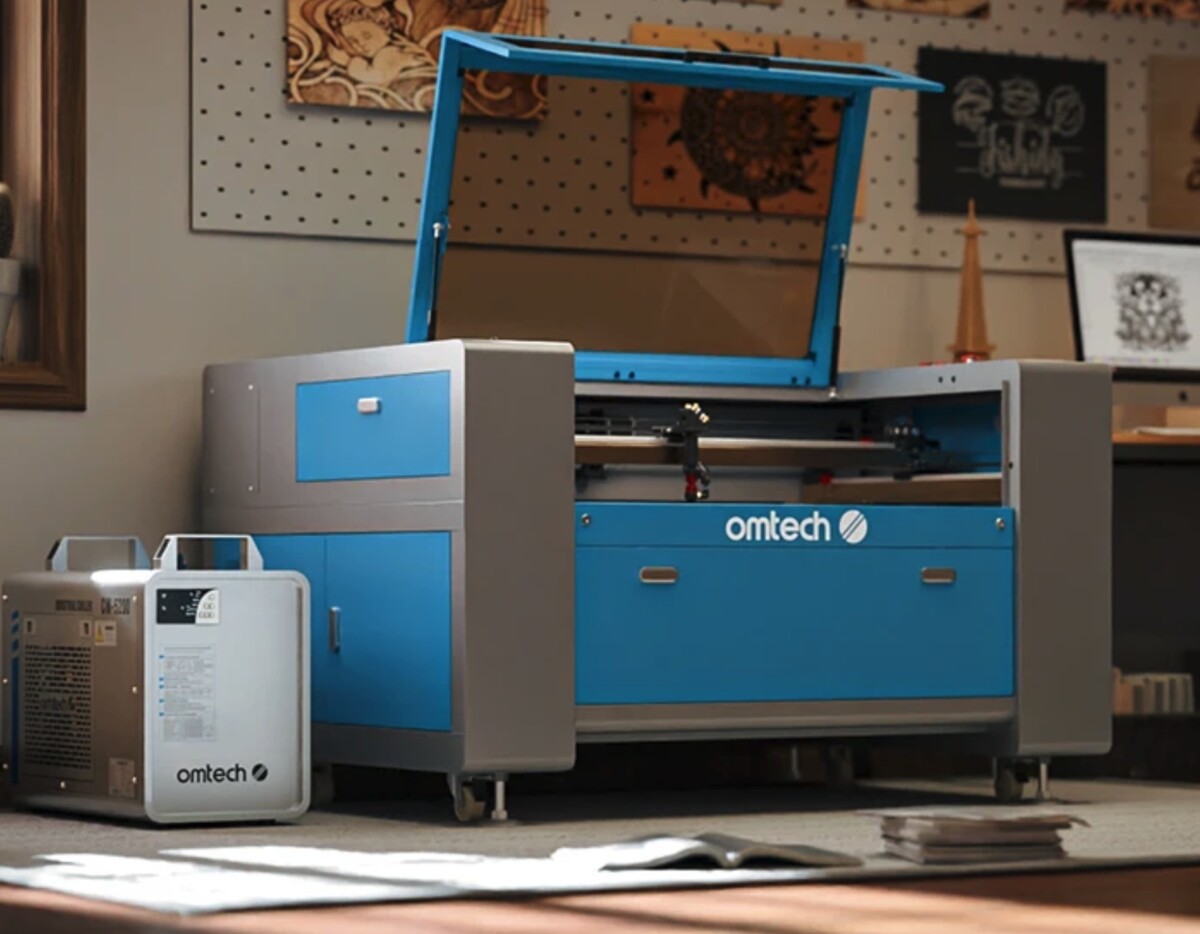
A 60W to 80W CO2 laser engraver puts an Etsy seller into real production for roughly $3,400 to $6,300 all in, including ventilation, chiller, rotary, and software. Machine capacity is rarely the constraint that decides whether the shop scales.
The sellers who plateau after buying a laser almost never plateau on capacity. They plateau on demand, and the machine makes that far more expensive to discover.
Jessica opened her Etsy shop in 2020 selling hand-painted wooden signs. She burned every design with a $40 wood burning kit, sanded each piece by hand, and listed eight to ten items a week when her day job allowed it. The reviews were good. The sales were slow. She could see the bottleneck and she could not get past it.
She bought a CO2 laser engraver in early 2022. Within six months the shop went from eight listings to sixty three, weekly output went from ten pieces to sixty, and her average selling price rose because laser engraving is sharper and more consistent than hand burning. She was also spending fewer hours per piece than she had been before.
By the end of 2023 she had left the day job. She runs a production shop now out of rented studio space with two CO2 machines running side by side, and the Etsy shop turns over between $12,000 and $18,000 a month depending on the season. Both systems are OMTech machines, which she talks about openly in her community because the equipment question comes up constantly. Jessica is a composite rather than one verified seller, but the shape of her path is the one that repeats.
CO2 is the right first laser for a personalized products shop because it is the only machine category at a small business price that both engraves wood cleanly and cuts clear acrylic. Those two capabilities cover the large majority of what sells in personalized gift categories, which is why CO2 machines dominate the Etsy maker segment rather than the newer diode units that get more attention online.
Wood is where CO2 genuinely excels. The wavelength is absorbed efficiently by wood fibre, producing a dark burn line with sharp contrast against the surrounding material. Maple, walnut, bamboo, birch plywood, and MDF all engrave cleanly at settings you dial in once and recall reliably for every production run afterward. That repeatability matters more than raw speed. A seller who has to re test settings on every job is not running production, they are running experiments.
Clear acrylic is the dividing line. Diode lasers cannot cut clear or light coloured acrylic at all, because the material does not absorb their wavelength. A CO2 machine cuts it with a polished edge that looks professionally finished straight off the bed, and a 60W to 80W unit handles thicknesses up to roughly 10 to 12mm. For anyone making award pieces, display products, backlit signage, or layered dimensional work, that single capability decides the purchase.
The stage aware version of this: if you sell wood only and you are under $2,000 a month, a diode at a fraction of the cost may genuinely be enough for another six months. The moment acrylic enters your catalogue, or the moment engrave time per piece becomes the reason you are turning down orders, the CO2 is the buy.
Personalized kitchenware and custom drinkware carry most laser shops through their first profitable year, because both combine durable year round search demand with margins that survive a four to eight minute machine cycle. Everything else in a typical catalogue tends to be seasonal, lower margin, or both.
Cutting boards, serving boards, and charcuterie sets sit among the most searched personalized gift categories on Etsy. A maple blank costs $10 to $16 wholesale. Engraved with a family name, a wedding date, or a custom design, it sells in the $55 to $85 range, and the engrave itself takes four to eight minutes on a properly configured machine. The category also generates genuine repeat purchase behaviour, because a buyer who orders a personalized board for a wedding tends to come back for birthdays, anniversaries, and the December rush.
Engraved tumblers are the other volume workhorse. The market is enormous, the product photographs well, and photography is the single largest driver of conversion rate on visual platforms, which is worth reading up on before you scale listings rather than after. If you are unsure where your listings lose people, start with what actually moves conversion on a product listing and fix that before you add SKUs.
Drinkware has one hard prerequisite. Without a rotary attachment, the machine engraves flat surfaces only, and every cylindrical item is off the table. The attachment runs $80 to $200 and most CO2 units support one, but it is a separate purchase that budget lists routinely omit. Buy it with the machine rather than three months later.
Signs, home decor, and corporate awards stabilize revenue later in a shop’s life because they smooth out the seasonal spikes that pure gift categories create. A catalogue built only on wedding and holiday gifting has a January problem, and every seller discovers it in the same January.
Custom wooden signs for homes, nurseries, kitchens, and entryways sell year round with strong peaks around holidays and life events. New baby announcements, address signs, and family name pieces all live here. This is also where the laser does things hand methods simply cannot match: dimensional elements cut from acrylic or thin wood, layered designs combining multiple materials, and large format pieces that hold consistent engrave quality across a wide surface.
Corporate recognition awards, sports trophies, academic plaques, and event giveaways represent a B2B lane that grows naturally out of an established consumer shop. Organizations order in quantity, they reorder annually, and they pay premium prices because the item serves a professional purpose rather than a personal one. A single corporate account placing one 60 unit order each year is worth more in gross margin than a busy consumer week, and it arrives with no advertising cost attached.
Mixing consumer and B2B in one catalogue creates a pricing problem, and the answer is not one blanket markup across everything. Premium and low volume items carry a different margin profile than fast moving consumer pieces, which is the same logic behind pricing each category on its own logic rather than one blanket markup. Set the corporate line at what the outcome is worth to the buyer, not at cost plus.
Most laser shops scale through four stages, and the binding constraint changes at every one, which is why copying another seller’s next move so often fails. The seller you are watching on YouTube is solving a different problem than the one in front of you.
The first two to three months belong to a single product category, not because anyone is forcing that discipline but because narrow focus is the fastest way to learn what sells versus what merely seemed like a good idea. Setting up the machine, developing settings, building listings, and earning first reviews all happen faster when the surface area is small.
Optimization is unglamorous and it is where the money is. Better photography, designs refined against actual customer feedback, and batching routines that cut setup time per piece. A seller who batches twenty boards in one session rather than setting up per order gets substantially more output from identical machine hours.
Expansion works best sideways. A signs seller usually moves into boards and ornaments before anything else, because the material, settings, and workflow already exist. A tumbler seller moves into glassware and bottles for the same reason. The failure pattern is a seller adding a new product category, a new sales channel, and a second machine inside the same quarter, then discovering that none of the three was set up properly. Premature complexity kills more small product businesses than slow growth ever has.
A production ready CO2 setup runs roughly $3,400 to $6,300 in 2026 once ventilation, cooling, a rotary, and software are included, and the machine itself accounts for only about three quarters of that. Budgets that quote the laser price alone are the reason so many sellers are $900 short in week one.
One line on that table is worth calling out, because most guides still have it wrong. LightBurn is not $60 any more, and the cheaper tier is not the one CO2 sellers need. LightBurn Core at $99 covers GCode controllers, which is what diode machines run. CO2 machines use DSP controllers, which require LightBurn Pro at $199. Both licenses are perpetual and include a year of updates, after which renewal is $40 annually and entirely optional, and you can confirm current pricing on Core and Pro licenses directly rather than trusting a reseller quote.
On payback, treat any published figure as illustrative rather than promised. Sellers producing and listing consistently commonly recover the setup inside six to ten months, but that outcome is a function of order volume, not of equipment. A machine sitting idle has an infinite payback period regardless of what it cost.
Etsy requires you to disclose any production partner on the relevant listings, and running your own laser in your own workspace does not create one. This distinction trips up sellers constantly, in both directions, and getting it wrong is treated as a policy violation rather than an administrative slip.
Etsy’s Seller Policy states that if you work with a production partner, you must disclose that production partner in your relevant listings. A production partner is an outside individual or company that helps make items you designed. It is not you, it is not your shop members, and it is not your materials suppliers. Buying two OMTech machines and hiring a part time packer does not create a disclosure obligation, because that packer is a shop member and the machines are tools.
Where it does apply is the moment you send work outside. Contracting a third party engraver to run overflow, using a print on demand supplier for a product line, or having someone else physically produce items you designed all create a production partner relationship that has to be declared at both the account and listing level.
The second requirement is authorship, and it catches more laser sellers than the first. Etsy expects the design to originate with you. A purchased SVG file cut on your own machine is a weaker position than an original design, and a commercial use license does not resolve the authorship question. If a meaningful share of your catalogue runs on bought design files, that is a business risk worth understanding now rather than at the point a listing gets deactivated in mid November.
Add your own store when the Etsy shop is producing consistent monthly revenue and visible repeat buyers, not when Etsy’s fees start to annoy you. Fee irritation is the most common trigger and the worst one, because it moves a seller off a channel that works before they have built any of the demand generation that replaces it.
Etsy’s own numbers explain why the marketplace is worth starting on. Etsy reported roughly 87 million active buyers and $124 in annual spend per buyer in its second quarter of 2026, with marketplace sales growing for a third consecutive quarter. That is demand you do not have to buy, aimed squarely at handmade and personalized goods, and no new independent store has an equivalent on day one.
What Etsy does not give you is the customer. The buyer belongs to the marketplace, the search algorithm decides who sees your listings, and your brand competes inside a template. Those are the real trade offs, and they are worth reading through properly before you commit either way, because the real trade offs between marketplace selling and an independent store are about ownership and control far more than about fees.
The strongest position is usually both. Keep the Etsy shop running for discovery and seasonal volume, build the independent store as the brand home and the email list, and let each channel do what it is good at. That is the pattern among sellers who run both channels deliberately rather than treating the move as a migration.
While you are still on Etsy alone, four things move the needle. Launch with 15 to 20 listings rather than three to five, because more listings mean more search surface and more credibility signals to a new buyer. Treat photography as the primary conversion lever it is. Offer personalization as an add on to in stock designs, not only through custom order listings, which captures the impulse buyer who will not wait on a production timeline. And answer messages within a few hours during peak season, because responsiveness affects both ranking and close rate.
The sellers who stall after buying a machine almost always stall on demand rather than on capacity, and the equipment purchase makes that discovery considerably more expensive. This is the part vendor content tends to leave out, so it is worth stating plainly.
A laser converts your time into more units per hour. It does nothing whatsoever about how many people want the units. If you were selling ten pieces a week because ten people wanted them, you will own a machine capable of sixty and a queue of ten. The honest sequence is demand first, capacity second, and the sellers who reverse it usually spend eighteen months paying off equipment that removed a bottleneck they did not have.
The second trap is labour. Unlike print on demand, laser production does not compress. Every piece still needs material prep, machine time, cleanup, finishing, and packing, and none of that scales without either more hours or more people. Two machines running side by side roughly double throughput but they do not halve the finishing work, which is why the infrastructure stage is usually about hiring rather than about buying.
The third trap arrives later and hits harder. Once you are selling across Etsy, your own store, and possibly a wholesale account, stock and component counts stop reconciling and the spreadsheet quietly starts lying to you. That is a well documented failure mode in product businesses of every size, and it is worth understanding what breaks when Shopify, Amazon, and TikTok stop talking to each other before you are living inside it.
The move from Etsy listing to production shop is a demand problem solved with equipment, not an equipment problem solved with demand. Jessica’s arc reads like a machine story because the machine is the visible part, but the ten pieces a week she was already selling, with good reviews, are what made the purchase rational.
The equipment is genuinely accessible now. A capable, production ready CO2 setup lands between $3,400 and $6,300, the market for personalized goods is large and stable, and the production process is learnable inside a few weeks. None of that is the hard part.
What separates the sellers who build real businesses from the ones who buy a machine and drift is narrower and less satisfying: focus on one category long enough to learn it, consistency through the unglamorous months, and a willingness to build what the market keeps buying instead of what seemed like a good idea at the start. The Etsy shop is often the beginning. The production shop is where it can go, provided the demand goes with it.
OMTech is a laser equipment manufacturer based in Anaheim, California. The company builds CO2 laser engravers and cutters, fiber laser marking systems, and MOPA fiber lasers for ecommerce sellers, small businesses, and production shops across the United States. OMTech CO2 machines are used by thousands of Etsy sellers and ecommerce business owners, with a product line covering entry level desktop systems through high output production machines, US based technical support, and an active seller community.
Expect $3,400 to $6,300 for a production ready CO2 setup in 2026. That breaks down as $2,500 to $4,500 for a 60W to 80W enclosed machine, $150 to $400 for ventilation and ducting, $200 to $500 for a water chiller, $80 to $200 for a rotary attachment, $50 to $120 for a honeycomb bed, $199 for a LightBurn Pro license, and $200 to $400 in starting material stock. Budgets that quote only the machine price routinely leave sellers several hundred dollars short in the first week, because ventilation and cooling are requirements rather than upgrades.
No, and the gap is specific rather than general. Diode lasers engrave wood acceptably and cost far less, but they cannot cut clear or light coloured acrylic at all, because the material does not absorb their wavelength. If your catalogue is wood engraving only and you are under roughly $2,000 a month, a diode may be genuinely sufficient for another six months. The moment acrylic enters your product line, or engrave time per piece becomes the reason you are declining orders, CO2 becomes the necessary purchase rather than the nicer one.
Sellers producing and listing consistently commonly recover a $3,400 to $6,300 setup within six to ten months, though that figure is illustrative rather than promised. Payback is driven almost entirely by order volume, not by equipment specification. A seller with existing demand for ten pieces a week who scales to sixty recovers quickly. A seller who buys the machine before demand exists has no payback period at all, because the constraint they removed was never the one holding the business back.
No. Running your own machine in your own workspace does not create a production partner relationship, and neither does hiring shop members who help you produce or pack. Etsy defines a production partner as an outside individual or company that helps make items you designed, so the obligation begins when work goes outside your shop: contracting a third party engraver for overflow, using a print on demand supplier, or having someone else physically produce your designs. In those cases disclosure is required at both the account and the listing level.
Move when the Etsy shop shows consistent monthly revenue and visible repeat buyers, not when the fees start to irritate you. Etsy supplies roughly 87 million active buyers you do not have to acquire, which no new independent store can match on day one. What it does not supply is ownership of the customer or control of the brand. The strongest position for most sellers is running both deliberately: Etsy for discovery and seasonal volume, your own store as the brand home and the email list you actually own.




