

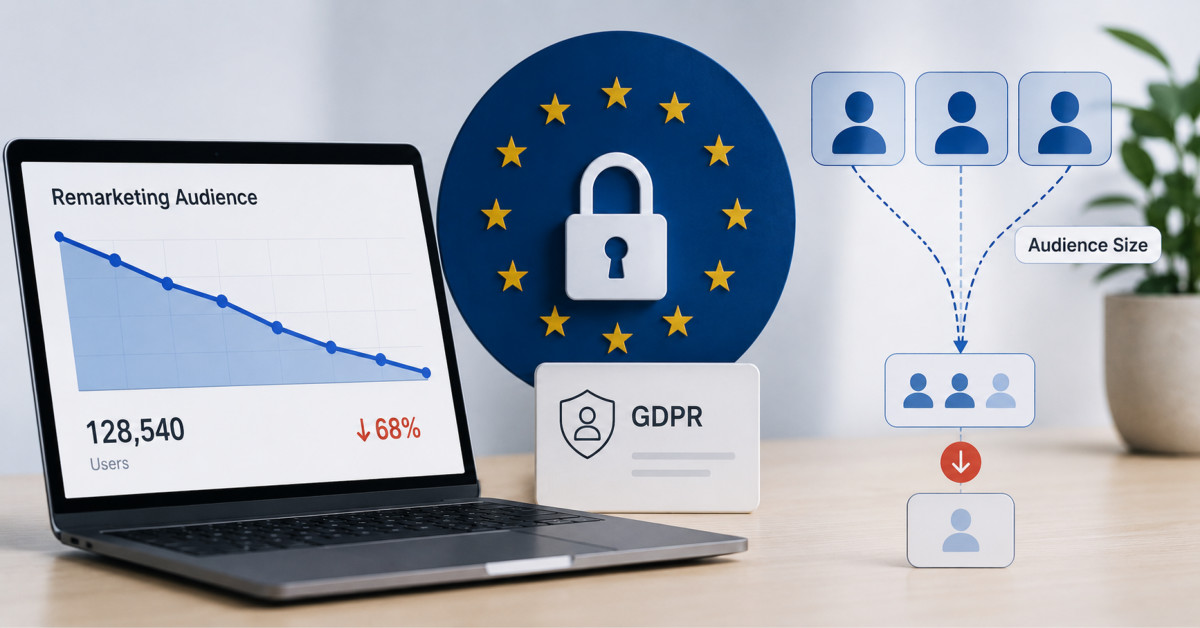
EU remarketing audiences are shrinking because consent behavior changed, not because Google changed the algorithm. Forty eight percent of consumers now click accept all less often than three years ago, against 23 percent who click it more. Consent rate is the lever.
Marketing teams treat consent rate as legal’s number. It is the input variable on every audience, every modeled conversion, and every Smart Bidding decision you make in Europe.
EU remarketing lists are contracting because a structural share of European consumers stopped clicking accept all, and no bidding change or creative refresh will reverse that. Remarketing lists populate only from sessions where the visitor granted the relevant consent signals. Fewer grants, smaller list, and the contraction compounds because a list that stops growing also keeps aging out at its membership duration.
The scale of the behavioral shift is documented. Usercentrics’ State of Digital Trust 2026 report, conducted by Sapio Research across 11,000 consumers in seven markets in March 2026, found 48 percent of consumers now click accept all less often than they did three years ago, against 23 percent who click it more often. That two to one ratio held across every market in the study.
What makes this different from previous signal loss events is that it is not a platform decision you can engineer around. When iOS 14 landed, the response was server side tracking and modeled conversions, and those worked because the underlying user behavior had not changed. This is the user behavior changing. There is no technical workaround for a person deciding not to consent.
The strategic consequence is a reallocation question. If your EU audience pool is structurally smaller every quarter, the return on optimizing bids against that pool is falling, while the return on widening the pool itself is rising. Most teams I talk to have the opposite allocation: hours spent on bid strategy and creative rotation, zero hours spent on the banner that determines who enters the pool in the first place. That imbalance made sense when consent rates were stable. It does not make sense now.
The decline in accept all comes from two different populations, and telling them apart determines whether you can do anything about it. Usercentrics’ research separates consent fatigue, meaning users worn down by years of banners clicking whatever ends the interruption fastest, from what the report calls a privacy awakening, meaning consumers reading the more information link, understanding what is being asked, and choosing deliberately.
The gap between those two groups is 31 percentage points in accept all rates. That is the single most actionable number in the dataset, because it means the same banner produces radically different outcomes depending on who is looking at it, and the composition of your traffic is shifting toward the more deliberate group over time. The report’s own framing is that the consent rate brands are banking on today is not the consent rate they will have tomorrow.
Underneath both groups sits a design failure that has not moved in two years: 46 percent of consumers still say they do not have a good understanding of how their data is collected and used. That figure was identical in the 2025 study. Two years of banners, policies, and preference centers, and the comprehension needle has not moved at all.
I want to be honest about where this leaves an operator, because there is a temptation to read consent decline as inevitable and give up. The 31 point gap argues the opposite. If deliberate, informed consumers behave 31 points differently from fatigued ones, then the content of your banner is doing real work, not decorative work. The brands losing consent fastest are the ones whose banners were written to satisfy a lawyer rather than to be read by a shopper.
Consent rate belongs in your weekly media reporting alongside CPA and ROAS, because it is the multiplier applied to every downstream measurement input you have in Europe. Most Shopify brands cannot state their current EU consent rate from memory. Almost all of them can state last week’s ROAS to one decimal place. That asymmetry is the actual problem this article is about.
Three things depend directly on it. Remarketing audience size, because lists populate only from consenting sessions. Conversion modeling eligibility, because Google’s models train on your consented traffic and need enough of it to clear confidence thresholds. And Smart Bidding quality, because the bidding algorithm optimizes against whatever conversions it can see, and a systematically incomplete conversion picture produces systematically wrong bids.
The measurement itself is simple and most teams already have it. Your consent platform reports accept, reject, and no interaction rates. Pull them by country rather than in aggregate, put the number in the same weekly view as your media metrics, and track its direction. If your platform does not expose this, you can push consent state events from Google Tag Manager into your analytics tool and build the view yourself in an afternoon.
One caution that the research itself raises, and I think it is the right one. Usercentrics’ own guidance in the report is that opt-in rate alone tells you nothing, and that the numbers that matter also include retention, churn, complaints, and data subject request volume. That is a vendor arguing against the simplest version of its own pitch, which is worth noting. A consent rate driven up by pressure is worse than a lower rate freely given, because the resulting data trains your models on people who did not mean it. Measure the rate, but measure the quality alongside it.
A ten point consent rate improvement translates roughly linearly into addressable audience size, which makes it one of the few marketing levers with a clean, calculable return. Work an illustrative example, and treat these numbers as a modeling exercise rather than a benchmark: a brand doing 40,000 monthly EU sessions at a 45 percent consent rate has roughly 18,000 addressable sessions. Lift consent to 55 percent and that becomes 22,000. The audience pool grew 22 percent, from a change that touched no campaign, no creative, and no bid.
The second order effect is larger than the first. Google requires 700 ad clicks over seven days per country and domain grouping before conversion modeling activates, per its published documentation on consent mode modeling. A brand sitting just under that threshold in its second and third European markets gets nothing from modeling in those markets. A consent lift can push a borderline market over the line, and the value of crossing that threshold is discontinuous rather than proportional. You go from a general model to one trained on your own traffic.
The third effect is the hardest to quantify and probably the largest. Smart Bidding trained on a more complete conversion picture allocates budget better, and allocation errors compound daily. If your bidding algorithm has been optimizing against 45 percent visibility, every day of that is a day of misallocation you cannot recover.
Set expectations honestly on timeline. A banner change does not produce a measurable audience effect in a week. Remarketing lists rebuild over their membership duration, modeling needs its training window, and bidding needs time to respond. Give any change four to eight weeks before judging it, and hold everything else steady during that window so you can attribute the result. If you have never sorted out how your attribution model handles multi channel journeys, do that first, because you will not be able to read the result otherwise.
Privacy aware consumers are nearly three times more comfortable with personalization than privacy unaware ones, which inverts the assumption most marketing teams operate on. The State of Digital Trust data puts it at 53 percent comfortable among the privacy aware group against 19 percent among the unaware. The headline number in the same study is that 71 percent of consumers find AI driven personalization intrusive, and read alone that sounds like a mandate to pull back on personalization entirely.
Read together, the two figures say something more useful. The problem is not personalization. The problem is unexplained personalization. The consumers who understand what you are doing with their data are the ones most willing to let you do it, which means the constraint is communication rather than technology.
For a DTC brand, this reframes the banner from a tax into an asset. A shopper who understands why you want analytics consent, and grants it, is a better member of your remarketing pool than one who clicked accept to make the box disappear. They are more engaged, their behavior is more predictive, and they are less likely to become the person who complains publicly later.
It also argues for spending the explanation where the shopper already trusts you, rather than only at the banner. Post purchase surveys, preference centers, and the account creation moment are all places where a European shopper who just bought from you will answer questions they would have ignored on arrival. That is the practical bridge to zero party and first party data you own outright: it survives consent decline, browser changes, and platform policy shifts, because the shopper handed it to you on purpose.
Plain language, fast rendering, and genuinely equal accept and reject options lift consent rate; asymmetric buttons and buried reject links lift it too, and cost you far more than they return. The distinction matters because both categories move the number, which is exactly why the number alone is a bad target.
Start with what works. Write the banner for the shopper, not the legal reviewer who approved it. Name what the cookies actually do in the shopper’s terms rather than in category jargon. Render fast, because a banner that appears half a second after the page paints gets dismissed reflexively before it is read. Offer granular categories, because shoppers who would refuse everything will often accept analytics when analytics is a separate choice. Usercentrics frames its own version of this sequence as Translate and Remove: get the consent moment itself right, then strip out whatever is undermining the choice, before attempting anything more sophisticated.
Now the backfire list, which is enforcement territory rather than opinion. Unequal button prominence, reject buried behind a manage preferences click, pre-ticked non-essential boxes, and cookie walls with no genuine alternative have all drawn regulatory action. France’s data protection authority fined Shein’s Irish subsidiary 150 million euros partly because clicking refuse all did not actually stop cookies being placed and read. California’s rules as of January 2026 go further and state that a visitor closing or navigating away from a consent popup without affirmatively accepting does not constitute consent, which retires the pattern of treating dismissal as agreement. A platform that supports granular categories and per market banner variants natively, such as Cookiebot by Usercentrics, removes most of the temptation to reach for these patterns in the first place, because the compliant configuration is also the default one.
The commercial argument against dark patterns is stronger than the legal one for most operators. A coerced accept produces a person in your remarketing pool who did not want to be there. They do not click, they do not convert, and they drag down the signal quality your models depend on. You have grown the list and degraded the asset. Meanwhile the same design is generating the misrepresentation exposure covered elsewhere in this cluster, so you are paying twice for a number that looks better on a dashboard.
European consent behavior varies enough by market that a blended EU consent rate will hide your worst performing country entirely. This is the reporting error I see most often, and it is expensive because Google’s modeling thresholds are also evaluated per country, so the market averaging conceals exactly the failure that costs you modeling eligibility.
The variation is substantial. In the 2026 study, 73 percent of German consumers said they would pay more for AI transparency, the highest of any market, at a 9 percent premium. In the Netherlands the figure is 35 percent, the lowest, while 77 percent of Dutch consumers find AI personalization intrusive, the highest. In the UK, 80 percent said they would stop using a service over data misuse, also the highest in the study. Spain leads on action taken against brands over data concerns at 76 percent.
Translate that into media terms. Germany rewards explicit transparency with willingness to engage, which argues for a banner that explains rather than minimizes. The Netherlands combines high concern with low willingness to pay a premium, which means transparency there is defensive rather than an upside play. The UK punishes mistakes hardest. Same currency, same shipping zone, materially different consent economics.
The operational fix is to report consent rate by country, set your banner copy by market rather than translating one English version seven ways, and prioritize the markets where you are closest to the 700 click modeling threshold. If you are already thinking about Europe at a market level for the commercial side, the same logic applies to consent that applies to how you present duties and taxes at checkout: the brands that win European markets treat them as separate countries with separate expectations, not as one region with one setup.
Every brand should establish a per country consent rate baseline this week; what changes by spend level is what you build on top of it. Without the baseline you cannot tell whether anything you do afterward worked, and the baseline takes half an hour.
Under €2,000 a month in EU spend, pull your consent platform’s accept and reject rates by country, write them down, and read your own banner as a shopper would. If the copy is category jargon, rewrite it in plain language. That is the whole assignment. Do not buy tooling and do not run tests, because your volume will not produce a readable result.
Between €2,000 and €25,000, add the baseline to your weekly media reporting, identify which markets sit closest to the 700 click threshold, and run one banner change at a time with a four to eight week read window. This is also where server side infrastructure starts earning its cost, because it maximizes the value of the consent you do obtain rather than trying to work around consent you do not. Tools like Littledata and Aimerce push consented events to the ad platforms at the server level, which is a different problem from raising consent rate and complements it.
Above €25,000, treat consent rate as an owned KPI with a name attached to it and a target. Segment your reporting by market, A/B test banner copy the way you would test a landing page, and track the quality metrics alongside the rate: retention, complaint volume, and data subject requests. At this spend level a blended attribution view across your consented and modeled data is worth building properly, which is where a platform like Triple Whale earns its place in privacy restricted markets.
The durable version of all this is simpler than the tactics. European shoppers are not becoming unreachable. They are becoming selective about who reaches them, and the selection happens at a banner most brands have never read. Fix the moment where the relationship starts, and the audience arithmetic downstream takes care of itself.
EU remarketing lists populate only from sessions where the visitor granted advertising consent, so a declining consent rate shrinks the list structurally. Research across 11,000 consumers in seven markets found 48 percent now click accept all less often than three years ago, against 23 percent who click it more, a two to one shift present in every market studied. The contraction compounds because a list that stops growing continues to age out members at its membership duration. This is a behavioral change rather than a platform change, so bidding adjustments and creative refreshes will not reverse it. Raising consent rate is the only lever that widens the pool itself.
There is no single good number, because consent rates vary substantially by market and by how the banner is designed, which is why a blended European average is misleading. What matters more than hitting a benchmark is establishing your own per country baseline and tracking its direction over time. Report by country rather than in aggregate, because Google evaluates conversion modeling eligibility per country and domain grouping, so an averaged figure hides the specific market where you are failing to qualify. Track the rate alongside quality signals like retention and complaint volume, since a rate inflated by pressure produces worse data than a lower rate freely given.
A consent rate improvement translates roughly linearly into addressable audience size, plus two compounding effects. As an illustrative model, a brand with 40,000 monthly EU sessions at 45 percent consent has about 18,000 addressable sessions; at 55 percent that becomes 22,000, a 22 percent larger pool from a change that touched no campaign. The second effect is discontinuous: crossing Google’s threshold of 700 ad clicks over seven days per country activates conversion modeling trained on your own traffic rather than a general model. The third is better Smart Bidding allocation, which compounds daily and is the largest of the three though the hardest to isolate.
Making rejection genuinely easy lowers your raw accept rate but usually improves the quality of the data you keep, and it removes significant legal exposure. A coerced accept puts someone in your remarketing pool who did not want to be there: they do not click, they do not convert, and they degrade the signal your bidding models train on. Meanwhile asymmetric buttons and buried reject links have drawn regulatory enforcement across multiple jurisdictions. Research also shows privacy aware consumers are nearly three times more comfortable with personalization than unaware ones, which means clear, honest banners recruit the audience segment most willing to engage commercially.
Allow four to eight weeks before judging a banner change, and hold other variables steady during that window. Three things need time to respond. Remarketing lists rebuild over their membership duration, so an improved consent rate does not show up as a larger audience immediately. Google’s conversion modeling requires a training period after thresholds are met before uplift figures appear. And Smart Bidding needs enough new signal to adjust its allocation. Testing multiple changes simultaneously, or changing creative and bids in the same window, makes the result unreadable. Change one thing, wait, and measure per country rather than in aggregate.





