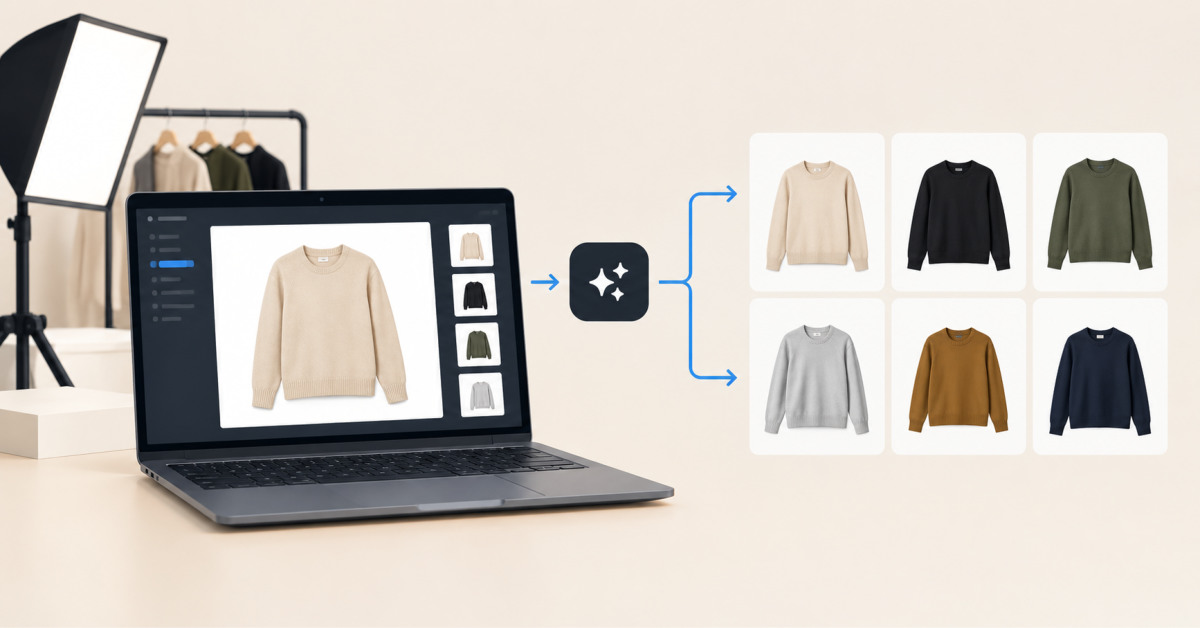
Growing fashion brands can scale product imagery without replacing professional photography by using approved product assets as a controlled starting point for channel-specific visual variations, while keeping humans responsible for garment accuracy, brand consistency, and final publishing approval.
Fashion imagery becomes a growth constraint when every new channel, campaign, colorway, and collection requires a new production. The scalable answer is not unlimited image generation. It is an operating system that gets more value from every approved product asset.
For a growing fashion brand, product photography can become a bottleneck long before sales or inventory become a problem.
Adding new products sounds simple. You photograph them, edit the images, upload them to your store, and start promoting them. That process works when a brand has a small catalog. It becomes much harder when the business carries hundreds or thousands of products and needs fresh creative for several channels.
A single collection may require product images for an online store, lifestyle imagery for social media, campaign visuals for paid advertising, marketplace images, email creative, and seasonal promotions. Photographing every product in every possible setting is rarely practical.
The result is often an uneven catalog. A handful of products receive polished model photography, while many others are shown only as flat lays, mannequin shots, or basic product photos.
There is another way to approach the problem. Instead of treating every new image as a completely new photoshoot, brands can build a more flexible image-production workflow around the product assets they already have.
Traditional photography remains valuable, particularly for major campaigns and creative work where the brand needs complete control over the production.
The challenge is scale.
A professional fashion shoot can involve models, photographers, stylists, makeup artists, studio or location fees, lighting equipment, samples, logistics, editing, and post-production. Even a relatively straightforward shoot requires coordination between several people.
Now multiply that process across a large catalog.
A fashion retailer might introduce dozens of new products every month. Some products may have multiple colors or variations. Others may need new imagery for a seasonal campaign or a particular marketing channel.
The problem is not necessarily that brands cannot afford photography at all. The problem is deciding which products justify another shoot and which do not.
This is why many businesses end up prioritizing their best-selling products and leaving the long tail of the catalog with basic imagery.
For customers, however, every product still needs to compete for attention.
The first step is to stop thinking about product photography as a one-time task.
Instead, treat every product image as an asset that can potentially support several marketing activities.
Suppose a brand has a clean image of a jacket against a simple background. That image may already be enough for the product page, but it could also become the starting point for other creative.
The same product could potentially be presented:
The goal is not to turn one photograph into an unlimited number of random images. The goal is to make better use of the work that has already been done.
Before investing in another photoshoot, ask:
That question can prevent brands from spending money on photography simply because it is the traditional way of solving the problem.
Not every product needs the same amount of photography.
A useful approach is to divide the catalog into groups.
These might include new launches, bestsellers, high-margin products, seasonal collections, or products being used in major advertising campaigns.
These products may deserve a full professional shoot.
These products generate meaningful sales but may not justify a large production every time new imagery is required.
This is where additional digital image production can be particularly useful.
These are products with lower sales volume or limited promotional activity.
Rather than spending heavily on a complete shoot, brands can focus on making their existing imagery more useful.
This approach also helps marketing teams allocate photography budgets based on business impact instead of applying the same production process to every product.
Many ecommerce businesses already have a large library of product photography.
The challenge is that these images are often designed primarily for product pages. They show the garment clearly, but they may not communicate how it looks when worn or how it fits into a broader fashion story.
For brands with suitable source imagery, modelia’s AI mannequin model can provide another way to present products without arranging a new physical shoot for every catalog reference
This can be especially useful when the objective is to expand the range of model-based imagery across a large catalog.
The important point is that the product should remain the focus. A generated image that looks attractive but changes the garment’s important details does not solve the ecommerce problem.
Brands should review generated images for things such as garment shape, color, patterns, proportions, sleeves, collars, prints, and other product-specific details before publishing them.
Producing more images only helps if those images still look like they belong to the same brand.
Imagine visiting an online store where every product appears on a completely different type of model, under different lighting, with unrelated backgrounds and inconsistent styling.
Even if each individual image looks good, the overall catalog can feel disconnected.
Create simple visual rules before expanding image production.
For example, a brand might define:
These guidelines give creative teams a reference point when producing new imagery.
Consistency is particularly important for larger brands because customers may see products across several touchpoints before purchasing. The website, Instagram feed, paid advertisements, email campaigns, and marketplace listings should feel connected.
One common mistake is trying to make one image work everywhere.
Ecommerce, advertising, and social media have different requirements.
A product page needs clear product presentation. A paid social advertisement may need a stronger visual hook. An email campaign might require a horizontal composition. A marketplace may have stricter image requirements.
Instead of asking, “What is our main product image?” ask:
This can also make your existing catalog much more valuable.
A product that already has a clean ecommerce image may not need another traditional shoot just because the marketing team needs a social asset. Depending on the campaign and the product, an alternative image can sometimes be created from the existing product reference.
Small changes in presentation can have a surprisingly large effect on a fashion image.
A straight standing pose communicates something different from a walking pose. A front-facing image feels different from a three-quarter view. A close crop can emphasize the garment, while a wider composition can establish a lifestyle setting.
Physical reshoots are not always necessary for every variation.
Tools such as an AI pose changer can help teams explore alternative poses from existing imagery.
Again, the objective should not be to generate dozens of meaningless variations.
Choose variations based on a real marketing purpose.
For example:
The number of images matters less than whether each image has a job.
Scaling image production does not mean removing creative review.
In fact, the larger the catalog becomes, the more important review becomes.
A marketing or creative team should establish a simple approval process before new imagery goes live.
Check:
Product accuracy: Does the garment still look like the actual product?
Model presentation: Does the model fit the brand’s target customer and visual identity?
Styling: Does the styling complement rather than distract from the product?
Image quality: Are there visible inconsistencies, distortions, or unusual details?
Brand fit: Would this image look natural next to the rest of the company’s content?
Channel requirements: Does the image meet the technical and creative requirements of the destination?
A short review process can prevent low-quality images from reaching customers.
AI-assisted image production does not have to compete with professional photography.
A more practical approach is to use each method where it creates the most value.
Major seasonal campaigns, hero launches, brand films, celebrity collaborations, and important editorial shoots may still deserve a full production.
For the rest of the catalog, brands can look for ways to expand their visual coverage without repeating the entire production process.
This creates a hybrid workflow.
Professional photography establishes the core creative direction.
Digital image production helps extend that direction across more products and use cases.
For a growing ecommerce company, this can make the photography budget work harder without lowering the importance of professional creative work.
More content is not automatically better.
Track what happens after introducing new product imagery.
Useful measurements include:
If products with model imagery consistently perform better than products with basic photography, that gives the team a stronger basis for expanding the approach.
Likewise, if a particular image style does not improve performance, there is little reason to keep producing it simply because it looks good.
The objective is better ecommerce performance, not a larger image library.
Once a brand understands which products and channels benefit from additional imagery, the process can become repeatable.
A simple workflow might look like this:
Identify products that need additional visual coverage based on launches, sales, margins, campaigns, or customer demand.
Collect product photographs, reference images, brand guidelines, and relevant creative direction.
Decide exactly what the new images will be used for and what formats are needed.
Use professional photography, existing assets, AI-assisted production, or a combination depending on the product and campaign. Before committing to a platform, teams can explore AI tools ranked by real users to compare options across categories and see which products are gaining support from the community.
Check product accuracy, quality, consistency, and brand fit.
Prepare the approved imagery for the website, advertising platforms, marketplaces, email, and social media.
Compare performance and use those results to determine what should be produced next.
This turns image creation from an occasional production project into an ongoing ecommerce process.
Fashion brands do not have to choose between traditional photography and newer technology.
The more useful question is how the two can work together.
Professional photographers bring creative judgment, lighting expertise, styling knowledge, and an understanding of how to create a compelling visual story. New image-production technologies can help brands explore variations and extend visual coverage when producing another physical shoot would be difficult or inefficient.
For ecommerce businesses with large catalogs, that distinction matters.
The brands that benefit most will likely be the ones that stop treating every image as an isolated project and start building a system around their entire visual catalog.
The goal is not to eliminate photoshoots.
It is to make sure that when a brand invests in photography, the resulting product assets can support as much of the customer journey as possible.
For a growing fashion business, that can mean better coverage, more creative options, and a more manageable production process without requiring a new photoshoot every time the catalog or marketing calendar changes.
A fashion brand can scale product photography without lowering quality by using professional photography to establish product truth and creative direction, then extending approved source images through a controlled review workflow. Start with clear product references that show the actual SKU, including color, shape, fabric, print placement, hardware, and proportions. Prioritize high-value products for full shoots, use existing assets for targeted channel variations, and require human approval before publication. The objective is not to generate unlimited images. It is to create only the images that help a shopper understand the product or help a campaign perform.
A fashion brand should use AI-generated model images when it needs additional on-model coverage, campaign variations, social assets, or channel-specific creative and already has an accurate source image of the garment. AI-assisted model imagery can be useful for mid-priority and long-tail products that do not justify a new physical shoot, but every output should be checked against the approved product reference. Do not use generated imagery if it changes material texture, color, garment construction, print placement, accessories, or fit in ways that could mislead a shopper. Product accuracy and clear brand rules must come before speed.
A team should check garment color, silhouette, neckline, sleeves, hems, seams, fabric texture, print placement, closures, hardware, visible accessories, layering, and proportions before publishing AI fashion images. It should also check for visual artifacts such as warped hands, broken garment edges, inconsistent shadows, distorted logos, unnatural drape, or incorrect stitching. Compare every output directly with an approved product reference rather than relying on a general impression that the image looks good. A fashion image succeeds commercially only when it is both visually compelling and faithful to the item the customer will receive.
A fashion ecommerce product page should have enough images to answer the customer’s practical questions about fit, color, material, shape, and styling, which commonly means a core set of four to eight useful images rather than a fixed universal number. Start with a clear hero image, add alternate angles, include close-ups for texture or construction where relevant, and provide at least one contextual or on-model image when it helps explain scale and fit. The right number depends on the product category. A technical jacket usually needs more detail coverage than a simple accessory. Test image sets against conversion and return behavior.
Fashion brands should measure new product imagery through product-page conversion rate, add-to-cart rate, revenue per visitor, paid-media click-through rate, cost per acquisition, email revenue, social engagement, and performance by image type or product category. Compare similar products or controlled creative variants where possible, while accounting for traffic source, price, promotion, seasonality, inventory, and category differences. The most useful insight is not that one image received more likes. It is whether the image helped customers understand the product, improved campaign efficiency, or increased profitable product demand. Use that evidence to prioritize the next production cycle.