
A fintech explainer video earns approval when it makes one product mechanism and one buyer action clear while keeping every visual, narration line, and disclosure inside an evidence boundary the company can support.
In fintech, a polished video is not automatically a commercial asset. It becomes one only when a buyer can understand the mechanism and the company can explain why every material claim belongs on screen.
A fintech explainer video should make one product mechanism and one buyer action understandable without creating claims the company cannot support. The strongest videos do not try to compress an entire platform into two minutes. They show who does what, what changes inside the product, what evidence the user sees, and what the viewer should do next. That makes the asset useful for commercial evaluation while giving product, legal, compliance, and marketing teams something concrete to review.
TapVid is an Explainer Video Engine for turning existing source material into structured explainer video. In a fintech workflow, that source-led approach matters because the approved script, product screenshots, policy language, and brand assets should define the production boundary. The tool can help structure and revise scenes, but the fintech company still owns the claims, approvals, and final acceptance decision.
A buyer is seldom asking for more features in the video. The harder problem is the invisible mechanism. Money moves between states. An identity check changes eligibility. An approval event unlocks an action, and a risk rule may create an exception. Friendly characters and floating cards can look polished, but they leave the central buying question unanswered when the mechanism stays hidden.
Before production, define one sentence the video must make credible:
For this audience, this product changes this input into this observable outcome, under these conditions, so the viewer can take this next step.
That sentence is an acceptance contract, not a slogan. Each scene should help prove part of it. Anything that does not serve the contract is a candidate for removal.
A documented TapVid test illustrates why acceptance criteria still matter after a system follows a targeted instruction. In the test, a fictional employee onboarding brief requested that two-factor authentication appear before Slack setup. The generated eight-scene sequence reflected that change. However, the requested 60-second duration became a 90-second timeline. The result shows that a local revision can be incorporated, but it does not prove fintech expertise, timing accuracy, or approval readiness. A human reviewer must still compare the output with the brief.
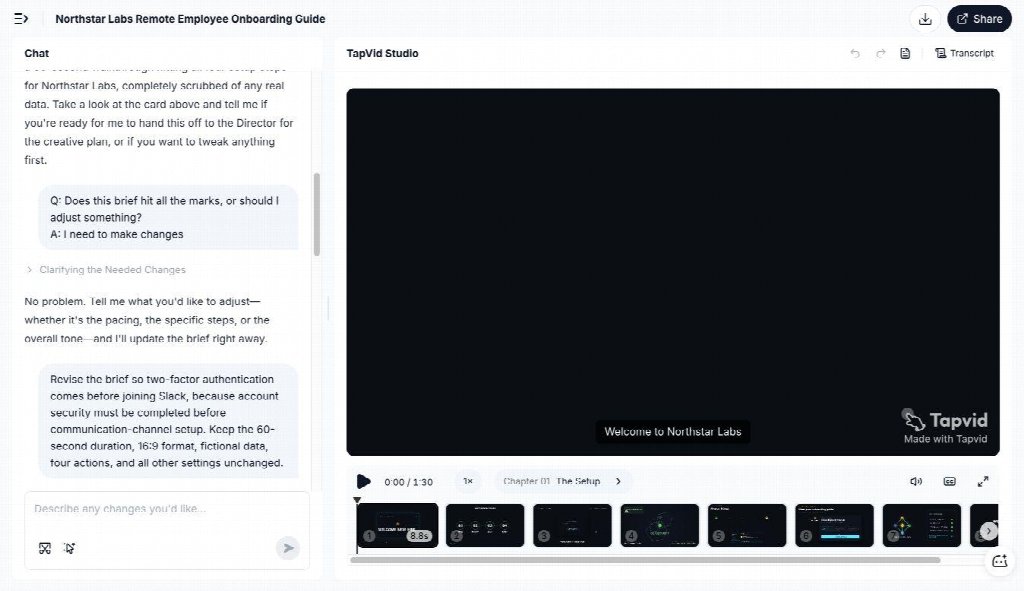
Figure: A documented TapVid test accepted a targeted sequence change, while the final duration still required human acceptance review.
For a fintech buyer, this distinction is commercially important. The question is not simply whether a system can generate scenes. The question is whether the finished video preserves the approved meaning, makes the mechanism visible, and gives every reviewer a clear reason to accept or reject each scene.
A creative brief often contains a product description, brand references, a desired style, and a target duration. Those inputs help production, but they do not define the decision the asset must support. Add five fields before anyone writes the script.
Name a role and a buying situation, not a demographic. “Small business owners” is too broad. “A marketplace finance lead comparing payout controls before a vendor call” is actionable. The second description reveals what the viewer already knows, what they worry about, and which next step is realistic.
If two audiences have different proof requirements, plan two versions. A CFO may need control, reporting, and approval logic. An operations user may need setup, exceptions, and daily workflow. Combining both can produce a vague video that satisfies neither.
Choose the transformation the viewer must understand. Examples include how a payment is authorized, how an invoice enters an approval queue, how a user becomes eligible for an offer, or how a suspicious transaction is escalated. A mechanism is stronger than a feature list because it connects cause, system action, and visible result.
State what the team can show and what it cannot claim. The approved boundary might include current interface states, documented workflow rules, or a supported calculation. It might exclude future functionality, unsubstantiated performance comparisons, or universal eligibility language. This boundary prevents a creative metaphor from quietly becoming a product promise.
Assign a person or function to every material claim category. Product should own workflow accuracy. Compliance or legal should own applicable disclosure and claims review. Brand should own identity and tone. Marketing should own the audience and next action. “The team will review it” is not ownership.
Select one next step that matches the viewer’s stage. A commercial evaluation video might lead to a product demo, a qualification page, or a detailed implementation guide. An onboarding video might lead directly into the first setup action. Multiple competing calls to action make it harder to judge whether the video did its job.
This five-field brief is also a buying tool. Use it when comparing an agency, an in-house process, or an explainer production system. Ask each option how it will preserve the five fields from source material through final revision.
The product mechanism should exist as a simple map before it becomes narration. A useful map has five parts: actor, input, state change, visible evidence, and exception or approval.
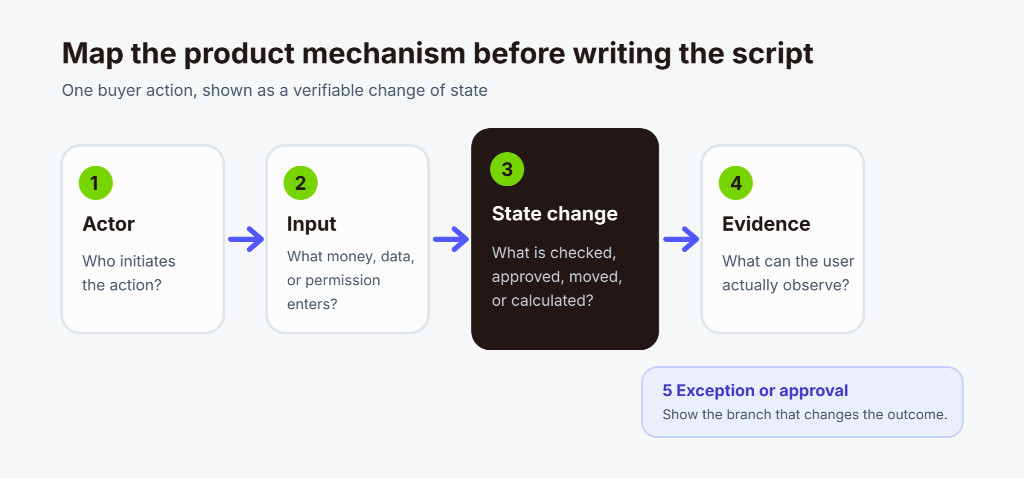
Figure: A mechanism map turns an invisible fintech process into a sequence that can be checked against source material.
Suppose the video explains a spend-control product. The actor is an employee requesting a purchase. The input is the amount, vendor, category, and receipt. The state change is a policy check followed by approval or escalation. The visible evidence is the request status and audit trail. The exception is a purchase above a threshold that requires an additional approver.
That map immediately improves the script. It shows where the audience needs product UI, where a process diagram is clearer, and where a limitation must appear. It also exposes missing information. If the team cannot describe the state change or the exception, the production team should not invent it.
Keep the map focused on the first useful outcome. A product may contain dozens of workflows, but the video only needs the path that supports its acceptance contract. Secondary features can appear on a landing page, in a product tour, or in a separate role-specific video.
The map also helps teams resist a common conversion mistake: beginning with the company story instead of the buyer problem. The first scenes should establish the situation, the friction, and the product mechanism quickly enough that the intended viewer recognizes why the rest is relevant.
Fintech review cannot stop at the voiceover script. A picture, chart, label, animation, or omission can change what a reasonable viewer understands. The Federal Trade Commission explains that express and implied advertising claims are evaluated in context, including words and pictures, and that objective claims need support before an advertisement runs. A specific financial product may also face additional rules. This article is not legal advice, so the company’s reviewers must determine which requirements apply.
A visual claim ledger makes that review operational. Create one row for every scene and record:
The ledger is especially useful for motion. A rapidly rising line can imply performance even when no percentage appears. A lock icon can imply a security property without explaining its scope. A frictionless animation can erase an approval step that exists in the real workflow. None of these choices is automatically wrong, but each needs an owner and an evidence boundary.
Reviewers should also check disclosure adjacency. If a condition changes the meaning of a claim, it should appear where the viewer needs it, not as an unrelated final frame. The correct placement, wording, and duration depend on the product and channel, so those decisions belong to qualified company reviewers.
Visual style matters, but proof burden should determine the format. Use three levels.
Use current interface footage or screenshots when the buyer needs to see a real action, status, control, or output. Label prototypes or simulated data when necessary. Record the product version and capture date so the team can identify when a future interface change makes the scene stale.
Observed UI is strong for commercial evaluation because it reduces ambiguity. It is less useful when the interface contains too much detail for the viewer’s question or when the product has not reached a stable state.
Use a diagram when the important event happens across systems or behind the interface. Keep the actor and state changes explicit. Avoid decorative arrows that suggest instant movement, guaranteed approval, or universal availability when those implications are not supported.
A process diagram can also show boundaries that UI footage hides: a partner system, a manual review, an eligibility check, or an exception path. For a complex fintech product, those boundaries often determine buyer trust.
Use a metaphor when it helps the audience form a mental model, but make its purpose clear. A bridge can represent connection. A gate can represent a control. A queue can represent ordered review. The metaphor should not function as proof of security, speed, savings, or outcome.
This rule prevents a false tradeoff between clarity and accuracy. The goal is not to remove creativity. It is to select a visual language whose implied claim matches the evidence available.
An aesthetic review asks whether a scene looks good. An acceptance test asks whether it is ready to ship. For each scene, answer six questions:
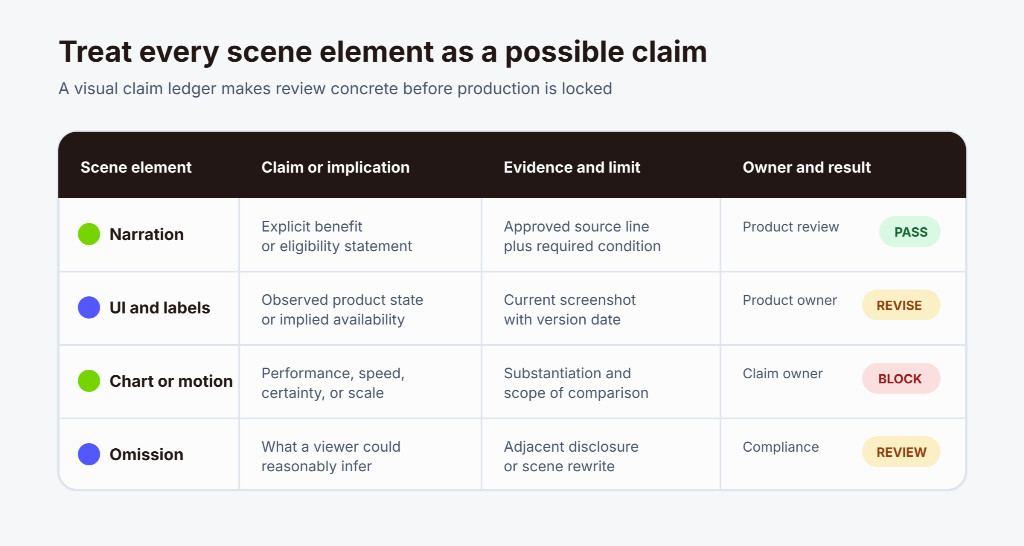
Figure: The ledger expands scene acceptance beyond narration so that UI, labels, charts, motion, and omissions receive an explicit result.
A scene fails if the team cannot locate its source, name its owner, or explain its role in the acceptance contract. “It makes the video flow better” may be a valid editing reason, but it is not enough to justify a new product implication.
Run the test at storyboard stage, not only after animation. Early review makes revision cheaper and more precise. Product and claims owners can correct a diagram or remove an unsupported line before timing, voice, music, and motion make the scene expensive to change.
The same test supports localization and channel variants. A shorter paid-social cut may remove context that made a claim appropriately bounded in the full version. A translated label may not preserve the approved meaning. Each variant needs its own acceptance result, even if it inherits the same source pack.
There is no universal best route for fintech explainer production. The practical choice depends on source control, review complexity, update frequency, and the type of visual evidence required.
An agency can be useful when the company needs concept development, custom illustration, motion direction, and project management. The brief should still require scene-level source mapping, named review rounds, editable deliverables, and a process for future updates.
An in-house team can move close to product and compliance owners. It may be the right route for frequent releases, provided the team has scripting, design, editing, accessibility, and version-control capacity. The hidden cost is often not production itself but the coordination required to keep claims and visuals current.
A source-led Explainer Video Engine can help when the team already has approved scripts, PDFs, URLs, screenshots, or brand assets and needs to convert them into a structured video workflow. TapVid’s public explainer page describes using those inputs, preserving approved wording and source visuals, and revising a specific scene. Those capabilities support a controlled production process, but they do not replace product, legal, compliance, accessibility, or brand review.
Whatever route you choose, ask for a revision model before asking for a style reel. Can the team change one fee label without rebuilding every scene? Can a product owner trace a scene back to its source? Can a reviewer compare the old and new version? Can the company obtain the transcript, captions, and source files needed for future changes? A beautiful first version is less valuable if every product update turns into a new production project.
A finished video should ship with the information required to maintain it. At minimum, keep:
The World Wide Web Consortium provides guidance on accurate captions and transcripts, including relevant non-speech information. Those assets support accessibility, but they also make review and future revisions easier because the approved wording is available outside the video timeline.
The change-trigger matrix connects product events to content actions. Use rows such as:
Assign an owner and review date to each trigger. The goal is not to predict every change. It is to prevent a known change from leaving a high-conversion asset in circulation with stale product information.
Use this checklist before approving a vendor, production system, or internal plan.
A production option that cannot answer these questions may still create an attractive video. It has not yet shown that it can create a maintainable commercial asset.
It is a video that makes a financial product, workflow, or concept understandable for a defined audience. A commercial fintech explainer should connect a buyer problem to a visible product mechanism and one next action. It should also preserve the conditions, exceptions, and evidence boundaries that affect what the company can claim.
There is no universal duration that makes a video effective. Set the duration after defining the audience, mechanism, channel, and acceptance criteria. Then check the final timeline against the brief. If the explanation needs too many exceptions or features, narrow the reader job or create role-specific versions instead of forcing everything into one cut.
Include the audience and buying situation, the product mechanism, the approved proof boundary, named review owners, and one conversion action. Attach the approved script or source copy, current product visuals, brand assets, disclosure requirements, channel specifications, and creative references. Mark any future, simulated, or illustrative material clearly.
Start review before animation. Map each scene to an approved source, record explicit and implied claims in a visual claim ledger, assign an owner, and review conditions in context. Recheck shorter versions and translations because removing context can change meaning. A qualified company reviewer should determine the legal and regulatory requirements for the specific product and market.
Choose based on the work the asset requires. An agency may provide custom concept and motion capacity. An internal team may be closer to frequent product changes. A source-led system may help structure approved material and make targeted revisions. Evaluate every route on source traceability, reviewer access, scene-level revision, deliverables, and maintenance, not only visual style.
TapVid’s public explainer page describes using approved scripts, PDFs, URLs, screenshots, and brand assets as inputs. It also describes preserving approved wording and source visuals and revising a specific scene. The company must still verify every output against the source, duration, product state, claims boundary, and applicable review requirements.
The best fintech explainer video is not the one that says the most or uses the most elaborate animation. It is the one a buyer can understand and the company can defend, approve, update, and connect to a meaningful next step.
Start with the five-field decision brief. Map the mechanism before writing. Review every visual element as a possible claim. Test each scene against its source, owner, limitation, and conversion job. Finally, ship a change-trigger release pack with the video. That process turns explainer production from a one-time creative purchase into a controlled commercial asset.