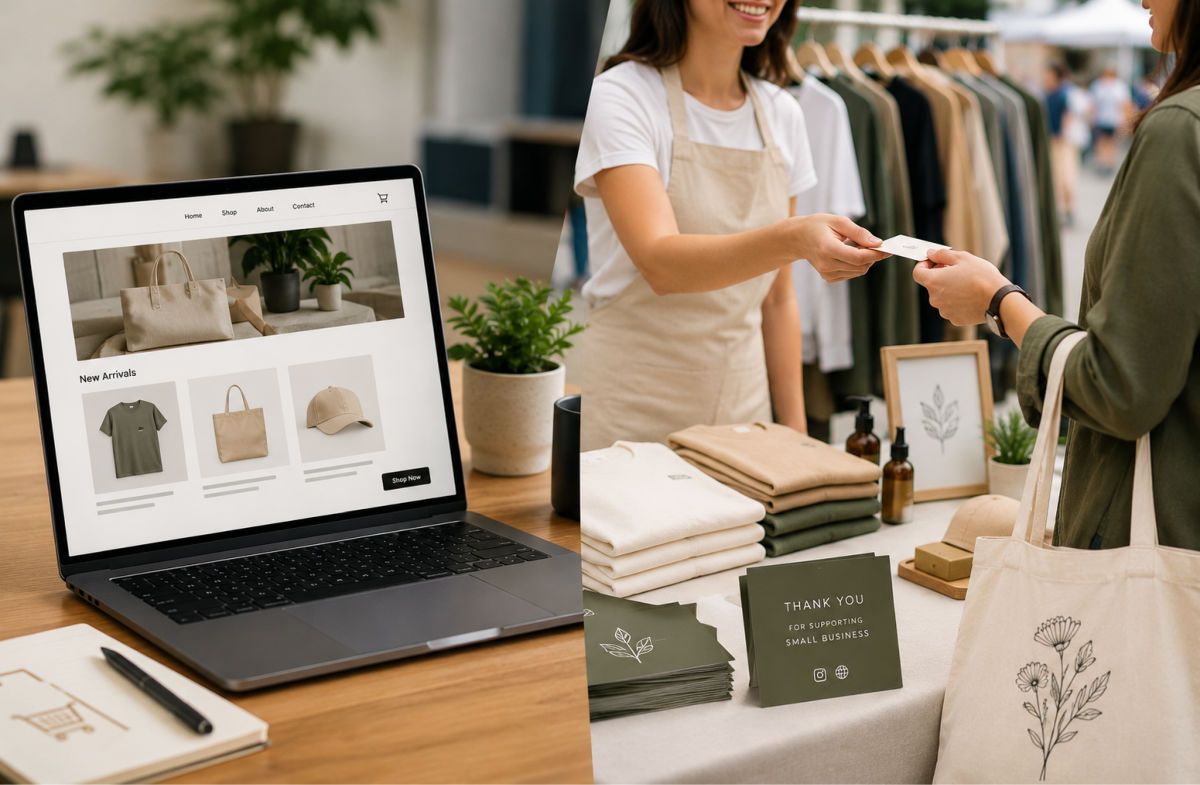
The right way to take an ecommerce brand offline is to start small with markets and pop‑ups, show up with professional physical materials, learn from every in‑person interaction, and then scale into wholesale and events at the pace your operations can actually support.
Digital channels can launch a brand, but it is often the first real‑world moments—someone picking up your product, asking a question, remembering your card—that unlock the next stage of growth.
Most ecommerce founders build their entire business inside a screen. The store, the ads, the customer service, the analytics dashboards you refresh a bit too often, it all happens online, and for good reason. It’s scalable, it’s measurable, and it doesn’t require you to leave the house. But at a certain point, usually once the online channels start feeling crowded and customer acquisition costs start climbing, a lot of sellers hit the same wall: the internet alone isn’t growing the brand anymore.
That’s usually the moment an online-only business starts looking for a real-world presence, markets, pop-ups, wholesale deals, local retail, industry events, and discovers that “taking the brand offline” is a genuinely different skill set to running a store. This piece is about that shift, and what it actually takes to make it work.
It’s worth naming the problem plainly. Digital channels are efficient, but they’re also finite and increasingly expensive. Ad costs on the major platforms have crept up for years, organic reach on social keeps shrinking, and every seller in your category is fighting for the same attention in the same feeds. None of that means digital marketing stops working. It just means it stops being enough on its own, especially for brands trying to grow past their first wave of customers.
Offline presence solves a different problem. It puts your product in front of people who weren’t already looking for it, and it does something digital struggles to replicate: it lets someone physically hold what you make. That single interaction, picking something up, flipping it over, asking a question in person, builds trust faster than almost any ad ever will.
This trust gap is worth understanding properly, because it explains why so many online brands eventually invest in physical touchpoints even though their entire business model is digital. A website, however polished, is still just a website. Customers have been burned before by stores that looked legitimate and weren’t. A real person standing behind a stall, a properly printed brochure, a business card handed over with a bit of eye contact, these things do a lot of quiet work closing that gap.
It’s a big part of why so many growing ecommerce brands turn to an established online printing company once they start showing up in person. It’s a small operational decision, but it changes how the brand is perceived the moment someone sees it outside a screen.
This matters more for ecommerce brands specifically because so much of the trust-building work usually happens invisibly, through reviews, return policies, and secure checkout badges. Offline, none of that infrastructure is visible. You’re relying entirely on how the brand presents itself in the room, which is exactly why the physical details, packaging, signage, printed materials, carry more weight than founders often expect the first time they show up somewhere in person.
For most ecommerce sellers, the first taste of “real world” business happens at a local market or a pop-up stall, and it’s genuinely useful, not just for sales but for research. You get direct, unfiltered feedback. You see which products people pick up first. You hear objections you’d never get from a support ticket.
It’s also where a lot of founders realise how much they’ve been relying on their website to do the talking. Online, your product page, reviews, and photography carry the entire pitch. In person, that job falls to you, and to a handful of physical materials that back you up. Having proper business card printing services sorted before your first stall is one of those unglamorous but genuinely useful steps, because a customer who liked your stand but didn’t buy on the day needs something more memorable than a scrawled Instagram handle to find you again later.
Once markets prove there’s demand beyond your existing customer base, the natural next step for a lot of ecommerce brands is wholesale, getting the product into local shops, boutiques, or cafes that already have the foot traffic you’re trying to reach. This is a different kind of pitch to a market stall conversation. You’re not selling to an end customer anymore. You’re selling to a buyer who needs to see margins, minimums, and a clear reason your product fits their shelf.
This is where a proper leave-behind matters more than most founders expect. A well put together one-pager or catalogue, using Custom brochure printing services rather than a hastily formatted PDF, gives a buyer something concrete to refer back to after you’ve left the shop. It also signals, in a small but real way, that you take the wholesale side of the business seriously, which matters more than it should when you’re asking someone to take a chance on stocking a brand they’ve never heard of.
Buyers see a lot of pitches, and most of them blur together by the end of the week. A printed piece that stays on their desk, rather than buried in an inbox, is one of the simplest ways to be the one they remember when they’re finally ready to place an order.
Before your first market stall, pitch meeting, or industry event, it helps to have a short, practical checklist rather than trying to figure it all out on the day. A few things consistently make the biggest difference.
None of this needs to be expensive. It just needs to exist before you need it, not scrambled together the night before.
Trade shows and industry expos are where a lot of ecommerce founders get their first real look at scale, seeing competitors, suppliers, and potential retail partners all in one room. They’re also where it’s easiest to overspend trying to look bigger than you are.
The good news is that looking professional at this level doesn’t require a big production. Sourcing custom printing services online, rather than committing to a large minimum order through a traditional print shop, lets a smaller ecommerce brand order exactly what it needs for a single event, signage, a small run of brochures, updated cards, without tying up cash in stock that won’t be useful again for months. It’s a practical way to show up looking established without the overheads that used to come with it.
The other thing that often gets missed is that this isn’t a one-way street. What you learn offline should feed straight back into your online store. The questions customers ask in person are usually the same objections quietly costing you conversions on your product pages. The story you find yourself telling at a market stall is often a better version of your About page than the one currently sitting on your website.
Treat every offline touchpoint as market research as much as a sales opportunity. The brands that get the most out of taking their business offline are the ones paying attention to what they learn there, not just counting the sales made on the day.
None of this needs to happen all at once, and it shouldn’t. Start with a single market stall or a small local event. See what it teaches you before committing to wholesale conversations or a trade show booth. The goal isn’t to build an offline operation to match your online one overnight. It’s to add real-world touchpoints gradually, in a way that actually strengthens the brand rather than stretching it thin.
An ecommerce business doesn’t have to choose between being an online brand and having a real-world presence. The founders who grow past that first digital ceiling are usually the ones willing to step outside the screen, even in small ways, and bring what they learn back into the business they’ve already built.
The right time is usually when digital channels still work but are no longer delivering the growth you want, and you have enough operational stability to handle new demand from offline experiments.
Most brands should start with a local market, pop‑up, or small event because the cost is low, the feedback is immediate, and you can iterate quickly before approaching wholesale or trade shows.
For a first event, keep printing lean: a small batch of professional business cards, a simple one‑page handout, and basic signage are usually enough to test the channel without overspending.
Yes, wholesale typically requires lower unit pricing so retailers can add their margin, which means you need enough production margin to support both channels profitably.
You can measure offline success by tracking event sales, wholesale orders, email signups, and online traffic or conversions that come from specific offline codes, URLs, or QR links.