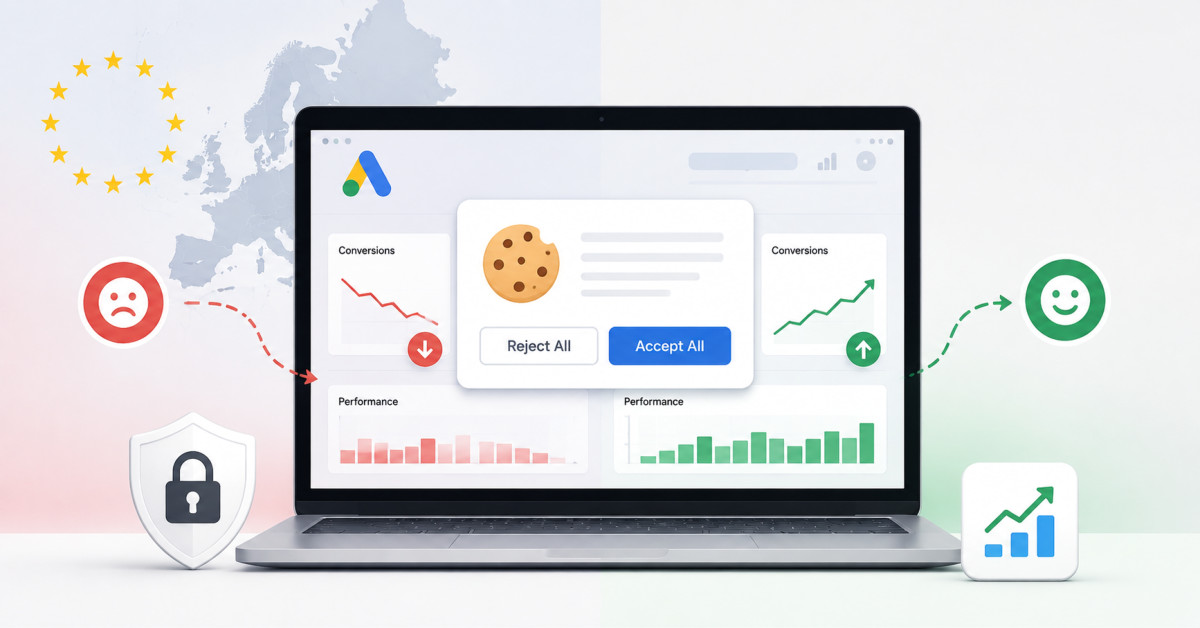
Shopify brands selling into the EU lose reported conversions when their cookie banner collects consent but never passes it to Google. Advanced Consent Mode with all four signals recovers modeled conversions; Basic Consent Mode and a misconfigured banner recover nothing.
Most brands respond to a drop in EU performance by changing the creative. The creative was never the problem. The bidding algorithm simply stopped being told which clicks turned into orders.
When EU reported conversions collapse overnight while clicks and spend hold steady, the cause is almost always a consent signal failure rather than a campaign, creative, or market problem. Google began actively disabling advertising features for accounts that had not implemented Consent Mode v2 for EEA and UK traffic on July 21, 2025, and the failure mode is silent. No warning email. No account notification. Conversions simply stop arriving.
The clearest documented case comes from Mike Teasdale, founder and planning director at Harvest Digital, who described a client whose Google Ads conversions dropped 90 percent overnight with nothing changed in the account. Campaigns were live, clicks were arriving, conversions had vanished. The diagnosis took two days. The client’s consent banner was collecting user preferences correctly and simply never transmitting those preferences to Google’s tag infrastructure. After remediation, roughly 40 percent of the missing attribution came back through modeling. The remaining 60 percent was permanently gone.
That last detail is the one operators need to sit with. Attribution data lost during a non-compliant period is not recoverable retroactively. You cannot backfill it. Which means the cost of a broken Consent Mode implementation is not the day you find it, it is every day between the break and the fix, multiplied by however badly Smart Bidding misallocated budget while optimizing on partial data.
The diagnostic is fast. In Google Ads, go to Goals, then Conversions, then Summary, select a conversion action and check the tracking status. You are looking for confirmation that consent mode conversion modeling is active. If the status says consent mode is implemented but thresholds are not met, that is a different problem, addressed further down. If it says nothing about consent mode at all, your banner is not talking to Google and you have found your answer.
Consent Mode v2 transmits four separate signals, and a consent management platform that only sets two of them is running an incomplete integration that will quietly break remarketing. The first version carried ad_storage and analytics_storage. Version 2, mandatory for EEA and UK advertisers since March 2024, added ad_user_data, which governs whether data may be sent to Google for advertising purposes, and ad_personalization, which governs personalized advertising and remarketing specifically.
The legal driver here is the Digital Markets Act rather than the GDPR directly, which trips up a lot of teams. Your legal counsel may sign off on your GDPR posture and your Google Ads account can still lose features, because these are different obligations enforced by different parties for different reasons.
The practical consequence of a missing ad_personalization signal is the one that costs the most money: remarketing lists stop growing the moment a denied state is recorded. Remarketing is typically the highest return activity in a DTC media mix, and EU remarketing audiences commonly shrink by a large margin against pre-consent baselines once denial states are properly honored. That shrinkage is legitimate and unavoidable. What is avoidable is shrinkage caused by your banner failing to pass a granted signal from visitors who did in fact consent.
Worth naming plainly: setting your defaults to granted where a denied default is legally required would inflate your audience data and create compliance exposure at the same time. That is not a clever workaround, it is the configuration that produced the CNIL decisions discussed below. The signals must reflect what the visitor actually chose, which is exactly why the consent management platform layer has to be correct before any of the measurement layer works.
Basic Consent Mode blocks Google tags entirely until a visitor accepts, which means you get zero conversion modeling from everyone who declines, while Advanced Consent Mode sends cookieless pings that make modeling possible. Google’s own documentation on how the two consent mode implementations behave is explicit about the difference: under Basic, when a user does not consent, no data reaches Google at all, not even the consent status, and modeling falls back to a general model rather than one trained on your traffic.
Most teams default to Basic because it feels conservative and it is easy to explain to legal. In my experience that decision is usually made once, in a meeting where nobody frames it as a revenue decision, and then never revisited. It is a revenue decision. If your EU consent rate is somewhere in the range most ecommerce banners see, Basic mode means the majority of your European traffic is invisible to your bidding algorithm and stays invisible.
Advanced mode is more work to implement correctly, because the ordering matters. Default consent states must be set before any Google tag fires, then updated when the visitor makes a choice. Get the sequence wrong and you either leak data before consent, which is the CIPA and CNIL fact pattern, or you send a denied default that never updates, which looks identical to having no consent mode at all.
This is where the platform choice earns its keep. Cookiebot by Usercentrics ships with native Consent Mode v2 support and handles the default-then-update pattern, which removes the most common source of implementation error. It is not the only option. OneTrust covers the same ground with more enterprise governance around it, and several lighter tools do the job for simpler stacks. The test that matters is not which vendor you pick, it is whether all four signals verifiably reach Google after a visitor clicks accept and after a visitor clicks reject. Check both paths.
Google requires a minimum of 700 ad clicks over seven days per country and domain grouping before conversion modeling activates, which means a large share of Shopify brands running EU campaigns never qualify. This threshold is published in Google’s documentation on consent mode modeling, alongside the requirement that consent mode or the IAB TCF framework be correctly implemented first. Models then enter a training period before uplift appears.
Run the arithmetic against your own account. Seven hundred clicks in seven days is 100 clicks a day, in a single country, to a single domain. A brand spending €3,000 a month across five European markets is comfortably under the threshold in every individual market even though the aggregate number looks healthy. Country by country is how Google counts it, and that is the detail that surprises people.
If you are below the threshold, the honest answer is that modeled conversions are not coming to rescue your measurement and you should stop waiting for them. Two things work instead. Consolidate your European spend into fewer markets so at least your primary market clears the bar, which is usually the right commercial call anyway. And shift your measurement weight toward first party signal that does not depend on Google’s models at all.
That second path is where server side tracking earns its cost. Tools like Littledata and Aimerce capture conversion events at the server level and push them back to Google through Enhanced Conversions, which survives browser restrictions that break pixel based measurement. Triple Whale approaches the same problem from the analytics side for brands that want a blended view. None of these replaces consent. Consent still governs what you are permitted to send. What they change is how much of the permitted signal actually arrives.
Treat your consent banner as a conversion surface with a measurable accept rate, because every point of consent rate improvement widens the base your models are trained on and directly improves bidding accuracy. Most brands never measure this number. They should, because it is one of the few metrics on the site that improves both compliance posture and media performance at the same time.
What lifts it is unglamorous. Neutral, plain language explaining what the cookies actually do outperforms urgent or aggressive framing. Fast rendering matters, because a banner that appears half a second late gets dismissed reflexively. Clear granular categories perform better than an all or nothing choice, because visitors who would decline everything will often accept analytics.
What does not work, and is now explicitly enforced against, is any design that makes rejecting harder than accepting. Asymmetric buttons, a reject option buried two clicks deep, pre-ticked boxes, and consent walls have all drawn enforcement action. Beyond the legal exposure, they are self defeating: a coerced accept from a visitor who did not mean it produces worse model training data than an honest decline.
There is a broader point here that goes past the banner. Every point of consent you cannot obtain is an argument for owning more of your customer relationship directly, through email, SMS, loyalty, and post purchase surveys, none of which depend on a third party cookie surviving a browser update. If you are also selling into Europe on the merchandising side, the same logic applies to how you handle duties and taxes at checkout: the brands that win international markets are the ones that remove friction and surprise, not the ones that optimize a tag.
France’s data protection authority fined Shein’s Irish subsidiary €150 million for placing advertising cookies before any visitor action and for continuing to place and read cookies after visitors clicked reject all. The CNIL’s published decision is worth reading in full because the findings map almost exactly onto what a typical Shopify storefront does by default.
Three specific failures were cited. Advertising cookies were placed as soon as a visitor arrived, before accepting or rejecting anything. The banner did not adequately explain the purposes of the cookies or identify the third parties involved. And when a visitor clicked reject all or withdrew consent, new cookies were still placed and existing ones continued to be read. The regulator weighed the scale of the operation, roughly 12 million monthly visitors from France, in setting the amount.
On the same day the CNIL fined Google €325 million, partly over cookies placed during account creation without valid consent. Together those decisions signal that cookie enforcement in Europe is not softening, and that ecommerce is squarely in scope rather than being a bystander to platform level cases.
The transferable lesson for a brand doing €2M in Europe is not the fine size, which is scaled to Shein. It is the finding pattern. Every one of the three failures is a technical implementation defect that a quarterly test would catch, and none of them is a legal drafting problem. Your privacy policy could be flawless and you would still have failed on all three counts. This is the same gap I keep seeing between what teams believe their consent setup does and what it demonstrably does, which is why I now treat the reject all path as a mandatory test case rather than an edge case.
The EU’s Digital Omnibus proposes moving cookie consent rules out of the ePrivacy Directive and into the GDPR itself, but it remains in negotiation and is not something to plan a 2026 implementation around. Published on 19 November 2025, the package introduces new Articles 88a and 88b, which would restructure consent for access to terminal equipment and make browser level consent signals legally binding on controllers.
Taylor Wessing’s analysis of what the proposal changes for cookies and digital advertising sets out the mechanics: where personal data is being processed, the ePrivacy rules would step aside and the GDPR alone would apply, consolidating rules that currently sit across two instruments and two sets of regulators. Other elements under discussion include a moratorium on re-requesting consent after a refusal and standards for machine readable preference signals.
The uncertainty is real and worth being honest about. The European Data Protection Board and the European Data Protection Supervisor have welcomed the goal of reducing consent fatigue while warning that splitting terminal equipment rules across two instruments could create fresh legal uncertainty. Member states have already softened contested elements, and the Council’s own text has at points dropped the core cookie provisions entirely.
My read, and I am willing to be wrong about this in public: the direction of travel toward browser level signals is durable, the specific article numbers and timelines are not. Apply the eighteen month test. A brand that builds its consent architecture around granular category blocking and a platform that can respond to browser level signals will be fine under either the current rules or the proposed ones. A brand that builds around a specific banner design optimized for today’s exact requirements will be rebuilding. Build for the principle, not the paragraph.
Your priority order depends on European ad spend, because the return on fixing measurement scales directly with how much budget the bidding algorithm is currently misallocating. Start with the diagnostic regardless of size, then branch.
Under €2,000 a month in EU spend, run the tracking status check in Google Ads and the reject all path test on your own storefront. If Consent Mode is not implemented, implement it in Advanced mode. You will likely not clear the modeling threshold, so do not expect modeled conversions, and do not buy server side infrastructure at this spend level. Focus on getting the signals correct and on consolidating spend into your strongest single market.
Between €2,000 and €25,000 a month, verify all four signals fire correctly on both the accept and reject paths, which is the point at which a platform with native Consent Mode v2 support stops being optional, confirm your primary market clears 700 clicks in seven days, and start measuring consent rate as a tracked metric. This is also the point where Enhanced Conversions with hashed first party data earns its implementation cost, and where your attribution model across channels needs to be a deliberate choice rather than whatever GA4 defaulted to.
Above €25,000 a month, the measurement stack itself becomes the project. Server side tagging, Enhanced Conversions, and a consent platform that logs granular consent states with timestamps are all justified. Test quarterly rather than annually, and make one named person accountable for the consent banner, because in nearly every broken implementation I have seen, the underlying cause was that the banner belonged to nobody: legal assumed marketing owned it, marketing assumed the developer owned it, and the developer left eighteen months ago.
Whatever your stage, the sequence is the same. Consent first, because it governs what you are allowed to collect. Signals second, because they determine what actually reaches Google. Modeling third, because it only works when the first two are right. Reversing that order is how brands end up paying for attribution software that has nothing accurate to attribute.
The most common cause is a Consent Mode v2 implementation failure, where your cookie banner collects visitor preferences but never transmits them to Google’s tag infrastructure. Google began disabling advertising features for non-compliant EEA and UK accounts on July 21, 2025, and the failure produces no warning. Check Google Ads under Goals, then Conversions, then Summary, and look at the tracking status for your conversion actions. If there is no confirmation that consent mode modeling is active, your banner is not communicating with Google. Attribution lost during the non-compliant window cannot be recovered retroactively, so diagnosing quickly matters more than diagnosing perfectly.
Basic Consent Mode blocks Google tags completely until a visitor consents, while Advanced Consent Mode loads the tags immediately and sends cookieless pings when consent is denied. The revenue difference is conversion modeling. Under Basic, visitors who decline send no data at all, not even their consent status, so modeling falls back to a general model rather than one informed by your own traffic patterns. Advanced makes your account eligible for modeling based on your actual data, subject to Google’s volume thresholds. Advanced requires more careful implementation, specifically setting default consent states before any Google tag fires and updating them when the visitor chooses.
Google requires a minimum of 700 ad clicks over a seven day period, per country and per domain grouping, before conversion modeling activates. That works out to roughly 100 clicks per day in a single market, not aggregated across all your European countries, which is the detail most advertisers miss. Consent mode or the IAB Transparency and Consent Framework must also be correctly implemented, after which Google’s models enter a training period before uplift figures appear. If you run modest spend spread across several European markets, you may not qualify in any individual one, in which case consolidating spend or investing in server side tracking is the better path.
Yes, Consent Mode is not a consent mechanism, it is a way of communicating consent decisions to Google’s tags after a visitor has made them. Something still has to ask the visitor and record the answer, which is what a consent management platform does. Consent Mode also does not satisfy your legal obligations under the GDPR and the ePrivacy Directive on its own, because those require prior informed consent before non-essential cookies are set. The two layers work together: the consent platform obtains and stores the decision, and Consent Mode relays it. A Consent Mode implementation without a functioning banner is neither compliant nor complete.
The Digital Omnibus would move cookie consent rules out of the ePrivacy Directive and into the GDPR through new Articles 88a and 88b, but it remains in negotiation and should not drive 2026 implementation decisions. The proposal, published in November 2025, would make browser level consent signals legally binding on controllers and consolidate enforcement under GDPR supervisory authorities. European data protection regulators have supported the goal of reducing consent fatigue while warning about new legal uncertainty, and contested elements have already been softened. The durable planning assumption is that browser level signals are coming; the specific timelines and article numbers are not yet settled.