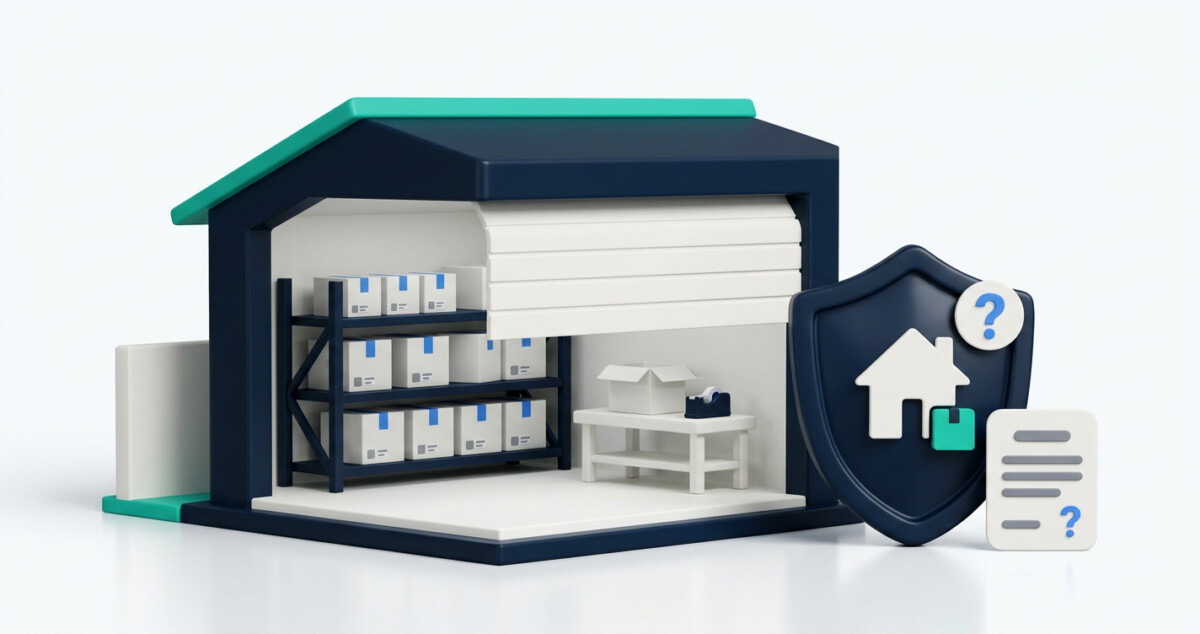
A standard homeowners policy covers about $2,500 of business property, so a Shopify merchant holding five figures of stock at home is largely uninsured. Under roughly $5,000 of inventory, an endorsement is enough. Past that, an in-home business policy earns its cost.
Insurers pay out on the policy you held the day of the loss, not the one you bought the week after.
A typical homeowners policy covers only $2,500 of business equipment in the home, and just $250 once that property leaves the premises, according to the Insurance Information Institute guidance on insuring a home based business. That limit was written for a home office. It covers a laptop, a thermal label printer, and a heat press.
It was not written for 900 units of skincare stacked in a basement three weeks before Black Friday. A brand holding $40,000 of peak inventory at home is carrying roughly six cents of coverage for every dollar of stock. The $250 off premises limit matters more than it looks, too, because that is the number in play when you take inventory to a pop up, a market, or a trade show.
Liability is the second gap and the more expensive one. Homeowners policies generally exclude business related liability outright, which is the Institute’s own framing: you need liability coverage in case clients or delivery people get hurt on your premises. That exclusion covers the courier who slips on your steps during a pickup and the part time packer working Saturdays. The denial arrives after the loss, when you have the least room to argue it.
Most merchants find this out during a claim rather than before one. The adjuster asks what is in the boxes, you answer honestly, and the payout shrinks to a limit you could have read on your declarations page a year earlier.
There are three coverage structures available to a home based merchant, and the right one is set by how much stock you hold and whether anyone else sets foot in the house. The endorsement is a limit increase. The in-home business policy is a real business policy. The businessowners policy is for when the operation has outgrown one address.
If you are holding less than $5,000 of stock and nobody comes to the house, the endorsement is the correct answer and the cheapest. Doubling the standard business equipment limit is usually an endorsement on the policy you already have rather than a new policy, so ask your agent what your carrier charges to add it before you shop anything more complicated.
The endorsement stops being enough earlier than most merchants expect, and the reason is not the property limit. It is everything the endorsement does not touch. A mid season loss costs you replacement inventory, refunded orders, and expedited freight to restock, and then it costs you again in reviews, one for every customer who waited three weeks on a package you could not ship. An in-home business policy is the structure that replaces the income you lose while the operation is dark. That business interruption piece, not the higher property limit, is what you are actually buying.
The businessowners policy is the right answer later rather than now. Move to it when stock lives in two places, when a storage unit enters the picture, or when headcount grows past what an in-home policy will allow. Buying it early is premature complexity, which is the single most common way merchants in the $500K to $2M range waste money on infrastructure they do not need yet.
Package theft costs a shopper one refund request and costs a merchant on both ends of the supply chain at once. One in four Americans, about 64 million people, has had a package stolen at some point, according to the 2025 package theft report from Security.org, which surveyed 3,307 adults in October 2025 and put the average stolen package value near $222. A shopper reads that as an inconvenience. If you fulfill from home, your doorstep is on both sides of the ledger.
Your poly mailers, printed cartons, raw materials, and customer returns land on the same doorstep as everyone else’s retail orders. A pallet of custom packaging sitting curbside for six hours is a better prize than a paperback, and it is harder to replace on a deadline because your branded cartons have a lead time. Returns are the worse half. A stolen return becomes a refund you issue on merchandise you never got back, and your policy almost certainly does not make that distinction.
Picture an apparel brand running 60 orders a day out of a townhouse. Every afternoon, 60 labeled parcels sit inside the front door waiting for a 4pm carrier pickup, each one printed with the same brand name. Anyone watching that street for a week has your schedule, because the staging area and the timetable are both visible from the sidewalk.
The cost lands on you rather than on the shopper, and that is measured, not assumed. The USPS Office of Inspector General working paper on package theft, published in May 2025, estimates at least 58 million packages stolen in 2024 and found that 58% of victims contacted the retailer for a refund or replacement while 40% contacted the shipping company. Most stolen parcels become a merchant expense by default, whatever carrier liability says on paper.
Worth separating two different products here, because merchants conflate them constantly. Property coverage protects the stock while it sits in your house. It does nothing once a parcel is in a carrier’s hands or sitting on a customer’s porch. That second exposure is what shipping insurance that pays claims on theft after confirmed delivery is built for, and it is a separate line item with separate economics. Buying one and assuming it covers the other is how a merchant ends up paying twice for a single loss.
A camera gives you footage and a case number, while a monitored system puts a person in the loop within seconds of the event. That is the whole distinction, and it is the reason insurers price the two differently. Recorded video is useful for a claim and for a police report. It does not shorten the time between someone opening your garage side door and someone responding to it.
Monitored systems behave differently because the response does not depend on you checking your phone. Door and window contacts trigger a dispatch call. Glass break sensors cover the garage side door that home operators forget about, which is also the door with the least visibility from the street. Motion sensors in the storage room can run on a schedule separate from the rest of the house, which matters on the week you fly to a trade show and want family areas lightly armed while your stock is watched closely.
Merchants storing five figures of inventory at home commonly move to ADT-monitored home security for exactly this reason. Response time shrinks from whenever you next look at your phone to right now, and carriers commonly credit central station monitoring against the premium, so ask your agent for the specific discount figure before you sign the monitoring contract. That credit changes the real monthly cost of the system and it is the one number that makes the decision concrete.
Pair the monitoring with documentation, because the alarm protects the stock and the paperwork protects the claim. Photograph your storage room monthly, keep a running unit count, and file supplier invoices in one folder. An adjuster will ask you to prove what was there, and a merchant who can produce an invoice and a dated photo settles a claim in a different timeframe than one who cannot.
Water is a far more likely cause of loss than burglary, and the gap is wider than most merchants assume. The Insurance Information Institute’s claim frequency data for 2019 through 2023 puts water damage and freezing claims at roughly 1.6 per 100 insured homes each year, fire and lightning at about one in 425 homes, and theft at about one in 700. Securing the building is worth doing. Lifting your cartons off a concrete floor is worth doing first, and it costs under $100.
A garage exposes inventory to both of the likelier perils at once. Water heaters fail. Washing machine hoses split. A concrete slab wicks moisture into the bottom layer of every carton stacked directly on it, and you will not see it until you open the box at the bottom of the stack in November.
Climate is the slower version of the same problem. Apparel absorbs humidity. Label adhesives lift in summer heat, which turns into a packing problem rather than a product problem when a printed mailer will not seal. Anything with a shelf life ages faster in an uncooled space than the supplier’s storage assumptions allow, which is why regulated categories run out of road on home storage sooner than apparel does.
Pallets or plastic shelving permanently lift stock off the floor for less than the cost of one month of monitoring. Add a temperature and humidity sensor to the same room while you are there, because the cheapest version of this problem is the one you catch on a sensor reading rather than in a carton.
Standard home security advice assumes a house, and you are running a small distribution node, which reorders the priorities. The zones that matter are the ones holding stock, and the schedule that matters is your packing and pickup rhythm rather than when the family is asleep.
Arm the storage room as its own zone. The point is being able to lock down the stock without living inside an armed perimeter, which is the reason most home systems get disarmed and left that way by week three. A merchant who has to choose between an armed house and a convenient evening will choose the convenient evening every time, so remove the choice.
Cover the detached structures. Sheds and detached garages get overlooked almost universally, and they are frequently where the overflow inventory ends up in October. A padlock is the floor. A contact sensor on that door, reporting to the same monitored panel as the house, is the version that actually belongs in this piece, because an unmonitored padlock is a camera by another name.
Give every helper a unique code. Temporary smart lock codes handle the freelancer who packs weekend orders without putting a permanent key into circulation, and they give you a log of who opened what. Our guide to lowering risks in fulfillment operations covers the process and technology side of the same problem at larger operations, which is where this goes next as you grow.
One call worth making this week: tell your insurer what you actually store and how much of it. Merchants skip this call because they fear a rate increase. Skipping it is the mechanism by which claims get denied, and a rate increase you chose is cheaper than a denial you did not.
Most of your annual exposure sits in November and December, which means your security and insurance decisions have a September deadline rather than a November one. Peak season stacks every variable in the same direction at once. Inventory value climbs, parcel volume climbs, and delivery traffic on your street climbs, and the third one is what makes the first two visible from outside.
The household version of this is measurable. Security.org’s respondents expect about 25 packages between October and December, roughly double a normal three month volume. Your street is busier, every house on it is receiving more, and a parcel sitting out is less remarkable than it would be in March.
Illustrative benchmark rather than a measured figure: merchants running home fulfillment commonly describe peak storage holding three to four times its normal value. Count your own number instead of borrowing that range, because it is the number that decides whether an endorsement still fits.
The asymmetry is what matters. A break in during March costs you a bad week. The same break in on November 20 costs you the quarter, because the inventory is at its annual high and there is no time to replace it before the window closes. Our BFCM 2026 data report found that roughly 80% of shoppers start before Thanksgiving week and 30% begin in September or October, so the window you are protecting opens earlier than the calendar suggests. Your security setup should be finished in September, not tested in November.
When peak inventory value passes what a residential policy will insure at a sensible price, third party logistics stops looking expensive and starts looking like the cheaper of two bad options. That crossover is a number, not a feeling, and it is worth calculating once a year rather than arguing about every peak.
Warehouses typically carry commercial coverage, 24 hour monitoring, and loading docks that never sit exposed on a public sidewalk. You are not only buying storage. You are buying out of the insurance problem, the alarm contract, and the liability exposure in one line item.
Home fulfillment looks free because the rent is already paid, and that is the accounting error. Count the insurance premium, the monitoring contract, the hours you spend packing instead of selling, and the ceiling it puts on how many orders you can physically move in a day. Our guide to how order fulfillment works on Shopify lays out the four models side by side if you have never priced the alternatives properly.
For regulated categories the math tilts harder and tilts earlier, which is why supplement and beauty brands tend to move first. Lot level expiration tracking and climate control are difficult to do credibly in a garage, and the compliance exposure is not insurable with a homeowners endorsement at any price. Our rundown of FDA-registered 3PLs for Shopify supplement and beauty brands is the practical starting point if that is your category.
Count what is sitting in your storage room tonight and write down the dollar figure, because that number decides every other choice in this piece. Everything below is gated on it.
If you are under $5,000 of stock and nobody visits the house, one phone call handles it. Ask your homeowners carrier what your business property limit is and what the endorsement costs to double it. That is the whole job at this stage, and buying more than that is premature.
Once orders are steady and deliveries are daily, the endorsement stops being enough and the liability gap is the reason. Quote an in-home business policy before your next inventory buy rather than after it, and ask in the same conversation what central station monitoring takes off the premium.
Past that point the question stops being what to insure and becomes where to store it. Set the inventory value at which stock moves to a 3PL, write it down, and start those conversations two quarters ahead of the peak you expect to need them for. A 3PL conversation started in October is a 3PL conversation you will lose.
None of this is a security project or an insurance project. It is one decision, taken once a year, about how much of your business you are willing to leave uncovered in the eight weeks when all of it is on the line. The merchants who get caught are rarely the ones who chose wrong. They are the ones who never counted the stock, never read the limit, and never made the call.
Barely. A typical homeowners policy covers about $2,500 of business property in the home and $250 off premises, which rarely matches what a product brand holds at peak. The limit was written for a home office rather than for inventory, and it sits alongside a second gap that costs more: homeowners policies generally exclude business related liability entirely, so an injured courier or a part time packer is not covered either. Depending on your stock level you need an endorsement that doubles the property limit, an in-home business policy, or a businessowners policy. The limit is printed on your declarations page, so you can check yours in about two minutes.
Yes, once you hold more than a few thousand dollars of stock or take regular deliveries. The property limit increase is not the reason. An in-home business policy adds business liability coverage and business interruption income, and neither one comes with a homeowners endorsement at any price. The interruption piece is what pays while your operation is dark, which is the cost that actually sinks a small brand after a loss: replacement inventory, refunded orders, expedited freight, and the reviews from every customer who waited. Under roughly $5,000 of stock with no visitors to the house, the endorsement is still the right call.
Carriers commonly discount central station monitoring, though the amount varies by insurer, by location, and by what the system actually includes. Ask your agent for the specific figure before you buy rather than after, because the credit changes the real monthly cost of the monitoring contract and sometimes covers a meaningful slice of it. Note the distinction carriers draw: a recording camera and a professionally monitored panel are not the same product to an underwriter. Monitoring puts a person in the loop and triggers a dispatch, which is what the discount is priced against.
Stop staging parcels where they are visible and predictable. Move pickups to a scheduled window, keep labeled boxes out of sight until the driver arrives, and arm the storage area separately from the rest of the house so it stays armed on the days you forget. Then handle the part you cannot control with coverage rather than with process: your property policy stops protecting a parcel the moment it leaves your hands, and theft after confirmed delivery is a shipping insurance question, not a homeowners question. Merchants who conflate the two end up absorbing both losses.
When your peak inventory value exceeds what a residential policy will cover at a reasonable price, or when order volume forces daily carrier pickups from a residential address. Price the full cost of home fulfillment before you decide: the premium, the monitoring contract, the hours spent packing instead of selling, and the hard ceiling on orders you can physically move in a day. Regulated categories usually hit the crossover sooner, because lot level expiration tracking and climate control are hard to run credibly in a garage. Start the conversation two quarters before you need it, not in October.