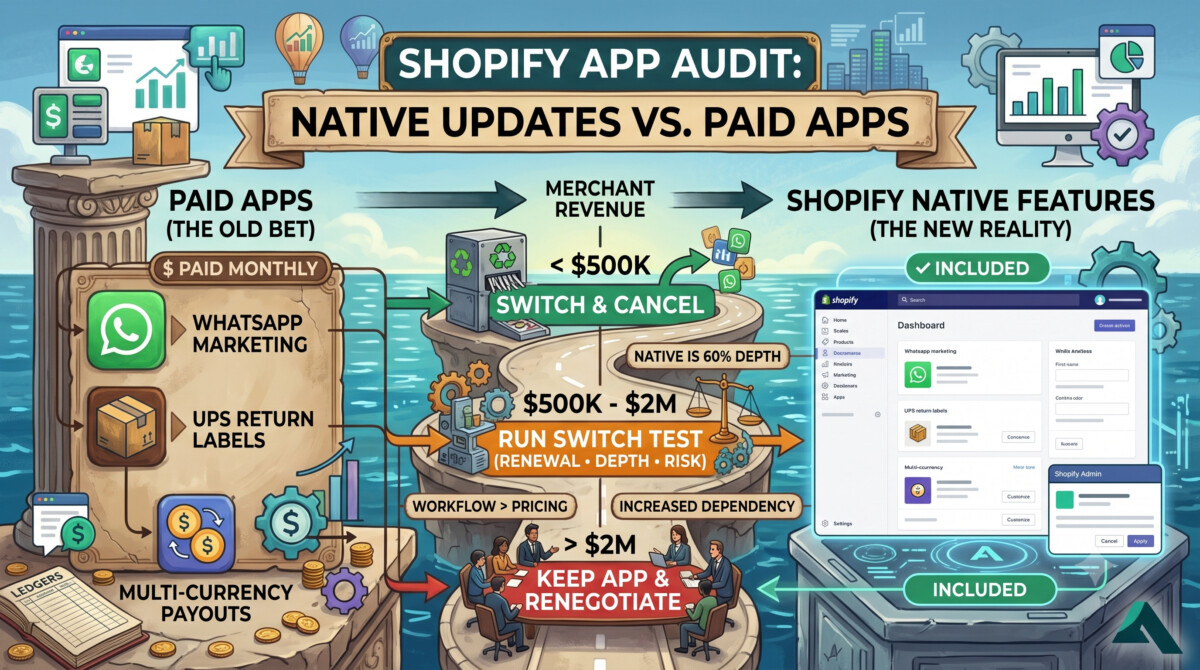
Shopify shipped native WhatsApp marketing, UPS return labels, and unlimited multi-currency payouts between July 27 and July 29, 2026. Below $500K, cancel the overlapping app. Between $500K and $2M, run a switch test. Above $2M, keep the app and renegotiate.
Every app you pay for is a bet that Shopify will not build it. Shopify just settled three of those bets in fourteen days, and the correct response is different at $300K than it is at $3M.
In the fourteen days between July 16 and July 29, 2026, Shopify shipped native WhatsApp marketing, native UPS return labels, unlimited multi currency payouts, a rebuilt Collections model, and cart sharing across point of sale devices. Every trade publication covered these as five separate line items in a changelog roundup.
That framing misses the only question that matters to an operator. When the platform ships a free version of something you pay $50 to $300 a month for, do you switch, wait, or stay?
I have watched merchants get this decision wrong in both directions for close to a decade. The store doing $280K that keeps paying $89 a month for a returns portal because switching feels like a project. The $4M brand that ripped out a working retention stack in a weekend because the native version was free, then spent six weeks rebuilding flows that had taken eighteen months to tune. Both mistakes come from treating this as a pricing question. It is a workflow question with a pricing component.
Shopify released three merchant-facing features in the final week of July 2026 that each displace a paid app category, and none of them arrived with an announcement post. On July 29 Shopify made UPS return labels available from any fulfilled US domestic order directly in the admin, using either Shopify’s negotiated UPS rates or your own connected UPS account, with the label delivered to the customer by email or shareable link. You are charged only when the carrier scans the label, and unused labels expire after six months at no cost.
The same day, WhatsApp marketing became part of Shopify Messaging, with campaign templates, media pulled from your product catalog, interactive buttons, keyword replies, and pricing that charges per message sent rather than per contact stored. Two days earlier, on July 27, Shopify removed the eight currency limit on multi currency payouts and now allows one bank account per payout currency.
Read individually, these are minor conveniences. Read together, they are a pattern. Returns, conversational marketing, and cross border settlement were all app categories in June. In August they are admin settings. The per message pricing model on WhatsApp is the detail most worth noticing, because it is Shopify deliberately undercutting the per contact pricing that Klaviyo, Attentive, and Postscript built their businesses on. That is not an accident of engineering. That is a pricing strategy aimed at a category.
Native platform features consistently ship with about 60% of the functionality of the specialist app they displace, and the missing 40% is almost always segmentation, reporting, and edge case handling. Shopify’s native WhatsApp campaigns give you templates, catalog media, and keyword replies. They do not give you the behavioral segmentation, the multi step conditional branching, or the revenue attribution reporting that a mature Klaviyo or Postscript implementation gives you.
The same gap shows up in returns. Shopify’s UPS return labels solve label generation and customer delivery. They do not solve return reason taxonomies, automated exchange logic, international returns routing, or the analytics that tell you which SKU is quietly generating 30% of your return volume. If you are running a customized returns portal today, the tool in our comparison of Shopify returns software that you chose was probably chosen for one of those reasons, and the native feature does not replace it.
Here is why that 60% number still favors switching for most smaller stores. A merchant doing $250K per year with 40 returns a month was never using the segmentation, the exchange logic, or the return analytics. They were using label generation and customer email. They were paying for a platform and consuming a feature. When the platform ships the feature, the honest accounting is that they were overpaying for depth they never touched.
The number that matters is not what the app can do. It is what you actually use. In my experience most merchants under $1M can name maybe three functions of any given app in their stack, and the rest of the feature list was sales collateral that closed the deal.
Run three questions against any app that a native Shopify feature now overlaps, and the answer resolves in under 30 minutes per app. The three questions are renewal timing, workflow depth, and failure cost, in that order.
Question one is renewal timing. When does the contract renew, and is it monthly or annual? A monthly app with an overlapping native feature is a low risk switch because your downside is one month of double payment. An annual contract with nine months remaining is not a switch decision this quarter, it is a non renewal decision you calendar for next year. A surprising number of operators burn a weekend migrating off software they have already paid for through March.
Question two is workflow depth. Count the number of other systems that read from or write to this app. A returns app that only your support team touches has a depth of one. A retention platform wired into your customer data platform, your subscription app, your loyalty program, and your paid media audiences has a depth of five, and every one of those connections is a rebuild if you switch. This is the same infrastructure versus peripheral distinction that governs stage appropriate tech stack decisions, and it is the question most operators skip because counting integrations is tedious.
Question three is failure cost. If the native feature breaks or lags during Black Friday Cyber Monday week, what does it cost you? For return labels, the answer is a slower support queue. For your primary email and SMS revenue channel in November, the answer can be six figures. High failure cost means you do not switch during peak season regardless of how good the native feature looks in July.
Switch when renewal is monthly, depth is one or two, and failure cost is a support inconvenience. Wait one release cycle when the native feature is under 90 days old and your renewal is more than a quarter out. Stay when depth is four or more, or when the app is doing revenue critical work you cannot afford to have wobble.
The correct answer to platform absorption changes at every revenue stage, and the $500K to $2M band is where the real analysis lives because it is the only stage where the answer is genuinely ambiguous. Below that, native almost always wins. Above it, switching costs usually dominate.
Under $500K, the calculation is close to arithmetic. If a native feature covers the three things you actually use, cancelling a $89 per month app returns roughly $1,068 a year to a business where that money buys inventory or ad testing. A full stack audit at this stage typically surfaces $500 to $2,000 per month in redundant tool spend, which is the pattern documented in our walkthrough of how app bloat and operational drift accumulate.
From $500K to $2M is where I see the most damage done, in both directions. This is the stage where premature complexity kills brands, and it is also the stage where operators start believing their workflows are more sophisticated than they are. Run the test per app rather than making a stack wide decision. Above $2M, the honest answer is usually that you stay, because a platform migration that consumes forty hours of your team’s attention to save $200 a month is a bad trade no matter how the spreadsheet looks.
Every move from a paid app to a native platform feature increases your dependency on that platform, and that cost never shows up on the invoice you just cancelled. This is the part of the absorption story that gets left out of the changelog coverage, and it is the part I care about most.
When your email lives in Klaviyo, your customer list is portable. Ugly, but portable. When your returns logic, your conversational marketing, and your payout structure all live inside Shopify admin, your ability to leave Shopify drops. You have traded a monthly fee for switching costs that are harder to see and much harder to reverse. That is a real trade, and for a lot of merchants it is the right one, because the probability that they replatform in the next five years is low and the $1,000 a year is real money today.
But it should be a decision, not a default. The merchants who get hurt by platform dependency are rarely the ones who chose it deliberately. They are the ones who accumulated it one convenient free feature at a time and then discovered, during an acquisition diligence process or a platform pricing change, that they had no leverage left.
My rule after watching this cycle play out through Scripts, through checkout.liquid, and now through Functions is straightforward. Go native on anything where the data is not the asset. Return labels, payout accounts, POS device management, none of those hold anything you would need to carry to a new platform. Think harder before going native on anything that owns your customer relationship or your historical performance data, because that is the layer where dependency actually costs you something.
Write a platform absorption clause into your next annual app agreement, and do it before you sign rather than after Shopify ships the feature. The specific ask is a pro rata refund or a plan downgrade right if the platform releases native functionality that materially overlaps the app’s core use case during your contract term.
Most vendors will not grant a full refund clause. A meaningful number will grant a downgrade right or a shortened term, particularly newer apps competing for install base and particularly if you ask during a renewal negotiation rather than at initial signup. The worst outcome is that you asked and they declined, which tells you something useful about how they think about their own exposure.
The second change is simpler and costs nothing. Stop signing annual contracts for anything with a depth of one or two. The discount on an annual plan for a peripheral tool is typically 15 to 20%, and that discount is not worth eleven months of exposure in a platform that ships 150 or more updates per Edition. Save annual commitments for infrastructure, where you want the vendor relationship and the price certainty. Keep everything peripheral on monthly, and treat the small premium as insurance against exactly the week that just happened.
The pattern from the last two weeks of July is not going to slow down. Shopify shipped 150 plus updates in the Spring 2026 Edition and has been absorbing adjacent categories steadily since Winter. Assume that anything in your stack doing a single well defined job is on the roadmap, and price your commitments accordingly.
Cancel it if you are under roughly $500K in annual revenue and you only use the app for label generation and customer notification. Shopify’s native UPS return labels, live since July 29, 2026, cover both of those for US domestic orders with no monthly fee, charging only when the carrier scans a label. Keep your returns app if you rely on automated exchange logic, return reason analytics, international returns routing, or a branded returns portal, because the native feature does not replace any of those. Check your renewal date first. If you are on an annual plan with months remaining, this is a non renewal decision rather than an immediate switch.
Not for most brands above $500K, but it is good enough to replace a standalone WhatsApp app for many stores below that. Shopify Messaging’s WhatsApp campaigns include templates, product catalog media, interactive buttons, and keyword replies, priced per message sent. What they do not yet include is the behavioral segmentation, conditional multi step flows, and revenue attribution reporting that mature retention platforms provide. If WhatsApp is a secondary channel for you, the native version is likely sufficient. If WhatsApp is your primary revenue channel in markets like India, Brazil, or Spain, the segmentation gap will cost you more than the subscription saves.
Count how many other systems read from or write to that app, because integration depth predicts switching cost better than any other single signal. An app with one or two connections is a low risk switch. An app wired into four or more systems, such as a retention platform connected to your subscription app, loyalty program, customer data platform, and paid media audiences, becomes a rebuild project rather than a switch. Then check your renewal date and ask what breaks if the native feature lags during peak season. Monthly renewal, shallow depth, and low failure cost means switch. Anything else means wait or stay.
The main risk is increased platform dependency, which does not appear anywhere on the invoice you just cancelled. Data held inside a third party app is generally portable if you ever replatform. Logic and history held inside Shopify admin is much harder to extract. A practical rule is to go native freely on anything where the data is not the asset, such as return labels, payout bank accounts, and POS device management, and to think harder about going native on anything that owns your customer relationship or your historical performance data. The trade is often worth making, but it should be a deliberate choice rather than an accumulation of convenient defaults.
Generally no, unless you negotiated that right into your agreement before signing. Standard app terms do not include a platform absorption clause, so a mid term release of overlapping native functionality typically leaves you paying through the end of your term. The practical fix is forward looking. At your next renewal, ask for a pro rata refund or a plan downgrade right if the platform ships materially overlapping functionality during the term. Many vendors will decline a refund clause but will grant a downgrade right or a shorter term. Separately, keep peripheral tools on monthly billing, where the annual discount of 15 to 20% rarely justifies the exposure.