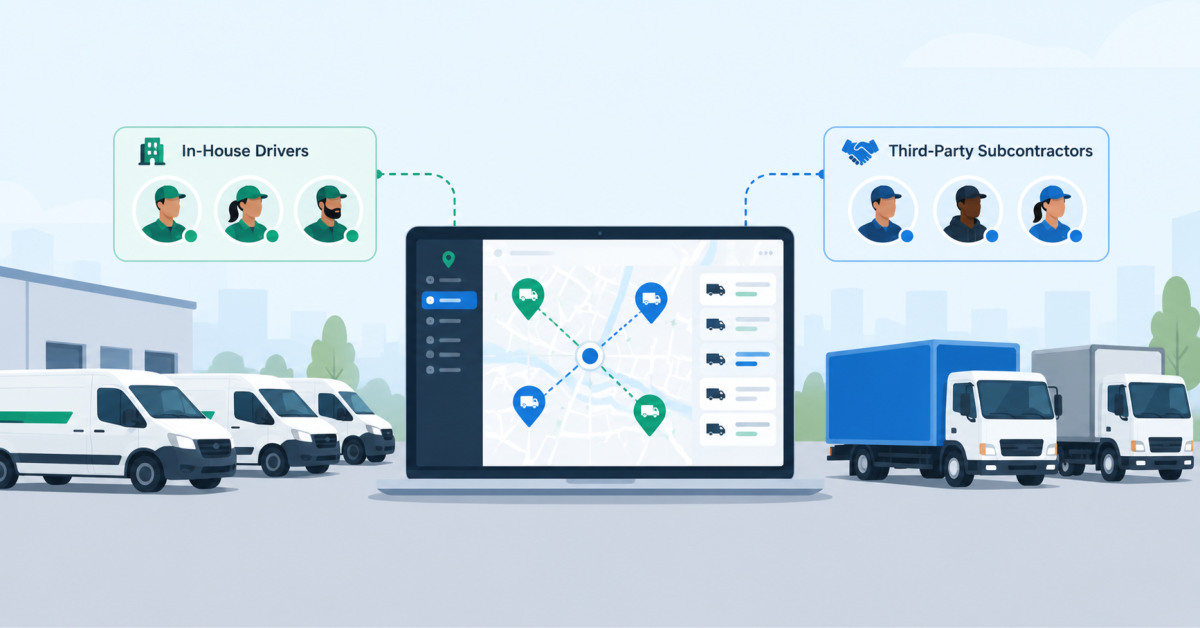
A hybrid delivery fleet works when in-house drivers and subcontractors operate through one set of allocation rules, route visibility, proof-of-delivery standards, scorecards, and exception protocols. The goal is not to choose between employed and outsourced drivers, but to make both groups perform like one customer-facing delivery operation.
Hybrid fleets fail when the business treats subcontractors as overflow labor. They succeed when dispatch, service standards, and accountability treat every driver as part of one operating system.
Most ecommerce brands don’t decide to run a hybrid delivery fleet. It happens to them the first time order volume spikes past what their own drivers can handle. The real question isn’t whether to bring delivery in-house or hand it to subcontractors – it’s how to make two separate workforces behave like one operation.
If you were to ask ten ecommerce operators whether they used local delivery in-house or outsourced it, most would hesitate before answering. The best response is “both, depending on the day.” A brand may use employed drivers for most of their metro routes and rely on subcontractors during a launch or in the weeks leading up to a holiday. Another may have a small in-house team for high-value orders and default all the rest to outsourcing.
That’s ok. It’s also almost never intentional. Most hybrid fleets come together under stress – a warehouse manager calls a local courier because Tuesday’s volume doubled and by Friday they’re just always there, a second delivery workforce with no clear way to decide who should do what.
The solution isn’t to choose a model. It’s to develop a conscious approach to which orders go to who and ensure both fleets are managed through the same operational system. Those who view this as a coordination issue instead of a staffing pattern tend to have a lower cost per stop and fewer customer problems than those who are still debating over which model to choose.
The most common mistake we see is assigning drivers order-by-order, based on whoever’s available at the moment a route needs covering. That’s not a strategy – it’s improvisation, and it produces inconsistent service.
A better approach is to define, in advance, which categories of delivery go to which fleet:
In-house drivers should handle the deliveries where service quality is the differentiator. That means white-glove delivery, high-order-value shipments, and orders going to customers who’ve already had a bad experience. These are the touchpoints where a professional, trained driver in a branded vehicle actually changes how the customer feels about the brand.
Subcontractors should absorb high-volume, predictable, low-touch drops. Think routine parcels in familiar zip codes, repeat customers who don’t need hand-holding, and anything where speed and cost matter more than the experience of the handoff.
Once you’ve made that call, encode it into your routing rules rather than re-deciding it every morning. Dispatch shouldn’t need a judgment call about whether today’s batch of orders is “in-house-worthy.” The system should already know.
Many hybrid operations lose money because they first develop a delivery or service plan based on the company-owned fleet. Then, they do the same for the external fleet without considering whether both plans put the external and internal vehicles in the same neighborhood at the same time.
Duplication of service occurs on a block by block basis. The company would not deliver to the same neighborhood twice if they knew the two drivers were already in that area at the same time.
This regularly occurs when companies use a 3PL for a handful of deliveries every business day. The 3PL makes its deliveries and the company makes its deliveries often to precisely the same destinations.
Route optimization needs to treat the combined pool of in-house and subcontractor drivers as one fleet with two cost structures, not two fleets with two plans. That means your dispatch function needs visibility into both sets of drivers at the same time, sequencing stops based on proximity and time windows regardless of who’s technically on the payroll.
When you have your in-house team and your contractors out in the field, your dispatch needs to have complete visibility into the location of all drivers, their current status, and a list of all assigned and completed orders. This level of control can make the difference between a smooth operation and a customer-losing catastrophe.
There’s a lot of low-hanging fruit here in terms of how smartphones and tablets can help with this, and not only through making location tracking, routing, and traffic updates available to everyone. Automatically pushing order assignments out based on who’s closest to which stop right now and routing both your in-house and contract drivers to their next job is a nice feature. Manually text-messaging that same information to each and every driver every morning is not.
This is also where proof of delivery has to be standardized. If your in-house drivers capture photo and signature confirmation through one process and your subcontractors do something different – or nothing at all – you end up with inconsistent records and no reliable way to resolve customer disputes. Both fleets need to be using the same capture standard, feeding into the same system, so a support agent looking at an order has one place to check regardless of who delivered it.
This is the gap spreadsheets, email threads, and group chats can’t fill. They’re fine for everything running on one fleet out of one building. But as soon as you introduce a second workforce operating under a different strategy, using different software and having different oversight, every handoff between drivers is a point at which shrinkage and error can occur. Purpose-built courier software removes the need for side channels by making order intake, route assignment, live tracking, and proof of delivery a single operational process that your in-house team and subcontracted drivers are jointly logging into. No one needs to forward WhatsApp messages to see where a package is.
Once you’ve solved for visibility, the next problem to solve is whether you actually have enough subcontractor capacity to call on when volume spikes. This isn’t something you can improvise – you have to forecast it.
Look at historical order volume by week. Factor in lead time for onboarding new subs. Build a capacity plan that tells you how much surge coverage you’ll actually need heading into peak season. Every year, it’s a similar story. The earlier you start courting local capacity, the more likely you are to get it. The later you wait to start asking, the more expensive and less available local subcontractors will become.
Many fulfillment managers learned this the hard way last year. The perfect storm of COVID-19 and peak demand pushed last-mile capacity to the brink. Surging volumes outstripped lead times to hire new subcontractors many weeks before peak. The market will be every bit as tight this year. The World Economic Forum’s 2020 white paper on the future of the last-mile ecosystem projected that without intervention, the number of delivery vehicles in the world’s top 100 cities would rise by 36% by 2030. That’s a lot more competition for the same pool of local drivers – and it means locking in subcontractor capacity early matters more every year, not less.
Clear service-level agreements are essential to managing subcontractor relationships. This includes specifying delivery windows, proof-of-delivery obligations, and guidelines for customer communication. All of these must be written down and agreed upon before engaging in any business. Verbal agreements can lead to misunderstandings as soon as the workload increases.
However, you do need to be very careful with this approach as it’s easy to cross the line into treating an independent contractor as an employee. The key distinction is that you can set performance requirements like those in the first paragraph above, but you can’t supervise the specific methods, hours, sequence, locations, or toolkit that your drivers use – unless you’re willing to make them employees with benefits and rights, which you probably aren’t.
The right tool for enforcement is a scorecard, not a stopwatch. Track cost per stop, on-time rate, and failed delivery rate separately for in-house drivers and subcontractors, and review the numbers monthly. If a subcontractor’s failed delivery rate is running double your in-house rate in the same zip codes, that’s a conversation and possibly a reallocation – not a punishment, just a data-driven adjustment to the split.
Hybrid fleets don’t fail on the easy days. They fail on the exceptions – the missed delivery, the damaged package, the customer who wasn’t home and now needs a reattempt. If nobody’s decided in advance who handles that reattempt, who eats the cost, and how the customer gets notified, every exception turns into an ad hoc scramble that eats time and goodwill.
Write the protocol down. Decide whether failed subcontractor deliveries automatically reroute to in-house drivers or get reattempted by the same sub the next day. Decide who absorbs the cost of a redelivery caused by subcontractor error versus one caused by the customer not being available. Decide what message the customer gets and when. None of this needs to be complicated, but it does need to exist before the first bad day of peak season, not during it.
The worst time to onboard a new subcontractor is during a volume surge, when you have no idea whether they’ll show up on time or handle proof of delivery correctly. Vet and test subcontractor relationships during slower months with low-stakes order volume. Give them a real trial run when the stakes are low, so by the time peak season hits, you already know which subs are reliable and which ones aren’t worth the risk.
A proven bench of subcontractors built over months of quiet testing is worth more than any amount of coordination software applied to an unproven one at the last minute. The tooling can manage visibility and dispatch. It can’t manufacture trust in a courier you’ve never actually worked with.
Running a hybrid fleet well isn’t about resolving the in-house-versus-outsourced question once and for all. It’s about building the allocation rules, the visibility, and the accountability that let two different workforces operate like a single delivery function – so customers never have to know, or care, which kind of driver showed up at their door.
A hybrid delivery fleet in ecommerce combines in-house drivers with subcontracted couriers, 3PL delivery partners, or independent delivery capacity to complete local and last-mile orders. Brands commonly use employed drivers for service-sensitive work, such as white-glove, high-value, or customer-recovery deliveries, while using subcontractors for predictable parcel volume, defined route zones, and peak-season overflow. The model works best when both driver groups use the same dispatch, tracking, proof-of-delivery, customer-notification, and exception-management process. Customers should receive one consistent delivery experience even when the business uses different capacity sources behind the scenes.
In-house drivers should generally handle ecommerce orders where service quality, brand presentation, customer recovery, or delivery complexity is a competitive differentiator. That often includes high-value shipments, white-glove delivery, bulky or fragile products, installation or setup appointments, VIP customer orders, and deliveries to customers who previously experienced a service issue. These are the situations where direct training, stronger brand knowledge, and closer operational accountability can justify the higher fixed cost of an employed delivery team. The exact rules should be defined in advance and encoded into dispatch logic rather than decided manually every morning.
You prevent duplicate routes between employees and subcontractors by planning the entire delivery network in one dispatch system before assigning orders to either fleet. Route optimization should first evaluate delivery location, time window, vehicle capacity, package requirements, route density, and customer promise across all available drivers. Then the system should apply allocation rules for in-house or subcontracted capacity. If each fleet is planned separately, an internal driver and an external courier can easily serve the same neighborhood at the same time, increasing cost per stop, mileage, and operational complexity. One shared route plan is essential for a hybrid fleet.
Subcontracted drivers should provide the same proof of delivery standard as in-house drivers, typically including a delivery timestamp, GPS-supported location record where available, customer signature when required, delivery photo, barcode scan, and a documented exception reason if the delivery fails. The evidence should be captured through the same delivery-management system so customer support and dispatch can find it in one place. Standardized proof of delivery reduces disputes, supports customer-service recovery, and prevents the business from maintaining different evidence standards for different driver groups. Define these requirements clearly in the subcontractor agreement and test compliance before peak volume.
Ecommerce brands should prepare subcontractors for peak season by forecasting demand early, estimating route and stop capacity by week and ZIP code, onboarding delivery partners before volume spikes, and testing them with low-risk orders during slower periods. Verify insurance, commercial terms, service-level requirements, proof-of-delivery procedures, technology access, invoicing processes, and customer-communication expectations before assigning critical routes. Build a tiered bench of preferred partners rather than relying on one courier or searching for capacity after demand surges. A subcontractor relationship that has already passed real operational tests is far more valuable than an unproven provider added during peak pressure.