

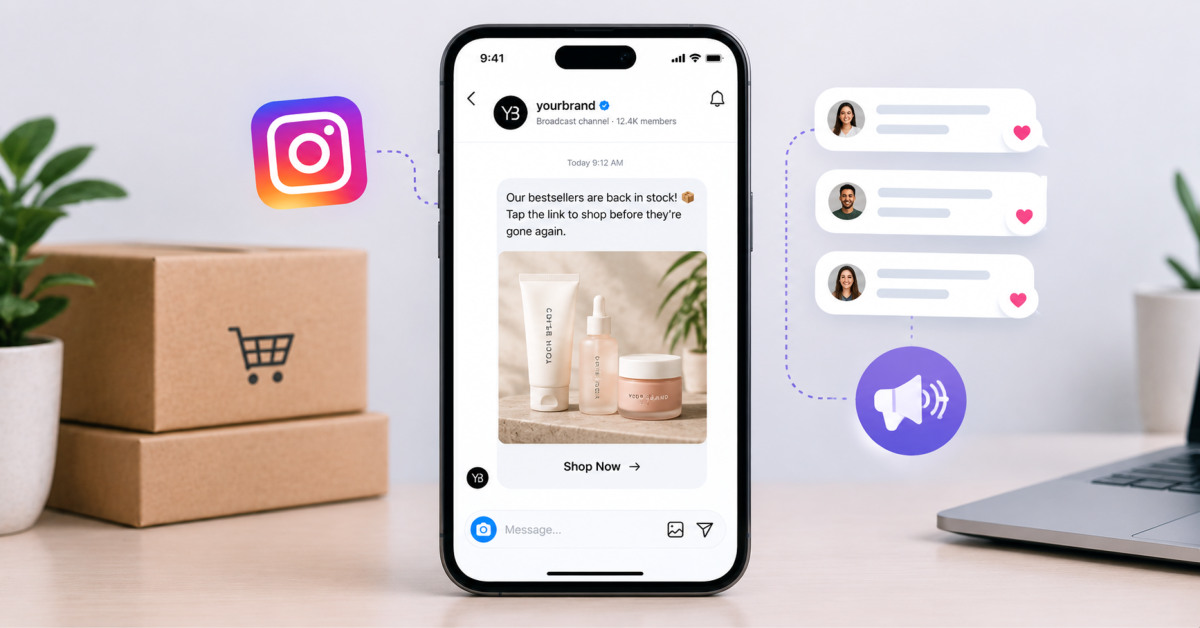
Instagram Broadcast Channels give ecommerce brands an opt-in, one-to-many way to share launches, restocks, feedback requests, and behind-the-scenes updates inside Instagram messaging. They work best as a retention and community layer, not as a replacement for email, SMS, customer support, or a dependable owned-audience strategy.
A Broadcast Channel is not valuable because it sends more messages. It becomes valuable when subscribers know that joining gives them earlier, clearer, or more useful access than following the brand passively.
For years, reaching people on social media would require bypassing the algorithm. You’d post something, you’d hope it gets noticed, and when it doesn’t get much attention, you’d adjust things.
Have you ever felt like your content went unnoticed, no matter how much effort you put in? There’s a solution to that!
Nowadays, companies are searching for simpler, more direct ways to communicate with their clients who are already considering their offerings. Wouldn’t it be easier if you could reach out to your clients without competing with the algorithm?
This is where Instagram Broadcast Channels come in. They allow e-commerce companies to communicate straight with their customers without having to compete for feed space. You are sending updates directly to your customers rather than speculating about what might reach them.
Have you ever wished you could connect with your audience directly without fighting the algorithm?
That is absolutely what Instagram Broadcast Channels do.
Instagram’s Broadcast Channels are a one-to-many messaging feature letting brands and creators communicate directly with followers who decide to sign up. Brands and creators can send updates directly to their followers. Though followers aren’t added automatically, it is easy for them to sign up to receive updates.
The opt-in nature is important. You’re not talking to just a random crowd, you are reaching a more engaged group of people, which makes your messages feel more personal. And your audience will likely feel special for receiving a private update rather than a public one.
Another big difference here is that messages don’t compete in the feed and get lost. They are more noticeable and likely to be read because they show up directly in your audience’ inbox.
One-way communication is the purpose of broadcast channels. Followers directly receive messages from the brand they are following. Although it is structured, interaction is still available. People can respond, react, vote in polls, and can reply if the option is turned on.
This setup keeps conversations focused while still allowing your audience to give feedback and engage.
Broadcast Channels live in the Instagram inbox, alongside regular messages. As soon as someone signs up, they begin to receive updates automatically.
From the user’s perspective, it’s super simple. They open the channel, browse messages, react and take part in polls. It’s simple to remain involved without feeling overburdened because there’s no compulsion to reply.
Broadcast Channels combine several content formats into one space. This gives brands flexibility in how they communicate.
You don’t need to use different posts or formats to combine information, storytelling, and engagement, thanks to these features!
Broadcast Channels are available to Creator and Business accounts. Some accounts may need to meet certain follower thresholds before the feature appears.
Availability can also depend on region and account status. You can make one if the option appears in your Instagram tools.
So why are Broadcast Channels a big deal for e-commerce brands?
For e-commerce brands, the value of Broadcast Channels comes from control and clarity.
To reach your audience, you don’t rely on trends or timing. Compared to regular posts, you can actually send your messages directly to those who have already expressed interest.
This enhances communication consistency. Whether you are announcing a restock, a replacement, a product promotion, or a brief behind-the-scenes glimpse, you can distribute information to your audience in real time.
Consumers begin to view your channel as more than just another source of information; they begin to perceive it as a location for helpful updates.
Now, where do Broadcast Channels actually fit in?
Broadcast Channels are not here to replace other Instagram tools. They fill a different role.
Feed posts are still useful for visibility and discovery. Stories are good for quick, temporary updates. Direct messages are better for individual conversations.
In between are broadcast channels. They provide you with the directness of a message and the reach of a post without the stress of one-on-one replies or the noise of a crowded feed. Your post will never get lost.
Setting up a channel is quick:
To encourage followers to join, you may also utilize notifications or post the link on your profile or stories.
The majority of people find channels by way of the creators they already follow. When you start one, your followers receive an invitation to join. You can also add a link to it in your profile or share it via stories to make your channel more visible.
People are more inclined to join if it is easy to find.
What kind of content actually works in Broadcast Channels?
Here is the takeaway: it shouldn’t feel like a nonstop stream of ads. The best channel constantly offers useful and fascinating updates.
Some content tends to perform better than others:
Creating a sense of access is the aim here. Your audience ought to feel as though they are receiving something unique.
Moreover, consistency is important. People are more inclined to stick with a subscription when its tone and value are consistent.
Engagement on broadcast channels is intentional. It comes from small actions like reacting to a message or answering a poll.
Using these features regularly helps keep your audience involved. Simple queries, brief surveys, and feedback requests give the channel a lively, non-demanding vibe.
Visibility is the source of growth. To increase your audience, consistently promote your channel via posts, stories, and other media.
When it comes to posting, what matters more is consistency rather than volume. You do not need to send updates all the time. What is more important here is keeping a steady communication so your audience stays engaged without having the feeling of being overwhelmed.
See how people respond. You can determine what is and is not working by looking at responses, poll participation, and overall activity.
If engagement declines, you should adjust both the content and the frequency of your updates.
Your insights will eventually reveal trends. Make use of them to improve your material, retain what appeals, and discard what doesn’t.
Broadcast channels increase the effectiveness of polls because they reach those who have chosen to participate. These are not inactive viewers who are just scrolling by. Their replies are typically more intelligent and pertinent because they are subscribers who choose to participate.
Additionally, they facilitate fast action. You may ask and determine what your audience wants in real time rather than speculating. The feedback is prompt and useful, whether it’s regarding product selection or content direction.
Businesses may communicate with their audience more reliably and easily using broadcast channels. Instead of relying on feed visibility, customers who request updates can get them straight from companies. For time-sensitive information, like product debuts, restocks, or limited-time sales, where visibility and timing may affect outcomes, this is especially helpful. They also support the development of interpersonal connections.
The audience is more engaged as a result of subscribers’ voluntary participation, allowing businesses to engage with customers in a more personal and transparent way.
You do not need to fight the algorithm just to reach your audience, you just need Instagram Broadcast Channels which allow you to interact with your audience in a more targeted and straightforward manner. They give you a way to interact, establish rapport, and share updates without depending entirely on the feed. This is a chance to build relationships with your audience, earn their trust, and stay on top without getting lost in the noise of the feed.
When used properly, Broadcast Channels become a trustworthy channel for deep interactions rather than merely a place to post.
Instagram Broadcast Channels are opt-in, one-to-many messaging spaces that ecommerce brands can use to share product launches, restocks, behind-the-scenes updates, polls, and timely customer information with followers who choose to join. They sit inside Instagram’s messaging environment and offer a more direct communication path than public feed posts. For ecommerce, they work best as a retention and community layer for people already interested in the brand. They should complement, not replace, owned channels such as email and SMS, which give the business more durable access to customer relationships and first-party data.
Businesses can generally create Instagram Broadcast Channels when their account is eligible and the feature is available in their region and account setup. Availability can vary based on Instagram’s product rollout, account type, account status, and other platform conditions. Check the Instagram inbox or professional account tools for the option to create a channel. Before launching, make sure the account is managed by the appropriate team members, decide who owns the publishing calendar, and define what subscribers will receive. A channel needs a clear value proposition before it needs more followers.
An ecommerce brand should use an Instagram Broadcast Channel for information that rewards subscribers with useful access, such as restock alerts, product previews, early launch updates, founder notes, product education, focused polls, and occasional subscriber-relevant offers. Avoid using it as a nonstop promotional feed. Set a predictable cadence, such as one to three useful updates per week, then increase temporarily around launches or major restocks when subscribers have a reason to expect more timely communication. Use tracked links and participation data to learn which updates create qualified traffic, customer feedback, and conversion.
Instagram Broadcast Channels do not replace email and SMS marketing because Instagram controls the audience relationship, notification experience, feature availability, and platform rules. Email and SMS are permissioned channels that brands can manage within their own retention and customer-data systems, while Broadcast Channels are a useful platform-based engagement layer. Use the channel to build relevance, share timely updates, collect lightweight feedback, and create product excitement. Continue giving customers reasons to opt in to email and SMS for order communication, personalised retention, lifecycle messaging, and durable first-party relationship building.
Brands should post content that gives subscribers practical access, useful context, or a chance to participate in real decisions. Strong examples include restock alerts, early product previews, launch countdowns, product-use tips, founder messages, behind-the-scenes updates, polls on colours or bundles, customer-question answers, and limited offers that are relevant to subscribers. Every post should have a clear job. If the same message would work equally well as a standard feed post, consider whether the channel needs a more exclusive or timely angle. Subscribers should feel that joining creates value, not just additional promotional volume.




