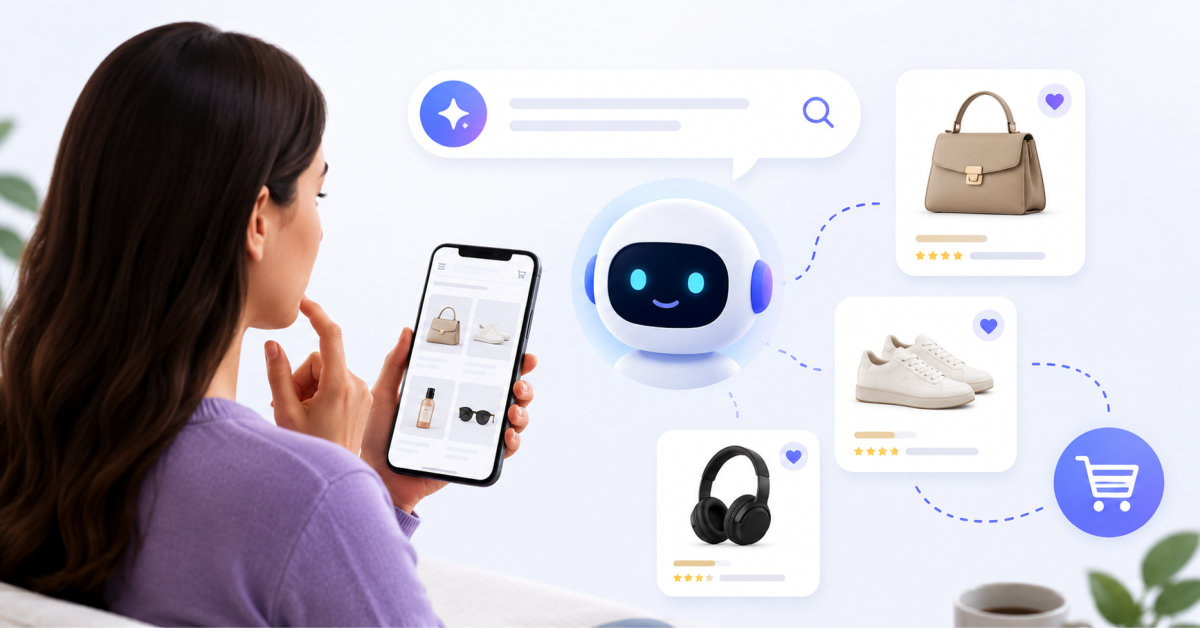
AI is changing how shoppers discover and compare products, but the retailers gaining visibility are not chasing a separate AI trick: they are maintaining complete product data, clear buying guidance, trustworthy reviews, and consistent information across every channel.
AI does not make weak product information more persuasive. It makes the gap between a well-described product and a vague product page much easier for shoppers to see.
For years, online shopping has followed a fairly familiar pattern. Someone decides they need something, types a few words into a search engine, scrolls through the results and visits a handful of websites before making a decision. That behaviour has shaped everything from ecommerce website design to SEO strategies and paid advertising.
Artificial intelligence is now starting to change that process.
AI-powered search tools, shopping assistants and conversational platforms can answer detailed questions, compare options and recommend products without requiring shoppers to work their way through pages of traditional search results. Rather than simply searching for “best running shoes”, for example, someone might ask for “comfortable running shoes for someone who runs three times a week, has wide feet and wants to spend less than £120”.
The result is a much more conversational way of discovering products. For retailers, this means the battle for visibility is beginning to look different too.
Traditional search engines encouraged relatively short searches. People might type in the name of a product, a brand or a simple phrase such as “best coffee machine”.
AI allows people to be far more specific.
A shopper can explain exactly what they want, including their budget, preferences, circumstances and even products they have previously considered. AI tools can then process those details and provide a more tailored response.
Someone furnishing a small flat, for instance, could ask for a compact dining table that seats four people, works in a Scandinavian-style room and costs less than £500. Instead of opening ten different tabs and comparing dimensions manually, they may receive a shortlist immediately.
That convenience could significantly influence how people approach online shopping.
One of the biggest changes for retailers is that discovery no longer necessarily begins on their own website.
A shopper may first encounter a brand through an AI-generated recommendation, comparison or answer. This means businesses need to think about how easily AI systems can understand what they sell and why their products may be relevant.
Clear product descriptions are becoming increasingly important. Pages should explain materials, specifications, use cases, benefits, pricing and other useful information without forcing visitors or search systems to piece everything together.
Businesses thinking about this emerging area may choose to work with AI search visibility experts to understand how their products and brand information appear across AI-driven search experiences.
Ultimately, the principle is relatively simple. If information about a product is difficult to find or understand, there is less chance of it being surfaced when shoppers ask highly specific questions.
It is not only dedicated AI platforms that are changing shopper behaviour. Traditional search engines are increasingly incorporating AI-generated summaries and conversational features into the search experience.
That means the distinction between “searching Google” and “asking AI” is becoming less clear.
Instead of being presented only with a list of links, users may receive summaries, recommendations and answers directly within the search interface. They can then refine what they want with follow-up questions.
For retailers, ranking highly in a conventional set of search results is still valuable, but it may no longer be the only objective. Being mentioned or referenced within an AI-generated response could also become an important source of visibility.
AI systems work best when there is useful information available to interpret.
Thin product pages containing little more than a photograph, product name and short sales description may therefore become increasingly limiting.
Retailers can improve the usefulness of their websites by providing details such as:
These details are useful for shoppers anyway, so improving them is not simply about responding to AI.
A customer deciding between two products will often have very specific questions. Answering those questions clearly can make the buying process easier while also giving search technologies more context about what the product actually offers.
Reviews have always played an important role in ecommerce, but AI could make the information contained within them even more useful.
Rather than expecting a shopper to read through dozens of customer comments, an AI tool may be able to identify recurring themes.
For example, customers might consistently mention that a particular suitcase is surprisingly lightweight, that a sofa is easy to assemble or that a pair of walking boots performs particularly well in wet conditions.
These details can help AI systems understand real-world product experiences.
It also makes genuine customer feedback increasingly valuable. Retailers should encourage reviews without trying to control them too heavily. A mixture of positive comments, constructive criticism and detailed experiences is often far more useful than dozens of generic five-star ratings.
It would be easy to assume that AI recommendations will reduce the importance of branding. In reality, trusted brands may become even more valuable.
If shoppers increasingly rely on AI tools to narrow down large numbers of choices, credibility becomes important. A business with a strong reputation, substantial customer feedback and useful information across the web may be easier to recommend confidently than an unknown retailer with very little supporting information.
Brand awareness can also influence what people ask for.
Someone may specifically request comparisons involving brands they already recognise, while another shopper may use an AI recommendation as the starting point before researching the company independently.
This means retailers should avoid treating AI visibility as a replacement for broader marketing. PR, SEO, social media, customer service, content marketing and brand building can all contribute to the wider online footprint surrounding a business.
One area where AI is particularly suited to ecommerce is comparison.
Anyone who has researched a laptop, television, camera or major appliance online knows how quickly specifications become overwhelming. Different websites use different terminology, features can be difficult to compare and prices constantly change.
AI tools can potentially simplify that information.
A shopper could ask for three laptops within a particular price range and then request a comparison based on battery life, weight, storage and suitability for video editing.
This reduces the effort involved in researching purchases.
Retailers may therefore need to become better at explaining what differentiates their products. Generic claims such as “high quality” or “great value” provide very little useful information. Clear evidence, specifications and genuine points of difference are far more persuasive.
AI shopping is not limited to text.
Visual search technology allows people to search using photographs or screenshots. Someone might photograph a chair they like in a restaurant and look for similar designs, upload an image of an outfit to find comparable clothing or search for a replacement household item without knowing its exact name.
This creates another route into online stores.
High-quality product imagery becomes important in this environment. Retailers should use clear photographs from multiple angles and make sure product information accurately reflects what appears in the images.
Visual discovery could become particularly influential in sectors such as fashion, interiors, furniture and accessories, where customers often know the look they want without necessarily knowing the terminology needed to search for it.
Despite the excitement surrounding AI search, conventional search behaviour is unlikely to vanish overnight.
People will still use search engines, marketplaces, retailer websites, social platforms and recommendation sites. Many purchasing journeys will involve several of these channels rather than just one.
AI is therefore better viewed as another layer of product discovery.
Retailers still need technically sound websites, useful content, strong product pages and sensible SEO strategies. What may change is the range of environments in which that information needs to be understandable and visible.
Businesses that have already invested in clear website architecture and helpful content will arguably have a head start because many of the fundamentals remain the same.
Perhaps the biggest change is that there is no longer one obvious route from product search to purchase.
A customer might discover an item through TikTok, ask an AI assistant whether it is worth buying, search the brand on Google, read Reddit discussions, watch a YouTube review and finally purchase through the retailer’s website.
Another customer might ask an AI tool for recommendations and buy something within minutes.
Retailers therefore need to think beyond individual channels. Information about their products should remain consistent wherever customers encounter the brand.
Accurate pricing, clear descriptions, trustworthy reviews and recognisable messaging all help create that consistency.
AI undoubtedly has the potential to change how people find products online. Search is becoming more conversational, comparison is becoming quicker and shoppers can describe what they want with far more detail than traditional keyword searches allowed.
However, the fundamentals of ecommerce have not suddenly disappeared.
Customers still want useful products, transparent information, competitive prices, trustworthy businesses and straightforward buying experiences.
The retailers most likely to benefit from AI-driven shopping are therefore not necessarily those chasing every new technology. They are the businesses making it extremely easy for both customers and search systems to understand what they sell, who it is for and why it is worth considering.