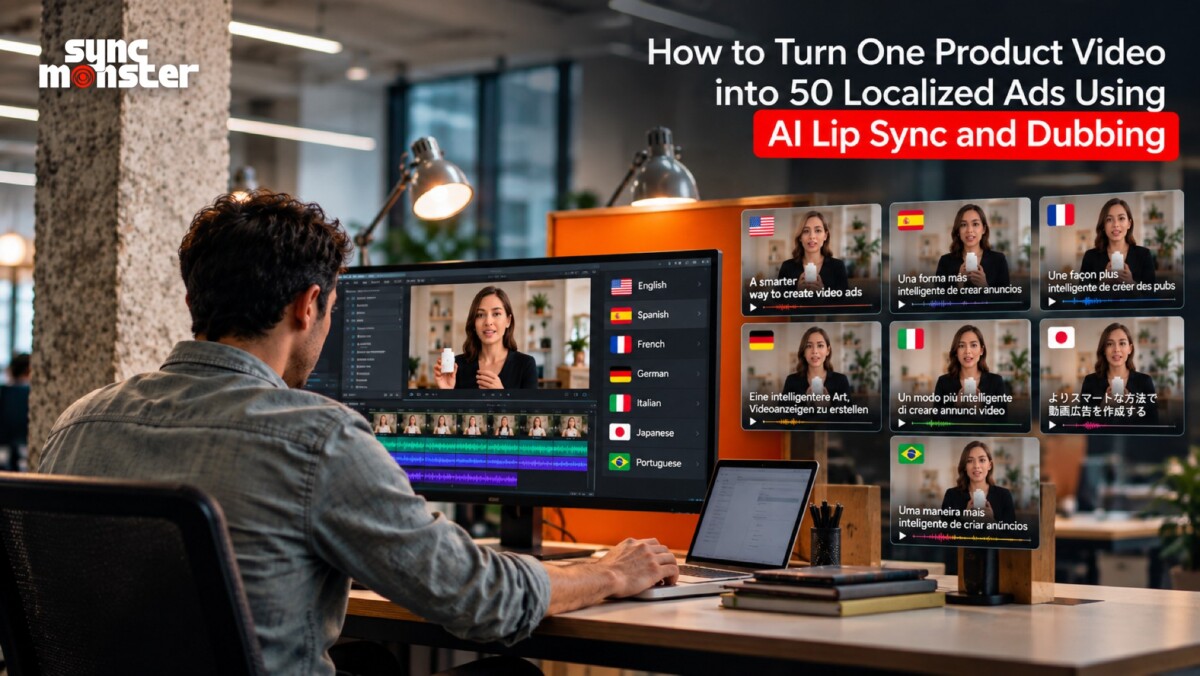
One product video can become dozens of localized ads when AI dubbing translates the voice track and AI lip sync matches mouth movements to each new language. It works best for brands already selling into those markets, with a native speaker reviewing every version before it spends a dollar.
The expensive part of a great product video was never the language. It was the shoot. AI dubbing lets you pay for the shoot once and spend the savings on testing whether a market actually wants you.
Running one product video across 50 ad variations used to mean 50 separate shoots, or at least 50 separate rounds of voiceover work, editing, and syncing.
For most startups and lean marketing teams, that kind of scale was out of reach. Localized ad campaigns often stopped at two or three markets instead of the ten, twenty, or fifty markets a growing product might actually need.
SyncMonster AI lip sync and dubbing are changing that. One well produced product video can now become dozens of localized, lip synced ad variations, each tailored to a different language, market, or audience segment, without reshooting a single frame.
This guide breaks down exactly how that process works, and where it still needs a human in the loop. The workflow is the same at every stage; what changes is how many of those 50 versions you should actually make.
One product video can become fifty ads because the visuals of a strong product demo rarely need to change from market to market, while the language, tone, and offer usually do. Once you separate those two layers, the video stops being a finished asset and becomes a template.
The product shots, the pacing, the framing, and the on-screen structure stay the same in every version. What changes is the audio track and, increasingly, small emotional adjustments that make the message land in a specific market. The picture can carry across borders. The voice usually cannot.
The commercial case for doing this is strong. In CSA Research’s 2020 Can’t Read, Won’t Buy survey of 8,709 consumers in 29 countries, 76% of online shoppers said they prefer products with information in their native language, and 40% said they will never buy from websites in other languages. That study is about buying experiences broadly rather than video ads specifically, and it is now several years old, so treat it as directional. Still, the pattern is consistent: an English ad shown in a non-English market is asking a large share of viewers to do translation work before they can even consider buying.
That is where AI lip sync and dubbing help: dubbing replaces the voice with a translated track, and lip sync adjusts the speaker’s mouth so the new track looks native rather than layered on top.
The catch is that the template only works if the master is strong. A weak video multiplied fifty times is fifty weak ads, and every one of them still costs ad spend to learn that lesson.
Every localized version is built from one master file, so the master has to be right before you scale it. Pacing, framing, messaging, and the call to action should all be locked, because fixing a major issue later can mean reprocessing every version built from it.
The best master is usually not a brand new shoot. It is an ad that already won in your home market. If a 30 second demo has held a strong hook rate and a healthy cost per purchase for several weeks in English, you have evidence the visual story works. Localization then tests a narrower question: does the same story work in another language? That is a much cheaper question to answer than starting from zero in a new market with an unproven creative.
A few production choices make the master far easier to localize. Keep the speaker facing the camera with their mouth clearly visible for most of the video, because lip sync models work best on front facing, well lit faces and struggle with profile shots, hands near the mouth, or heavy motion blur. Record clean audio with little background music under the voice, or keep music on a separate track, so the dubbing step has a clear vocal to work from. Keep on-screen text, prices, and captions on separate editable layers rather than burned into the footage, since every one of those elements will need translating and some languages, such as German, tend to run longer than English and need more room on screen.
Finally, avoid lines that only work in English. A clear, specific script (“This bottle keeps coffee hot for twelve hours”) travels much better than a clever one.
Mapping your variations before you upload anything turns localization into one structured production run instead of 50 separate decisions made on the fly. Write the matrix down first, then produce against it.
The variables most brands work with are language, regional dialect, tone (formal or casual), currency and pricing, localized offers, and market specific messaging. A practical way to reach fifty without chaos is to multiply a small number of choices. Illustrative example, assuming a brand testing ten language and dialect combinations: give each of those ten markets five versions (a formal and a casual tone, a price led and a benefit led hook, and one market specific offer), and you have fifty planned variations from one master.
Dialect deserves its own column. Spanish for Mexico and Spanish for Spain differ in vocabulary, pronunciation, and formality, and Portuguese for Brazil differs from Portuguese for Portugal. If a market matters, give it its own version.
Offers and pricing need the same care. Showing a US dollar price to a shopper in France, or promoting free shipping you do not offer in Japan, is a fast way to waste spend and lose trust. Before you build the matrix, confirm what the shopper will see after the click. Our guide on building a localization strategy that adapts messaging market by market covers how to decide what changes per market beyond the words.
A good matrix also names the fluent reviewer for each language, so that check does not get skipped when deadlines tighten.
With the master video uploaded to SyncMonster, AI dubbing generates a translated voice track for each target language. SyncMonster lists dubbing in more than 45 languages, which covers the major ecommerce markets most Shopify brands consider first.
Unlike a basic text to speech voiceover, the workflow does not replace the original speaker with a generic narrator. It is designed to preserve the original speaker’s tone, pacing, and energy in the new language. When your founder or on-camera presenter is part of the brand’s appeal, that continuity matters. A Spanish viewer hears something close to the same person they would hear in the English version, rather than a stock voice layered over the existing video.
Translation quality is where most of the risk sits. AI translation handles everyday product language well, but it can miss idioms, mistranslate technical terms, or choose a register that is too formal or too casual for the audience. Before you approve any dubbed track, have your reviewer read the translated script, not just listen to the audio, and check three things: product names and claims are correct, prices and units match the market, and the tone fits how your brand speaks there.
Claims deserve extra attention. A line that is legally fine in the United States, such as a health or performance claim, may need different wording or may not be allowed at all in another market. AI will translate the claim faithfully, which is exactly the problem if the claim should not travel. When in doubt, cut the claim from that version rather than hoping no one notices.
AI lip sync matches the speaker’s mouth movements to the new language once the dubbed audio is ready, so each localized version looks natural instead of obviously dubbed over. This is the step that separates a localized ad from a translated one.
Viewers rarely notice good lip sync, but they almost always notice bad lip sync, and in a feed where people decide in the first second or two whether to keep watching, that hesitation costs you.
For product videos with more than one presenter, such as a founder and a customer or two hosts trading lines, look for tools that can handle each face separately. SyncMonster’s paid plans include face selection for lip sync, which is meant to let you match each person’s lip movements to their own lines; confirm it handles your specific footage on a test clip first. That keeps a two person demo consistent across every language version rather than forcing you back to single speaker scripts.
Review every rendered version at full speed and at full screen before approving it. Watch the moments where the speaker turns, smiles, or pauses, because those are where sync errors show first. A version that looks fine on a laptop can look off on a phone held close to the face, which is where most of these ads will actually run.
Not every line carries the same emotional weight after translation, so some versions need their delivery adjusted rather than just their words. A phrase that sounds enthusiastic in the original language can feel flatter in another, and a face that looked excited in English can look mismatched over a calmer translated line.
SyncMonster’s answer is DRAMA, which it calls an AI expression editor. Instead of reshooting or regenerating the whole video, a team can go back into one specific version and adjust the speaker’s facial expression directly. SyncMonster lists expressions such as happy, sad, angry, and excited, with control over intensity and the option to blend them (blending sits on the top Pro plan). In practice, that means you can lift the energy on a Spanish version’s opening hook or soften the delivery on a Japanese version without touching the other localized versions.
Use this step sparingly. Expression editing is a correction tool, not a creative strategy. If you find yourself adjusting emotion on most versions, the master script probably needs work, or the tone column in your matrix needs a rethink for that market. The goal is a delivery that matches what the words now say, nothing more.
Export finalized versions in batches, on a plan that removes the watermark, and launch them with the right disclosure and a landing page that matches the ad’s language. SyncMonster’s free plan adds a watermark, while its paid Creator and Pro plans export without one, so budget for a paid plan before any version goes into a live campaign.
SyncMonster’s plans pair a monthly allotment of credits with a per video processing limit, which lets a team plan usage around a specific batch of content. Pricing and renewal terms change, so check the current plan details before buying, and note when your credits reset so a campaign does not stall halfway through a batch.
Disclosure is the step many brands skip. Meta’s generative AI transparency policy for ads describes “AI info” labels for ads created or significantly edited with Meta’s own AI tools, and says it will detect and label ads made with third party AI tools. Other ad platforms have their own rules. Read the current policy for every platform you run on, and treat AI edited faces as the case most likely to need a label.
The click matters as much as the ad. A Spanish ad that lands on an English product page with US dollar pricing undoes most of the work you just did. Before you launch, make sure each target market has localized pricing, shipping, and at least translated product pages. Our guide on setting up Shopify Markets, local currency, and duties for cross-border selling walks through what needs to be in place.
Launch in waves rather than all fifty at once. Start with your strongest two or three markets, read a week of results, then expand.
AI powered localization replaces repeated shoots and separate voice talent with one repeatable workflow, while traditional localization still wins where human performance and cultural nuance matter most. The comparison below summarizes the trade-offs.
The last row is the one most vendors leave out. AI handles the mechanics of localization well. It does not know that a gesture reads as rude in one market or that a color carries a different meaning in another. That judgment still comes from people who live there.
AI dubbing falls short when your product sells on touch and feel, when your claims are regulated, or when your store cannot serve the market the ad is reaching. In those cases, a localized ad either underperforms or creates problems downstream that cost more than the ad saved.
Products like apparel fit, mattresses, and skincare texture often win on human demonstration and trust built by real people in the market. A dubbed founder video can open the door, but local creators may close the sale better. Our look at how Shopify brands are using AI generated UGC video alongside human creators covers where synthetic video works as a testing layer and where it does not replace real people.
It is also worth comparing tools before committing. HeyGen’s video translation tool translates video with lip sync, ElevenLabs’ dubbing studio is built around voice cloning and translated audio, and Rask AI is another video localization platform with dubbing and lip sync. Language coverage, voice quality, and pricing differ across all of them and change often. SyncMonster’s distinguishing feature is post render expression editing through DRAMA. The right choice depends on whether your bottleneck is language coverage, voice quality, or fixing delivery after the fact. Run the same 30 second master through two tools on their free tiers and let your native speaker reviewers pick.
Finally, ask whether you will still want to ship to, support, and take returns from a market 18 months from now. Localizing ads into markets you cannot ship to, support, or return goods from is complexity you will pay for later. Fifty ads are only useful if the business behind them can serve fifty audiences.
The real advantage of AI localization is not producing 50 ads instead of three, it is the testing that scale makes possible. Teams can test different messaging and tones across markets without committing to a full reshoot for every experiment, expand into new regions when demand appears rather than waiting for another production cycle, and update a campaign across every market when the core message changes.
How much of that you should use depends on your stage. As a rough rule, if you are spending around $10K a month on ads, pick one or two markets where you already see organic orders, localize your single best ad into one or two tone or hook variations for each, two to four versions in total, and stop there until it proves out. Fifty versions would spread your budget too thin for any of them to produce a readable result. Between roughly $10K and $250K a month, a matrix of three to five markets with two or three variations each gives you real signal without overwhelming your team. Above that, the full fifty becomes practical, and the constraint shifts from production to review and approval capacity.
That last point matters at every stage. Most creative slowdowns come from how work moves through approvals, not from how fast assets can be made. Our breakdown of whether your ad production problem is people or process is worth reading before you multiply your output, because AI makes producing versions faster but does nothing for an approval chain with five people in it.
Scaling one product video into 50 localized ads is not about cutting corners, it is about removing the parts of the process that never needed to be repeated, including reshoots, studio bookings, and separate voice talent for every market.
With AI dubbing adapting the audio and AI lip sync keeping the visuals aligned, a single well made video can support a campaign across dozens of markets. The work that remains is the work that should stay human: choosing the right master, deciding which markets deserve a version, and having a fluent speaker sign off before anything goes live.
For startups and lean marketing teams trying to expand into new regions without a production budget to match, that changes what is realistically possible. You can start building your own localized ad variations at syncmonster.ai.
You can translate a product video ad without reshooting it by using AI dubbing to create a translated voice track and AI lip sync to match the speaker’s mouth to the new audio. Start with a finished master video where the speaker faces the camera and the audio is clean. Upload it to a dubbing tool, choose your target languages, and review each translated script with a fluent speaker before approving it. Then apply lip sync, check every rendered version on a phone at full screen, and fix any moment where the face and voice do not match. Keep prices, captions, and on-screen text on separate layers so they can be translated too.
AI lip sync looks natural enough for paid social ads when the source video gives the model a clear, front facing, well lit view of the speaker’s mouth. Results get weaker with profile shots, fast head movement, hands near the face, or heavy motion blur. Most viewers will not notice good lip sync, but they will notice a mismatch in the first second or two, which is when they decide whether to keep watching. Review every version at full speed on a phone before launch, and pay particular attention to moments where the speaker smiles, turns, or pauses, since sync errors tend to show there first.
A small Shopify brand spending around $10K a month on ads should usually make two to four localized versions, not fifty. Pick one or two markets where you already see organic orders, localize your single best performing ad into those languages, and give each version enough budget to produce a readable result. Spreading a small budget across dozens of variations means none of them gathers enough data to tell you anything. Once a market proves out with steady purchases, add tone and offer variations there before expanding into new languages. Scale the number of versions with your ad spend and your ability to review them.
You may need to, because Meta applies “AI info” labeling to ads created or significantly edited with generative AI, including ads made with third party tools. Meta labels ads made or significantly edited with its own AI tools and says it is extending that to ads it detects were made with third party AI tools, so expect lip synced ads to carry an AI info label. Policies change, so read Meta’s current guidance and the rules for every other platform you advertise on before launching. Being upfront also protects trust: a viewer who later learns a video was AI edited without disclosure may question the brand, not just the ad.
Before launching a localized video ad in a new country, check that the landing page, pricing, and shipping match the ad’s language and market. A translated ad that sends shoppers to an English page with US dollar prices wastes most of the spend. Have a fluent speaker review the translated script for product names, claims, units, and tone. Confirm that any health, performance, or pricing claims are allowed in that market. Make sure you can take orders, ship, handle returns, and answer support questions in that language. Finally, launch with a small budget in two or three markets first and expand only after a week of results.