

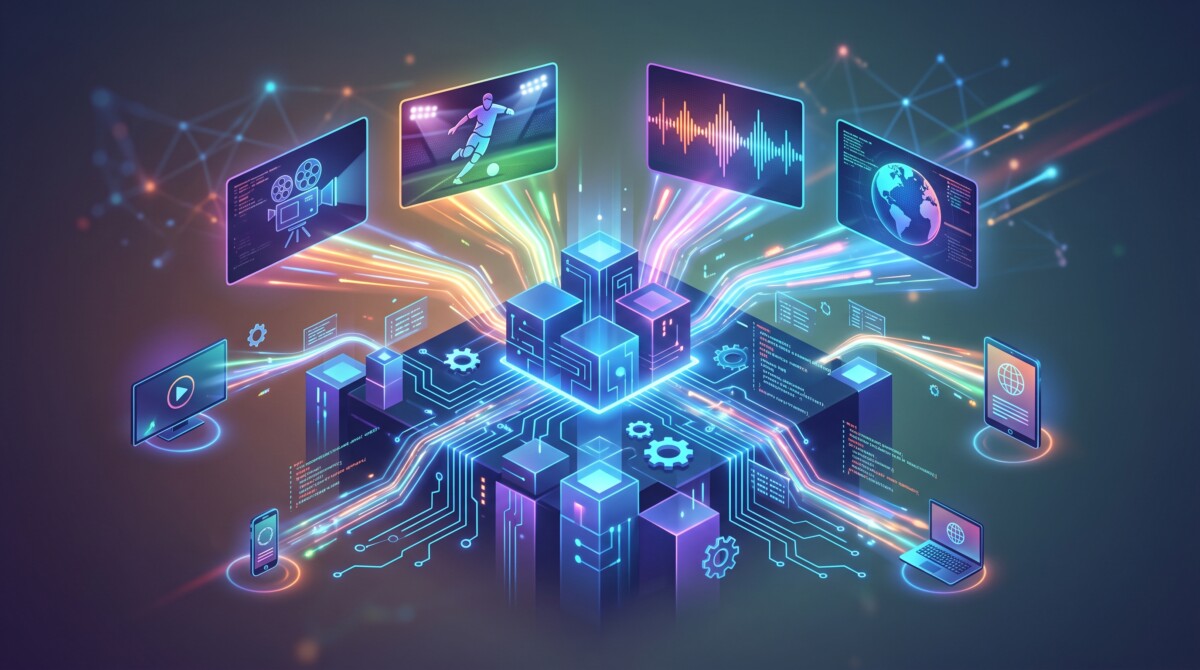
Custom OTT platform development earns its cost when streaming revenue clears roughly $2M a year or your library is itself the asset. Below that, licensed SaaS video delivers the same viewer experience without the transcoding, multi-DRM, and Smart TV engineering burden.
The build versus license question in streaming is not a technology question. It is a question about which line on your P&L you would rather defend to a buyer three years from now.
A media company with 4,000 hours of library content and a working ad sales team is a different business from a brand with 40 product videos. Both get pitched streaming platforms. Only one of them has a decision worth agonizing over.
The direct-to-consumer shift in video is real and permanent. Regional sports networks, independent studios, faith networks, fitness brands, and corporate training organizations are all delivering broadcast-quality video over the open internet without a cable operator in the middle. The technology to do that is mature and largely commoditized at the component level.
What is not commoditized is the assembly. This piece walks the architecture layer by layer, prices out where the real cost sits, and ends with the honest answer for the majority of readers who should not build anything at all.
OTT platform development is the engineering work of building the video pipeline, device applications, and billing systems that deliver streaming content over the open internet without a telecommunications operator in between. It is not app development with a video player bolted on, which is the single most common way the scope gets underestimated.
A complete build covers a cloud video content management system where masters are uploaded and tagged, a transcoding pipeline that produces the multiple renditions a viewer’s connection will switch between, encryption and packaging for the digital rights management systems each device family requires, content delivery network routing so a viewer in Lisbon is not pulling bytes from Virginia, and native frontend code for every screen you intend to appear on.
Each of those is a solved problem with a managed service behind it. AWS Elemental MediaConvert handles file-based transcoding and supports four adaptive bitrate packaging formats along with 4K and 8K sources. It is worth noting that MediaConvert is file-based only and does not process live video, which is a scoping detail that catches teams planning a live sports product partway through a build.
The engineering work is the orchestration between those services, the failure handling when one of them misbehaves at 200,000 concurrent viewers, and the ongoing maintenance as each device platform ships new operating system versions.
Licensed SaaS video platforms break down for enterprise broadcasters on four specific points: code ownership, revenue share, burst capacity, and native Smart TV coverage. For a creator or a niche channel, none of these matter. For a business whose library is a balance sheet asset, all four compound.
Code ownership is the one that shows up during diligence rather than during operations. When your platform, your subscriber database, and your playback layer live inside a vendor’s account, a pricing change or a terms revision or an acquisition can reprice your entire business without your involvement. This is the same structural exposure operators face elsewhere in their stack, and it is why the half of your infrastructure you actually control tends to be worth more than the half you rent, a pattern covered in more depth in the half of the agent protocol stack you actually control.
Revenue share is the one that shows up on the P&L. Illustrative benchmark: a platform taking 5 to 10 percent of subscription revenue costs a service doing $2M annually somewhere between $100,000 and $200,000 a year, which is roughly the loaded cost of one senior engineer. That comparison is the entire build versus license argument stated in a single line, and it is why the threshold sits where it does. Owning your own merchant account through Stripe or a comparable processor also means your payment data and your dunning logic are yours.
Burst capacity matters if you broadcast live events. Shared multi-tenant infrastructure is provisioned for aggregate load, not for your one Saturday in November. Native Smart TV coverage is the fourth, and it is the one most template builders quietly do not solve.
Five layers make up a production OTT pipeline, and each one has a distinct cost driver that scales differently as your audience grows. Understanding which layer scales with catalog size and which scales with viewership is how you build a budget that survives contact with reality.
Two of those cost drivers deserve specifics. Transcoding is billed by output, not by input: MediaConvert bills for every minute of transcoded output rather than per job, which means a title packaged for both HLS and DASH costs exactly twice what a single package costs. Deciding which packaging formats you genuinely need is a real budget lever, not a technical footnote.
Multi-DRM is the layer teams assume is one purchase and discover is three. Widevine’s own supported platform matrix lists Roku, Android TV, Fire TV, PlayStation, Tizen, and webOS as supported, and lists Apple TV, Xbox, and desktop Safari as not supported. Those gaps are precisely why Apple’s FairPlay and Microsoft’s PlayReady enter the build. If you plan to license studio content, the studios will require all three, and that requirement is contractual rather than negotiable.
Four features separate platforms that retain subscribers from platforms that churn them: cross-device synchronization, recommendation, secure offline viewing, and parental controls. None of the four is a differentiator in 2026. All four are table stakes, and their absence is noticed immediately.
Cross-device synchronization means a viewer who starts an episode on an iPhone at 8:10am finishes it on a Roku at 7:00pm without hunting for their place. That requires playback state written to a central profile in near real time rather than cached locally per device, and it is a backend requirement that teams often defer past launch and then regret.
Recommendation is where machine learning actually earns its keep in this category. A viewer facing an undifferentiated grid of 4,000 titles closes the app. A viewer facing three rows built from their own completion rates and search history keeps watching, and watch time is the metric every other metric in a subscription video business depends on.
Secure offline viewing requires time-bound local storage that revokes access when a rental window or subscription lapses, which is a DRM problem rather than a storage problem. Parental controls require PIN-protected profiles and maturity rating filters, which is the cheapest of the four to build and the most expensive to be caught without.
Your monetization model determines your backend requirements, which means choosing between SVOD, AVOD, TVOD, and hybrid comes before any build versus license decision rather than after it. A platform architected for subscriptions cannot absorb a pay-per-view spike without rework, and a platform architected for ads without server-side insertion will lose most of its inventory to blockers.
Server-side ad insertion is the detail worth internalizing on the AVOD side. Client-side ad calls are visible to ad blockers and are simply not served to a meaningful share of your audience. Stitching advertisements into the video stream at the server means the ad and the content arrive as one stream, which restores the inventory and produces a commercial break that behaves like broadcast television rather than like a web page.
Hybrid is where most mature platforms land, because a free ad-supported tier captures reach while a paid ad-free tier captures the viewers who will pay to skip. The cost of hybrid is that you now maintain both backends plus the entitlement logic that decides which experience a given viewer sees, so it is a phase two decision rather than a launch decision.
A custom build runs through six phases: discovery and strategy, interface design, backend engineering, frontend application development, quality assurance with load testing, and deployment followed by permanent maintenance. The last word in that sentence is the one that gets underweighted in every budget.
Discovery defines the audience, selects the monetization model, and maps the cloud and CDN architecture. Interface design has to solve two genuinely different problems, because a Smart TV interface operated by a five-button remote from three meters away shares almost nothing with a mobile touchscreen. Teams that design mobile first and adapt to television produce television experiences that feel wrong in a way viewers cannot articulate but do act on.
Backend engineering builds the CMS, the transcoding pipelines, the DRM integration, and the payment gateway. Frontend development writes native code for iOS, Android, Roku, Apple TV, Amazon Fire, and the major Smart TV ecosystems, which in practice means four or more codebases rather than one. Quality assurance simulates traffic spikes and throttled connections, because a platform that works beautifully for 500 concurrent viewers tells you nothing about how it behaves at 50,000.
Deployment is not the end. Each device platform ships operating system updates on its own schedule, and each one can break a certified application. Firms specializing in OTT platform development typically carry that SDK maintenance obligation forward as a retained engagement rather than a project close, and any proposal that treats launch as the finish line has mispriced the work.
For the overwhelming majority of Shopify merchants, custom OTT development is the wrong tool, and the right one is a shoppable video or live selling app that plugs into the storefront you already run. The video ambition is usually correct. The infrastructure conclusion usually is not.
The demand is genuine. US livestream ecommerce sales grew close to 50 percent in 2025 to reach $14.64 billion, with the buyer count up 21.5 percent year over year, and specialist platforms like Whatnot cleared $6 billion in sales over the same period. That is a real channel. It is also a channel merchants enter through shoppable video on their product pages or through live shopping on a platform where an audience already exists, not through a transcoding pipeline and three DRM licenses.
The failure pattern here is familiar to anyone who has watched brands stall between $500K and $2M, and it is almost always premature complexity rather than a lack of ambition. Adding an owned streaming channel before the fundamentals are solid buys a maintenance obligation and a second product to run.
The threshold in the Lead Atomic Answer is a working rule of thumb rather than a published benchmark, and the arithmetic behind it is the revenue share comparison from section two. When the percentage a platform takes from you exceeds the loaded cost of the engineering required to replace it, and when your library is durable enough to still be earning in five years, the build case starts to hold. Before that point, licensing is not a compromise. It is the correct allocation of capital.
There is no credible public price, because the range is driven entirely by scope decisions you make before engineering begins. The honest way to size it is by component rather than by total. Transcoding is billed per minute of output, so the number of packaging formats you support multiplies that line directly. CDN cost scales with egress volume and how many regions you serve. Multi-DRM means licensing three separate systems rather than one. Frontend cost scales with device families, and each Smart TV platform is a separate native codebase. Add a permanent maintenance line for SDK updates, because every device platform ships operating system changes that can break a certified application.
Custom development means you own the source code, the backend architecture, and the subscriber database, while a SaaS platform means you rent all three. The practical differences show up in four places. You keep 100 percent of subscription and advertising revenue instead of sharing a percentage. You provision your own auto-scaling infrastructure rather than sharing capacity with other tenants. You get native applications written specifically for each Smart TV operating system. And your platform becomes a transferable asset during a sale rather than a vendor dependency a buyer will discount. The trade is a materially higher upfront cost and a permanent engineering obligation.
You need multi-DRM if you license third-party content or intend to reach every major device, and you may not need it if you own all your content and stream to a narrow device set. Widevine’s published platform matrix shows support across Roku, Android TV, Fire TV, PlayStation, Tizen, and webOS, and shows Apple TV, Xbox, and desktop Safari as unsupported. Those gaps are why Apple’s FairPlay and Microsoft’s PlayReady become necessary rather than optional. If you plan to license studio content, all three are typically a contractual requirement in the distribution agreement, so the decision is made for you.
Technically yes, and for almost every Shopify merchant it is the wrong investment. An OTT build assumes a library deep enough to sustain habitual viewing and revenue directly attributable to that content. A product catalog with fifty videos does not meet either condition. The channel most merchants are actually reaching for is shoppable video on product pages or live selling, both of which install as apps on your existing storefront in days rather than quarters. Revisit the OTT question only when content itself is generating revenue you can measure separately from product sales, and when a platform’s revenue share exceeds what replacing it would cost in engineering.
Plan for the frontend and the certification process to dominate the timeline rather than the backend. The cloud pipeline of ingest, transcoding, DRM packaging, and CDN routing is assembled largely from managed services and moves relatively predictably. What extends the schedule is writing and certifying native applications for each device platform, since Roku, tvOS, Tizen, and webOS each run their own review process on their own timeline, and a rejection restarts that clock. Load testing at realistic concurrency is the other commonly compressed phase, and it is the one worth protecting, because platform behaviour at 500 viewers predicts nothing about behaviour at 50,000.




