

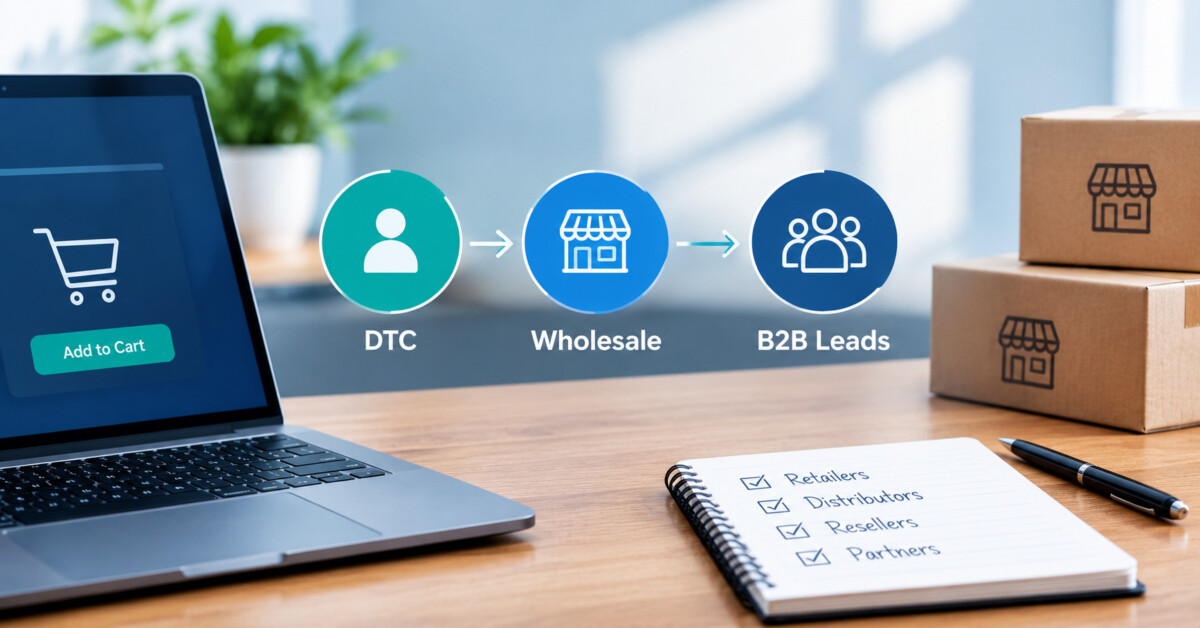
Outsourcing B2B lead generation works for ecommerce brands that already know which accounts they want and what a qualified opportunity looks like. Brands under $2M usually get more from wholesale marketplaces first, because outbound cannot fix an undefined commercial offer.
US manufacturing and wholesale distribution sales grew 0.4% in 2025. Every wholesale account you win next year is one somebody else loses, which is why the quality of the message matters more than the volume of it.
A brand doing $4M in DTC revenue can reach that number without anyone on the team ever having written a sales email. Paid social, search, email, marketplaces, and repeat purchase carry consumer revenue for years, and none of them require a pipeline. Then a regional chain asks for a line sheet, the conversation goes well, and the brand discovers it has no way at all to produce the next twenty conversations like that one.
Building that function internally takes time, especially at a company that grew around performance marketing rather than outbound sales. Some brands bring in an account-based marketing agency or another specialist partner to run selected parts of B2B prospecting. That buys researchers, sales development staff, outreach systems, and campaign management without committing to a permanent prospecting department before anyone knows how large the wholesale channel will actually be.
That trade can be the right one. It can also be the most expensive way to discover that your wholesale offer was never finished. The difference is rarely the partner. It is whether the brand walked in knowing which accounts it wanted, what it could supply, and what a qualified conversation looks like. Whether you are doing $500K or $10M, the test below tells you which side of that line you are standing on before the first invoice.
Strong consumer demand makes a product attractive to retail buyers, but it produces none of the pipeline needed to reach them, because the buying process changes entirely once another business is the customer. A shopper buys after seeing an ad and reading reviews. A retail buyer wants expected sell-through, wholesale margin, minimum order quantities, packaging that survives a stockroom, delivery reliability, merchandising support, and payment terms before placing an opening order.
The market context sharpens why this matters. According to Digital Commerce 360, US manufacturing and wholesale distribution sales reached $15.12 trillion in 2025, growing just 0.4% over the prior year. That is a very large pot of money that is barely expanding. Wholesale expansion in 2026 is share-taking, not wave-riding. You are asking a buyer to give you shelf space that currently belongs to someone else, and the argument has to be good enough to justify the swap.
Which means you cannot point consumer marketing at business buyers and expect the same result. The commercial opportunity needs its own target account criteria. A premium skincare brand might prioritise specialty retailers, day spas, hotel groups, and regional distributors, and each of those four has different unit economics and a different reason to care. The spa wants treatment-room consumables and a training story. The hotel group wants amenity sizing and a supply guarantee across properties. Same product, two unrelated pitches.
Outsourced prospecting teams are genuinely good at turning broad categories like those into workable account lists, researching store count, product mix, geography, price positioning, and the brands a buyer already carries before any outreach begins. That is more disciplined than buying a contact database and sending everyone the same message. It is also only useful once someone inside your business has decided which of those four segments you actually want.
Before paying anyone to run outbound on your behalf, list on a wholesale marketplace for two buying seasons and find out whether retail buyers will order from you without being contacted at all. This is the cheapest possible test of whether your wholesale offer is finished, and most brands under $2M skip it and go straight to paying for outreach.
The demand on those platforms is real and it is not small. Faire reported in more than 100,000 retailers across more than 30 countries buying from 50,000 brands, with more than one in five new retailer relationships leading to a second order within 90 days. That reorder figure is the useful one. It is the closest thing you will get to a free read on whether your product sells through once it is on a shelf, and it arrives without a retainer attached.
Work through the B2B marketplaces where retail buyers are already shopping and pick the one or two that match your category, then get your commercial terms genuinely ready before you list. If you have not yet configured wholesale pricing tiers and customer groups, the practical mechanics of setting up wholesale sales inside Shopify are the prerequisite, not an afterthought.
Here is the stage split. Under $2M in DTC revenue, run the marketplace test first and let inbound orders tell you which retailer profile converts. Between $2M and $10M, if you already have a named list of twenty to fifty accounts that marketplaces will never reach, such as a grocery chain or a hospitality group with a procurement process, outsourced prospecting starts to earn its place. Above $10M, the question is usually not whether to outsource but how much of the function to keep permanently in house.
An internal sales development hire reaches productivity in roughly three months and stays a little under two years, which means you are buying about twenty productive months against a full year of fixed cost before the first replacement cycle begins. The salary is the smallest part of the decision.
The Bridge Group surveyed 351 B2B companies on sales development staffing and metrics for its 2025 report. Median ramp time came in at 3.0 months, the lowest since 2010. Median tenure was 1.9 years. Median on-target earnings sat at $80K, unchanged since 2022. Only 60% of reps hit quota, the lowest figure on record in that study, and reps averaged 4.1 quality conversations per day. Read the caveat with the numbers: that sample skews toward B2B software, so treat it as directional for a consumer brand hiring its first prospecting seat rather than a like for like benchmark.
Even directionally, it reframes the choice. One hire does not solve the problem, because research, data hygiene, email deliverability, campaign operations, and management all still need an owner. For a brand that wants to test wholesale demand in two regions before next buying season, or open a corporate gifting channel ahead of the holidays, several permanent hires is a large fixed cost attached to a commercial experiment.
An external team supplies that capacity for a defined market and period. You learn which segments respond, which buyer profiles turn into real conversations, and how much internal sales capacity the channel deserves. If it works, you build the function later with information you did not have at the start. Worth noting: some of this work is inbound rather than outbound, and there are B2B lead generation strategies you can run in house at far lower cost while the outbound question stays open.
B2B targeting runs on account level data your consumer stack does not collect: store count, category mix, dominant price points, current brands carried, and who actually controls purchasing. Your consumer data tells you which creative converts a 34 year old in Ohio. It tells you nothing about whether a regional chain has an open-to-buy budget this quarter.
The platform side of this has improved. Shopify’s B2B feature set now covers company profiles with per-buyer permissions and payment terms, customer specific catalogs, quantity rules for case packs and increments, volume pricing, and vaulted payment methods. Shopify’s own claim is up to 33% more self-serve orders within 12 months, which is a vendor figure rather than an independent one, so weigh it accordingly. The mechanics of running DTC and wholesale from one store are no longer the hard part of this channel. The account intelligence is.
This is where an outside research team adds something you cannot easily replicate. Their researchers build account records around commercial fit instead of consumer audience characteristics, and they find multiple contacts inside one company, because a retail account frequently involves a buyer, a category manager, a merchandising lead, a procurement contact, and a commercial director rather than one obvious decision maker.
Your internal data still earns its place in the targeting. If consumer orders cluster around three cities where a particular chain operates, that is a prioritisation signal worth acting on. If customers keep asking where they can buy locally, those messages map your wholesale demand for free. If a handful of business customers are already placing unusually large orders through your DTC checkout, you have evidence for a structured business-purchasing offer before you have spent a dollar on prospecting. Good B2B targeting combines bought research with data you already own.
Outsource research, list building, first-touch outreach, and follow up sequencing. Keep reply handling, pricing conversations, and final qualification inside the brand, because that is the exact point where a wholesale account is won or lost.
This is a deliberate narrowing of the usual advice. Plenty of outsourcing models include reply handling in the scope, and on paper it looks efficient. In practice, when a category manager replies asking about margin, MOQ flexibility, or exclusivity in their region, an external rep has three options: guess, stall, or route it internally with a delay. All three cost you credibility with a buyer who has limited patience and other brands in their inbox. Founders and commercial leaders handle early wholesale conversations themselves for a good reason, which is that they know the answers.
What does move outside the team cleanly is the repetitive layer: account research, opening sequences, the third and fourth follow up, list maintenance. That frees senior people for product presentations, assortment planning, samples, negotiation, onboarding, and account growth, which is where their knowledge compounds. It also requires explicit boundaries. The external team needs to know your account size floor, which territories you can service, which products suit B2B, your minimum order expectations, and which commercial promises they may never make on your behalf. A meeting with a major retailer is worth nothing if you cannot supply the volume.
Qualification has to mean more than a prospect agreeing to talk. Pay attention to how you structure the incentive, because a partner rewarded purely on calendar volume will reliably deliver a pipeline of meetings your own sellers would never have chosen. If you want a sense of what an external team will actually be executing day to day, the mechanics of the outbound channels they run are worth understanding before you brief them, so you can tell a considered campaign from a volume play.
A retail buyer needs a specific reason this particular account should carry you, which is a different message from the one that converts a shopper, and it has to survive a committee rather than one person. Consumer advertising can lead with product benefits, visual appeal, reviews, and a promotion. A commercial buyer is weighing margin, demonstrated demand, reorder potential, exclusivity, merchandising support, and whether you can still supply them in eighteen months.
The committee part is routinely underestimated. Gartner research published in May 2025, based on a survey of 632 B2B buyers, found that buying groups range from 5 to 16 people across as many as 4 functions, and that 74% of those buyer teams showed unhealthy conflict during the decision process. Your outreach is not persuading a buyer. It is arming one person to argue for you in a room you will never enter.
That is why generic cold outreach performs so badly here. A retail buyer does not need another email calling a product innovative or popular. They need a credible reason you are contacting their company specifically: you fit their existing price band, you fill a visible gap in their assortment, your consumer sales are strong in their trade area, or you serve a customer group they already have and cannot currently supply.
Practically, this means the external team works from commercial positioning you approved rather than claims invented during a campaign. Give them product facts, buyer benefits, proof points, fulfilment capability, and hard limits around pricing and exclusivity. Then treat what comes back as data. If eleven buyers raise the same objection about minimum orders or case pack sizes, that is market research you paid for by accident, and it should reach whoever owns the wholesale offer before you spend another quarter on outreach.
Ask any prospective partner for two named retail or distribution accounts they opened for a consumer product brand, and what the opening order was, because most B2B lead generation experience is software experience and it does not transfer cleanly to a buyer with a planogram. This single question will tell you more than any deck.
The reason is structural. The majority of account-based marketing and lead generation agencies are built around software, fintech, and professional services, where the buyer is a department head with a budget line and a problem that can be solved in any month of the year. A retail buyer works to a seasonal calendar, an open-to-buy budget that is committed months ahead, a planogram with finite slots, and a category review cycle that may run twice a year. An outreach programme that ignores that calendar will produce polite replies in the wrong month and call it a soft market.
Four questions worth asking on the qualification call. Which retail or hospitality accounts have you opened, and for which category. How do you time outreach against category review cycles. What do you do when a buyer asks a margin question your client has not answered yet. And what is the smallest opening order you have seen convert, because a partner who only talks about enterprise pipeline has probably never sold a case pack.
Some partners will answer those questions well and the fit will be genuine. Others will reframe the question toward the B2B experience they do have, which is a useful signal in itself. At $500K to $2M, a specialist who has done your exact motion matters far more than a large agency with a broad client list, because you do not have the margin to fund someone else’s learning curve. Above $5M, you can absorb more of that curve, and a stronger operational partner with adjacent experience becomes a reasonable bet.
Outsourcing works when it extends a commercial strategy the brand already owns, and fails when it quietly substitutes for one. You can hand over prospect research, list building, outreach, and follow up. You should stay closely involved in deciding which accounts deserve pursuit and what a qualified opportunity actually is, because you are the only party who knows your margin requirements, production limits, channel conflict risk, geographic priorities, and inventory position.
A good partner will recommend segments and test ideas, and should. It should not be independently deciding that you need to chase every retailer willing to take a call. That drift is easy to spot in a monthly report if you are measuring the right things and almost invisible if you are not.
Which brings the measurement question into focus. Outreach volume and reply rates diagnose a campaign, and they are genuinely useful for that, but they do not describe commercial value and should never sit at the top of a partner scorecard. Track qualified conversations, opportunities created, proposals sent, new accounts opened, expected revenue, actual orders shipped, and above all the reorder rate. Compare that last number against the roughly one in five marketplace relationships that produce a second order within 90 days. If your expensively acquired outbound accounts are reordering at a materially worse rate than the accounts that found you on their own, the problem is not your prospecting. It is the offer, and no retainer fixes that.
Fast growing ecommerce brands outsource B2B lead generation because a new channel creates commercial workload faster than the organisation can absorb it, and that is a legitimate reason to buy capacity. An external team can add research, outbound execution, and a repeatable process while your own people stay focused on closing and developing accounts. The model just requires you to have answered the questions first: which companies you want as customers, why they should care, what you can actually supply them, and what makes an opportunity worth pursuing. With those settled, an external team turns a wholesale idea into a pipeline you can evaluate with real sales data. Without them, it turns a wholesale idea into an invoice.
Outsource when you are testing whether a wholesale channel is worth building, and hire when you already know the channel works and want the capability permanently. The Bridge Group’s 2025 research puts median sales development ramp at 3.0 months and median tenure at 1.9 years, so a first internal hire means paying a full year of fixed cost for roughly twenty productive months before you replace them. For a brand under $2M testing two regions before next buying season, that is a large commitment to an experiment. An external team gives you a defined test window instead. Once a channel proves itself and you know which buyer profile converts, bringing it in house becomes the cheaper option over time.
Costs vary too widely by scope, geography, and account complexity for a single market rate to be meaningful, so compare structures rather than chasing a headline number. The three common shapes are a monthly retainer for a defined research and outreach programme, a per-qualified-meeting fee, and a hybrid of a smaller retainer plus a performance component. Per-meeting pricing looks attractive and carries a known failure mode, which is that it rewards calendar volume over account fit. Whatever the structure, benchmark the total against what the same capability costs internally, including management time, data, and tooling rather than salary alone, and insist the contract defines what qualified means before it starts.
Yes. Shopify’s B2B features let you run wholesale and DTC from one store, using company profiles with per-buyer permissions and payment terms, customer specific catalogs, quantity rules for case packs and minimums, and volume pricing. Some capabilities are tied to higher plans, so confirm what your current plan includes before you promise a buyer anything. The practical sequence is to get pricing tiers, minimum order quantities, and payment terms configured before you start outreach or list on a marketplace, because a buyer who is ready to order and hits a checkout that cannot handle their terms is a buyer you have to win twice.
Expect first qualified conversations within 30 to 60 days of campaign launch and first shipped orders considerably later, because retail buying runs on a calendar you do not control. A buyer interested in March may have an open-to-buy budget that only opens for the autumn category review. Onboarding also takes real time: a partner needs to learn your product, commercial terms, customer profile, competitive position, and qualification standards before contacting anyone, and rushing that produces fast outreach that misrepresents you. Judge the first 90 days on conversation quality and account fit rather than closed revenue, then judge the following 90 on proposals and opening orders.
Ask which retail, hospitality, or distribution accounts they have opened for a consumer product brand, and what the opening order was. Most B2B lead generation experience is software experience, where the buyer is a department head with a budget line rather than a category manager working to a planogram and a seasonal review cycle. Follow it with three more: how they time outreach against category review cycles, what they do when a buyer asks a margin question you have not answered yet, and what the smallest opening order they have converted was. Also settle who handles replies. Handing buyer replies to an external rep who cannot answer margin or MOQ questions is where accounts get lost.




