

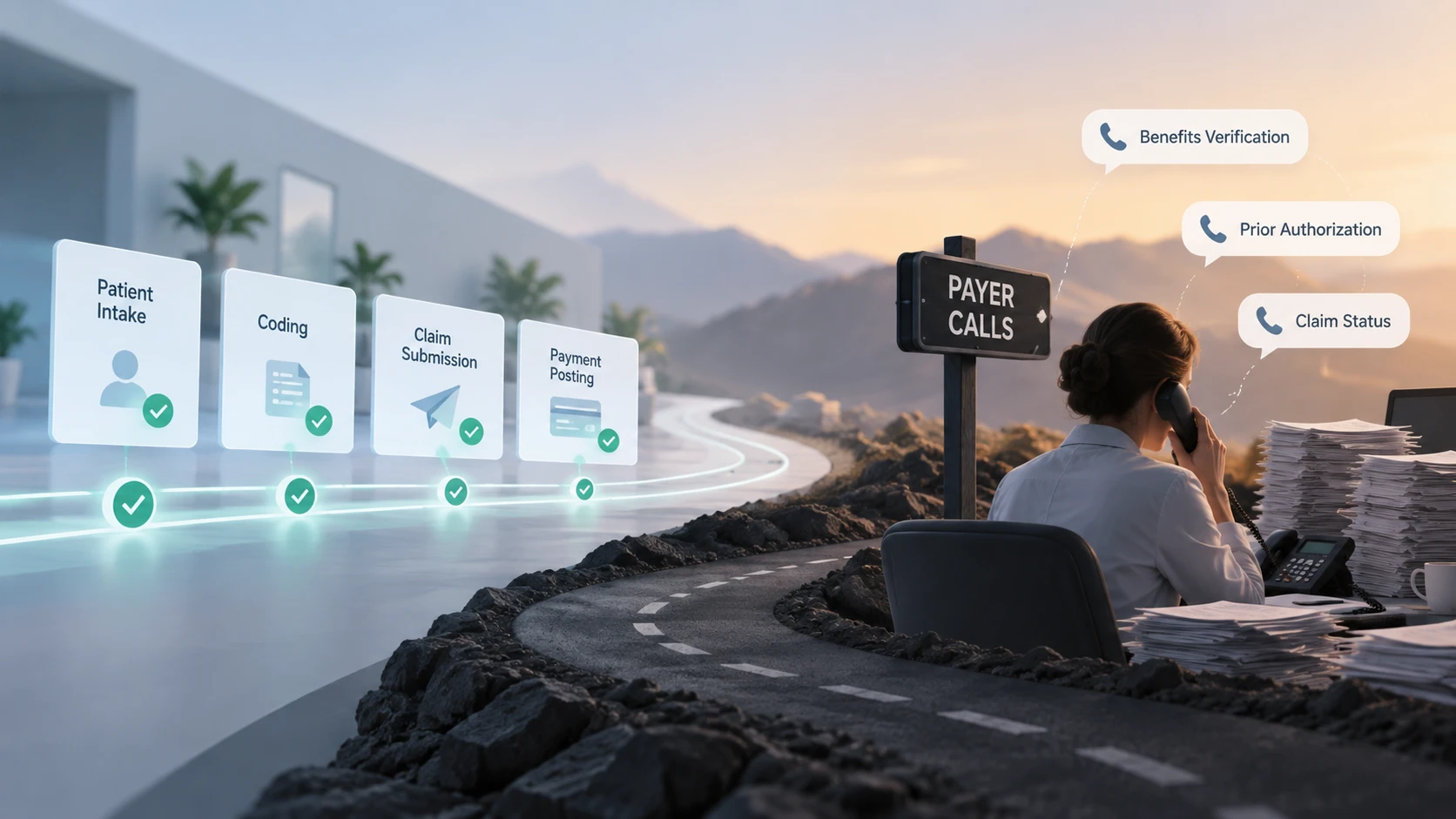
Payer-call automation can reduce manual revenue-cycle work when electronic transactions and portals leave unanswered questions. Start with one call type, validate the captured answers, integrate results into the billing system, and retain human escalation. Measure accepted completions and total operating cost, not natural-sounding calls or dialing volume.
The useful automation metric is not whether the agent reached a representative. It is whether the next billing step can proceed without someone repeating the call.
Walk through a billing office that has “automated” its revenue cycle and you will still hear phones. Eligibility runs through the clearinghouse, claims are scrubbed before submission, and bots log into payer portals overnight. Yet someone is on hold with a payer, waiting to ask whether a procedure needs authorization, how many physical therapy visits remain on a plan, or why a clean claim has sat in “pending” for 40 days.
That phone work is the last manual mile of medical billing automation. It is expensive, it is invisible in most automation dashboards, and it is the reason many teams that invested in automation still cannot shrink their verification and follow-up queues.
Revenue cycle automation has moved in waves: electronic transactions, then clearinghouse rules engines, then robotic process automation on payer portals. Each wave removed work. None removed the call, for three reasons.
Electronic responses are often too thin. A 271 eligibility response confirms active coverage, but it frequently leaves out what the front desk actually needs: service-specific benefits, visit limits, whether a specific procedure code requires authorization, or how a self-funded plan treats out-of-network care. When the answer decides whether a patient gets a $40 or a $900 estimate, staff pick up the phone.
Portals differ by payer and change without notice. Every payer portal has its own login flow, layout and data fields. A bot that worked last month fails when a screen is redesigned, and the case quietly falls back to a person.
Some answers only come from a representative. A reference number for an appeal, confirmation that a retro authorization will be accepted, or the reason behind a pended claim often exists only in a conversation.
The cost is easy to underestimate because it hides in staff time rather than in a software invoice. Vendor estimates put manual verification of benefits at 15 to 60 minutes of staff time per case once dialing, IVR menus, hold time and note-taking are counted. Multiply that by a few hundred specialty visits a week and you have a team whose main job is waiting on hold.
The downstream cost is larger. In Experian Health’s 2025 State of Claims survey, 41% of providers reported denial rates of 10% or higher, and 68% said submitting clean claims has become harder. Many of those denials trace back to information that was missing, wrong or never confirmed before the visit: exactly the information a payer call is supposed to capture.
| Call type | What the team needs | Why electronic data often falls short |
|---|---|---|
| Verification of benefits | Deductible, coinsurance, visit limits, network status | Service-level benefits are often missing from 271 responses |
| Prior authorization | Whether auth is required, status, decision details | Rules vary by payer and procedure code; follow-up moves to phone |
| Claim status | Why a claim is pended or denied, what to fix | 277 responses give a status code, not the reason a rep can explain |
| Denials and appeals | Reference number, appeal path, deadlines | Often available only from a representative |
The natural reaction is to throw the same tools at the phone that worked on portals. It rarely works, because a payer call is not a fixed sequence.
IVR trees differ by payer and sometimes by line of business. Prompts ask for member IDs, provider identifiers and dates in different formats. Hold times range from two minutes to forty. When a representative finally answers, the conversation branches depending on what they say. A script that expects a clean path fails at the first unexpected prompt, and a generic “call failed” status sends the case straight back to a person.
The data problem is just as real. Even when a human makes the call, the result usually lands as free-text notes in the billing system. Nobody can query those notes, and nothing checks whether the deductible a rep quoted matches what was entered for the estimate.
A voice agent that actually removes work has to own the whole call lifecycle, not just the dialing. In practice that means:
A purpose-built healthcare AI voice agent for payer calls is designed around this lifecycle: payer-specific IVR paths, hold handling, representative detection and outcome classes that decide what happens after a failed call. The test of any such agent is not whether the demo call sounds natural. It is what share of calls end with validated data in your system and no staff involvement.
A good automation strategy does not route everything through a voice agent. The cheapest call is the one that never needs to be made.
The right order is electronic first, portal second, phone last. Check the 270/271 and 276/277 transactions or a payer API; if the answer is complete, stop there. If it is not, try the payer portal. Send the voice agent only for what is left, and send it with the context gathered so far so it asks only the missing questions.
Regulation is pushing in the same direction. Under CMS-0057-F, impacted payers have had to decide on prior authorization within 72 hours for expedited and 7 days for standard requests since January 1, 2026, and must offer a Prior Authorization API by January 1, 2027. That will move a share of authorization traffic from phones to systems. But the rule covers Medicare Advantage, Medicaid, CHIP and plans on the federal exchanges, not most employer-sponsored commercial plans, and early APIs will not answer every question. The phone will remain the fallback for years.
The money at stake is still large. The 2025 CAQH Index estimates $21 billion in remaining savings from automating administrative transactions across the US healthcare system.
Teams that get results from payer-call automation tend to follow the same pattern.
Pick one call type. Verification of benefits for a high-volume specialty is a common first choice: the questions are predictable, the volume is high and the result feeds directly into patient estimates and claims.
Measure a baseline before launch. Record minutes per case, cases per staff member and denial rates tied to eligibility or authorization. Without a baseline, nobody can say whether the agent worked.
Keep humans on the exceptions. The agent should escalate ambiguous answers with the call recording and extracted fields attached, so staff review rather than redo the work.
Plan for integration, not just the agent. A voice agent that writes results into a spreadsheet moves the manual work instead of removing it. If your stack needs the agent to sit alongside eligibility checks, authorization tracking and claim generation, look for RCM software development services that can connect it to the EHR, clearinghouse and billing system you already run.
Settle compliance up front. Payer calls carry PHI. Confirm a BAA, where recordings are stored, and whether patient data is masked before it reaches an external model.
Gartner predicted in 2025 that over 40% of agentic AI projects will be canceled by the end of 2027 because of rising costs, unclear value or weak risk controls. Payer-call automation avoids that fate when it starts narrow, measures against a baseline and treats the phone as one channel among three.
Billing teams have already captured the easy wins. What remains is the work that resisted automation because it required listening, waiting and judgment. Voice agents built for real payer behavior can finally take that work on, as long as they sit inside the billing workflow rather than beside it. The teams that close this last mile will not be the ones with the most impressive demo. They will be the ones whose staff stop spending their afternoons on hold.
Payer-call automation should resolve a defined administrative task, preserve evidence, protect PHI, and leave an accountable next step when the case requires human review.
Payer-call automation uses software, potentially including an AI voice agent, to contact insurers and retrieve information needed for a defined revenue-cycle task. Examples include unresolved benefits questions, authorization follow-up, and claim-status clarification. A complete workflow handles navigation, questioning, extraction, outcome classification, and system updates. It should use information already gathered electronically and escalate uncertainty rather than inventing answers. Dialing or generating a transcript alone does not establish that the billing task is complete or that staff work has been reduced.
An AI voice agent should not make every payer call; use it for suitable unresolved administrative questions after considering available electronic and portal sources. Complex appeals, conflicting information, urgent cases, and issues requiring professional judgment need an approved human pathway. Route cases by workflow and payer requirements rather than sending everything through a fixed sequence. Pass existing information to the agent so it asks only what remains unresolved. Evaluate whether each route produces accepted answers at an appropriate cost without increasing risk or repeat work.
CMS-0057-F does not require every payer to decide authorizations within seven days. Its decision-timeframe provisions apply to specified impacted payers and exclude Qualified Health Plan issuers on federally facilitated exchanges. Applicable expedited requests have a 72-hour timeframe, while standard requests have a seven-calendar-day timeframe. The rule’s prior authorization provisions exclude drugs, and it is not a blanket mandate for all employer-sponsored commercial plans. Operational compliance dates generally begin January 1, 2026, while API compliance dates generally begin January 1, 2027, with payer-specific details.
A business associate agreement is not enough by itself to deploy a payer-call voice agent handling PHI. Appropriate BAAs must be accompanied by risk analysis, safeguards, permitted-use controls, incident procedures, and review of the complete data flow. Include telephony, transcription, model processing, storage, logs, and relevant subcontractors. Encryption or partial masking does not automatically remove business-associate obligations. Resolve recording and calling requirements separately, and confirm retention and deletion practices. Use qualified privacy, security, and legal reviewers for the organization’s actual deployment.
Measure payer-call automation savings by comparing the baseline with total cost per accepted completion, active staff effort, resolution time, and error or rework rates. Include software, telephony, integration maintenance, retries, review, and exception handling. Define accepted completion as the required validated information reaching the correct billing case, not merely a connected call. Report all assigned cases and disclose exclusions so difficult work does not disappear from the denominator. Track relevant downstream outcomes separately; a reduction in call handling does not automatically prove fewer denials or faster payment.




