

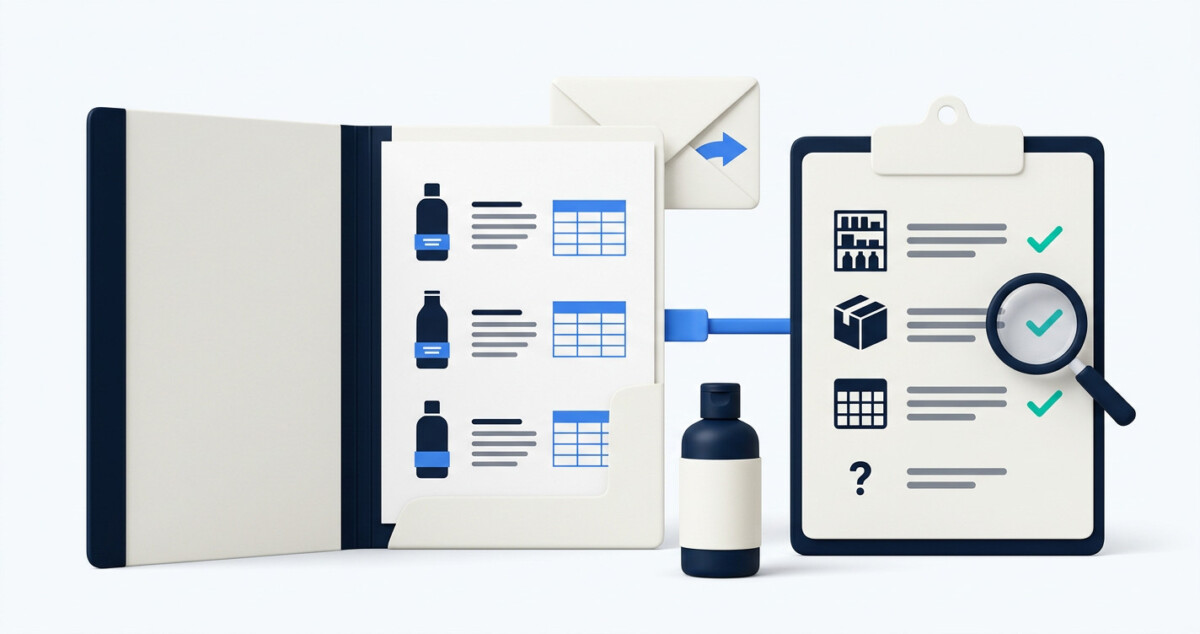
Retail buyers screen a wholesale pitch on four things: whether the margin works, whether it has sold in stores like theirs, whether you can ship like a vendor, and whether it fits their assortment. Answer all four in email one.
A buyer is not reading your email to find out whether your product is good. They are reading it to find a reason to stop reading.
Margin first, then proof it has sold in stores like theirs, then whether you can ship like a vendor, then whether it fits what they already carry. A buyer gets through all four in well under a minute, and they are reading to disqualify, because your email is one of dozens that week.
That sounds harsh. It is also useful, because it tells you exactly what the email has to do.
Most pitches that go nowhere do not lose on the product. They lose because one of those four answers was missing, and the buyer was never going to write back and ask for it. Silence is not a verdict on your brand. It is usually a verdict on your email.
Run every wholesale pitch through this before it goes out.
If the buyer can tick all four from your email plus the attached line sheet, you have earned the reply. If they are guessing on even one, expect nothing.
One scope note before you apply any of this. These four checks describe how an independent or specialty buyer reads a cold email, and that is a channel where a good email genuinely moves the outcome. If you are targeting a national chain, the gate sits somewhere else entirely: vendor onboarding requirements, EDI capability, insurance minimums, and a category review that happens on a fixed calendar. A flawless pitch to a chain buyer outside their review window is a pitch for next year, and no amount of margin math changes that.
Your margin works if the shop can sell at your MSRP and keep roughly half of it. Faire tells brands this plainly in its own pricing policy for brands: “Retailers who buy your products will need to be able to sell your products at a reasonable margin.” Faire puts the typical figure at 50%, or 2x the wholesale price. That is keystone pricing, and across gift, home, beauty, and much of apparel it is still the assumption a buyer brings to your email.
So put the numbers in the email. “Wholesale $14, MSRP $28.” Seven words, and the buyer knows whether to keep reading. Leave them out and you have asked a busy person to request a line sheet just to learn whether you are worth a conversation.
Two mistakes show up constantly when DTC brands start pitching stores.
The first is pricing from cost up instead of from the shelf down. Illustrative numbers here, assuming a $9 landed cost and a target wholesale margin near 35%. You want a reasonable margin, so you land on $14 wholesale and $28 retail. That holds until you notice the comparable products in the shop you are pitching sit at $22, at which point the buyer has already moved on. Walk the shelf, or at least the store’s website, before you set the price.
The second is channel conflict. If you are running a permanent 20% off code on your own Shopify store, the buyer will find it, and they will not stock something their customers can buy cheaper direct from you. Faire’s pricing policy makes this a platform rule rather than a courtesy: your prices there have to match or beat what you charge elsewhere. Settle your pricing across every channel before you pitch any of them, because a buyer who spots the conflict reads it as a signal about how you will treat the account later.
Buyers believe proof from other shops, and very little else. Your DTC conversion rate, your follower count, and your wall of five-star reviews all say that people like the product online. None of it says the product will move off a crowded shelf with no ad spend behind it, which is the only question the buyer is actually asking.
Three things land. The first is named stockists. “We are in fourteen independent gift shops across Portland and Seattle” beats any review count, because the buyer can verify it and because it tells them someone in their position already took the risk.
The second is reorders. For a small brand this is the closest thing to sell-through data you will have. “Nine of those fourteen have reordered” answers the question underneath every buyer’s hesitation, which is whether the stock will sit there.
The third is marketplace history. If you have no stockists yet, get on a wholesale marketplace before you start cold pitching. That is the same conclusion Steve reached from the other direction in his piece on what breaks when a DTC brand outsources B2B lead generation: a couple of buying seasons on a marketplace tells you whether retailers will order without anyone chasing them, which is information no outbound agency can give you. On the scale of that signal, Faire reported in its June 2026 five-year international update that more than one in five new retailer and brand relationships led to a second order within 90 days. That figure covers Faire’s international business specifically, not the platform as a whole, so read it as an order of magnitude rather than a benchmark for your category. If you are choosing where to list, there is a roundup of B2B marketplaces for finding buyers on the site.
If DTC data is genuinely all you have, lead with repeat purchase rate. It is the nearest DTC equivalent to a reorder, and buyers understand it immediately without translation.
You can ship like a vendor only if the boring things are settled before the first purchase order arrives: barcodes, case packs, minimums, lead times, and payment terms. Brands win the yes and then lose the account on exactly this, and buyers rarely hand out second chances.
Barcodes come first. Shops scan at the till and again in receiving, so you need UPCs, and you want them from GS1 US rather than a reseller. GS1’s own wording is the reason: “Barcodes from GS1 identify your company as the brand owner of that product,” which GS1 describes as information retailers look for. A resold number does not carry that ownership record, and a buyer running a vendor setup check will notice.
Case packs and minimums come next. How many units per SKU go in a case, and what is the opening minimum? Independents usually want to start small and test you. Chains want case quantities that divide cleanly across their store count.
Then payment terms. Plenty of retailers expect net 30, and Shopify supports net payment terms on B2B company profiles from net 7 through net 90, along with due on fulfillment and fixed date options on draft orders. One condition worth knowing before you promise anything: taking a percentage deposit requires Shopify Plus, so if you are on a lower plan, build your terms around what your plan actually does. Decide in advance what a new account gets and what they unlock after a few orders paid on time. If you are still working out how DTC and wholesale sit side by side on one platform, the piece on running DTC and wholesale in one store covers the setup, and the step-by-step guide to wholesale sales covers the pricing and minimum configuration underneath it.
Finally, lead times and insurance. Know how long a reorder takes to leave your warehouse. Larger accounts will ask for a certificate of product liability insurance, so have one before they ask rather than after.
None of this needs a paragraph in the first email. One line does it: “UPCs, cases of six, net 30 for approved accounts, line sheet attached.” That single line retires the operational worry before it forms.
Show fit by saying something true about their shop that your product completes. Buyers spot a mail merge instantly, and “I think your customers would love our products” is exactly what one sounds like, because it could go to any shop in the country and the buyer knows it.
Give each store ten minutes before you write. Their website, their Instagram, their Google reviews. You are looking for one of three things.
There may be a gap in a category they already carry, like a wall of candles and nothing for the bath. There may be a customer they obviously serve, such as new parents, hikers, or someone grabbing a gift under $40. Or there may be a brand already on their shelves that yours would sit naturally beside.
Then compress what you found into one sentence. “You carry three brands our customers also buy, and none of them have anything under $30 for gifting.” Now the buyer has a reason to read on, and they can tell you actually looked, which puts you ahead of most of their inbox before you have made a single claim about the product.
If you cannot find a sentence like that, take the hint. That is usually the store telling you it is not a fit, and those ten minutes are better spent on the next one. Pitching a store you could not find a reason to pitch is how brands end up with a 2% reply rate and a theory that cold email does not work.
Each email should carry something the previous one did not. Most wholesale sequences die because follow-up two and three repeat follow-up one with added urgency, and “bumping this to the top of your inbox” gives a buyer who already ignored you nothing new to respond to.
Here is a three-email version that does not waste anyone’s time.
Email one carries fit and margin. One sentence on why this store specifically, meaning the gap you spotted or the customer they serve, then wholesale price, MSRP, and a single proof point. Attach the line sheet.
Email two carries sell-through. Your named stockists and the reorder number. If a current stockist will let you quote them on how the product actually sold, this is where that goes.
Email three lowers the risk. Minimums and terms, plus something that makes a first order easy to approve. A smaller opening quantity works. So does a merchandising kit, or free freight on the first case.
Honestly, what sits behind those emails does more work than the wording does. A clean line sheet, a one-page retailer summary, one short reorder story from a real stockist, and a photograph of the product on an actual shelf will beat any subject line you can write. One thing to check if you plan to hand outreach to someone else: most demand generation agencies are built for software buyers with long sales cycles and buying committees, which is a different motion from retail wholesale, so ask which retail or distribution accounts they have actually opened before you hand over your sequence.
Pitch before their ordering window closes, not whenever your stock happens to land. Buyers plan assortments months ahead. Independents tend to buy around trade shows and their own holiday planning. Chains review whole categories on a set calendar and rarely bring in a new vendor between reviews.
So ask early, and ask directly: “When do you plan next season’s assortment?” Put the date in your CRM and work backwards from it. A great pitch that arrives two weeks after a buyer locked holiday orders is not a bad pitch. It is a pitch for next year, and it will be forgotten by then.
Timing is also where the economics of the channel start to justify the patience. On the eCommerce Fastlane podcast, Meghann Butcher of RepSpark put the contrast in why $100 DTC orders struggle to compete with $10K wholesale accounts, pointing out that brands obsess over marketing spend in DTC while doing almost no marketing for wholesale at all. Her framing is worth sitting with, because it reframes what a slow channel is actually worth: wholesale carries lower margin per unit but much higher value per transaction, and the fulfillment and acquisition cost per order runs very differently from consumer economics.
That matters for how you read a non-reply. In DTC, a channel that does not convert this month is a channel to cut. In wholesale, a buyer who does not reply in October may simply be eleven months from their next open window, and the account is worth more than the twenty consumer orders you could have chased in the meantime. Build the follow-up calendar that reflects that, rather than the one your paid media instincts suggest.
Wherever you are, start by rewriting your opening email so a buyer can tick margin, proof, operations, and fit without replying to ask you for anything.
Emerging, under $50K: list on one wholesale marketplace and give it two buying seasons before you cold pitch anyone. You are not chasing volume yet. You are chasing your first reorder, because that is the proof every later pitch rests on.
Growth, $50K to $500K: turn the stockists you already have into proof. Ask each one whether you can name them, and get one short quote about how the product sold. This is usually a single afternoon of emails and it upgrades every pitch you send afterwards.
Scaling, $500K to $2M: settle barcodes, case packs, terms, and insurance before you go anywhere near a chain. Build the line sheet and the retailer one-pager once, then reuse them. This is also the stage where premature complexity bites: one wholesale channel run properly beats three run badly.
Established, $2M and up: map each target account’s assortment calendar and pitch to it. By this point, when you pitch matters considerably more than how you word it, and the work shifts from writing better emails to running a calendar properly.
The common thread across all four stages is that the pitch is downstream of the preparation. A brand with named stockists, a clean line sheet, settled terms, and a calendar does not need a clever email. A brand without them cannot write its way past the gap, which is why the rewrite is the last step on that list rather than the first.
Open with why their store in particular, then give your wholesale price, MSRP, and one piece of proof such as named stockists or a reorder rate, and attach a line sheet. Keep it short enough to read on a phone. The buyer is checking four things: whether the margin works, whether the product has sold in comparable stores, whether you can ship like a vendor, and whether it fits their assortment. Answer all four in the first email so they never have to reply to ask. Make every follow-up carry something new rather than repeating the first email with more urgency.
Most independent retailers expect roughly a 50% margin, which means your MSRP lands at about twice your wholesale price. Faire states this directly in its pricing policy for brands, giving a typical retailer margin of 50%, or 2x the wholesale price. Some categories run higher, so check comparable products on the shelf of the store you are pitching before you set your prices. Price from the shelf down rather than from your cost up: if your intended retail price sits well above the comparable products in that store, the buyer will pass regardless of how your own margin math works out.
Yes, in practice you need UPCs, because most retailers scan products at the register and again in receiving. Buy them directly from GS1 US rather than from a barcode reseller. GS1’s own guidance is the reason: barcodes issued by GS1 identify your company as the brand owner of the product, which GS1 describes as information retailers look for. A resold barcode number does not carry that ownership record back to you. A GS1 Company Prefix also lets you create multiple barcodes, identify locations, and code higher packaging levels like cases and pallets, which you will need as accounts grow.
A line sheet should include product photographs, SKUs, UPCs, wholesale price, MSRP, case pack, opening minimum, lead time, and payment terms. Add one line of proof, such as your current stockists or a reorder figure. The test is simple: a buyer should be able to place an order from the line sheet alone, without emailing you a single clarifying question. If your line sheet leaves out minimums or lead times, you have moved work onto the buyer, and a busy buyer will usually resolve that by moving on to the next brand instead.
Two or three follow-ups across two to three weeks is reasonable, provided each one carries something new: sell-through evidence, a stockist quote, or easier opening terms. Repeating the same pitch with more urgency does not work, because the buyer already decided not to answer it once. If you still hear nothing, change the question rather than the volume. Ask when they plan next season’s assortment, note the date, and return then. A non-reply in wholesale often means the buyer is months from an open buying window, not that they dislike the product.
Stefan Kalpachev is the founder of Content RevOps, which builds content and outreach systems for B2B companies whose buyers do their research before talking to sales, including manufacturers and brands that sell through distribution. Disclosure: the demand generation link in this article points to his company’s site. LinkedIn




