

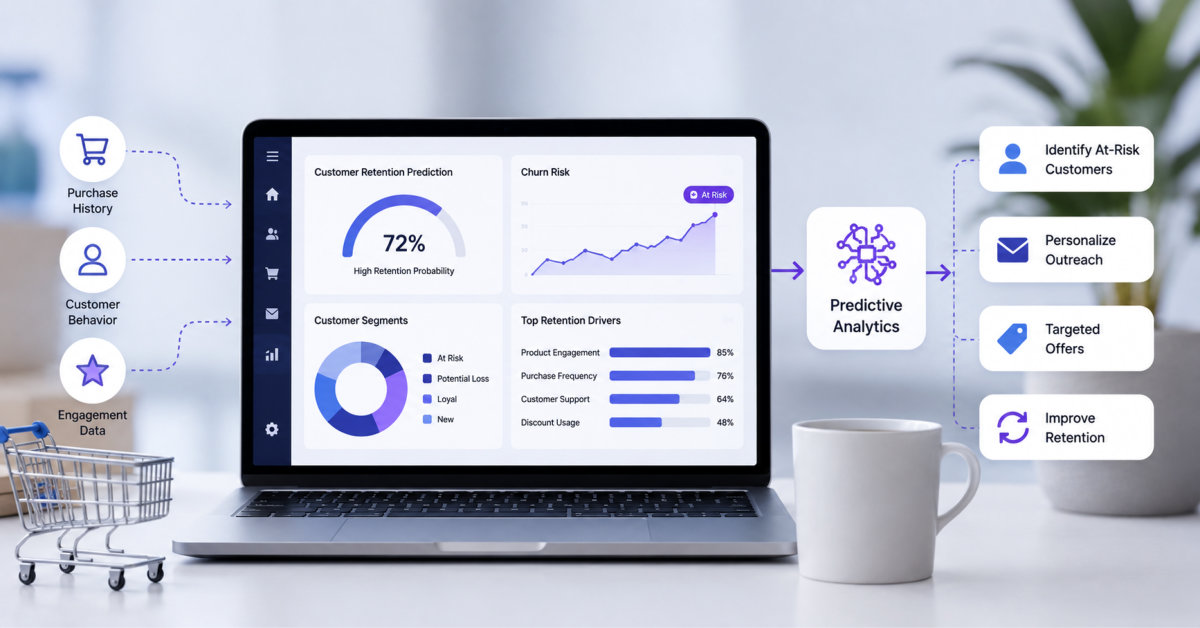
Predictive analytics improves ecommerce retention when a unified customer-data foundation turns purchase, engagement, support, and return behavior into timely interventions. Start with a simple churn and value model, activate it inside your existing retention tools, and prove incremental lift with a holdout group before expanding.
Predictive retention is not a model sitting in a notebook. It is a reliable path from customer behavior to an action your team can take before the customer has already left.
Predictive analytics in ecommerce uses historical and real-time customer data to forecast future behavior, such as churn risk, repeat purchase probability, customer lifetime value, demand, replenishment timing, and response to offers. For customer retention, predictive analytics helps ecommerce teams identify which shoppers are likely to leave, which are worth saving, and what intervention should happen before the customer is lost.
Most online stores spend as if acquisition is the only growth lever. New faces, new acquisition cost, repeat. Fred Reichheld and Bain put a price on that habit a generation ago: nudge retention up 5% and profit can swing somewhere between 25% and 95%, depending on your sector. It’s an old stat, and people stretch it, so take it as a compass heading rather than a promise. The thing it points at hasn’t changed. Keeping a loyal shopper is cheap. Replacing them isn’t, and the loyal one usually spends more the longer they hang around.
Which puts the whole problem on timing. Can you spot the shopper who’s halfway out the door while there’s still a door to hold open? That’s what predictive analytics in ecommerce is for. Score every customer on churn risk and future value, then nudge them before they disengage. The scoring sits on top of an engineering layer somebody has to build first: the integrations, the pipelines, a customer-360 warehouse. At GroupBWT, that’s the order we work in: retention as a plumbing problem before it’s ever a marketing one. Get the plumbing wrong, and the smartest model in the world won’t save you. So most of this guide is about the plumbing.
Walk into almost any retention build, and the same bad habit is already there, waiting for the GroupBWT team before it writes a line: retention done in the rear-view mirror. Someone stops buying. Three weeks pass. Then a win-back email shows up dangling a discount nobody asked for, by which point the customer is long gone in their head.
Prediction just moves the clock. Instead of chasing the people who already left, you watch the ones still here for the little wobbles. The browse that drags. A reorder that doesn’t land. Opens going quiet. None of that means anything on its own — pure noise. But feed enough of it to a model that’s watched thousands of customers begin to lapse, and the noise turns into a churn score you can actually do something with.
Does any of it pay off? The easiest way to find out is a holdout. Leave some at-risk customers completely alone, work the rest, then look at the gap. Roughly what you’d see (and these are made-up numbers to show the shape, not a client’s): the worked group churns around 23% across the quarter; the untouched one, 31%. Your vertical will move those figures, so trust the method here and let the eight points go. Still, that eight-point gap is the slide that gets the program funded. Accuracy scores don’t move finance. Saved customers do.
Strip every retention use case down, and you find the same goal underneath: hang onto the customer you already paid to win. We bucket the work into a handful of high-impact jobs. For retention, a few of them pull most of the weight.
Start with churn scoring, the obvious one. It lines up your active customers by how likely each is to lapse in the next 30 to 90 days. Next to it lives CLV prediction, which asks something blunter. What’s this shopper worth over time? Answer that, and your spend chases the valuable accounts instead of spraying across everyone. Then it gets tactical. A next-best-offer model, sitting on your recommendation engine, guesses the one product or nudge that pulls a wobbling customer back. Replenishment timing barely gets used,d and it should: for anything people burn through, you work out when they’re running low and remind them before a rival does. And sentiment-driven intervention reads the reviews and the support tickets, listening for the sour note that tends to land right before someone cancels.
Putting predictive analytics in ecommerce to work on retention is really one loop: churn score to intervention, and it walks through five steps. None are glamorous. Drop any of them and the model either never ships or ships and quietly goes off.
Composite, not a real named client, but stitched from the mid-market builds GroupBWT actually runs. Picture a retailer moving consumable goods. Supplements, say, or pet food. Orders sit in one system. Email events in a second. Support tickets in a third. Not one of them shares a customer ID with the others.
So engineering goes first, always. We run pipelines out of all three sources into a warehouse, fold the identities into a single customer-360 record, and crunch RFM and engagement features in a feature store. Only then does a churn model switch on, scoring customers nightly, pushing the results back into the email platform over reverse ETL.
And the retention logic on top is almost boring. A high-risk, high-value buyer who reorders every 40 days gets a replenishment nudge on day 35. The logic is simple. It works because the data beneath it is finally joined up. Data foundation before prediction. That’s the whole lesson sitting in this example.
Retention doesn’t live alone. The forecasts that flag a churn risk turn around and sharpen everything next to them.
Take demand forecasting. Keep the stuff your regulars actually reorder in stock, because nothing fires a repeat buyer off to a competitor faster than “out of stock” on their usual. Predicted CLV draws a ceiling on what a segment is worth holding onto, so promo money lands where it comes back instead of where it doesn’t. And those same scores route who gets which treatment. That’s the point of the matrix below — read each row as its own automated lane, with its own trigger and its own spending cap. No single blast going out to the whole list:
| Churn risk × customer value | Trigger source | Automated action | Cost ceiling |
| High risk, high value | Real-time event stream | Priority flag to retention or CS queue, plus a personalized offer in the rep’s tool | Highest per-customer spend |
| High risk, low value | Nightly batch score | Win-back email with free shipping or reactivation incentive | Email cost + margin on incentive |
| Medium risk, high value | Nightly batch score | Loyalty-points nudge or next-best-offer through the recommendation engine | Low, points-funded |
| Low risk, any value | Weekly refresh | No spend; keep scoring and monitor for drift | Compute only |
Even that top row, in a mid-market shop, is a routing decision the system makes. No call center scrambling. It flags the account, hands a rep the context, and the pipeline keeps scaling without you hiring for it. Land this and two numbers climb at once: retention, plus the conversion on whatever campaigns you’re still running. Here’s where predictive analytics in ecommerce really starts to stack with personalization. McKinsey’s Next in Personalization report has the receipts: personalization can push revenue up 5 to 15%, knock as much as 50% off customer-acquisition cost, and lift marketing ROI by 10 to 30%. The fast-growers, they pull 40% more of their revenue straight out of it (McKinsey).
So where does AI actually pull its weight? Honest answer: plenty of retention work hums along fine on plain old statistical models. What machine learning adds is reach. It can weigh thousands of behavioral signals at once, retrain itself as fresh data lands, and pick up things no hand-written rule ever could, say, a faint change in someone’s browsing rhythm weeks before they bail.
The bill comes due as maintenance. An ML pipeline needs clean, current data and a person who owns it, or the predictions rot, and nobody’s the wiser. Look across the retention work GroupBWT has shipped, and far more of it stalls on neglected data and unwatched pipelines than on a weak model. The data layer makes or breaks the whole thing: the integration, the warehouse, the feature engineering, the monitoring that catches drift. Sort that out first. For most mid-market stores, the smart move is to grab an early win with a simple model, then spend on AI only where the extra accuracy clearly earns back what it costs to keep alive.
Retention prediction rarely dies on the model. It dies on the engineering wrapped around it, and the ways it dies are predictable enough to list out:
Underneath all five sits one mistake. Teams run prediction like a data-science project when it’s mostly a data-engineering one. The model is a few weeks. The pipelines, the feature store, the activation layer, the monitoring-, that’s the other ten months, and that’s the ground where things live or die.
Retention is the cheapest growth lever most ecommerce stores still leave lying there. The whole shift fits in a sentence: quit reacting to customers after they’ve walked, and start spotting the shaky ones early enough to move.
A handful of things hold no matter your stack. Data foundation decides the result; siloed, messy records will sink your best model. Start small. One churn signal, one intervention, one number you genuinely track. Grow from there. And every prediction has to cash out as an action, or the score is just a figure idling on a dashboard. Read enough practitioner write-ups, and that same thread runs through all of them, and it matches what we see on the ground every time.
If you take one thing from this, take the cheapest one going. Find the single behavior that best predicts a lost customer in your store. Start watching it this week.
Predictive analytics is used for ecommerce customer retention by estimating each customer’s likelihood of churning, reordering, responding to an offer, or generating future value, then triggering a relevant action before that customer lapses. The model uses historical and current signals such as purchase timing, order frequency, spend, product usage, browsing, email engagement, returns, and support interactions. A retention team can then prioritize service recovery, replenishment reminders, loyalty messages, product recommendations, or carefully controlled win-back campaigns instead of treating all customers with the same generic sequence.
A small or mid-market ecommerce store can usually see an initial predictive-retention result within a few weeks once order history, customer identities, and activation channels are usable. The first version does not need advanced AI. A churn segment based on purchase recency, reorder timing, and email engagement can outperform a generic win-back message if it reaches customers at the right moment. The longest part is usually not model development. It is cleaning data, defining churn correctly, connecting scores to Klaviyo or another channel, and running a holdout test that proves incremental lift.
You need transaction history linked to a stable customer identifier to build a useful customer churn prediction model. At minimum, include purchase dates, order value, products purchased, refunds, cancellations, and customer ID or email. Improve the model with web behavior, Klaviyo or email engagement, subscription events, loyalty activity, support tickets, return reasons, delivery issues, and product replenishment timing. Data quality matters more than data volume. One clean year of joined order and engagement records is more useful than several years of disconnected, duplicate, or inconsistently labeled data.
Simpler models are enough for most ecommerce brands at the start because RFM segments, replenishment rules, logistic regression, and basic tree-based models can identify meaningful retention opportunities without heavy maintenance. AI becomes more useful when the brand has rich behavioral data, reliable pipelines, a team that can monitor model drift, and a clear reason to believe higher predictive accuracy will create additional retained margin. Start with an interpretable model that reaches an activation channel and can be tested. Add more advanced machine learning only after it proves more valuable than the cost and complexity of maintaining it.
You measure whether predictive retention is working by comparing customers who receive the predictive treatment with a randomized holdout group that receives no treatment or the existing baseline treatment. Compare retention rate, repeat purchase rate, incremental revenue, gross margin after incentives, customer lifetime value, refunds, and support outcomes over a defined period. Model accuracy alone is not enough because a highly accurate score creates no value if the intervention is irrelevant, too expensive, or poorly timed. The program is working only when it changes a business outcome that exceeds the cost of data, technology, incentives, and operations.




