

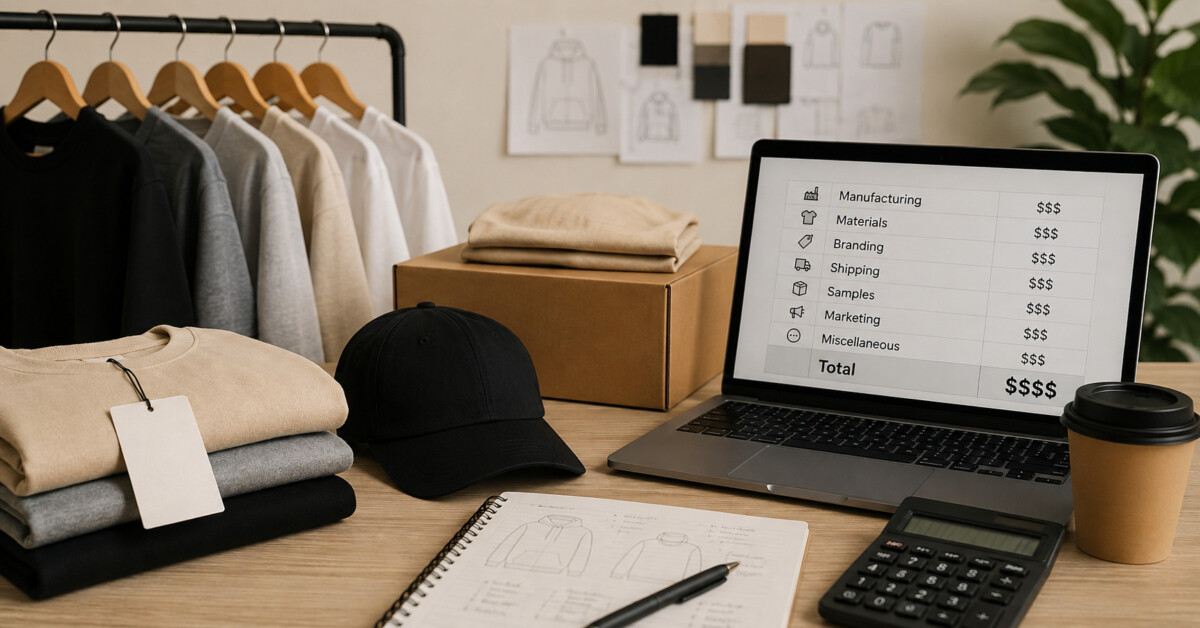
Launching a private label apparel line in 2026 costs more than the factory quote suggests, because the end of de minimis means duty is now owed on every unit at import. Budget landed cost, not unit cost, before committing to a minimum order.
The factory quote is the smallest number in the deal. Duty, freight, sampling, and the 300 units you cannot sell are the rest of it, and none of them appear on the quote.
A founder emailed me last spring with a spreadsheet that showed a 62% gross margin on a technical apparel product sourced from a factory in Guangdong. The unit cost was $8.40. The retail price was $58. On paper it was one of the cleaner margin structures I had seen from an early stage brand.
The spreadsheet had no line for duty. It had no line for freight, no line for the sampling rounds, and no line for the units that would sit in the garage in the wrong size. By the time the first container cleared, the real margin was closer to 38%, and the brand had roughly $19,000 of capital sitting in a product it had not sold a single unit of.
This is the most common failure I see when a Shopify brand moves from reselling to manufacturing. The category research is usually fine. The product instinct is often good. The landed cost model is almost always missing, and in 2026 that gap is wider than it has been at any point in the last decade.
A realistic first production run of a technical apparel SKU lands between $12,000 and $30,000 all in, of which the factory invoice is typically only 40 to 55%. That range covers goods, sampling, freight, duty, and the compliance testing that a performance claim requires, and it assumes a modest run of 300 to 500 units rather than a full MOQ commitment.
Work an illustrative example. Take 500 units at $8.50 FOB, which is $4,250 in goods. Add three rounds of pre-production sampling at roughly $150 per round with shipping, call it $600. Add ocean freight and drayage on a partial container, which runs $1,200 to $2,500 depending on lane and season. Add duty. For most knit and woven apparel from China, the combined rate lands somewhere near 35% once Section 301 and the general rate are stacked, though your actual number depends entirely on your HTS classification. On a $4,250 declared value plus freight, that is roughly $1,900. Add third party lab testing for any performance claim, $400 to $900 per fabric.
Illustrative benchmark: that puts you around $9,000 to $10,500 on a run whose factory invoice was $4,250. The unit cost you were quoted was $8.50. Your actual landed cost per unit is closer to $19 to $21.
Nothing about that math is a reason not to launch. It is a reason to model it before you commit, because the difference between a 62% margin and a 38% margin determines whether you can afford paid acquisition at all.
The strategy of sourcing from an overseas factory and shipping individual orders straight to US customers stopped being duty free on August 29, 2025, when the $800 de minimis exemption was suspended for all origins. Goods from China and Hong Kong had already lost the exemption on May 2, 2025. Every parcel entering the United States now requires customs entry and duty collection regardless of value.
This matters more than most operators realize, because de minimis was doing enormous quiet work. In fiscal 2024, more than 1.36 billion low value packages entered the US under that provision, with roughly 60% originating in China. A generation of apparel brands built launch strategies on the assumption that a $40 shirt shipped from a factory in Foshan arrived without a duty line. That assumption is gone, and the February 2026 Supreme Court ruling on IEEPA tariff authority did not bring it back. CBP published rulemaking in June 2026 confirming the indefinite suspension across all modes other than the postal network.
The practical consequence is that you now choose between two structures, and they have completely different cash flow profiles. Bulk import means you pay duty when the container clears, before a single unit sells. Direct fulfillment means duty applies per parcel as orders ship, matched against revenue from that specific sale. Same rate, same product, radically different working capital requirement.
Whichever structure you pick, the customer facing side needs attention too. If you sell across borders, showing guaranteed duties and taxes inside your Shopify checkout through Shopify Markets, Managed Markets, or Zonos removes the doorstep surprise bill that drives refusal rates of 10 to 20% in high tax markets.
US fishing participation declined in 2025 for the first time since 2021, which makes the standard pitch for this category wrong in an important way. According to the 2026 Special Report on Fishing released by the American Sportfishing Association, 57 million Americans fished in 2025, down from 57.9 million in 2024, with 19 million anglers lapsing between the two years.
I am using UPF fishing apparel as the worked example throughout this piece because it is a category that gets pitched constantly as an untapped DTC gap, and the data underneath that pitch is more interesting than the pitch itself. Participation is still up roughly 25% over the past decade at 18% of the US population. But the year over year direction reversed, and frequency is falling: fewer than 6% of anglers now report weekly outings, down from about 8% a decade ago.
Here is why that reframes the opportunity rather than killing it. Ninety nine percent of people who fished in 2025 said they expect to fish again in 2026. That is not an acquisition market. That is a retention and reactivation market with a leaky front door, which is a fundamentally different brand to build. You are not racing to capture a growing wave of new anglers. You are building repeat purchase behavior inside a large, stable, churning base.
Run this check on whatever category you are evaluating. Find the most recent participation or category data, published this year, not the number a supplier put in a pitch deck. If the trend line moved against the pitch, that does not necessarily disqualify the category. It changes which brand you should build.
A factory spec sheet tells you almost nothing until you separate the three things that actually govern your risk: minimum order quantity, sampling terms, and whether test reports exist for the specific fabric you are buying. Everything else on the page is catalog language, and catalog language is written to close you.
Start with MOQ, because it sets your capital exposure. Specialist performance apparel factories often quote minimums from 100 pieces per colorway, which is far more workable than the 1,000 unit minimums that general garment factories quote. A supplier that publishes a UPF fishing shirt wholesale catalogue with per colorway minimums is telling you something useful about how they are set up. But MOQ is a negotiation, not a fixed number, and renegotiating minimum order quantities and diversifying suppliers is one of the higher leverage moves available to a brand at this stage.
Then sampling. You want pre-production samples from the actual production line, not showroom samples, and you want to know who pays for them and how many rounds are included. Budget three rounds and eight to twelve weeks before you have a sample you would put on a product page. Any factory that resists a pre-production sample is telling you the production line does not match the catalogue photos.
Then ask for the third party test reports, by name, for your fabric. SGS, Intertek, and Bureau Veritas are the recognizable labs. A factory that cannot produce a report tied to the specific fabric weight and construction you ordered is not a factory you should be making performance claims on top of.
A performance claim you did not test yourself becomes your liability the moment it appears on your product page, and in the case of UPF, the certification chain is more specific than most brands realize. In the US, three standards work together: AATCC Test Method 183 measures UV transmission, ASTM D6544 preconditions the fabric first, and ASTM D6603 governs how the result is labeled.
The D6544 step is where the real distinction lives. It requires the fabric to undergo 40 simulated launderings and exposure to 100 AATCC fading units of simulated sunlight before testing, so the labeled number reflects protection across the garment’s use life rather than protection on day one. A factory test report on new, unwashed fabric is a materially weaker claim than a report run after D6544 preconditioning, and both will be described to you as certified.
None of this is legally mandated. Fabric testing is not required by the US government at all. What that means practically is that the substantiation burden sits entirely on the party making the claim to the consumer, which is you, not the factory. If your product page says UPF 50+ and blocks 98% of UV rays, you need a report you can produce on request.
The transferable version of this rule applies far outside apparel. Any time you print a number on a product page that came from a supplier document, ask what test produced it, under what conditions, and whether you can obtain the report. Supplement potency, waterproof ratings, battery life, and thread count all work the same way.
Size your first run against demand you have already collected, not against the MOQ the factory quoted, and use pre-orders to collect that demand before the deposit leaves your account. This single sequencing decision separates brands that survive a failed product from brands that do not.
Shopify has no native pre-order function, so this runs through an app. PreProduct handles deferred payment models and runs through native Shopify checkout, and Amai Preorder Manager automates pre-order windows against stock levels. Worth noting for anyone working from older advice: Purple Dot wound down its self serve pre-order product in February 2026 and is no longer listed on the App Store, so do not build a plan around it. Run a two to four week pre-order window with a clear ship date and a charge later model, and you get a demand signal with real intent behind it rather than a survey response.
On SKU count, be ruthless. One silhouette, one or two colorways, full size run. A custom fishing shirt program built around a single hero product teaches you your size curve, your return rate, and your repeat purchase rate on one variable instead of six. Launching six colorways at once means you learn nothing and carry five times the dead inventory.
On order cadence, the tariff environment argues for smaller and more frequent reorders instead of one large MOQ commitment. Your per unit freight cost rises slightly. Your capital exposure at any single duty rate falls significantly, and carrying costs on apparel typically run 20 to 30% of inventory value per year.
A private label apparel launch makes sense for brands with an existing audience and working capital they can afford to immobilize for 120 days, and it rarely makes sense as a first business. The capital cycle is the constraint, not the sourcing, and the cycle does not shorten with effort.
If you are under $50K, the honest answer is that your constraint is demand, not supply. Sourcing feels like progress because it is concrete and it involves spreadsheets and factory calls. It is usually procrastination. Sell 200 units of somebody else’s product first.
Above $2M, the conversation shifts to structure rather than entry. Foreign trade zone warehousing lets you defer duty until inventory actually enters US commerce, which on a $400,000 import at a 25% rate keeps $100,000 in your account instead of CBP’s until the goods sell. At that scale, duty timing is worth more attention than duty rate.
A realistic first production run costs between $12,000 and $30,000 all in for a technical apparel SKU at 300 to 500 units, with the factory invoice representing only 40 to 55% of that total. The remainder covers pre-production sampling across roughly three rounds, ocean freight and drayage, import duty that commonly lands near 35% on apparel from China depending on HTS classification, and third party lab testing for any performance claim. Brands consistently underestimate this because they model unit cost from the factory quote rather than landed cost per unit, which is typically two to two and a half times higher.
No, the $800 de minimis exemption remains suspended for all countries of origin as of 2026. It was eliminated for China and Hong Kong on May 2, 2025, then suspended universally on August 29, 2025, and CBP published rulemaking in June 2026 confirming the suspension is indefinite across all modes other than the international postal network. The February 2026 Supreme Court ruling on IEEPA tariff authority addressed a different legal question and did not restore it. Every commercial import into the United States now requires formal or informal customs entry with duties collected regardless of shipment value.
Specialist performance apparel factories commonly quote minimums from 100 pieces per colorway, while general garment factories more often start at 500 to 1,000 pieces. The number is negotiable and depends on fabric availability, print method, and whether you are ordering an existing block or a fully custom pattern. Treat a published MOQ as an opening position rather than a fixed threshold, particularly on a first order where the factory is also evaluating whether you become a repeat customer. Ordering to your validated demand and accepting a slightly higher per unit cost is almost always better than ordering to the MOQ.
Request the third party lab report for the specific fabric weight and construction you are ordering, and confirm whether testing followed ASTM D6544 preconditioning before the AATCC 183 measurement. D6544 requires 40 simulated launderings and exposure to 100 AATCC fading units before testing, so it reflects protection across the garment’s use life rather than on new fabric. Both a preconditioned and an unconditioned report will be described as certified, but only one supports a durable claim. Fabric testing is not mandated by the US government, which means the substantiation burden for what appears on your product page sits with you, not the factory.
Yes, running a pre-order window before placing a production deposit is the single most effective way to size a first run against real demand rather than optimism. Use a two to four week window with a clearly stated ship date and a charge later payment model, which produces a demand signal with genuine purchase intent behind it. Shopify has no native pre-order function, so this requires an app such as PreProduct or Amai Preorder Manager. Note that Purple Dot wound down its self serve pre-order product in February 2026, so any advice recommending it is out of date.




