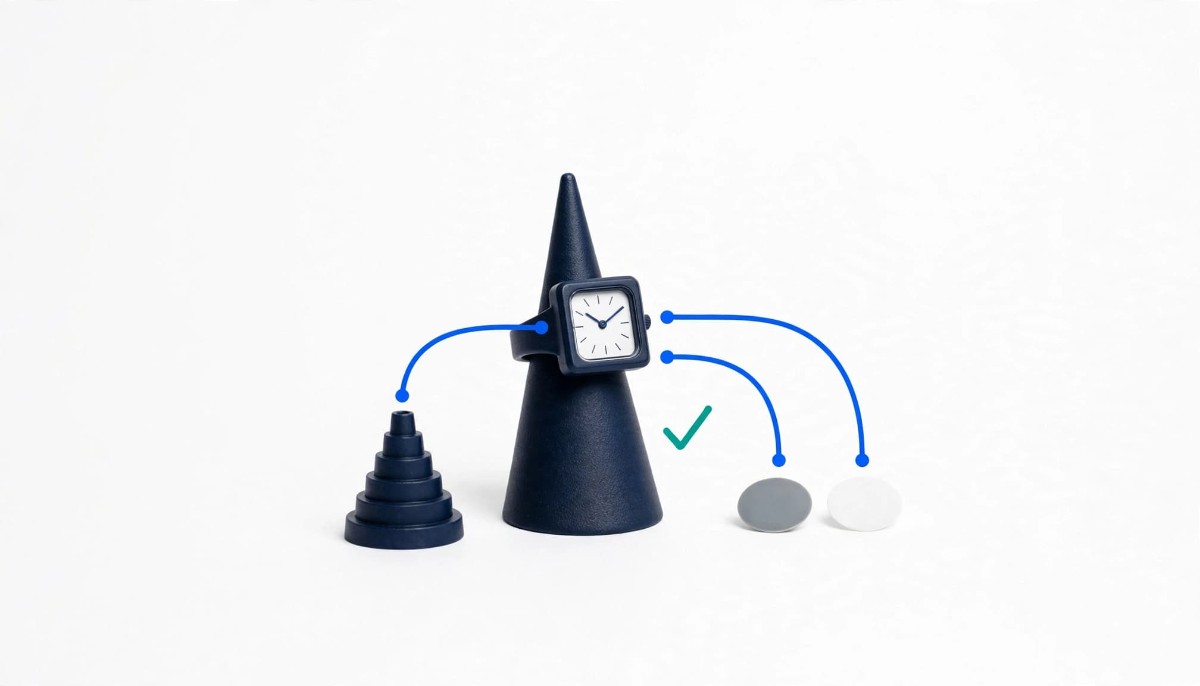
Small wearable jewelry sells online when the product page answers four questions a shopper cannot test: which finger and size, what color it really is, how it holds up daily, and what happens if it is wrong.
A ring watch cannot be tried on, judged by color on a screen, or tested in water before it ships, which makes its product page a small test of everything a product page has to do.
A ring watch has a size range, a case height, a dial color, a water rating, a crystal type and a battery, and a shopper has to judge every one of them from a screen. PASCAL’s ring watches for women are the worked example in this guide, which makes them useful to anyone selling small wearables, from rings and bracelets to watches.
PASCAL contributed this piece, and eCommerce Fastlane rewrote it for a merchant audience. The product details come from PASCAL’s own product pages and were not independently tested, so treat them as the brand’s stated specifications.
Small wearables create purchase doubt because every question that matters, including fit, color and durability, has to be answered by the page instead of by hands and a mirror. In a shop, a customer slides the ring on, turns it under the light and asks about the battery. Online, the page is the only sales associate. Fastlane’s guide to how online jewelry brands help shoppers choose with confidence makes the same point: a product page has to answer what a store associate would answer in person, from how the piece looks when worn to what happens if it is not right.
The numbers support the worry, with caveats. One finance advisory roundup puts online fine jewelry returns at roughly 8% to 15%, higher than in store because the buyer cannot size or inspect the piece first. A returns software vendor adds that after sizing, the most common jewelry return reason is an item that did not look as expected. Both figures are vendor and advisory estimates, not audited industry data, so use them as direction. The number that matters is your own return reasons by product.
A ring watch page answers the fit question by putting the adjustable size range, band width, case dimensions and weight in plain numbers beside the size selector. PASCAL lists its Sofia Prism with a stainless steel band 7.3 mm wide that fits ring sizes US 6 to US 10, a case of 21 mm by 21 mm and 10 mm tall, and a weight of 17 grams. Those figures answer most of what a shopper wonders before buying: will it fit my finger, will it look large, and will it catch on a sleeve.
Fit also includes which finger. A shopper who has never worn a watch on a finger needs a short line of guidance: the middle finger gives the most presence because the dial sits at the center of the hand, the index finger suits people who gesture a lot, and the ring finger gives a softer look when the watch replaces a cocktail ring. That sentence is product copy the shopper would otherwise have to ask for.
Two cautions apply. An expansion band only flexes so far, so say plainly what happens at US 5 or US 11 instead of leaving those shoppers to guess. And a full size chart is optional for a stretch band with a stated range, which a small store can leave out until support emails show a pattern of size misses. Showing the piece on a hand settles the scale questions that numbers leave open, and Fastlane’s guide to model worn jewelry photos covers how stores produce those images without a full studio shoot.
Show dial color honestly by naming each colorway, photographing it in more than one light, and placing swatches where the shopper chooses the variant. PASCAL’s Sofia Prism line shows why: Blueberry Fondant is a pink dial in a gold tone case, Mint Chocolate is a mint green dial, Tequila Martini is an emerald green dial, and Starry Night is a silver tone version. A pink dial and a mint dial are different purchases rather than different sizes, so a shopper who picks the wrong one returns the watch for a reason no size chart can fix. Fastlane’s guide to color swatches on product pages covers how to display variants so the choice is visible before the click.
Lighting matters as much as the swatch. The same returns vendor advises photographing jewelry in natural and indoor light because color shifts between them, and including a coin or ruler for scale in at least one image.
Styling copy belongs here too, because it answers the question behind the color question: will this go with what I already wear. A gold tone case sits naturally beside yellow gold rings, while a silver tone case suits white gold, platinum toned and sterling pieces. A dial acts like a gemstone, so pastel dials suit spring colors and cream knits, while a deep green dial anchors navy, grey and black. Writing those pairings into the description turns a color name into a decision.
One wording rule applies when a listing names stones. The FTC’s Jewelry Guides, codified at 16 CFR Part 23, treat the use of a stone name or the word gemstone for a lab-grown stone as deceptive unless a qualifier such as laboratory-grown appears with equal prominence. PASCAL describes the baguette cut stones on the Sofia Prism as lab-grown, so a listing should say so in the same line that names them. This is general information, not legal advice.
State every durability claim next to its limit: a 3 ATM rating belongs on the page beside the sentence that the ring should come off for swimming, the gym and dishwashing. ATM ratings come from the ISO 22810 standard for water resistant watches, and watch care guides read 3 ATM as protection against rain, splashes and handwashing only. A shopper who reads only water resistant and wears the ring in the pool creates a warranty problem, while one who reads the limit has a correct expectation.
Crystal type is the other durability spec. PASCAL lists a scratch resistant sapphire crystal on the Sofia Prism. Sapphire rates 9 on the Mohs hardness scale, second only to diamond, and mineral glass rates lower, which helps on a finger that brushes against desks and car doors. Hardness is not impact toughness, so the copy should promise scratch resistance and nothing more.
The argument for stating limits is simple, but no measured result for ring watches specifically was found, so treat it as a hypothesis to test. Write the limits, then watch whether not as expected return reasons fall over the next quarter. If conversion dips without any change in returns, the limit sentence can move lower on the page without being removed. Specifics also calm worry before checkout, and Fastlane’s breakdown of which website features calm buyers covers clear return terms and detailed product information among the fixes.
On the product pages reviewed for this guide, the spec details answer five shopper questions and leave two open. The answered questions are size range (US 6 to US 10), case size and height (21 mm by 21 mm and 10 mm tall), weight (17 grams), water resistance (3 ATM) and crystal (sapphire). The open ones are battery life, because the pages state a PC21 quartz movement but no figure for how long a battery lasts, and the service route when it runs down. Return terms were outside the scope of this review, so check your own separately.
The fix for any seller with the same gap is one line on battery replacement. If the number is not known, say so and describe how replacement works instead of inventing one. A buyer will ask the question after purchase anyway, and answering it before purchase is cheaper than answering it in a support inbox.
The subtraction matters as much as the addition. A separate ring sizer tool and a long size chart are optional for an adjustable band until return data says otherwise, so a seller with limited time should keep the five numbers above, in the order a shopper asks them, and skip the extra apparatus.
The order of fixes changes with stage because each stage has a different constraint. This is illustrative guidance, not benchmark data. Under roughly $10K a month, the constraint is time, so put size range, case dimensions, weight, water rating, crystal and battery on the page in plain sentences, which costs an afternoon and no apps.
Around $100K a month, shoppers arrive from several channels and variants multiply, so fix imagery next: swatches at the variant selector, a hand shot for scale, and photos in two lights. Fastlane’s look at product pages that cut returns with in scale photos shows why a picture next to a familiar object beats a number in millimeters.
Around $1M a month, the question shifts from what to add to what to measure. Tag return reasons by variant so a pink dial that returns twice as often as a mint one shows up in a report instead of an email thread, then revisit the story around the product. Fastlane’s guide to storytelling in high end ecommerce covers craft notes, provenance and care details that belong on a product page.
The common mistake at every stage is adding tools before the page states its facts. A sizing app, a virtual try on and a review widget each solve a real problem, but none of them fixes a page that never says how heavy the watch is.
A ring watch product page should state the adjustable ring size range, band width, case dimensions, weight, water resistance rating, crystal type and movement in plain numbers near the size selector. Add colorway names with swatches, photos in more than one light, and a hand shot that shows scale. Include one line on how the battery is replaced, because a quartz movement will need it eventually. Pair the water rating with its limit, such as taking the ring off for swimming, the gym and dishwashing. PASCAL lists a US 6 to US 10 band, a 10 mm tall case, 17 grams, 3 ATM and a sapphire crystal for its Sofia Prism, which makes a useful reference point.
You reduce returns on adjustable rings by stating the size range, saying what happens outside it, and showing the piece on a hand. Fit is only one return reason: a returns software vendor reports that after sizing, the most common reason for jewelry returns is that the item did not look the way the customer expected, so color accuracy and scale matter as much as size. Photograph in natural and indoor light, name colorways exactly, and put return terms near the add to cart button. Then tag return reasons by product and variant, because your own data will show which fix to make next.
Describe water resistance with the rating and its practical limit in the same sentence. A 3 ATM rating comes from the ISO 22810 standard and is generally read as protection against rain, splashes and handwashing, not swimming or showering. A line such as 3 ATM water resistant, remove for swimming, the gym and dishwashing sets the right expectation before the purchase. Avoid the word waterproof, which a 3 ATM watch does not earn. If you sell several models, give each its own rating, because ratings differ between products and shoppers compare them.
A store selling adjustable rings does not need a full ring size chart if it states the size range clearly, such as US 6 to US 10, and says what to do outside it. Stretch and expansion bands flex within a range, so the main shopper question is whether their size falls inside it. Add a measuring guide only when support emails or return reasons show a pattern of size misses. For fixed size rings, a chart with measuring help matters far more. Start with the stated range, then let your own data decide whether a chart earns its space on the page.
A ring watch listing should show the watch on a hand for scale, a close up of the dial in natural light, a second view in indoor light, and a clean front shot on a plain background. Add a coin or ruler in at least one image if you can, and show each colorway as its own photograph rather than recoloring a single image. Hand shots can be produced without a full studio shoot, so the smallest store can start there. Keep the lighting consistent across colorways so shoppers compare dial colors and not photography.
Yes, under the FTC’s Jewelry Guides a seller who names a stone or calls it a gemstone while it is lab-grown should disclose that with equal prominence, such as laboratory-grown beside the stone name. The guides are codified at 16 CFR Part 23, which treats an unqualified gemstone name for a lab-grown stone as deceptive. Put the qualifier in the same line as the stone name, not in a footnote. PASCAL describes the baguette cut stones on its Sofia Prism as lab-grown. This is general information, not legal advice, so check the current guides or ask a lawyer about your situation.