

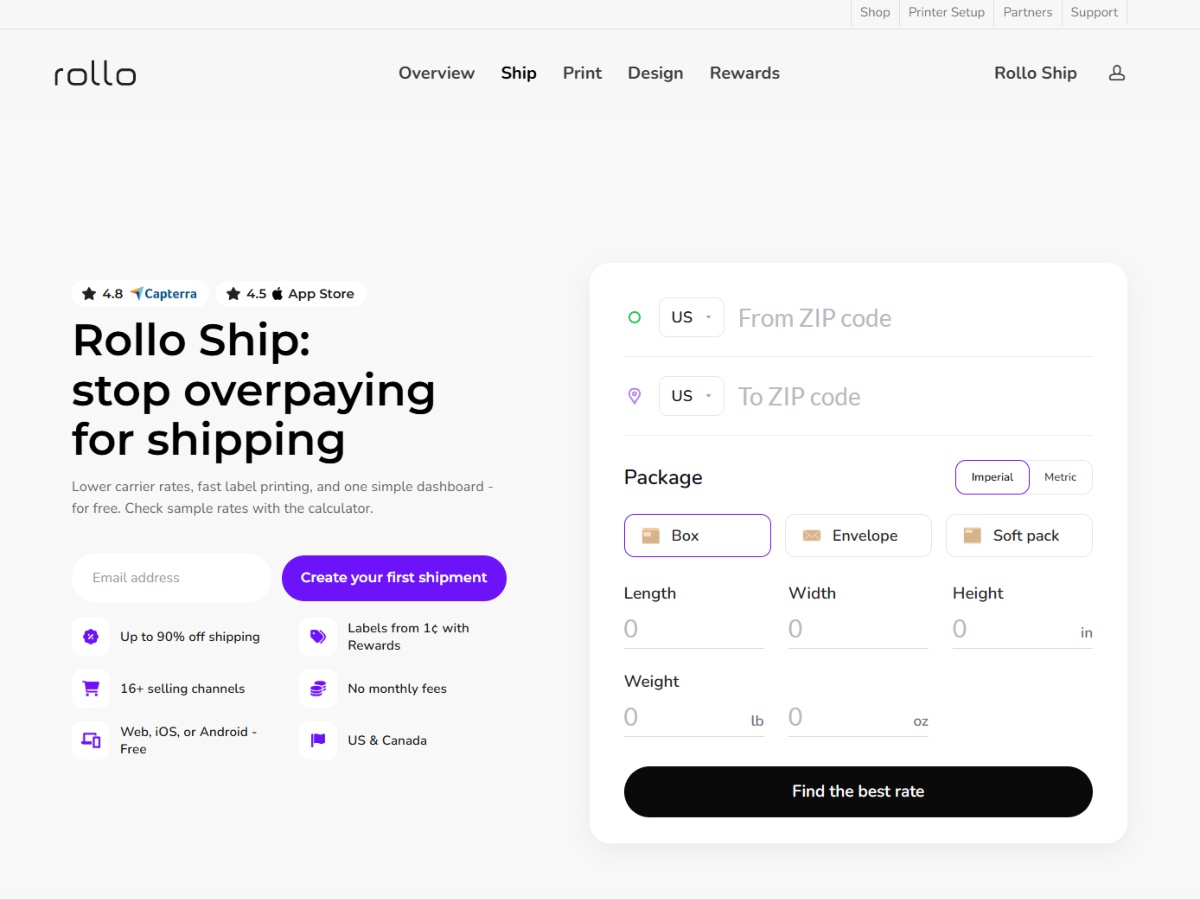
Rollo Ship is a strong fit for US and Canadian solo sellers who need to compare carriers, buy labels, and print from a phone without paying a monthly software subscription. It is less suitable for warehouse teams that need complex automation, multi-user controls, or dedicated pick-and-pack workflows.
For a solo seller, the expensive shipping problem is often not the label price. It is the unmeasured delay between a paid order arriving and someone being able to make a correct fulfilment decision.
There’s a number most solo sellers never measure: how long a paid order sits before it becomes a label. Not how long the carrier takes. Not how long packing takes. The dead time in between, when the order exists, the box is ready, and nothing is happening because the software lives on a computer in another room.
For a warehouse, that number is close to zero by design. For an operator who sells from a spare bedroom and works a day job or runs the store between school pickups, it’s routinely eight to thirty hours. The orders don’t stop arriving during that window; they queue. And a queue is where the expensive mistakes live, because Sunday-night batch processing is when you stop checking dimensions and start guessing at service levels. Lag isn’t a scheduling annoyance. It’s a cost.
Rollo Ship is built for people whose lag problem is a location problem. It’s a free multi-carrier shipping software and app used by e-commerce sellers and regular shippers across the US and Canada, with USPS, UPS, FedEx, Canada Post, and Purolator all quoting into the same rate comparison. Capterra users give Rollo Ship 4.8 stars. Separately, it carries a 4.5-star rating on the US iOS App Store from roughly 1,400 ratings. The design decision that distinguishes it is narrow but consequential: the iOS and Android apps run the same feature set and the same free plan as the browser version, rather than acting as read-only companions to it.
This review tests whether that holds up in practice.
Every shipping tool claims mobile support. The claim is nearly meaningless on its own, so use a single test instead: can you take an unfulfilled order all the way to a printed label without touching a computer?
Most platforms fail it somewhere in the middle. You can view the order. You can scan a barcode. You can check tracking. Then you hit a step — editing package dimensions, choosing a non-default service, sending to the printer — that quietly requires the desktop, and the whole trip was for nothing. Half a workflow is worse than none, because you did the work twice.
Rollo Ship passes it. Store connection, rate comparison across all five carriers, label purchase, and printing all happen on the phone. The Rollo Wireless Thermal Printer (X1040) joins over Wi-Fi, which removes the last hidden dependency — no cable, no driver install, no laptop quietly serving as a print server in the corner.
| Carriers | USPS, UPS, FedEx, Canada Post, Purolator |
| Markets | US and Canada, both origins, plus cross-border |
| Platforms | Web, native iOS, native Android — identical features, identical free plan |
| Pricing | No subscription; label-service fee waived on first 200 labels (one-time), then 5¢ per label, as low as 1¢ at the VIP tier of Rollo Rewards; postage paid separately |
| Integrations | 16+ live, including Shopify, Amazon, eBay, WooCommerce, TikTok Shop, Walmart, Wix, Square, BigCommerce |
| Bundled free | Inventory management across multiple stores, in USD or CAD |
One clarification on carriers: FedEx works by connecting your own FedEx account. Rollo Ship displays those rates next to the others so the comparison is complete, but it isn’t reselling FedEx pricing to you.
The seller with a day job. This is the largest group and the least discussed. Orders that used to wait until evening get handled in a ten-minute gap at lunch. The box still gets packed at home, but the label, the rate decision, and the customer notification are already done.
Exchanges and reprints. A wrong address or a damaged label used to mean the whole task went back into the queue. Now it’s resolved standing next to the parcel.
Sellers with inventory in more than one place. Stock at home, overflow in a storage unit, some items with a partner. If the shipping software only runs where the computer is, one of those locations is always the bottleneck.
Anyone whose volume arrives in bursts. Live-selling drops, market weekends, launch days. The pattern is well known; the point here is that on-site fulfillment turns those hours from a backlog generator into a clearing window.
Underneath all four is the same secondary benefit. Because Rollo Ship’s e-commerce and shipping automation tool compares the full five-carrier lineup at the moment of label creation, grouping similar orders and surfacing the cheapest qualifying service before you commit, handling shipments as they arrive doesn’t force you into a worse rate than batching would have. Immediacy usually costs money. Here it doesn’t.
For Canadian and cross-border sellers there’s a further wrinkle worth naming: Canada Post and Purolator sit in the same account as the US carriers, and inventory tracks in CAD or USD. Sellers currently running one platform per origin country can collapse to one.
Scope, not verdicts. Here is what each platform covers.
Pirate Ship is free and quotes USPS and UPS from US origin, through a web interface. No FedEx, no Canadian carriers, no Canadian origin, and no native mobile apps.
ShipStation is a paid subscription platform. Its feature set is built around multi-warehouse operations, rules-based automation, and staff permissions, and its mobile app is scoped to order visibility rather than end-to-end label creation.
Shippo and Easyship both quote a wider international carrier list than Rollo Ship, and Easyship includes duty and tax estimation for cross-border shipments. Neither offers a free tier structured like Rollo Ship’s.
The combination Rollo Ship is offering — five carriers, two countries, full mobile parity, no monthly fee — is what’s unusual. No single component of it is.
There’s no subscription. Rollo Ship waives its label-service fee on your first 200 labels, a one-time allowance rather than a monthly one. Past that, each label carries a 5¢ fee. Rollo Rewards is a five-tier program that pulls the per-label fee down as volume rises, bottoming out at 1¢ at the VIP tier. Postage is paid to the carrier on every label, including the first 200. Inventory management is included rather than sold separately, which is the clearest line-item gap against subscription platforms that charge for stock tracking on top of shipping.
At 150 labels a month, the first month costs nothing in fees and the second costs $5, once the waiver runs out partway through. After that, fees run $7.50 a month, or $1.50 at the VIP tier. At 400 labels a month, you pay $10 in the first month, then $20 a month, or $4 at the VIP tier.
The useful way to evaluate Rollo Ship isn’t feature-by-feature. It’s to answer one question about your own operation: is there a gap between when your orders arrive and when you’re physically able to act on them? If the answer is no, mobile parity is a pleasant extra and the decision comes down to carriers and price. If the answer is measured in hours, this is the variable the platform is aimed at.
For solo operators and small teams across the US and Canada — especially those who’ve outgrown a two-carrier, desk-bound setup but have no interest in a monthly bill — it’s a strong fit.
There’s no monthly subscription. Rollo Ship waives its label-service fee on your first 200 labels, a one-time allowance. After that, labels carry a 5¢ fee, dropping to as low as 1¢ at the VIP tier of Rollo Rewards. Postage is paid to the carrier separately. Inventory management across multiple stores is included at no extra cost, in USD or CAD.
Rollo Ship supports USPS, UPS, FedEx, Canada Post, and Purolator within a single shipping workflow for US and Canadian sellers. FedEx works by connecting your own FedEx account, after which Rollo Ship can display available FedEx rates alongside the other carrier options. That distinction matters because a connected carrier account may have separate eligibility, pricing, service, or billing requirements. Before changing your shipping process, confirm the available services, rates, account requirements, and origin support for the carrier mix your business uses most often.
Yes, Rollo Ship is designed to let sellers connect stores, compare carrier rates, buy labels, and print from its iOS and Android apps without opening a computer. This is particularly useful for sellers who pack from home, storage units, markets, or other locations where a desktop workstation is not available. The Rollo Wireless Thermal Printer X1040 connects through Wi-Fi, removing the need for a cable or laptop-based printer connection. Test the complete mobile workflow with your own phone, store, and printer before relying on it during a busy fulfilment period.
Yes, Rollo Ship supports Canadian sellers and Canadian shipping origins, with Canada Post and Purolator available alongside USPS, UPS, and connected FedEx accounts. This can simplify operations for brands shipping within Canada, from the US, or across the border because sellers can compare relevant carrier options through one account. The platform also supports inventory tracking in Canadian dollars or US dollars. Canadian businesses should still verify carrier-service availability, cross-border customs requirements, product restrictions, duties, taxes, and delivery expectations for their specific products and destinations.
Rollo Ship is not a strong fit for businesses that need a full warehouse-management workflow with multiple pick stations, employee permissions, advanced routing rules, and high-volume operational controls. Those teams will usually benefit from a subscription platform built for coordinated fulfilment. It is also a weaker fit for sellers whose inventory originates mainly outside the US and Canada, where local carrier access and regional support matter more than North American carrier coverage. Finally, brands using a 3PL for label purchase and dispatch should focus on provider accountability and integrations rather than shipping-software selection.




