

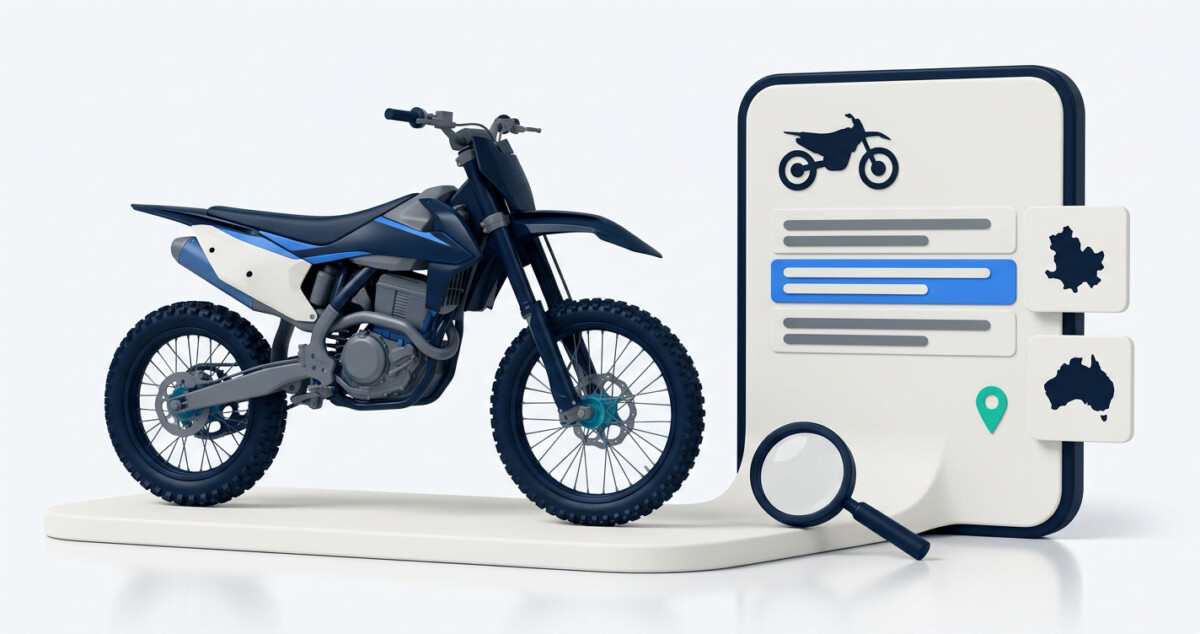
Selling electric dirt bikes online in 2026 makes your product page part of your legal exposure. Four states redrew the e-bike line by pedals, wattage and top speed, so every listing should state those specs, where the vehicle is legal to ride, and who can ride it.
The same 45 mph machine is an off-road motorcycle in one state, a titled motor vehicle in another, and simply cannot be sold online as a bicycle in a third. Your product page is the only place a buyer sees all of that before they pay.
The Heybike V1 electric dirt bike lists at $1,299 on sale. It has a 4,160 watt peak mid-drive motor, a 1,352 watt hour battery, three riding modes topping out at 45 mph, and no pedals. Scroll to the FAQ on its product page and you will find the sentence that matters most: the bike “is designed for off-road use only.” A safety reminder further down asks buyers to confirm the rider is 14 or older before ordering.
None of that is unusual for the category. What changed in 2026 is that four states stopped letting the category define itself. New Jersey, Washington, Illinois and California each rewrote where a bicycle ends and a motor vehicle begins, and New Jersey’s version reaches online sellers directly. If you sell anything with a battery and a throttle, the spec sheet you used to treat as marketing copy is now the first thing a regulator, a payment processor or a disputing customer will read.
This piece uses electric dirt bikes as the live case because the rules moved fastest there, but the playbook applies to any product where the law is catching up with the hardware: drones, high-powered scooters, hemp beverages, anything with an age floor or a state line in its future.
In 2026, four states redefined the e-bike by pedals, motor wattage and top speed, and New Jersey now restricts how the fastest pedal-equipped models can be sold online, with California poised to follow on labeling. In short, “e-bike” is becoming a protected term, and anything that exceeds it is being pushed toward motor vehicle rules.
New Jersey moved first. New Jersey’s P.L. 2025, c.285 (bill S4834), signed January 19, 2026, created an “electric motorized bicycle” category for any two-wheeler with operable pedals, a motor above 750 watts and a top speed above 28 mph. It requires sellers to make registration forms available to buyers, bans the sale of kits that turn a low-speed e-bike into something faster, and for one year after it took effect prohibits selling or offering an electric motorized bicycle on the internet at all.
Washington’s ESSB 6110, effective June 11, 2026, caps e-bikes at 750 watts, requires manufacturers and distributors to affix a permanent label showing class, top assisted speed and motor wattage, and excludes any vehicle “designed, manufactured, or intended by the manufacturer or seller to be easily configured” around those limits by switch, software or app. Illinois SB 3484, signed August 26 and effective January 1, 2027, treats electric motor-driven cycles between 750 and 8,000 watts as titled vehicles. In California, SB 1167 passed the legislature in late August and, at the time of writing, awaits the governor; it would bar advertising, labeling or selling anything over e-bike limits as an e-bike.
Your product’s legal category is now set by three specs, whether it has operable pedals, its motor wattage and its top speed, and not by the name on your collection page. Get those three right for every SKU and most of the downstream decisions become mechanical.
Look at how the New Jersey definition works. The electric motorized bicycle category, the one that cannot be sold online for a year, requires fully operable pedals. A machine like the V1, with no pedals and a 45 mph top speed, is not in that category at all. It sits outside bicycle law entirely, in off-road vehicle and motorcycle territory, which is exactly why Heybike labels it off-road only. A pedal-equipped 1,000 watt “e-bike” that tops out at 32 mph, on the other hand, lands squarely inside the new ban. Two products that look like cousins on a collection page end up with opposite obligations.
Illinois shows the other side of the same coin. Its new law gives 750 to 8,000 watt machines a path to registration, but as Electrek’s analysis of the Illinois law points out, a titled vehicle needs a VIN and has to meet federal motor vehicle safety standards, and most 35 to 40 mph e-bikes were never built to either. A buyer who reads “street legal in Illinois” in a headline and then buys your bike expecting a plate is a return, a chargeback or worse.
So the first job is an internal one. Pull every powered SKU into a spreadsheet with four columns: pedals (yes or no), continuous and peak wattage, top speed in each mode, and whether any mode can be unlocked by app or setting. That last column matters because Washington now treats “easily configured” products as outside e-bike rules, and a 20 mph mode that unlocks to 38 mph in the app is the textbook example. Whether you run four bikes or forty, this takes an afternoon, and it becomes the source of truth for everything that follows.
An honest e-moto product page shows seven facts in a structured block next to the price: vehicle category, motor wattage, top speed per mode, pedals or not, where it is legal to ride, minimum rider age, and battery test standard. If a buyer has to open an FAQ accordion to learn that the product cannot go on a public road, the page is not doing its job.
Heybike’s own electric dirt bike for adults collection is a useful reference because it already says most of the right things. The collection copy notes that these bikes are “generally designed for off-road riding, and street-legal requirements vary by state,” and the V1 product page carries the off-road only statement and the age confirmation. The improvement available to most brands in this category, Heybike included, is placement: moving those statements out of the FAQ and the safety reminder and into a spec block that sits beside the add to cart button, where they are read before purchase rather than after.
On Shopify, the clean way to do this is with product metafields. Create seven metafield definitions (category, peak wattage, top speed by mode, pedals, riding use, minimum age, battery standard) and connect them to a dedicated section through the theme editor’s dynamic sources. No app is required on an Online Store 2.0 theme. Write the riding use field as a use class (“Off-road only. Not an e-bike. Street use rules vary by state”) rather than a list of legal states, so it stays true when a state changes its law and never promises legality you have not verified. The same structured fields do double duty for machine readers, which is the argument in our guide to structuring Shopify product data so AI shopping agents can query it.
The battery field deserves its own line. California’s SB 1271, per the Assembly committee analysis, has since January 1, 2026 prohibited selling an e-bike unless its battery was tested by an accredited lab to a standard such as UL 2849, and requires the seller to produce the test report on request. If you have that report, say so on the page. If you do not, that is a sourcing conversation to have this quarter, not after a return.
You control where a regulated product ships with a dedicated Shopify shipping profile, and you control who buys it with an ID based age verification app at checkout. Neither needs custom code, and both are far cheaper than a single disputed order on a $1,300 vehicle.
Start with shipping. Shopify’s shipping profiles let you put specific products in a custom profile (you can create up to 99) and choose exactly which zones that profile ships to. If you sell a pedal-equipped machine that meets New Jersey’s electric motorized bicycle definition, remove New Jersey from that profile until the one year online sale window closes, and keep it in the profile for your compliant low-speed bikes. Heybike’s V1 page currently excludes Alaska, Hawaii, Puerto Rico and P.O. boxes, which is a freight decision; a regulated catalog needs the same mechanism applied to legal decisions, reviewed every time a state passes a law.
Age is the harder control. A pop-up that asks “are you 18?” is a courtesy, not verification. Our overview of why Shopify businesses selling restricted products need an age verification system covers the case for it; the practical question is cost. BlueCheck’s Shopify app verifies age at checkout using name and address, photo ID or the last four of a Social Security number, starting at $25 a month for 25 verifications and $1.25 each after that. The AgeChecker.Net Shopify app starts at $25 a month as well. At 200 verified orders a month, BlueCheck’s $100 medium plan plus overage comes to roughly $175, a rounding error against a $1,300 average order.
One more check before you move on: confirm your payment setup is comfortable with the category. Powered vehicles are not on Shopify’s standard prohibited list, but our breakdown of what Shopify Payments prohibits and restricts is worth a read before you add anything adjacent, such as speed unlock kits, which New Jersey now bans outright.
A regulated product line deserves its own storefront when its legal status, age floor or shipping map differs enough from your core catalog that mixing them would force you to weaken the rules on one to fit the other. Below that threshold, a separate collection with its own shipping profile is simpler and cheaper.
Heybike is the live example. Its commuter e-bikes sell on the main heybike.com store, and when it launched its first electric dirt bike at CES in January 2026, it put that line on Heybike Sports, a separate Shopify storefront on its own subdomain. The company’s CES 2026 announcement framed the move as the brand becoming “a comprehensive electric mobility brand,” and Electrek’s launch coverage of the Villain (the V1’s launch name) pegged it at $1,499 MSRP and 125 pounds.
The split buys three things. The off-road product gets its own age confirmation, shipping rules and return terms without touching the commuter bike checkout. The core brand keeps a clean “street legal e-bike” story, which matters more every time a state protects that term. And if a state bans online sales of a category outright, you can turn off one store’s shipping zone without auditing a mixed catalog.
The costs are real too: a second theme to maintain, a second customer list, split SEO authority across a subdomain, and a second set of apps. Our practical guide to managing multiple Shopify stores is blunt that this only works with clearly different customer segments. My rule of thumb: under roughly $1M a year, run the regulated line as its own collection and shipping profile. Above that, or once the regulated line has a different buyer (a parent buying for a 14 year old is not your commuter customer), the second store starts earning its overhead.
Clear disclosure protects you because “item not as described” is the dispute reason that does the most damage on a regulated vehicle, and a timestamped product page that states category, legal use and age is the strongest evidence you can submit. A buyer who expected a street legal bike and got an off-road machine will dispute; your page is what decides who wins.
Our Shopify chargeback prevention playbook rates “not as described” disputes as low to medium win likelihood, and names the evidence that moves the needle: product page screenshots, specs and customer messages. A spec block that says “Off-road use only. Not an e-bike. Check your state and local rules before riding on public land” is that evidence, written before the dispute exists. It also cuts returns, because the buyer who needed a street legal commuter self selects out before paying freight both ways on a 125 pound box.
I learned a version of this selling contact lenses online at VisionPros. When regulators define your product, the checkout and the product page stop being marketing and become the compliance record, and every order needed a verified prescription before it shipped. The brands that treated that as a feature, stating the rules plainly and building them into the flow, had fewer disputes and more repeat customers than the ones that tried to make it disappear. E-motos are heading down the same road, and the sellers who build the disclosure in now will not have to rebuild their pages every time another state votes.
This quarter, every seller of powered hardware should classify every SKU, add a structured disclosure block, and set up state level shipping controls, with the storefront question reserved for brands above roughly $1M in the regulated line. The order of operations matters more than the size of the catalog.
If you are under $500K a year, do the spreadsheet and the disclosure block first. That is two to four days of work, it needs no apps beyond what your theme already supports, and it covers most of your exposure. Add New Jersey to an exclusion list if any SKU meets its definition. Skip the second storefront; you do not have the team to run two.
Between $500K and $2M, add an ID based age verification app to the regulated collection and a custom shipping profile per legal category. This is the stage where I see brands most tempted to add another channel or another product type instead, and it is the wrong move. Premature complexity is what stalls stores at this size, and a clean compliance layer on the catalog you already have beats a new product line with the same gaps.
Above $2M, assign one person to track state legislation quarterly, keep your battery test reports on file and linked, and make the storefront decision deliberately. Watch California: if SB 1167 is signed, “e-bike” becomes a term you cannot use for anything over the limits, and every collection name, ad and product title needs checking. Washington’s electric motorcycle workgroup files an interim report in December 2026, with final recommendations due in October 2027, so expect a second round there. None of this will be irrelevant in 18 months. It is the direction every state in this category is heading, and the product page is where you meet it.
You can sell some electric dirt bikes online into New Jersey, but not ones that meet the state’s “electric motorized bicycle” definition during the first year after S4834 took effect in January 2026. That category covers two-wheelers with operable pedals, a motor above 750 watts and a top speed above 28 mph. Machines without pedals fall outside that definition and are generally treated as off-road vehicles or motorcycles instead, which carry their own rules. Check each SKU against the definition, exclude New Jersey from the shipping profile for any product that meets it, and make registration forms available for the categories that require them. When in doubt, have counsel review the specific model before you ship.
At minimum, show vehicle category, motor wattage, top speed in each mode, whether it has pedals, where it is legal to ride, minimum rider age and battery test standard. Washington now requires manufacturers and distributors to label e-bikes with class, top assisted speed and wattage, and your page should match that label, and California’s pending SB 1167 would bar labeling anything above e-bike limits as an e-bike. Putting those seven facts in a structured block next to the price, built with Shopify metafields, keeps the page accurate for shoppers, AI agents and payment dispute reviewers at the same time. Burying them in an FAQ tab is the most common gap in this category.
Put the product in its own custom shipping profile and leave the excluded states out of that profile’s shipping zones. Shopify allows up to 99 custom profiles, and each can have its own zones and rates, so a regulated product can ship to 45 states while the rest of your catalog ships everywhere. Customers in an excluded state will see that the item cannot be shipped to their address at checkout. Review the profile every time a state changes its law, and keep a short internal note explaining why each state was excluded so the next person on your team does not quietly add it back.
You need age verification whenever your product has a stated minimum rider age or a state sets one, and a checkbox or pop-up alone does not verify anything. New Jersey sets a minimum rider age of 15 for its e-bike categories, and many electric dirt bikes list a 14 or 16 year minimum. ID based apps such as BlueCheck verify at checkout using name and address, photo ID or partial Social Security number, starting around $25 a month. For a product with a four figure price, the per order cost is small, and it gives you evidence if a parent later disputes a purchase made by a minor.
Sell them on a separate store if their legal status, age floor or shipping map is different enough from your core catalog that sharing a checkout would weaken the rules on one side. Heybike launched its dirt bikes on a separate Heybike Sports storefront, which keeps the commuter e-bike store clean. Below roughly $1M a year in the regulated line, a dedicated collection with its own shipping profile and age check is usually enough. A second store adds a theme, apps, a customer list and split SEO authority to manage, so make that call when the buyer is genuinely different, not before.




