

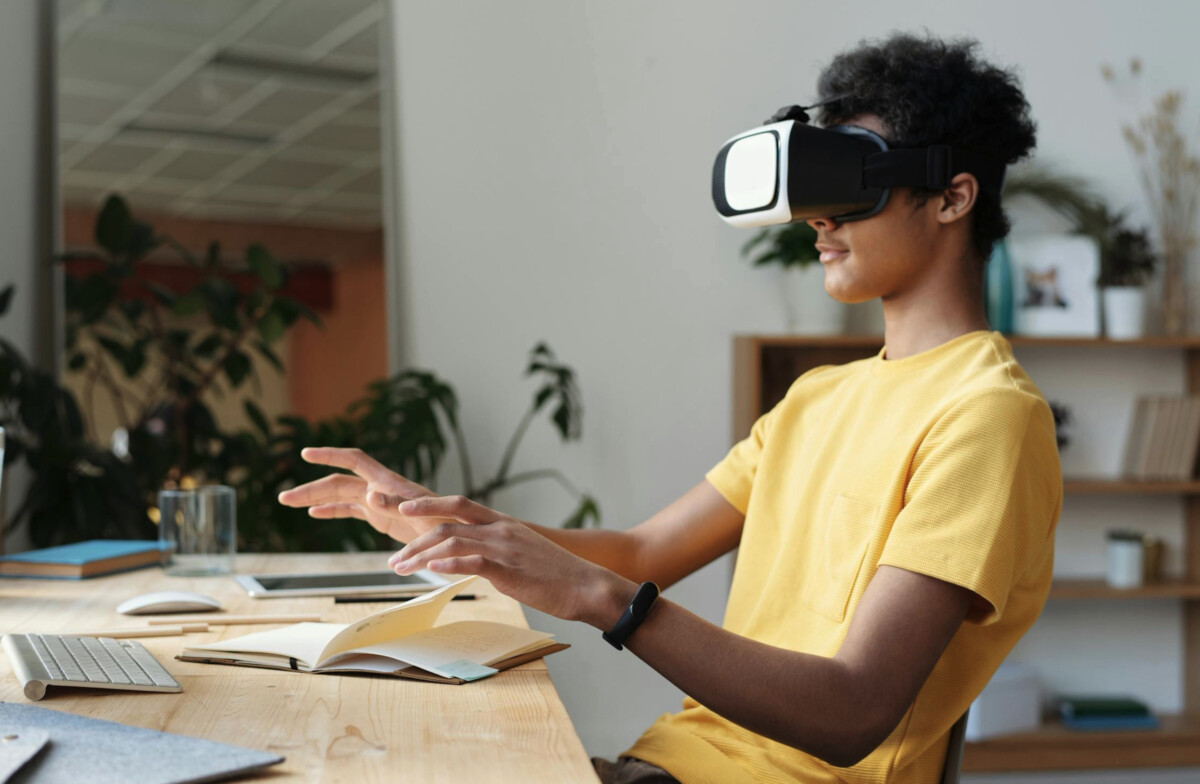
For most Shopify merchants in 2026, immersive commerce that pays off means native 3D models and AR on product pages, not headset VR. Headset VR earns its place only at scale, in virtual showrooms, experiential retail, and staff training, typically above $2M in revenue.
The merchants who lose money on VR are rarely the ones who skipped it. They are the ones who bought headsets before they had a single 3D model on a product page.
For the large majority of Shopify merchants, headset VR does not matter yet, but immersive commerce does, and the version that pays off today is 3D and AR on your product pages, not a headset program. The word VR makes people picture someone strapping on a headset in their living room. That is the consumer fantasy. The commercial reality runs along a spectrum: flat product photos at one end, interactive 3D models and phone-based augmented reality in the middle, and headset-based virtual reality at the far end. Almost all of the return for a typical store sits in the middle of that spectrum, not at the headset end.
This matters because immersive media is now built into the platform. When Shopify added built-in support for 3D models and video on product pages, it put interactive 3D and AR within reach of any store without custom code or a third-party app. Shopify reported that 3D models viewed in AR lifted conversion by up to 250% on certain product pages. That is the lever most merchants have not pulled yet.
Apply the 18 month filter before you spend a dollar on anything immersive. Will this investment still be paying its way in 18 months, or are you buying it because the technology is interesting? Whether you are doing $10K months or $1M months, the trap is the same: reaching for the headset because it is exciting, when the 3D model would have moved the number and the headset will sit in a drawer. I have sat across from founders who budgeted five figures for a VR activation while their best-selling product page still ran on three flat photos shot in 2021. The headset was the exciting line item. The flat photos were the actual leak, and the cheaper fix was the one nobody wanted to talk about.
At $0 to $250K, the immersive move that pays off is uploading native 3D models to your highest-traffic product pages, which costs nothing in Shopify app fees and lifts add-to-cart and order rates. Shopify’s core themes can display 3D models by default. You upload native 3D models to your product pages the same way you upload an image, and on iOS and Android the same model renders in AR at real-world scale.
The numbers are concrete. Rebecca Minkoff, reporting through Shopify, found shoppers who interacted with a 3D model were 44% more likely to add the item to their cart and 27% more likely to place an order, and that customers who viewed a product in AR were 65% more likely to buy. Bumbleride, a stroller brand, saw a 33% conversion increase and up to 21% more time on the product page after adding 3D models. These are not enterprise outcomes. They came from putting a model on a page.
The honest cost is the model itself. Native display is free, but producing a clean 3D model takes either a modeling service or a contractor, and a single model can run from a modest fixed fee into the low hundreds depending on complexity. Picture your own analytics for a second. The product doing the most sessions, the one customers zoom into and still email you about, is your first model. A shopper opens that page on a phone, taps to view the item in their space at real-world scale, and the question that used to generate a support ticket answers itself before they reach checkout. Skip this for cheap, low-consideration impulse products where a customer does not need to study the item. Start with your three or four highest-traffic, highest-consideration SKUs and measure the add-to-cart change before you model the whole catalog.
Between $250K and $2M, immersive commerce pays off when you add AR try-on or a 3D product configurator to considered-purchase categories, where reduced returns and higher average order value justify the build. This is the stage where the economics shift from conversion lift to returns avoidance, and returns are where margin quietly dies in categories like furniture, footwear, eyewear, and jewelry.
Augmented reality is the tool for spatial and fit uncertainty. Letting a customer place a sofa in their own room, on their own floor, against their own wall, removes the single biggest reason furniture comes back. In categories like furniture and footwear, return rates routinely run 20% to 40%, and a single wrong-size return can erase the margin on the order once you count two-way shipping and restocking. Shaving even a few points off that rate with better pre-purchase visualization compounds across every order you ship. The same logic covers AR for furniture and home goods, where a wrong-size return eats shipping both ways plus restocking. If you sell anything a customer has to imagine in a space or on their body, the the ROI math on adding AR usually clears the bar once your return rate is high enough to feel it.
For customizable products, a configurator earns its place. Apps such as VividWorks, Threekit, and Zakeke let a customer build and rotate a 3D version of a made-to-order product with live pricing, which both raises average order value and cuts the support load from people asking what their configuration will look like. Most of these run on a monthly subscription, so weigh the fee against the orders it actually influences. If your products are not configurable, skip the configurator entirely. The mistake at this stage is bolting on tools that do not match the catalog. When you are weighing choosing a 3D product configurator, start from the product, not the feature list.
Headset VR earns its place above roughly $2M in revenue, in three specific places: virtual showrooms for high-consideration catalogs, experiential retail and events, and staff or warehouse training, not on the consumer product page. At this stage you are no longer adding a media type to a page. You are running a program, with hardware, content, and the operational overhead of managing devices.
The hardware is the cheap part. A B2B-focused headset reseller will sell you an enterprise headset like the Pico 4 Ultra Enterprise for around $799 a unit, with mixed-reality passthrough and fleet features built for deployment rather than the living room. The expensive part is everything around it: building the 3D environment or training content, enrolling devices in mobile device management so a team can push apps and policies, hygiene between users, and the downtime when a headset needs reconfiguring. A profitable program budgets for the program, not the device. An expensive pilot buys headsets, runs one demo, and lets them gather dust.
Training is often the clearest case. Onboarding warehouse staff on picking and safety, or rehearsing high-stakes customer interactions, scales better in a repeatable virtual environment than in live shifts, and it pays back in reduced error rates and faster ramp. A warehouse that cuts new-hire ramp from three weeks to two, or trims its picking error rate, can see the program pay for itself within a single peak season, which is the kind of measurable outcome that separates a funded program from a novelty. Virtual showrooms work for catalogs too large or too expensive to display physically, letting a wholesale buyer or a high-ticket customer walk a full range. The test before you commit: if you cannot name the person on your team who will own this program, you are not ready to buy the headsets.
Decide by outcome first: pick the immersive investment that maps to a problem you can measure, and ignore the rest until it does. The four problems worth solving with immersive media are weak add-to-cart on high-consideration pages, high returns driven by fit or scale uncertainty, low average order value on customizable products, and slow or risky staff training. If you cannot tie the spend to one of those, the spend is premature complexity wearing a futuristic costume.
The pattern I have watched play out across hundreds of stores is that the ones stuck between $500K and $2M almost always have too many tools and not enough fundamentals. Immersive commerce is no exception. The right sequence is native 3D first, AR and configurators when returns or customization justify them, and headset VR only when you have a named program and the revenue to run it. Here is the same map in one view.
Start where the leverage is. If you have product pages live and a return rate you want to lower, this week’s move is not a headset. It is a 3D model on your best-selling page, measured against the add-to-cart rate you have today. Run that one test, read the result in your own analytics rather than in a vendor case study, and let the number decide whether you climb to the next rung. That discipline, outcome before tool and proof before scale, is what keeps immersive commerce a profit center instead of a line item you quietly regret at the next budget review.
Yes, Shopify supports 3D models, video, and augmented reality natively, without a third-party app. You upload a 3D model file to a product the same way you upload an image, and Shopify’s core themes can display it, with AR viewing available at real-world scale on iOS and Android devices. Depending on your theme, you may need a small theme update to surface the 3D and AR viewer in your storefront, which you can do yourself or hand to a developer. The practical takeaway for most merchants is that the platform cost of adding interactive 3D is zero. The real cost is producing the 3D model itself, which you commission once and then reuse across images, AR, and animations.
For a small Shopify store, headset VR is not worth it, but native 3D models and AR almost certainly are. Headset VR involves buying hardware, building or licensing content, and managing devices, which only makes economic sense once you have a defined program and the revenue to support it, usually above a couple of million in sales. A small store gets the same core benefit, helping customers understand a product before buying, from a 3D model on the product page that also works in AR on a phone. That investment costs nothing in platform fees and has been shown to lift add-to-cart and order rates. Spend there first and revisit headsets only when a specific use case appears.
AR reduces ecommerce returns by letting customers preview size, fit, and scale before they buy, which removes the guesswork that drives a large share of returns in considered-purchase categories. For furniture and home goods, a shopper can place a true-to-scale 3D model of a sofa or table in their actual room and confirm it fits before ordering, avoiding the costly round-trip of a wrong-size return. For fashion, footwear, eyewear, and jewelry, AR try-on helps a customer judge proportion and style on their own body or face. The economic point is that in these categories the cost of a return, including two-way shipping and restocking, is high enough that even a modest reduction in return rate can justify the cost of building AR-ready 3D assets.
The main cost of adding 3D and AR to product pages is producing the 3D model, not displaying it. On Shopify, native display of 3D models and AR carries no platform fee, so a store with in-house or contracted modeling can add interactive 3D for the cost of the asset alone, which can range from a modest fixed fee to the low hundreds per model depending on complexity. Paid tools sit above that: AR try-on and 3D configurator apps such as VividWorks, Threekit, or Zakeke typically run on a monthly subscription. Enterprise headset VR is a different order of magnitude, with hardware around several hundred dollars per device plus content, device management, and program overhead. Match the spend to the stage rather than buying at the top of the range.
An ecommerce brand should invest in enterprise VR headsets only when it has a specific, owned program that justifies the hardware and the operational overhead, which in practice usually means revenue above roughly $2M. The three programs that earn the investment are virtual showrooms for catalogs too large or expensive to display physically, experiential retail or event activations, and staff or warehouse training where a repeatable virtual environment beats live shifts. Enterprise headsets such as the Pico 4 Ultra Enterprise are built for fleet deployment, with mobile device management and shared-use features, because the hard part is running many devices over time, not buying one. The disqualifying test is simple: if no one on your team will own the program day to day, the headsets will not pay back.





