

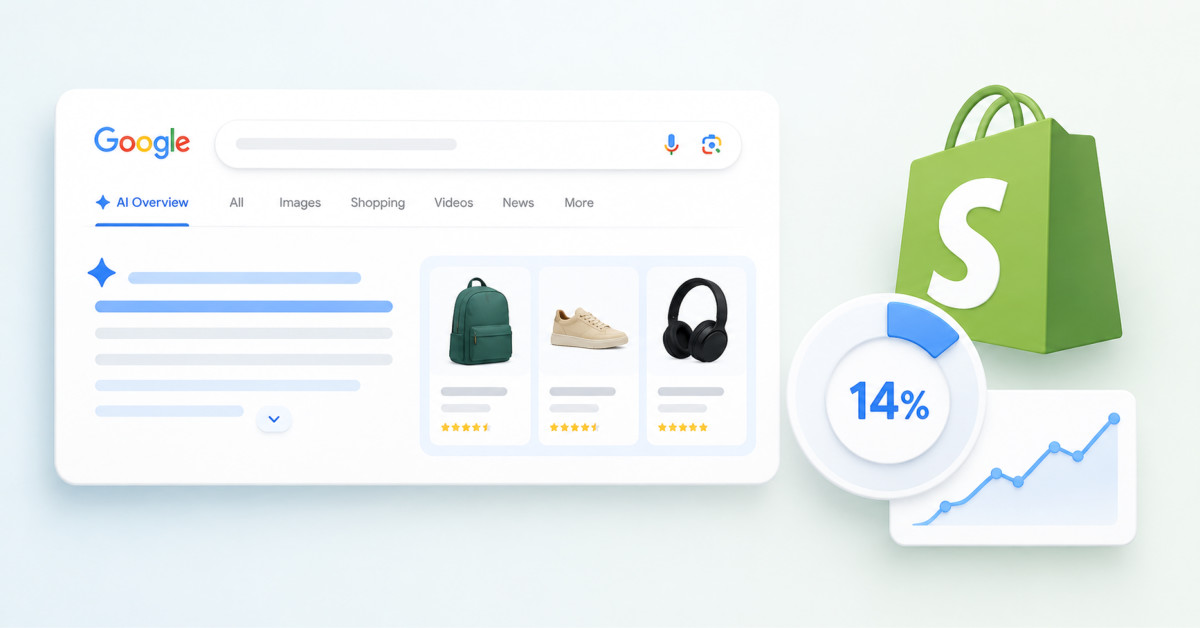
Google AI Overviews now appear across a meaningful share of shopping-intent searches, but Shopify merchants do not need special “AI schema” to participate. The durable advantage comes from indexable pages, accurate product data, consistent feeds and structured data, reliable rendering, and measurement across Google and Shopify’s AI shopping channels.
AI visibility is not a new marketing channel you can buy your way into. It is the result of whether search engines and shopping agents can identify, verify, and confidently present your product information.
In November 2025, AI Overviews appeared on 2.1% of a large set of shopping-intent Google searches. By March 2026, that figure had reached 14%, according to a Visibility Labs analysis of 20.9 million shopping keywords reported by Search Engine Land. Of those searches, roughly 2.9 million triggered an AI Overview.
That does not mean AI Overviews appear on 14% of every ecommerce search on Google. The dataset specifically tracked product-intent keywords associated with paid or organic Shopping results, including searches such as weighted blankets, mushroom coffee, protein powder, and blue T-shirts.
But for Shopify merchants, that distinction does not make the trend less important.
Commercial search intent is moving into an interface where Google can interpret a shopper’s question, summarize options, compare information, and present supporting sources before the shopper reaches a traditional organic result or product page.
The question is no longer whether AI changes ecommerce discovery.
It is whether a store is giving Google — and the growing number of AI shopping systems around it — enough reliable product information to understand what it sells.
Traditional SEO still matters, but an organic ranking does not automatically translate into an AI Overview citation.
BrightEdge’s February 2026 analysis found that the percentage of ecommerce AI Overview citations that also ranked in Google’s organic top 10 increased from 2.9% to 13.4% year over year.
That is a substantial increase.
The more surprising number is what happens outside page one.
BrightEdge found that 61.5% of ecommerce sources cited by AI Overviews did not rank anywhere in the organic top 100 for the same tracked searches. Across all industries in its dataset, only about 17% of AI Overview citations overlapped with top-10 organic results.
For ecommerce teams, the implication is important.
Ranking first does not guarantee an AI citation. At the same time, a page does not necessarily need a first-page ranking to become a supporting source.
Organic SEO and AI visibility are increasingly connected, but they are not identical distribution channels.
That makes measuring both increasingly important.
The early conversation around AI Overviews focused heavily on lost clicks, and with good reason.
Seer Interactive previously measured substantial declines in organic click-through rate on searches where AI Overviews appeared. But its April 2026 update showed a more complicated picture.
Organic CTR on queries containing an AI Overview recovered from 1.3% in December 2025 to 2.4% in February 2026. Queries without an AI Overview still performed better at 3.8%, but the gap had narrowed.
More importantly, Seer found that being cited mattered.
In its latest dataset, brands cited within an AI Overview generated approximately 120% more organic clicks per impression than brands that appeared on the same type of AI Overview result without receiving a citation.
AI Overviews can still compress organic traffic.
But the competitive question is becoming less about whether an AI Overview exists and more about whether your brand participates in the answer.
Google AI Overviews are only one part of the change.
Shopify introduced Agentic Storefronts with its Winter ’26 Edition in December 2025, creating infrastructure designed to make Shopify product catalogs available inside AI shopping experiences.
Today, Agentic Storefronts are active by default for eligible stores. Shopify supports product discovery across channels including ChatGPT, Google AI Mode and Gemini, Microsoft Copilot, Meta, and Shopify’s own Shop experience, although availability and checkout capabilities vary by channel and merchant eligibility. Google AI Mode and Gemini, for example, remain in early access for some Shopify stores.
ChatGPT is an especially useful example of how quickly this infrastructure has evolved.
OpenAI originally announced plans to support more than one million Shopify merchants through Instant Checkout. By March 2026, its strategy had evolved toward product discovery: Shopify product data is now integrated into ChatGPT through Shopify Catalog, while shoppers complete purchases through the merchant’s own Shopify checkout.
These systems are not identical to Google AI Overviews.
Google Search, Shopify Catalog, ChatGPT, Microsoft Copilot, and other AI shopping channels use different ranking systems and data sources.
What they increasingly share is a dependency on accurate, specific, machine-readable commerce information.
That makes product data quality a distribution problem, not just a merchandising problem.
One misconception is that Shopify stores need a new type of schema markup to become visible in AI search.
Google says they do not.
Its current guidance states that there are no additional technical requirements for appearing as a supporting link in AI Overviews or AI Mode. A page must be indexed, eligible to appear in Google Search with a snippet, and comply with Google’s existing technical and content requirements.
Google also explicitly warns against overfocusing on supposed AI-specific tactics such as special schema markup or rewriting every page into a format designed only for AI systems.
That does not make structured data irrelevant.
For ecommerce, Product structured data remains extremely valuable because it gives Google explicit information about attributes such as:
Google recommends providing both Product structured data and Merchant Center data when possible. Using both increases eligibility for product experiences and helps Google understand and verify information between the product page and merchant feed.
The distinction matters.
Product schema is not a magic switch that causes an AI Overview citation.
It is part of a cleaner technical foundation that helps Google understand the product accurately across Search and Shopping experiences.
For a Shopify merchant, product information now has to survive more than the product page.
Consider a store selling a weighted blanket.
A description that says:
Premium weighted blanket made from high-quality materials for ultimate comfort and relaxation.
contains very little usable product information.
Compare that with:
15 lb weighted blanket with a 60 x 80 inch cotton shell, glass-bead filling, removable machine-washable cover, and 30-day returns.
The second description answers substantially more potential customer questions.
It describes weight, dimensions, material, construction, care, and return policy without requiring a shopper — or another system — to infer them.
This matters beyond Google.
Shopify’s own documentation says its AI-channel listing quality system evaluates factors including description completeness, image coverage, average rating, and verified review count. Shopify says detailed descriptions can improve the ability of AI channels to match products against natural-language customer queries.
Shopify Catalog also recommends keeping titles, descriptions, images, categories, variants, options, prices, and inventory accurate and complete. Individual AI channels still control their own final ranking and presentation, so good catalog data improves eligibility and understanding rather than guaranteeing placement.
For merchants, that creates a practical checklist:
Product titles: Descriptive enough to identify what the item actually is.
Variants and options: Sizes, colors, materials, and other selections mapped consistently.
Identifiers: SKUs, GTINs, MPNs, and parent-product relationships where applicable.
Price and availability: Consistent between the product page, structured data, Shopify, and Merchant Center.
Descriptions: Specific product facts instead of interchangeable marketing adjectives.
Images: Enough visual coverage to represent important variants and product details.
Reviews: Genuine ratings and verified reviews where the store has them.
Shipping and returns: Clearly documented and reflected in structured commerce data when appropriate.
This is basic ecommerce hygiene, but AI shopping systems are making the cost of getting it wrong much more visible.
Page speed matters for users, conversion, and Search.
But there is a more specific technical issue Shopify merchants should watch: how product information reaches Google after the page loads.
Google specifically warns that dynamically generated Product structured data can make Shopping crawls less frequent and less reliable, particularly for information that changes quickly, such as price and availability.
That creates a real Shopify engineering issue.
Themes, third-party apps, personalization tools, subscription systems, review platforms, and custom JavaScript can all modify the final product page after initial HTML is delivered.
A technically healthy implementation should make it easy to verify that critical product facts remain consistent across:
This is a better reason to care about rendering than the vague idea that every slow page simply “runs out of crawl budget.”
The goal is consistency.
When a product costs $129 on the page, reports $129 in its Offer markup, remains in stock in Shopify, and sends the same information to Merchant Center, Google has fewer conflicting signals to reconcile.
Large ecommerce migrations provide a useful analogy.
Shugert, a Shopify engineering and technical SEO agency, recently migrated Llantas Cavazos, an 8,000+ SKU tire retailer, from its previous platform in under 7.5 weeks while retaining more than 90% of its organic traffic from the first week after migration.
At that scale, SEO preservation is not primarily about rewriting title tags.
It depends on maintaining the underlying relationships between products, URLs, identifiers, structured data, internal links, redirects, and catalog information.
The same discipline matters as AI-driven product discovery grows.
A search engine or AI system cannot reliably recommend a product it cannot identify. It cannot reconcile availability when multiple systems disagree. It cannot preserve authority when a migration destroys the URLs and product relationships that created that authority in the first place.
Technical SEO and AI readiness are therefore becoming less separable, not more.
Until recently, one of the biggest problems with AI Overview optimization was measurement.
That changed in June 2026.
Google launched dedicated Search Generative AI performance reports in Search Console, providing a separate view into visibility across features such as AI Overviews and AI Mode.
The initial reports show metrics and dimensions including:
Google is currently rolling the dedicated reports out to a subset of websites, so not every Shopify merchant will see them yet. Generative AI visibility remains included within the overall Search performance data as well.
For stores with access, this is the first place to check before making assumptions about whether AI visibility is improving or disappearing.
Shopify now provides another measurement layer inside Sales channels > Agentic, where eligible merchants can review sales, orders, sessions, conversion, and a search preview showing how products may rank in Shopify Catalog queries.
For the first time, merchants can begin comparing visibility across both sides of the transition:
Google’s generative search layer and Shopify’s agentic commerce layer.
A useful AI-readiness review does not require chasing every new “GEO” tactic.
Start with the fundamentals Google and Shopify can actually verify.
Running these checks manually across a large Shopify catalog can quickly turn into a technical project of its own.
Shugert built a free Shopify audit that checks technical SEO, performance, conversion issues, and AI-readability signals in a single pass, with results returned in under two minutes.
AI Overviews appearing on 14% of shopping-intent queries does not mean traditional ecommerce SEO is dead.
The opposite is closer to the truth.
Google’s current guidance repeatedly points merchants back toward foundational SEO: accessible pages, original content, reliable technical implementation, and accurate information. Google even says there is no special AI schema or required AI-specific content format for generative search.
What has changed is the number of places where those fundamentals now matter.
A Shopify catalog is no longer built only for shoppers moving from Google to a product page.
Its information can now influence traditional Search, Shopping, AI Overviews, AI Mode, Shopify Catalog, ChatGPT, Copilot, and other emerging shopping agents.
The stores best prepared for that environment will not be the ones chasing every new acronym.
They will be the ones whose products are easy to identify, whose claims are specific, whose technical data is consistent, and whose catalog remains understandable everywhere it is distributed.
Fourteen percent is simply the latest evidence that ecommerce discovery is already moving in that direction.
Samuel Noriega is Founder and CEO of Shugert, a Shopify partner since 2015. He has worked on more than 30 ecommerce migrations since 2016, including complex Shopify and Shopify Plus projects involving technical SEO, performance, catalog architecture, and conversion optimization.
Shopify stores do not need special schema to appear in Google AI Overviews because Google says there are no additional technical requirements or AI-specific structured data requirements for supporting links in AI Overviews or AI Mode. A page must be indexed, eligible to appear in Google Search with a snippet, and comply with Google’s existing technical and content policies. Product structured data still matters because it helps Google understand product identity, price, availability, ratings, shipping, and return information. Use Product schema as part of a reliable commerce-data foundation, not as a tactic that guarantees an AI Overview citation.
A Shopify product page becomes more visible in AI shopping results when its product information is accurate, specific, complete, crawlable, and consistent across the page, structured data, Merchant Center, Shopify Catalog, and related feeds. Improve generic titles and descriptions with product facts such as materials, dimensions, compatibility, use cases, variants, care details, price, availability, shipping, and returns. Include accurate identifiers such as SKUs, GTINs, and MPNs where applicable. Ensure important content is visible and reliably rendered. Good data improves eligibility and product understanding, but no platform guarantees ranking or citation placement.
AI Overview citations are not more important than Google organic rankings for ecommerce because they are separate visibility channels that serve different search-result experiences. Organic rankings remain essential for product discovery, category traffic, and high-intent clicks. AI citations can add visibility when Google answers a shopping question directly and selects your page as a supporting source. A strong ecommerce strategy measures rankings, clicks, revenue, Merchant Center performance, and generative AI impressions together. Do not sacrifice proven SEO fundamentals for speculative AI tactics. Improve the product data and technical foundation that supports both surfaces.
You can check whether your Shopify store appears in AI Overviews through Google Search Console’s Generative AI performance report if your property has access to the current rollout. The report provides dedicated visibility data for AI Overviews and AI Mode, including impressions and breakdowns by page, country, device, and time. Google is rolling the report out to a subset of site owners, so it may not be available for every store yet. You can also manually monitor priority commercial queries and use third-party tools, but establish a first-party baseline in Search Console when it becomes available.
Price and availability need to match across Shopify and Merchant Center because inconsistent commerce information can reduce product trust, create feed issues, and make it harder for Google to reconcile what shoppers see with what it receives from your product data. A product page, selected variant, Product and Offer markup, Shopify inventory record, and Merchant Center listing should all represent the same current commercial facts. This is especially important for promotions, subscriptions, location-based availability, bundles, and fast-changing inventory. Create a source-of-truth process and test priority products after theme, app, feed, or inventory changes.




