
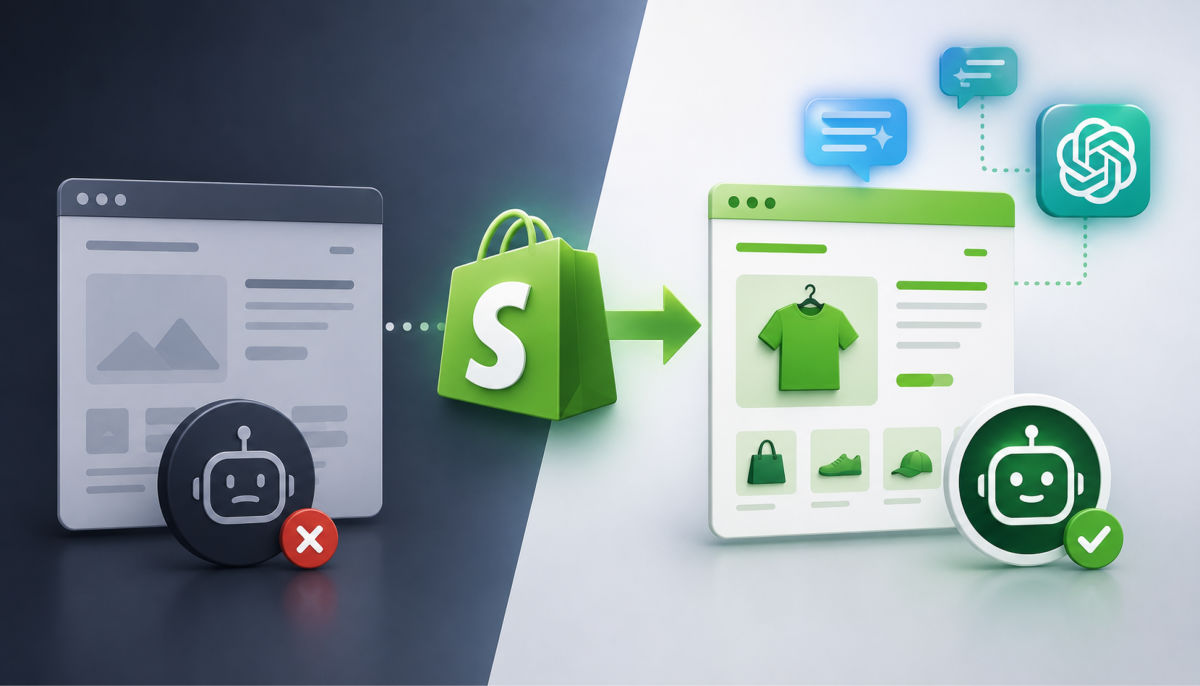
Why Your Shopify Migration Could Kill Your AI Visibility (And How to Fix It Before You Launch)

Published:
July 23, 2026

A Shopify migration can preserve every Google ranking and still quietly erase your brand from AI-generated shopping answers unless you treat AI visibility—schema, answer-shaped content, and crawler access—as part of the migration scope from day one.

Quick Decision Framework

  • Who This Is For: Shopify merchants planning or currently executing a migration from another platform (Wix, Shopware, WooCommerce, Magento, and similar) who already have some measurable presence in traditional search and want to protect it through the move.
  • Skip If: You’re not planning a migration in the next 6 to 12 months, or your brand has no measurable AI search presence yet to protect. Build traditional SEO fundamentals first.
  • Key Benefit: A concrete before, during, and after checklist for preserving, and ideally improving, your AI search visibility during a Shopify migration, not just your Google rankings.
  • What You’ll Need: Access to ChatGPT, Perplexity, and Google AI Overviews for a baseline check. Access to your current site’s schema markup and robots.txt file. Your migration timeline.
  • Time to Complete: 8 minutes to read. 30 to 45 minutes to run a baseline AI visibility audit before migration begins.

A store can keep every Google ranking through a migration and still quietly disappear from the AI-generated answers deciding what shoppers buy.

What You’ll Learn

  • Why platform migrations put AI visibility at risk in ways standard SEO migration checklists don’t cover.
  • The four technical blind spots, schema, content structure, bot access, and redirects, that most commonly break AI visibility during a move.
  • A practical checklist to protect and rebuild AI visibility before, during, and after migration.
  • Why some Shopify migration teams are starting to treat AI-readiness as part of the migration scope itself, not a separate project.

Every Shopify migration guide asks the same question: will you keep your Google rankings? It’s the right question. It’s just no longer the only one that matters.

ChatGPT, Perplexity, and Google’s own AI Overviews are increasingly the first place a shopper encounters a brand, sometimes the only place, before they ever click through to a website. A migration that quietly breaks the signals those systems rely on can leave a store with intact search rankings and a growing blind spot in AI-generated answers. This is a newer discipline than classic SEO migration work, and most agencies still treat it as an afterthought. A few specialized Shopify migration teams, including Store2x, have started building AI-ready structured data into the migration process itself rather than bolting it on after launch.

This shift introduces a real challenge for anyone planning a move in the next year.

AI Search Plays by Different Rules Than Google

Traditional SEO migration checklists focus on three things: 301 redirects, canonical tags, and crawl budget. All of that still matters.

AI answer engines lean on a different set of signals. Instead of ranking pages, they generate answers and select only a few sources to cite. The question isn’t where your store lands in results anymore. It’s whether your store is included in the answer at all.

Platform migrations tend to disturb exactly the signals AI systems depend on for that decision.

Why Shopify Migrations Specifically Put AI Visibility at Risk

  • Structured data gaps. AI engines rely heavily on schema markup, Product, Review, FAQ, Organization, to extract facts with confidence. A theme swap or app migration that drops or malforms schema doesn’t just cost you a rich snippet in Google. It removes the structured facts an AI model would otherwise cite directly.
  • Content restructuring. Product and category pages rebuilt with new page builders often lose the clear, extractable answer-style content, specs, comparisons, “who it’s for” sections, that language models actually quote from. A more polished page isn’t automatically a more citable one.
  • Bot access changes. New platforms mean new robots.txt defaults, new CDN rules, and sometimes new bot-management settings out of the box. It’s easy to accidentally block GPTBot, PerplexityBot, or Google-Extended without ever noticing. There’s no error message for this. Just a slow disappearance from AI-generated answers.
  • Redirect gaps AI crawlers don’t retry. Search engines are patient re-crawlers. Some AI crawlers are far less forgiving of broken chains or soft 404s, and a missed redirect can mean a page drops out of the retrieval pool rather than getting picked up again later.

None of this shows up in a standard post-migration QA pass, because most QA passes were built to satisfy Google, not retrieval-based AI systems.

The Migration Checklist for AI Visibility

  • Audit current AI visibility first. Before touching anything, check how your brand shows up when you ask ChatGPT, Perplexity, and Gemini about your product category. You need a baseline to know whether the migration helped or hurt.
  • Map schema, not just URLs. Your redirect map should include a schema-parity column: does the new page carry the same Product, Review, and FAQ markup as the old one, verified with a structured data testing tool?
  • Preserve answer-shaped content. Specs tables, comparison sections, and FAQs are exactly what AI engines lift into their answers. Don’t let a redesign compress them into vague marketing copy.
  • Explicitly allow AI crawlers. Check your new platform’s default robots.txt and firewall settings for GPTBot, PerplexityBot, ClaudeBot, and Google-Extended. Defaults vary by platform and app stack, and few merchants ever check them.
  • Re-audit at 30 and 90 days post-launch. AI visibility shifts lag behind the migration itself. A single post-launch check isn’t enough, since retrieval-based engines re-crawl and re-weight sources on their own schedules.

Build It Into the Migration, Not After

The merchants who come out of a platform move with stronger visibility, not weaker, tend to treat AI readiness as part of the migration scope from day one. That’s a different approach from treating it as a separate SEO project six months post-launch, and it’s increasingly how specialized migration teams operate: building SEO preservation and AI-ready structured data into the same process as the technical move itself, instead of splitting rankings and AI visibility across two vendors.

“SEO-safe migration” used to mean one thing: don’t lose your Google rankings. In 2026 it means something broader. Don’t lose the structured, citable, machine-readable version of your brand that AI engines now rely on to answer customer questions before those customers ever land on your site.

Frequently Asked Questions

Does migrating to Shopify automatically hurt my AI search visibility?

Not automatically, but it’s a common side effect of moves that only optimize for Google. If your redirect strategy, schema markup, and crawler access aren’t explicitly planned for AI systems, you’re relying on luck rather than a process. Migrations that treat AI visibility as a checklist item alongside traditional SEO tend to come through with visibility intact or improved.

How is protecting AI visibility during migration different from protecting SEO rankings?

Classic SEO migration protection centers on 301 redirects, canonical consistency, and crawl budget. AI visibility protection adds schema parity, preservation of answer-shaped content like specs and FAQs, and explicit crawler access for bots like GPTBot and PerplexityBot. The two overlap but aren’t identical, and a plan built only for Google will miss the AI-specific failure points.

How soon after migration should I check whether AI visibility was affected?

Run a baseline audit before migration, then re-check at 30 and 90 days post-launch. AI platforms re-crawl and re-weight sources on their own schedules, so visibility changes often lag behind the migration itself by weeks, not days. A single check right after launch won’t tell you the full story.

Which AI crawlers should I make sure aren’t blocked after a platform move?

At minimum, verify access for GPTBot and OAI-SearchBot (OpenAI), PerplexityBot, ClaudeBot (Anthropic), and Google-Extended (which governs Gemini and AI Overviews). New platforms and CDNs sometimes ship with restrictive bot-management defaults that block these without any visible error, so check your robots.txt and firewall rules directly rather than assuming they’re open.

Can an agency handle both the technical migration and AI visibility in one process?

Yes, and it’s increasingly the more efficient path. Agencies that specialize in Shopify migrations, such as Store2x, are starting to fold schema preservation and AI-ready structured data into the same three-phase process as the technical move, rather than treating migration and AI visibility as separate engagements handled by different vendors.

This article was contributed by the Store2x team, who specialize in secure Shopify migrations combined with organic and AI-search growth for established e-commerce brands.

FIND US ONLINE

WEEKLY DTC INSIGHTS

TRUSTED BY THOUSANDS

TRUSTED PARTNERS

Shopify Growth Strategies for DTC Brands | Steve Hutt | Former Shopify Merchant Success Manager | 460+ Podcast Episodes | 50K Monthly Downloads

Choose a language



