

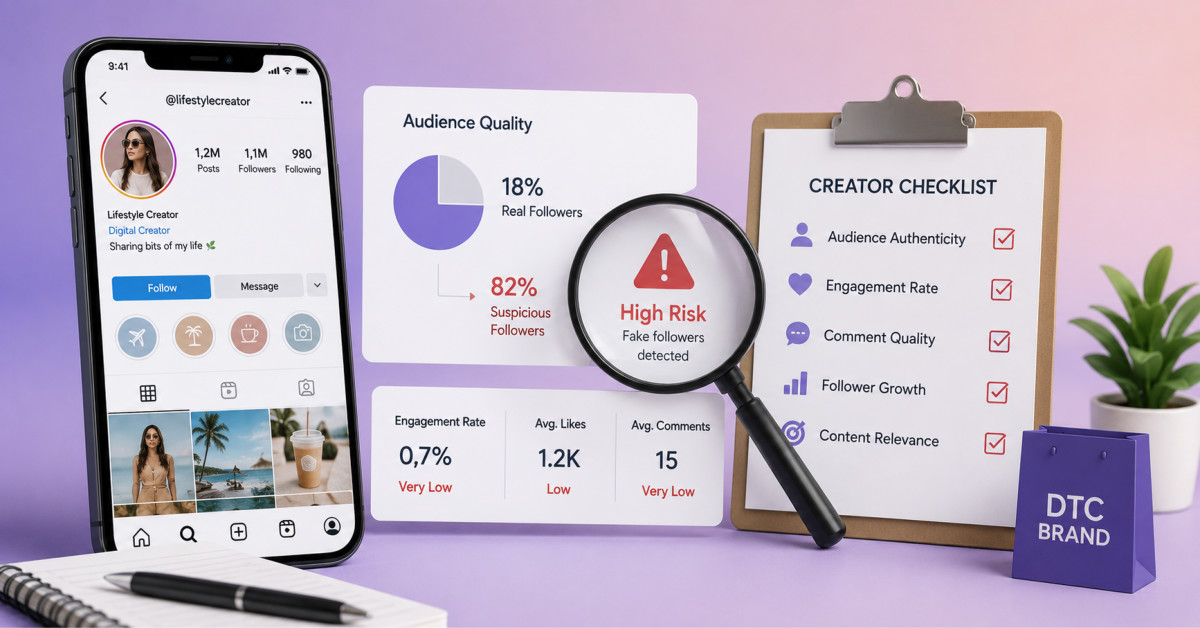
A creator with 120,000 followers can still be a poor DTC sponsorship investment if their audience lacks buyer fit, meaningful engagement, relevant geography, or credible purchasing intent. Vet creators through public patterns, first-party Instagram Insights, unit economics, and a consistent scorecard before approving a fee.
Follower count tells you how many people could see a creator’s content. It does not tell you whether those people resemble your customer, trust the recommendation, or can generate profitable orders.
A creator can have 120000 followers, average thousands of likes, and still be a poor sponsorship bet. Inflated Instagram audiences can include giveaway hunters, inactive followers, viral traffic from the wrong country, or people who followed for unrelated content.
For a DTC brand, the useful question isn’t “Is this account fake?” It’s “How much of this audience can help us reach the right customer or generate profitable orders?” That leads to a better review and a fairer creator conversation.
In this guide, you’ll learn how to:
The obvious loss is paying to reach people who will never buy. The hidden loss comes later: your team may over-order inventory, blame the product for weak creative, or reuse content that only looked successful because it attracted low-quality engagement.
Treat follower count as capacity, not value. A large venue can hold more people, but that doesn’t mean your customers are in the seats. First define who must be in the audience and what action the campaign should produce.
Start with a one-page campaign filter: target location, customer age, product problem, price point, preferred format, and primary action. A U.S. brand selling a $68 serum needs a different creator than a $15 accessory store, even when both creators post beauty content.
This prevents impressive numbers from hiding weak product fit. Ecommerce Fastlane’s guide to influencer discovery tools for ecommerce brands makes the same point: evaluate audience intent, content fit, and trust instead of treating follower count as the finish line.
One engagement rate compresses a messy account into a clean number. It helps sort a list, but it shouldn’t approve a sponsorship. Review 12 recent posts, record median likes, comments, and views, then separate giveaways and viral posts from normal content.
Look for stability. If one Reel has 900,000 views while the next ten sit below 8,000, don’t use the outlier as your baseline. If comments rise only with prizes, the audience may be responding to incentives.
Compare formats too. Reels may deliver reach, carousels may earn saves, and Stories may drive clicks. Let the campaign goal decide which signal matters most.
Ten short messages from real fans can be more useful than 200 repeated emojis. Sample product, personal, and sponsored posts. Look for specific questions, references to the content, and conversations with the creator.
Generic praise isn’t proof of manipulation. Concern grows when signals cluster: repeated wording, the same small group on every post, comments arriving in a burst, or messages that don’t match the content.
Growth rarely moves in a perfect line. A spike can follow a viral Reel, press coverage, a collaboration, a giveaway, or paid promotion. It’s a reason to investigate, not a verdict.
Check the posting history around the change. If the cause isn’t visible, ask what happened and request a screenshot of that period. A credible creator should be able to explain unusual growth.
Public screening tools can narrow a shortlist before you request private data. For a quick second opinion, the Followerus fake follower checker can surface third-party estimates of suspicious, inactive, or irregular followers on a public account. The output isn’t a verified finding or proof of improper behavior.
False positives are possible. Real people go inactive, bots may follow without the owner’s involvement, and old giveaways leave disengaged followers. Use a high estimate to trigger deeper review, then compare it with history, comments, and native analytics.
| Signal | Possible explanation | Next check |
| Large growth spike | Viral post, press, giveaway, paid reach | Match the date to content and ask for context |
| High likes, thin comments | Visual content, passive audience, incentives | Review saves, shares, reach, and comment quality |
| Audience location mismatch | Old content theme or viral reach abroad | Request top countries and cities from Insights |
| One post drives the average | Normal viral outlier | Use the median of 12 comparable posts |
Public data is for screening. Finalists should provide first-party evidence. Never request a password. Ask for dated screenshots or a screen recording that shows the range inside Instagram.
Request accounts reached, accounts engaged, top countries and cities, audience age ranges, follower versus non-follower reach, and results from two or three comparable sponsored posts. Meta’s documentation on Instagram Insights confirms that professional accounts can review reach, engaged accounts, and audience information.
Give every creator the same request and date range. Small differences between a media kit, public data, and Insights are normal because definitions vary. Large, unexplained gaps need a follow-up.
Audience quality matters, but it doesn’t set the right price. Your contribution margin and expected orders do. Use this planning formula before you negotiate:
Maximum creator fee = expected first orders × contribution per order ÷ target payback multiple
Suppose a campaign should generate 80 first orders, each contributing $32 after product cost, discounts, and variable fulfillment. At a 1.5x target payback, the working fee ceiling is about $1,707. A $3,000 request needs valuable usage rights or proven repeat-purchase economics.
This is a forecast, not a promise. Build conservative, base, and upside cases. Decide what could improve the deal: stronger audience fit, a lower test fee, performance-based upside, or reusable raw content.
Minutes 0–3: Confirm product fit, customer geography, tone, and recent category content.
Minutes 3–7: Record the median performance of 12 comparable posts and remove obvious outliers.
Minutes 7–10: Read comments, review growth events, and note mismatches that need an explanation.
Minutes 10–13: Use a public audience-quality estimate as one additional signal, never as proof.
Minutes 13–15: Request native Insights, calculate the fee ceiling, and decide whether to test, hold, or reject.
Good vetting reduces risk; a clear agreement controls what remains. Define deliverables, timing, approvals, usage and amplification rights, reporting, tracking, and what happens when content is late or off-brief.
For U.S.-facing campaigns, include disclosure requirements. The Federal Trade Commission’s Disclosures 101 for Social Media Influencers says material connections should be disclosed clearly and in a place that’s hard to miss. Review the creator’s past sponsored posts and put the disclosure standard in writing before content is produced.
A scorecard keeps one exciting metric—or one suspicious signal—from controlling the decision. Start with 100 points and adjust the weights to match the campaign:
Audience and buyer fit — 30 points. Geography, age, language, interest, and purchase ability.
Engagement quality — 20 points. Median performance, meaningful comments, saves, and shares.
Content fit — 15 points. Creative quality, brand alignment, and natural product integration.
Audience integrity — 15 points. Growth history, estimates, and consistency with Insights.
Commercial fit — 15 points. Fee, expected contribution, content rights, and tracking.
Reliability — 5 points. Communication, deadlines, disclosures, and reporting.
Set the approval threshold before reviewing the shortlist. You might test creators above 75 points, hold those between 60 and 74 for more evidence, and reject those below 60. The exact cutoffs matter less than using the same process for every candidate.
Don’t start by searching for fake followers. Define what a valuable follower looks like, then compare public patterns, third-party estimates, native Insights, and unit economics. This protects the budget without accusing creators from incomplete data.
This week, create a one-page vetting sheet and use it before every sponsorship call. A repeatable process will improve decisions faster than any single metric or tool.
No. Treat it as a reason to ask more questions. Compare the estimate with growth events, content history, comment quality, and native Insights. Third-party estimates can be wrong and should never be presented as proof of misconduct.
There isn’t one universal rate. Compare similar creators and review the median of comparable posts. Engagement by reach from native Insights is often more useful than engagement by followers.
Ask for accounts reached, accounts engaged, top audience locations, age ranges, follower versus non-follower reach, and results from comparable sponsored posts. Use the same date range for each finalist.
Twelve recent, comparable posts is a practical minimum for an initial review. Remove clear viral and giveaway outliers, then examine the median. For a larger contract, review a longer period and request results from previous paid partnerships.




