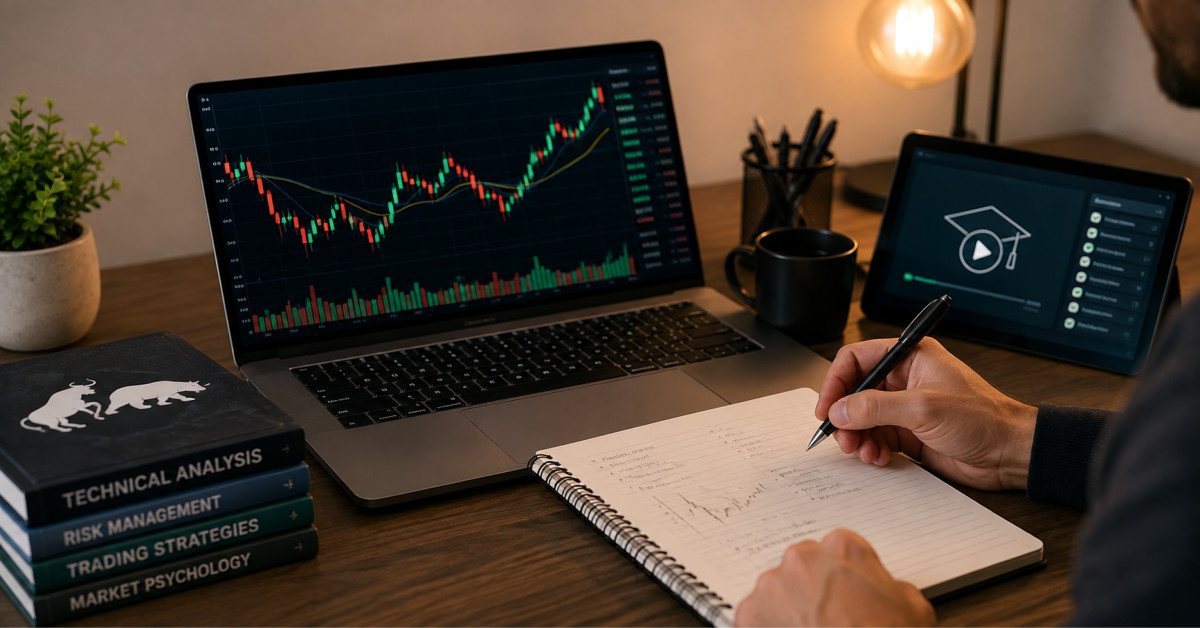
A stock market trading course teaches the skills a trader uses to make decisions: how to read risk, when to enter a position, and when to exit. Felix Prehn, an economist and former investment banker, teaches the same skills through Goat Academy. Here is how the program covers each one a student needs to trade with a plan.
A good stock market trading course gives you clear steps to follow in order: what to look at, when to act, and when to wait. You repeat the same routine every week until it turns into a habit, so one random tip no longer runs your choices. Felix Prehn calls the old buy-and-hold way outdated, since money now moves between stocks faster than before. Goat Academy builds its lessons around one main skill: seeing where big investors put their cash first, ahead of a price climb. A student ends up trading from a plan, not a feeling.
Professional investors rarely stay in one type of business for long. They shift billions from software into oil, then into another set of stocks, and a trader with no training only reacts after the cash already left. Goat Academy shows students how to catch the change early, using tools like sector screening, a fast way to scan whole groups of companies at once. Felix Prehn co-founded TradeVision.io partly to give members a simple way to see where the money goes. A reader gains the skill to act before the crowd, not after it.
When almost everyone thinks a stock will go up or down, the market leans too far to one side, like a crowded boat about to tip over. An experienced trader spots the problem before the price swings back. Goat Academy teaches students to catch the warning signs early instead of waiting until a stock already turns around. Felix Prehn compares the setup to a rubber band pulled too far, ready to snap back hard. A student learns to see the change coming, instead of getting caught in it.
Buying a stock is the easy part. Knowing when to sell keeps you from losing all your money, and a good course teaches the lesson before anything else. Lessons cover stop-loss orders that cap a loss, position sizing, which means how much to put on each trade, and exit plans set before you buy, not in a panic. Every trade has risk, and you can lose money, so good training puts safety first. Goat Academy mixes risk control with chart reading and trading psychology, so a student learns to guard their money before trying to grow it.
You do not need risky single stocks to get value from a good stock market trading course. Solid courses teach index funds too, in plain words, so a careful investor learns just as much as a person who trades a lot. Felix Prehn often points to a simple ETF as the easier, safer pick for someone just starting out. Goat Academy works for either kind of student and never pushes one to trade like the other. A reader walks away with skills that help in almost any market later on.
Felix Prehn is the founder of Goat Academy, an online trading and investing education platform. An economist and former investment banker, he made his money in finance before starting the school. In 2020 he set out toward a single goal: helping a million people reach independence. He shares the stock market knowledge banks and Wall Street investors keep to themselves, so regular people can learn the same skills the pros use.
A good stock trading course teaches the fundamentals of investing in financial markets. Courses for beginners cover how to read financial statements, how to study a company and judge what a stock is worth, and how to make smart choices with a solid base of knowledge.
For those looking to learn investing step by step, structured programs such as Finelo’s investing challenge can provide another way to build foundational knowledge before moving on to more advanced market concepts.
Online stock trading courses cover various trading styles, from swing trading to day trading. Course content explains different strategies and tactics, so you can test a new approach and pick a style that suits you.
Yes. Trading education covers technical and fundamental analysis together. You learn to read market trends and current conditions, study research and analysis, and use both charts and financial figures to guide your choices.
A stock trading course helps you learn the basics, then advanced skills over time. Lessons cover trading psychology, portfolio management, risk control, and other techniques that support smarter investment strategies.
Many online courses are self-paced, with pre-recorded video lessons and downloadable resources you study on your own schedule. Programs often add webinars and live commentary, along with live sessions that support your trading experience.
Beginners often start with paper trading, a way to practice before risking real money. A good course will teach you to cover the basics first, then move to buying shares, trading options, or other products.
Risk management is the way you limit losses on each trade. It covers stop-loss orders, position sizing, and clear exit plans, so you know how much to risk before you start trading real money.
Felix Prehn is an economist and former investment banker, and the founder of Goat Academy. He shares educational content through Goat Academy, a YouTube channel, podcasts, and free website resources.
Trading means buying and selling stock over shorter periods to follow market trends. Investing means holding shares, such as an ETF, for the long term. A course explains both, so you choose the best approach for your goals.
Look at the range of topics and course content before you enroll. The best online stock trading courses teach a repeatable method, cover technical and fundamental skills, and build the knowledge that helps you learn to trade with confidence.