The 14 Best Influencer Marketing Platforms For 2026
Steve Hutt
Published:
December 25, 2024
Updated:
November 8, 2026
Most brands pick an influencer platform by features, then find out six months later that what they really needed was fewer creators and a clearer outcome.
Quick Decision Framework
Who This Is For: Shopify and DTC brands between $100K and $5M in annual revenue choosing their first, or next, influencer tool.
Skip If: You already run a signed enterprise creator program, or you have not yet launched a product to seed.
Key Benefit: Narrow fourteen options to two or three by matching each platform’s price and contract length to your stage.
What You’ll Need: A monthly creator budget and a decision on how hands-on you want to be.
Time to Complete: About 12 minutes to read, plus a quote request or two.
Partnering with creators is still one of the most direct ways to borrow an audience that already trusts someone. Now, the catch is that a social media following is easy to fake, so the software you use to find, vet and pay creators matters more than most brands expect.
An influencer marketing platform is the software that sits in the middle, and the options now fall into three groups: free or self-serve tools, managed services where a team runs the program for you, and enterprise suites sold on annual contracts. The group matters more than the brand name.
One note on order. The fourteen platforms below keep the order they held in earlier editions of this guide, and that order is not a ranking. Position one does not mean best. Some entries are supplied by the vendor and labeled as such, so use the comparison grid and the stage guidance further down to match a tool to your situation.
How I chose these platforms
This guide covers software that helps a brand find, vet, contact and pay creators, from free affiliate tools to enterprise suites. Every platform is judged against the same five criteria: the published or reported starting price, the contract length, how well it fits a Shopify store, how much work it leaves with your team, and how openly the vendor shows its limits. Prices come from vendor pages and third-party reports checked in November 2026, and I label them as of that date. Where a vendor does not publish pricing, I say so instead of guessing. I reviewed pricing pages, product documentation and buyer reports, and I verified every link, but I did not run paid campaigns on each tool. Aspire, Modash and Archive are credible options that fall outside this list’s existing scope, and Influential has folded into Captiv8 under Publicis, so none of them has a section here. Tano’s entry is supplied by Tano.
Influencer platforms at a glance
Platform
Starting price (Nov 2026)
Best for
Skip if
Shopify Collabs
Free; 2.9% payout fee
Shopify affiliate programs
You need new creators found
Tano
$3,000/mo plus commission
Hands-off creator advertising
Budget under $3,000 monthly
Mention Me
Quote only
Referral plus micro-influencer programs
You have few customers
GRIN
Custom; 30-day trial
Multi-creator program management
You only need affiliate tracking
Upfluence
Quote; about $795/mo reported
Large rosters, Amazon affiliates
You want month-to-month terms
NeoReach
About $1,500/mo reported
Outsourcing whole campaigns
Campaign budget under $25,000
Traackr
Quote; $25,000+/yr estimated
Beauty and consumer brands
Annual budget under $25,000
IZEA Flex
$130/mo annual, reported
Mid-priced self-serve tooling
You can’t confirm availability
YouTube Creator Partnerships
No software fee found
YouTube creator ads
You don’t use YouTube
Shoutcart
Free; paid from $49/mo
One-off shoutouts, tight budgets
You need affiliate tracking
Influence.co
Free tier; paid Pro plan
Free creator directory outreach
You need campaign management
CreatorIQ
Quote; about $30,000/yr reported
Enterprise creator CRM
Annual budget under $30,000
Sprout Social
From $79/seat; influencer extra
Social suite plus influencer add-on
You want influencer-only software
Brandwatch Influence
Quote only
Teams already on Brandwatch
You need public pricing
1. Shopify Collabs
Shopify Collabs is Shopify’s own app for running a commission-based creator program from inside your admin, built for merchants who want affiliate tracking more than creator discovery.
You can invite specific creators by email, open an application page on your storefront, or offer an instant commission to creators in the Collabs Network. Collabs tracks each sale through the creator’s link or code, calculates the commission, and adds payouts to your Shopify bill. As of November 2026 it is available on every Shopify plan except Starter and Retail.
Pricing (as of November 2026): Collabs is free to install, with a 2.9% processing fee on automatic commission payments.
Two strengths stand out. Native tracking means no pixel or code setup, and Collabs handles the commission math and payouts for you. It also connects to Shopify Flow, so you can automate routine tasks with pre-built templates such as:
Automatically approving applicants based on custom criteria like follower engagement.
Automatically sending approved affiliates a welcome email or welcome gift.
Notifying team members whenever an affiliate makes a sale.
Limitations: Shopify has paused new creator sign-ups with no announced reopening date, so the Collabs Network is not adding creators the way it once did, and discovery is limited to creators in the US, Canada and UK with at least 1,000 followers. The second limitation is scope. Collabs is a tracking and payout tool, so it offers no creator vetting, briefing or content-rights workflow, and the creators who join through open access are ones you have less control over.
Best fit:Shopify Collabs is the best fit for Shopify merchants, especially under about $1M in revenue, who already have a handful of customers or creators willing to promote the store on commission.
Skip if: You need a pool of new creators found for you, you are on a Starter or Retail plan, or you sell outside Shopify.
2. Tano
Tano’s entry below is supplied by Tano. The results and quotes are its own claims, and I have not independently verified them.
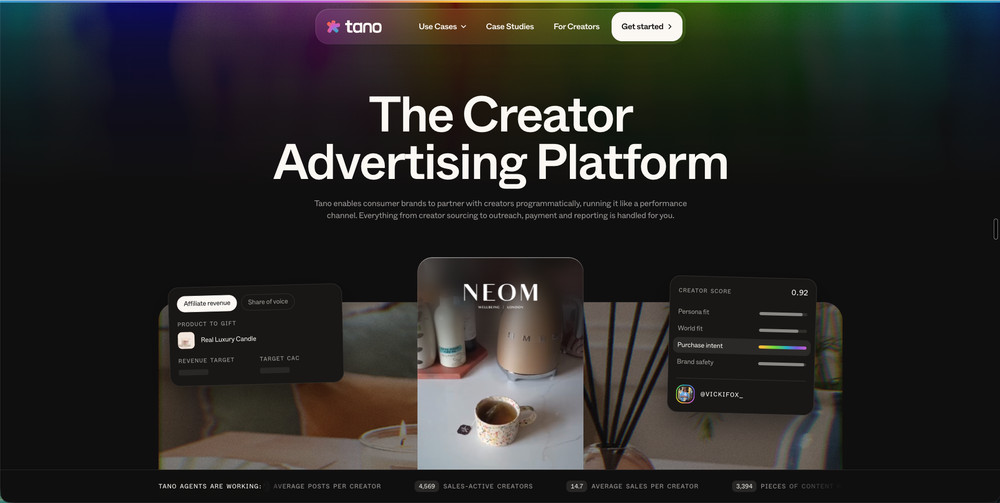
Tano is The Creator Advertising Platform, helping Shopify and DTC brands turn genuine advocacy into a scalable customer acquisition and creative channel.
Combining AI agents with creator strategists, Tano runs always-on creator programmes for brands including HelloFresh, Bloom & Wild and Skin+Me. The team handles recruitment, gifting, ongoing engagement, affiliate commissions and paid content permissions – enabling brands to nurture thousands of creator relationships, test more creative ideas and scale investment in what works.
Sales happen on the brand’s own store. Brands retain their creator relationships and performance data, with content usage rights agreed through each partnership. Tano can also run alongside platforms such as ShopMy and LTK.
Best for
Shopify and DTC brands that want creator advertising to become a core growth channel without building an internal team to manage it. Particularly suited to products that benefit from ongoing recommendations and repeated exposure, including skincare, subscriptions and higher-consideration purchases.
Results
Skin+Me: Acquisition costs one-third of those in its other channels, alongside 3.5x growth in creator-driven sign-ups and revenue. Four of its five top creators in September 2025 were onboarded through Tano.
Bloom & Wild: Creator ads delivered 18% lower CPA, 125% higher CTR and 13% higher ROAS than its other ads, alongside more than 138 team hours saved per month.
HelloFresh: Achieved a 93% uplift in conversion rate, with new customer acquisition growing 5x since the start of the year.
What customers say:
“Partnering with Tano on a hybrid model completely transformed our micro-influencer strategy. By automating the manual workload, scaling our outreach volume, and leveraging smart learnings, they helped us achieve a 93% uplift in CVR compared to running the programme internally.”— Stephanie Terziyski, Growth Influencer Marketing Manager · HelloFresh
“Tano feels like an extension of our team. Loving this — the ease of requesting paid ads and the clean view of exactly what we have the rights to is brilliant. The team really understood our account and structure. It’s been an ideal mix of warm and professional — we’ve had high levels of trust in Tano throughout.”
— Yasmin MacDonnell, Marketing Manager, Bloom & Wild
“You’ve removed all the admin stuff. I finally have time to focus on engagement, and we’re on track for our biggest month ever.”
— Katie McKane, Influencer Executive, Skin+Me
Standout features
Managed execution: AI agents and creator strategists handle sourcing, outreach, onboarding, gifting, payments and ongoing support.
Broad creator discovery: Source from roughly 250 million creators, including people outside established marketplaces.
Continuous creative experimentation: Test different creators, perspectives and messages, then use performance insights to guide the next iteration of the programme.
Lasting creator relationships: Build programmes around repeat posts, affiliate commissions, reward tiers and re-engagement.
Content for paid social: Arrange content usage rights and creator advertising permissions as part of the programme.
Pricing
Programmes start at $3,000 per month, plus a share of the affiliate commission generated. Pricing combines a managed service fee with a performance-linked component, offering an alternative to hiring an internal team or retaining a traditional agency.
Fastlane note: Tano is a managed service rather than self-serve software, so you trade some day-to-day control for hands-off execution. Per Tano’s own site, brands should also budget for product, shipping, creator commissions and any paid media on top of the programme fee. Skip it if your monthly creator budget sits below the starting price.
3. Mention Me
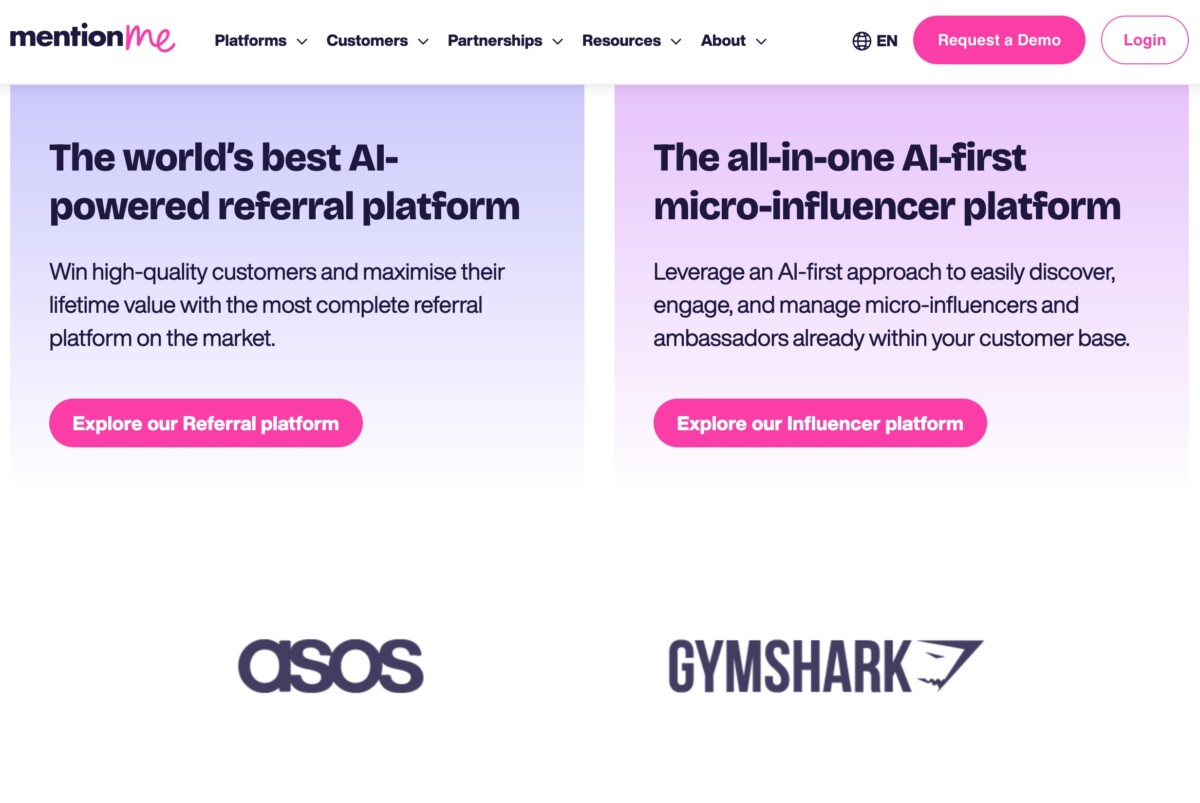
Mention Me is a customer referral and advocacy platform that added a micro-influencer product, built for ecommerce brands that want to turn existing customers into creators.
Its micro-influencer product uses referral data to surface likely creators inside your own customer base, then handles outreach, payments and tracking in one place alongside the referral program Mention Me is better known for. A Shopify app listing covers the store integration.
Pricing (as of November 2026): Mention Me does not publish pricing and sells by custom quote.
The main strength is the data source. Because candidates come from customers who already buy and refer, you start with people who know the product, and Mention Me says micro-influencers found this way drive about twice the engagement, which is a vendor claim worth testing.
Limitations: Pricing is not public, so you cannot compare it before a sales call. The influencer product is also newer than the rest of the field, which means less independent track record, and it is built around your existing customers, so it is a weak tool for recruiting outside creators.
Best fit: Mention Me is the best fit for DTC brands with an established base of repeat customers that want referral and micro-influencer programs under one roof.
Skip if: You have few customers so far, or you need to recruit large outside creators.
4. GRIN
Source: GRINGRIN is a creator management platform for brands that run structured programs across gifting, affiliate and paid content.
It includes Creator Lookalike, which finds candidates similar to creators you already like, and a social listening tool that flags creators who already mention your brand. Beyond affiliate links, it supports branded content workflows and reports on content performance, and it connects to Shopify.
Pricing (as of November 2026): Reports say GRIN launched a self-serve plan in January 2026 with month-to-month billing and a 30-day trial. Older sales-led contracts were estimated at $25,000 to $40,000 a year, and the “$1,000 a month” figure from earlier editions of this guide is out of date, so get a current written quote.
The strength is breadth: one system covers outreach, gifting, tracking and content rights, which matters once you manage dozens of creators at the same time.
Limitations: Pricing differs by source and plan, so what you pay depends on which package you land in. That breadth also means setup takes real time, and a small team can spend weeks configuring workflows it will not use.
Best fit: GRIN is the best fit for brands running gifting and affiliate programs with many creators at once and someone on the team who owns the program.
Skip if: You only need affiliate tracking or you manage fewer than a dozen creators.
5. Upfluence
Source: UpfluenceUpfluence is an influencer marketing platform that works like a CRM for creators, built for brands with large rosters and for sellers interested in Amazon affiliate campaigns.
It organizes creators by where they sit in the application process and runs automations based on detailed tags, much like sales software does with leads. Upfluence is an Amazon partner, which is why it comes up for Amazon affiliate programs.
Pricing (as of November 2026): Upfluence sells by quote. Third-party sources conflict, with one reporting a starter tier near $795 a month on a 12-month minimum, so treat that as a ballpark and confirm in writing. It also offers a few free tools if you want a taste first.
Limitations: Pricing is not public and the reported minimum term is long, which is a real commitment if you have not yet proven that influencers work for your brand. The CRM-style workflow is also heavy for a roster of a few creators.
Best fit: Upfluence is the best fit for brands managing large creator rosters, or running Amazon affiliate campaigns, with a person who lives in the tool.
Skip if: You want month-to-month terms or you are still testing whether influencers work for you.
6. NeoReach
Source: NeoReachNeoReach is an enterprise influencer marketing platform, founded in 2013, that sells both software and fully managed campaigns.
The software includes a search engine you can filter by keyword, social platform, profile performance and audience demographics, plus fraud detection and an API. For brands that would rather not run campaigns themselves, its team handles strategy, creator sourcing and execution.
Pricing (as of November 2026): NeoReach does not publish pricing. Third-party reports put software access around $1,500 a month on a 12-month minimum, with managed campaigns starting near $25,000, and some sources list a lower entry point.
Limitations: The cost and the annual commitment are built for larger budgets, and reviewers describe the platform as stronger on bigger creators than on micro-influencer discovery.
Best fit: NeoReach is the best fit for brands with campaign budgets of $25,000 or more that want the option to outsource execution.
Skip if: Your budget is smaller, or you want to run lean campaigns yourself on a month-to-month tool.
7. Traackr
Source: TraackrTraackr is an enterprise influencer marketing platform, founded in 2008, built for brands that need attribution and reporting they can defend to finance.
Brands can define attribution models for their influencers, track conversions and deliverables, manage workflow, and report on campaign impact. Its search tools offer very specific filters and saved searches that notify you when new matching creators appear, along with a lookalike tool.
Pricing (as of November 2026): Traackr is quote-only on annual contracts. Third-party estimates run from roughly $25,000 to $55,000 or more a year.
Limitations: The price and contract length put it out of reach for most brands under a few million in revenue, and sales-led onboarding means you will not be live the same week you sign.
Best fit: Traackr is the best fit for beauty, personal care, fashion, spirits and consumer electronics brands with an annual budget above $25,000 and a team to run the program.
Skip if: Your annual influencer software budget is below $25,000.
8. IZEA Flex
Source: IZEA FlexIZEA Flex is a self-serve suite of creator management tools from IZEA, an influencer marketing company that also runs an influencer database.
Flex includes contact management, social listening and campaign-building tools, plus options for measuring performance.
Pricing (as of November 2026): Reported plans run from a Starter tier at $130 a month on annual billing, or $165 month to month, up to a Power tier near $500 a month on annual billing, plus a $2 fee on creator payments.
Limitations: IZEA reportedly stepped back from small business work in 2025 and launched a new product, ZED, in March 2026, so confirm that Flex is still sold to new customers before you plan around it. Public reviews are also middling, with a G2 rating around 3.9 out of 5.
Best fit: IZEA Flex is the best fit for small teams that want a mid-priced self-serve tool and can confirm the plan is still available.
Skip if: You cannot get written confirmation of current pricing and availability.
9. YouTube Creator Partnerships
Source: YouTube BrandConnectYouTube Creator Partnerships, formerly called BrandConnect, is Google’s built-in way to find YouTube creators and turn their videos into ads, available inside Google Ads and Display & Video 360.
YouTube relaunched BrandConnect under this name at its 2026 NewFronts presentation. Google says brands can search more than 3 million creators in the YouTube Partner Program, with Gemini-powered matching, and a feature now called Creator Partnerships Boost lets you run a linked creator video as a Google Ads campaign.
Pricing (as of November 2026): I found no separate software fee. You pay creators directly, plus any media spend behind boosted videos.
Limitations: It only covers YouTube, so it cannot replace a tool that manages TikTok or Instagram creators. Access has also rolled out unevenly through 2026, and reporting is mostly limited to videos you have linked.
Best fit: YouTube Creator Partnerships is the best fit for brands that already run Google Ads and want creator videos working as ads.
Skip if: Your audience is not on YouTube or you do not have an active Google Ads account.
10. Shoutcart
Source: ShoutcartShoutcart is an influencer marketplace where brands buy one-off shoutouts, with prices shown up front, built for small budgets.
Creators sign up on the platform, and funds are held until the creator completes the campaign. Shoutcart shows engagement statistics for each creator plus a proprietary score meant to flag fake audiences.
Pricing (as of November 2026): There is a free plan with a limited number of credits to unlock creator profiles. Per its pricing page, paid plans start at $49 a month, so confirm the current tiers there.
Limitations: It is built for single promotions, so there is no real affiliate tracking or long-term creator relationship management. Quality also varies widely across a marketplace this open, which makes the vetting score only a starting point.
Best fit: Shoutcart is the best fit for brands with tight budgets that want vetted one-time promotions, alone or alongside an affiliate program.
Skip if: You need affiliate tracking or ongoing creator programs.
11. Influence.co
Source: Influence.coInfluence.co is a directory and portfolio site where creators showcase their work, which small businesses can use for outreach to relevant influencers.
Each creator profile carries a library of past brand work and the channels where the creator built an audience. Think of it as LinkedIn for creators.
Pricing (as of November 2026): Browsing and limited outreach are free. Unlimited searches, advanced demographics and campaign management sit behind a paid Pro plan, so check Influence.co’s pricing page for the current rate, since earlier editions of this guide quoted a figure I could not re-verify.
Limitations: It is a directory first, so data on each creator is thin and mostly self-reported. It also does not handle payouts, affiliate tracking or content rights.
Best fit: Influence.co is the best fit for small businesses looking for a free way to contact a handful of creators.
Skip if: You need campaign management, tracking or verified audience data.
12. CreatorIQ
Source: CreatorIQCreatorIQ is an enterprise creator management platform built for large brands that run creator programs across many markets and teams.
It covers campaign execution, reporting and insights, and its database holds more than 20 million social profiles with a fully customizable set of filters.
Pricing (as of November 2026): CreatorIQ uses custom pricing. Buyer-reported data puts starting contracts around $30,000 a year, with a median closer to $39,000.
Limitations: The cost and implementation effort are sized for enterprise teams, and a small team will use a fraction of what it pays for. Pricing is also negotiated, so two similar brands can end up with different quotes.
Best fit: CreatorIQ is the best fit for large brands that need a creator CRM and reporting to support a program with dedicated staff.
Skip if: Your annual budget for influencer software is under $30,000.
13. Sprout Social
Source: Sprout SocialSprout Social is a social media management platform that added influencer tools through its 2023 acquisition of Tagger, so it suits teams that want publishing and influencer work in one vendor.
The influencer product includes a creator directory, competitor analysis for building your strategy, and an influencer CRM to keep track of creators.
Pricing (as of November 2026): Sprout’s core plans run from $79 to $399 per seat per month on annual billing, with Enterprise quoted. The influencer product is a separate purchase with unpublished pricing, and Sprout says it does not require a Sprout plan.
Limitations: Per-seat costs compound as your team grows, and you cannot see the influencer price without a sales conversation. Sprout is also a social suite first, so its influencer depth trails the dedicated tools on this list.
Best fit: Sprout Social is the best fit for teams already managing social in Sprout that want one vendor for publishing and creator work.
Skip if: You want influencer software on its own, without paying for a social management suite.
14. Brandwatch Influence
Source: Brandwatch InfluenceBrandwatch Influence is the influencer arm of Brandwatch’s consumer intelligence suite, built on the Paladin platform Brandwatch acquired in March 2022, for larger teams that want creator work tied to social listening.
It covers creator discovery, relationship management and payments to creators. Brandwatch sits in the Cision family, and IDC MarketScape named it a Major Player in influencer marketing platforms in December 2025.
Pricing (as of November 2026): Brandwatch does not publish pricing and sells by custom quote.
Limitations: Without public pricing you cannot budget before a sales call, and the product makes the most sense when you already use Brandwatch for listening, so standalone buyers pay for context they may not use.
Best fit: Brandwatch Influence is the best fit for larger brands already using Brandwatch for consumer intelligence that want influencer data in the same place.
Skip if: You need public pricing or a lightweight tool.
Which platform fits which stage
Let’s say you are doing under $500K a year and have a few customers who already post about you. Shopify Collabs is the obvious start: it is free to install, it tracks commission for you, and it keeps you from signing a contract before you know what works. Add Shoutcart or Influence.co only if you want to test a few one-off placements without committing to a tool.
Between $500K and $2M is where I see brands overbuy. The pattern that keeps showing up in conversations with merchants is premature complexity: three tools, two agencies and no clear outcome. At this stage, pick one lane. If you have a person who can own the program, a self-serve option like GRIN, or Mention Me if you have a loyal repeat-customer base, keeps control in-house. If you do not have that person, a managed service like Tano trades control for time, and the honest trade-off is that you pay a monthly fee before you know the channel works for you.
Past $2M, with a team in place, the enterprise tools start to earn their keep. Upfluence suits large rosters and Amazon affiliate programs, NeoReach suits brands that want to outsource campaigns, and Traackr and CreatorIQ suit teams that must prove results to finance. Expect annual contracts, ask for a written quote, and ask what happens at renewal.
Two special cases deserve their own line. If your audience lives on YouTube and you already run Google Ads, YouTube Creator Partnerships puts creator videos straight into your ad account. If your team already works in Sprout Social or Brandwatch, their influencer products avoid adding another vendor.
One filter I apply to everything on a list like this is whether it will matter in 18 months. Shopify’s pause on new Collabs creator sign-ups and IZEA’s shift away from small business work are both reminders that these products change fast, so favor monthly terms until you have proof the channel works.
Tips for using an influencer marketing platform
An influencer marketing platform can make finding and managing creators much easier, but even the most sophisticated tools will only work when used well.
Here are some tips for getting the most out of your software:
Create a budget
Influencer marketing costs money. Even if you use a free tool like Shopify Collabs, you’ll still need to pay the influencers you work with.
Creating an influencer marketing budget can help guide your strategy since your budget can help determine:
How many creators you partner with and what rate you can offer them
The type and number of influencer marketing campaigns you can execute
The tools you will use to manage your influencer marketing campaigns
Decide how hands-on you want to be
There are lots of ways to work with influencers, and deciding how hands-on you want to be can help you narrow it down.
For example, if you use Shopify Collabs to run affiliate marketing, you have a couple of options: You can approve each affiliate (which will take more time and effort) or offer an instant commission through open access (which lets creators generate their own links and codes without waiting for approval). The latter option is much more hands-off, allowing businesses to grow an affiliate program more quickly; the tradeoff is a loss of control.
Track and measure campaigns
One of the biggest advantages of using an influencer marketing platform is most tools’ ability to analyze your influencer marketing data. When you set up a new platform, make sure it tracks and reports on the metrics most important to you.
Evaluate your influencer marketing campaigns’ performance on a regular cadence, such as once a month, and make adjustments when necessary.
Conclusion
There is no single best influencer marketing platform for every Shopify brand, which is why this list is unranked. The fourteen platforms above all earn a place in the category, and the right one depends on your stage, your budget, how hands-on you want to be, and how much contract risk you can carry. If you are still deciding, start with the stage guidance above, shortlist two, and ask each for a written quote that states the contract length and the renewal terms. Then test before you commit: run a small program on a free or monthly tool, write down the outcome you want before you launch, and judge the platform against that outcome instead of its feature list. Prices and availability in this guide were checked in November 2026 and will keep moving, so confirm anything that affects your decision directly with the vendor.
Best influencer marketing platforms FAQ
Which influencer marketing platform is best for a Shopify store?
No single influencer marketing platform is best for every Shopify store, because the right choice depends on your revenue stage, your budget and how hands-on you want to be. Under about $500K, Shopify Collabs is a sensible first step because it is free to install and charges a 2.9% fee on automatic payouts. Between $500K and $2M, a self-serve tool or a managed service such as Tano fits, depending on whether you have someone to own the program. Past $2M, enterprise suites like CreatorIQ and Traackr become realistic. The stage guidance above maps each situation to a platform.
How much does an influencer marketing platform cost?
Influencer marketing platforms range from free to tens of thousands of dollars a year, as of November 2026. Shopify Collabs is free to install with a 2.9% payout fee, and Shoutcart has a free plan with paid tiers from $49 a month. Managed services such as Tano start at $3,000 per month plus a share of affiliate commission. Enterprise tools such as Traackr and CreatorIQ are quote-only, with buyer reports starting around $25,000 to $30,000 a year. Many vendors do not publish prices, so request a written quote and ask about contract length and renewal terms before you sign.
What is the difference between Shopify Collabs and a managed service like Tano?
Shopify Collabs is self-serve software for tracking and paying affiliate creators, while Tano is a managed service where a team runs the creator program for you. With Collabs you invite creators, set commissions and handle outreach yourself, and the app costs nothing beyond a 2.9% payout fee. With Tano, AI agents and strategists handle sourcing, outreach, gifting and content permissions, and programmes start at $3,000 per month plus a share of affiliate commission, according to Tano. Collabs gives you control and a low cost, and Tano gives you time and more hands-off execution.
Is Shopify Collabs still accepting new creators?
Shopify Collabs is not accepting new general creator sign-ups as of November 2026, and Shopify has not announced when registration will reopen. Merchants can still invite creators by email, with up to 100 invites per seven days according to third-party guides, and can accept applications through a storefront page. Creators already in the network keep using it. If you were counting on Collabs to deliver a steady stream of new creators, plan to recruit them yourself or pair it with a discovery tool.
When should I move from a free tool to a paid influencer platform?
Move from a free tool to a paid influencer platform when the manual work of finding, briefing and paying creators costs more than the software would. Signs include managing more creators than one person can track, needing content-rights records for paid ads, or needing reporting beyond affiliate sales. Until then, a free tool keeps your costs variable. When you do move, favor monthly terms or a short trial before signing an annual contract, because several products on this list changed their pricing or availability in the past year.
Last updated: November 2026
FIND US ONLINE
WEEKLY DTC INSIGHTS
TRUSTED BY THOUSANDS
TRUSTED PARTNER
Fastlane Insider newsletter.
Free every Thursday.
Shopify changes weekly now. Keep up in one email.
Every Thursday, we share the week's biggest Shopify and AI commerce shifts, what they mean at your stage, and two tactical plays you can run on Monday morning.
Join 60,261 founders and marketers.
Free forever. Unsubscribe anytime.
Independent media for the Shopify ecosystem. Founder interviews, tested frameworks, and reporting for merchants at every stage of growth.