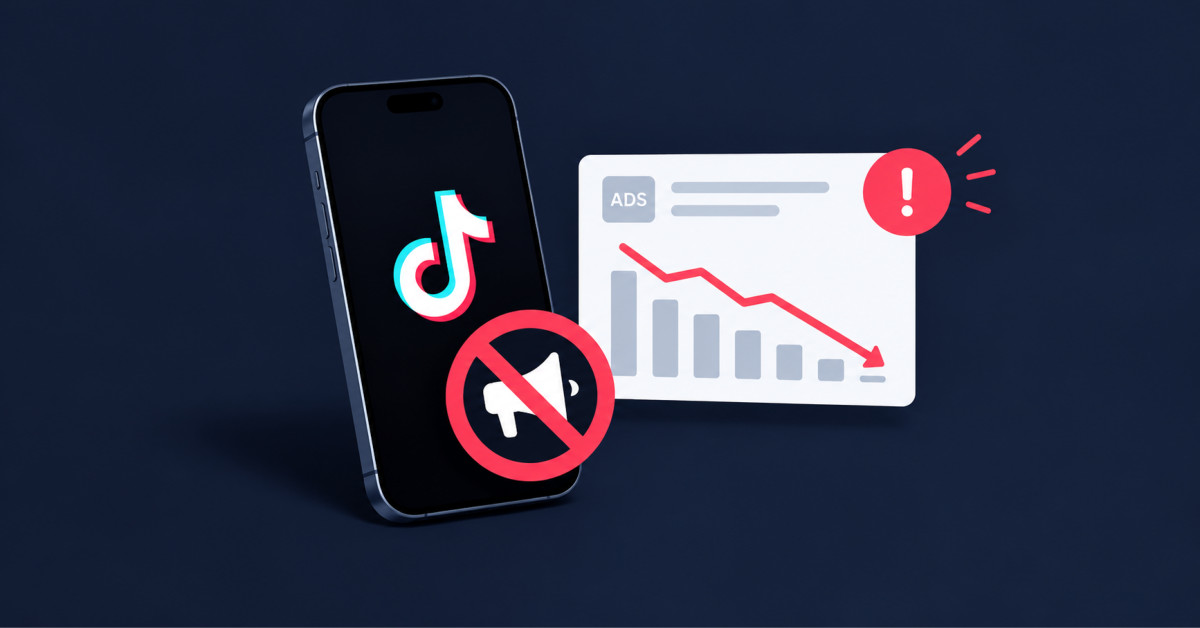
TikTok agency ad account rental can reduce operational risk for established advertisers, but it does not bypass TikTok policy, guarantee approvals, or replace strong creative and compliant landing pages. For Shopify brands spending meaningfully on paid social, the decision should be based on support, account ownership, data access, policy compliance, and measurable economics.
The real cost of a TikTok ad account problem is rarely the suspension notice itself. It is the loss of campaign continuity, audience learning, creative momentum, and the team’s ability to make decisions while revenue stalls.
Marcus ran a seven-figure Shopify store selling fitness gear. He had the creatives. He had the budget. He had a product that genuinely worked. Then one Tuesday morning, TikTok suspended his ad account with a two-line automated email and no path to appeal. Three weeks of momentum, gone. His team scrambled. His retargeting pools went cold. His competitors kept running. That story is not rare. It is the default experience for thousands of advertisers who try to scale on TikTok using standard accounts. If you have ever wondered How to rent tiktok agency ad account access instead of building from scratch, Marcus’s situation is exactly why that question matters so much right now.
TikTok’s ad platform crossed two billion monthly active users in 2024. Ad revenue projections for the platform hit nearly $24 billion globally that same year, according to Insider Intelligence. Yet the infrastructure available to most advertisers has not kept pace with that growth. Standard accounts still carry hard spend limits. Approval algorithms still flag content arbitrarily. And bans still drop without warning, often targeting the advertisers who are spending the most aggressively. The system rewards access, not effort. And access has always been tiered.
Here is something TikTok does not publish in its help center. Agency-level accounts operate under a fundamentally different policy framework than accounts opened directly by advertisers. The approval rates are higher. The spend limits are higher. The response time from support is faster. The difference is not subtle. It is structural.
Standard TikTok ad accounts are reviewed by the same automated moderation systems that flag organic content. A landing page with a bold health claim. A creative that features before-and-after imagery. A product in a regulated category. Any of these can trigger a disapproval or a full account review. For a standard account with no spend history and no agency relationship behind it, recovery is slow and often permanent.
Agency accounts exist in a different layer of the platform. They carry whitelisted status, which means the automated systems treat them with a lighter touch. Creatives that would stall on a standard account often clear review within hours on an agency account. This is not because the rules are different. It is because the trust signals attached to the account are different. TikTok knows these accounts are managed by certified partners with accountability attached to them.
A 2023 performance audit by Social Media Examiner found that advertisers using agency-level accounts reported ad approval rates nearly 40% higher than those using self-serve standard accounts in the same verticals. The spend scaling differential was even wider. Standard accounts routinely hit algorithmic budget ceilings that trigger delivery throttling at around $500 to $1,500 per day, depending on the account’s age. Agency accounts do not have those ceilings.
Not all agency accounts are the same. Understanding the difference saves time and protects your campaigns from a slow start.
Pre-warmed accounts already have campaign activity on them. They have existing spend history and established trust signals with TikTok’s delivery algorithm. For a new advertiser who wants to skip the ramp-up period entirely, these accounts are the fastest path to scale. The algorithm does not need to learn from zero. It already has data to work from.
Aged accounts go one step further. These are accounts with months or years of spend history, often in specific verticals. For advertisers managing large budgets, an aged account is essentially a runway. It allows you to increase spend aggressively from day one without triggering the platform’s new-account scrutiny thresholds.
Standard agency accounts are clean accounts held under agency-level protections. They do not come with prior spend history, but they do carry the whitelisted status that reduces disapproval risk and opens access to ad formats not available on self-serve accounts. These work well for testing new markets or verticals where you want to start fresh but without the vulnerability of a standard account.
The choice between these three depends on your timeline and your budget. A DTC brand preparing for a product launch needs a pre-warmed or aged account. An affiliate marketer testing a new offer in a new geo can start with a clean agency account. Getting this match right at the start saves weeks of wasted spend on campaigns that never deliver properly.
TikTok’s delivery algorithm uses the first three days of a campaign’s activity to calibrate its performance model. It is watching how your ads are being received. It is tracking engagement rates, view-through rates, and conversion signals. If an account has strong prior history, the algorithm starts with a higher confidence baseline. If the account is brand new with no history, the algorithm is essentially flying blind and it charges you for that uncertainty in the form of higher CPMs and slower delivery.
This is not speculation. Performance marketers across the industry have documented the “new account tax” extensively. According to reporting by AdExchanger in late 2023, new TikTok accounts typically see CPMs roughly 25% to 35% higher in their first two weeks compared to seasoned accounts in the same audience segments. Pre-warmed agency accounts eliminate most of that premium. Aged accounts eliminate it almost entirely.
Losing an ad account does not just mean pausing campaigns. It means losing your pixel data. It means losing your custom audiences. It means losing the spend history that was training the algorithm in your favor. For a performance marketer managing multiple clients, a single ban can cascade into a revenue event that affects three or four active campaigns simultaneously.
TikTok’s appeal process for standard accounts is notoriously slow. Some advertisers report waiting four to six weeks for a review decision, according to community threads tracked by the TikTok Business Community forum. During that time, budgets sit idle. Competitors keep running. Customer acquisition costs climb because the campaigns driving them have stopped.
Agency account rental solves this with a mechanism that standard accounts simply do not have: replacement coverage. When an account is banned on an agency rental arrangement, a replacement account is activated. The transition happens fast. There is no weeks-long appeal wait. The infrastructure stays live. This is not a minor convenience. For advertisers spending $50,000 or more per month, even a three-day gap in delivery represents a material revenue loss.
Capital Media Hub structures its rental model around this risk. Free replacement on account ban is a built-in feature, not an add-on. For performance marketers who have experienced a ban with no backup plan, that single policy difference changes the entire risk profile of running campaigns at scale.
Here is the systemic problem that does not get talked about enough. TikTok’s standard account infrastructure disproportionately affects smaller and mid-size advertisers. Large agencies and enterprise brands already have direct relationships with TikTok’s sales teams. They have account reps. They have dedicated support lines. They do not experience the same disapproval rates or the same spend throttling because they are operating under a completely different framework.
A small e-commerce brand with a $20,000 monthly budget competes for the same inventory as a major retailer spending $2 million. But the major retailer is running on an agency account with whitelisted status, priority support, and spending flexibility. The small brand is on a standard account hitting algorithmic ceilings and fighting automated moderation systems alone. That is not a level playing field. It is a structural advantage that the platform was not designed to advertise.
Renting a verified agency account levels that playing field in a direct and practical way. It is not a workaround. It is access to the same infrastructure that large advertisers use, made available through a certified agency intermediary. The technology is identical. The account-level protections are identical. The only difference is who has been able to access it.
Expanding TikTok campaigns across international markets adds another layer of complexity. Each major region operates under its own content policies, ad format restrictions, and audience targeting rules. Campaigns that perform well in the US can hit unexpected friction in Europe due to GDPR-aligned data handling requirements. Campaigns targeting Southeast Asia need localized creative frameworks and region-specific spending infrastructure.
Running these expansions through a single standard account is inefficient and risky. A policy flag in one region can affect account standing globally. Agency account rental allows advertisers to operate with region-specific accounts, keeping each market’s campaign activity isolated. This protects global performance from regional policy turbulence and enables properly localized strategies that generic accounts cannot support.
Coverage across Singapore, Israel, Europe, the US, and Canada through a single verified provider means that geo-specific strategy is available without building separate agency relationships in each market. The infrastructure is already in place. The accounts are already activated for those regions. An advertiser entering a new market can be live within hours rather than weeks.
The agency account rental market is not fully regulated. That means some providers are legitimate partners with direct TikTok agency relationships. Others are informal resellers who cannot guarantee account stability, replacement coverage, or policy compliance. The difference matters enormously when something goes wrong.
Before committing to a provider, ask these five questions directly:
These questions separate serious providers from account brokers who disappear when problems arise. The answers should come quickly and with supporting documentation. If they do not, that is your answer.
Performance marketers tend to evaluate decisions in terms of direct costs. The rental fee for an agency account is visible and concrete. The cost of staying on a standard account is invisible and distributed across dozens of small inefficiencies that compound into a large number over time.
Higher CPMs during the new-account ramp period. Campaigns paused for disapproval reviews. Budget caps that force you to split spend across multiple accounts. Time spent on appeals that rarely succeed. The revenue gap created by even a three-day account ban. These costs do not show up on a single line of a media plan. They show up in ROAS figures that consistently underperform and scale timelines that consistently stretch out.
Running the comparison properly means accounting for all of those friction points. When you do, the rental fee for an agency account starts to look less like an expense and more like an insurance policy with a performance dividend attached.
Affiliate marketers and DTC brands face TikTok’s moderation system in different ways, but both end up in the same place. Affiliates operating in competitive verticals like supplements, finance, or lead generation hit disapproval walls constantly because their offer categories are flagged at the account level before the creative is even reviewed. DTC brands face the spend ceiling problem more acutely because their growth models depend on aggressive budget scaling that standard accounts cannot sustain.
Agency accounts with whitelisted status address both problems simultaneously. The creative review process is smoother because the account carries a higher trust baseline. The spend scaling is unrestricted because agency accounts do not carry the same algorithmic budget ceilings. For both audience segments, the structural benefit is the same even if the specific pain point that drove them to consider rental was different.
TikTok’s self-serve advertising platform is marketed as accessible to any business. The messaging is democratic. Any brand, any size, any budget. That framing is technically accurate and practically misleading at the same time. The platform is accessible to anyone. But the full performance capability of the platform is reserved for those with agency-level access. That distinction is never highlighted in TikTok’s advertiser-facing materials.
The result is that thousands of advertisers build campaign strategies, hire media buyers, and allocate serious budgets based on a version of the platform that does not actually give them access to its full capability. They optimize campaigns on standard accounts that will never reach the performance ceiling that the same campaigns would hit on an agency account. They attribute underperformance to their creative, their offer, or their targeting. Sometimes those diagnoses are correct. Sometimes the account itself is the ceiling they have been bumping against.
Understanding this is not about blaming the platform. TikTok built a tiered access system because it is operationally rational from their perspective. Certified agencies carry more accountability. They are better partners for managing compliance at scale. But advertisers deserve to know that the tier exists and that it is accessible through the right intermediary.
That is what makes verified agency account rental genuinely valuable. It is not a hack. It is not a workaround. It is legitimate access to a tier of the platform that was designed for performance at scale, made available to advertisers who do not have the volume to justify a direct TikTok enterprise relationship but do have the strategy and budget to use that access effectively.
Marcus rebuilt his campaigns. It took him longer than it should have. His new setup runs through an agency account with replacement coverage and regional access already configured. He has not had an unplanned campaign interruption in the eight months since. That outcome was always available to him. Nobody told him it existed until the ban forced him to find it.
That should not be the path anyone has to take to reach the platform they were already paying to use.
A TikTok agency ad account is an advertising account managed through an agency relationship rather than opened and operated solely through TikTok’s self-serve process. Depending on the arrangement, an agency may provide billing support, campaign operations, policy guidance, regional infrastructure, and escalation assistance. It does not exempt an advertiser from TikTok’s advertising policies or guarantee approval for ads, landing pages, products, or claims. Before using one, confirm account ownership, asset access, replacement terms, and whether the provider’s arrangement is compatible with TikTok’s current rules.
Renting a TikTok agency ad account cannot prevent ad account bans because all advertisers remain subject to TikTok’s policies, review systems, billing requirements, and enforcement processes. A legitimate agency arrangement may provide clearer support, escalation assistance, and a defined continuity process if an issue occurs. The durable protection is compliant creative, accurate product claims, transparent landing pages, reliable billing, correct tracking, and a documented backup plan. Avoid any provider that promises immunity from enforcement or encourages you to use agency access to run content that would violate TikTok policy.
TikTok agency account rental is most relevant for established advertisers that already have compliant offers, reliable conversion tracking, meaningful TikTok spend, and a business reason to need stronger operating support or account continuity. A Shopify brand spending $10,000 or more monthly, entering multiple countries, launching during a major seasonal window, or depending on TikTok for a material share of new customer acquisition may benefit from evaluating it. Early-stage brands with weak creative, unclear product-market fit, or limited conversion volume should first improve their offer, landing page, tracking, and testing process.
Before renting a TikTok agency ad account, ask for written details on the agency relationship, account ownership, pixel and catalog ownership, billing structure, geographic eligibility, support scope, replacement terms, contract duration, and termination process. Confirm whether your business retains access to campaign data, custom audiences, creative assets, and conversion tracking if the account is replaced or the relationship ends. Ask how the provider handles policy restrictions and whether their support includes compliance guidance. If the provider cannot document these terms clearly, do not rely on the arrangement for an important revenue channel.
An agency account does not automatically improve TikTok ad performance because performance still depends on creative quality, offer strength, audience fit, conversion tracking, landing page experience, bidding strategy, and customer economics. Agency support can improve operational performance when it helps a team launch faster, resolve account issues, maintain compliant campaigns, structure regional access, and reduce unnecessary downtime. Evaluate results using CPM, click-through rate, add-to-cart rate, checkout conversion, CAC, contribution margin, and retention value. Do not attribute better results to the account type unless the underlying campaign conditions are comparable.