

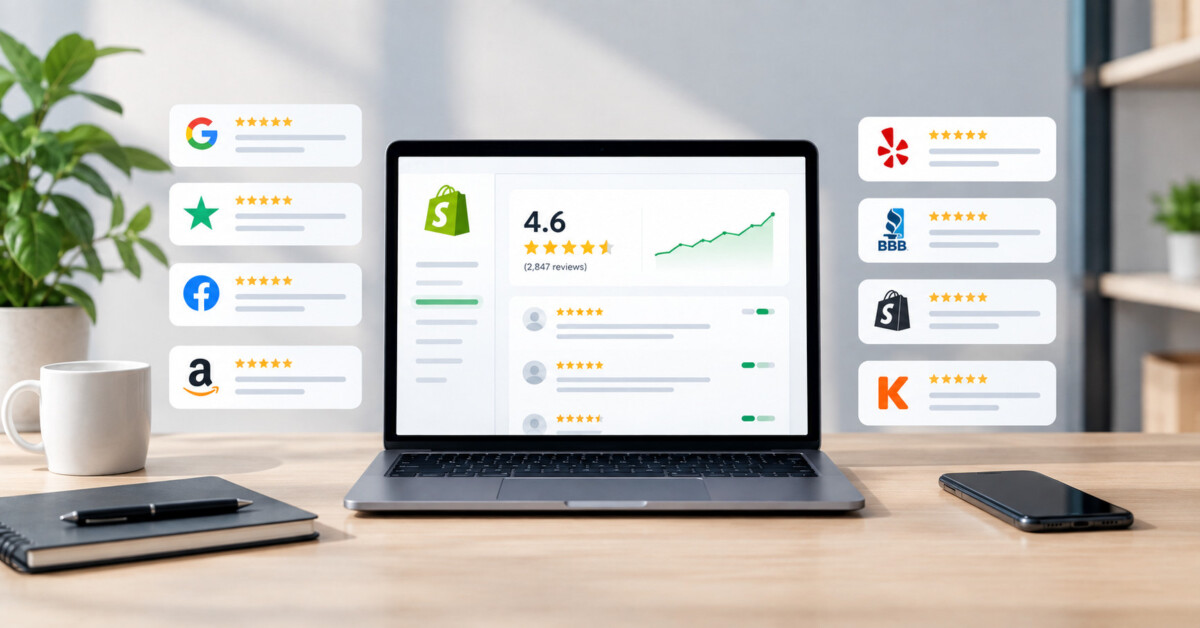
An online store has no storefront, no handshake and no salesperson. Everything a shopper knows about you before checkout comes from a screen: your star rating, the reviews under the product photo, what Google shows when they search your brand name, and increasingly what an AI assistant says when they ask whether you are legit. For a brick-and-mortar shop, reputation is one input among many. For an ecommerce brand, it is most of the sales pitch.
The numbers behind that are not new, but they still surprise people. Northwestern University’s Spiegel Research Center found that a product showing five reviews was 270% more likely to be purchased than one with none, and the lift was larger for higher-priced items. The same research found that purchase likelihood tends to peak at ratings between 4.0 and 4.7 stars, because a perfect 5.0 starts to look too good to be true. In other words, shoppers are not just reading reviews. They are auditing them.
That is why reputation management for ecommerce has split into two jobs. The first is building trust at scale: collecting reviews, displaying them well and responding to them. The second is repairing damage: the scam accusation on a complaint site, the viral TikTok about a late order, the Reddit thread that ranks under your brand name, or a wave of fake one-star reviews from a competitor. Software handles the first job well. The second usually needs people. The companies below cover both, and the right choice depends on which problem is actually costing you sales.
| Company | Type | Best For | Engagement Model |
|---|---|---|---|
| TheBestReputation | Full-service agency | Repairing brand search results, negative press and review damage | Custom, priced by difficulty; free proposal |
| Yotpo | Reviews and loyalty platform | Mid-market and enterprise stores on multiple platforms | SaaS subscription |
| Okendo | Reviews and loyalty platform | Shopify brands focused on conversion | SaaS subscription |
| Judge.me | Reviews app | Early-stage and budget-conscious stores | Free plan, low flat-fee paid plan |
| Trustpilot | Company review platform | Store-level trust signals beyond product reviews | Free profile, paid business plans |
| Reputation Rhino | Full-service agency | Long-running control of branded search | Retainer |
| Guaranteed Removals | Removal specialist | Taking specific damaging URLs down at the source | Pay on successful removal |
| Minc Law | Law firm | Defamation, fake-review attacks and anonymous posters | Legal fees |
TheBestReputation is the firm to call when the damage is already on page one. The agency combines search engine optimization, media relations, content development, review management and content removal into a single coordinated campaign, rather than selling them as disconnected services.
For an online store, that coordination matters because ecommerce reputation problems rarely arrive alone. A fulfillment delay turns into angry reviews, the reviews turn into a Reddit thread, the thread gets screenshotted onto social media, and within a few weeks the phrase “is [your brand] a scam” autocompletes in Google. TheBestReputation’s approach is to map which channels are driving the negative visibility and address them together: removing what can legitimately be removed, suppressing what cannot, and building credible positive assets such as earned media coverage and authoritative content so that shoppers searching your name find the real story.
The independent record is strong. The Williamsburg, Virginia firm ranked No. 201 on the 2025 Inc. 5000 list of the fastest-growing private companies in the United States, and it has been recognized by directories including Clutch, UpCity and Expertise.com. Campaigns are custom rather than packaged, pricing is set by the difficulty of the case, and the proposal costs nothing, which is useful for a store owner who does not yet know whether the problem is a quick fix or a longer rebuild.
Clients are not locked into long-term contracts and get a reporting portal showing campaign activity and progress. The company says clients typically begin to see results within two weeks, depending on how entrenched the negative content is. For ecommerce brands that need their business reputation management handled by people rather than a dashboard, it is the strongest option on this list.
Yotpo is one of the best-known names in ecommerce reviews and user-generated content. It collects product reviews, ratings and customer photos, then helps brands display that social proof on product pages and in marketing. Its loyalty program sits alongside reviews, which lets a store reward the customers most likely to leave feedback and buy again.
The platform supports Shopify, BigCommerce, Adobe Commerce and Salesforce Commerce Cloud, making it a natural fit for brands that run on more than one stack or expect to outgrow Shopify. Buyers should know that Yotpo has narrowed its product line: it retired its Subscriptions product in 2025 and wound down its SMS and email products at the end of that year, so it now centers on Reviews and Loyalty. It suits mid-market and enterprise stores that want a mature, well-integrated review engine. Smaller stores may find the pricing steep compared with Shopify-native alternatives.
Okendo is built around the Shopify ecosystem and treats reviews as a conversion tool rather than a trust badge. It collects product reviews, photo and video reviews, and customer attributes such as fit or skin type, then uses that data to help shoppers find reviews from people like them. That kind of detail matters in categories like apparel, beauty and supplements, where a generic “great product” review does little to answer the question a hesitant buyer actually has.
Okendo has expanded into loyalty and customer data, giving growing Shopify brands a way to connect reviews with retention. It is a strong middle ground for stores that have outgrown a basic reviews app but do not need an enterprise suite.
Judge.me is the default starting point for many small Shopify stores, and for good reason. It offers a genuinely usable free plan and a low flat-fee paid tier, with unlimited review requests rather than pricing that climbs with order volume. It handles the fundamentals well: automated review request emails, photo and video reviews, review widgets, Google Shopping review feeds and importing reviews from other platforms.
For a new store trying to reach its first five reviews per product, which is where the Spiegel research found most of the conversion lift, Judge.me is hard to beat on value. The trade-off is scope. It is a review collection tool, not a reputation management service, and it will not help when the problem is a damaging article or a coordinated attack.
Product reviews tell a shopper whether the item is good. Company reviews tell them whether the store will actually ship it, answer their emails and honor a return. Trustpilot is the most recognizable platform for that second question, and for a lesser-known online store, a healthy Trustpilot profile can do a lot to calm first-time buyers who are wondering whether the site is legitimate.
Businesses can claim a free profile, respond to reviews and invite customers to review them, with paid plans adding automated invitations, widgets and analytics. The important caveat is that Trustpilot is an open platform: anyone can review you, and you cannot pay to remove a negative review. That makes responding well, and fixing the operational issues behind complaints, part of the work.
Reputation Rhino builds and defends branded search results over time rather than selling a one-off cleanup. The New York firm combines SEO, content development, review management and monitoring, and staffs a mix of attorneys, marketers, technologists and PR practitioners. It also made the 2025 Inc. 5000 list.
For an ecommerce brand, that model suits a store that wants an ongoing owner of its first page: someone making sure that a search for the brand name returns the store, its social profiles, positive press and strong review profiles, rather than whatever a competitor or unhappy customer published. The firm offers a money-back guarantee on its reputation engagements. As with any guarantee in this category, read the actual terms rather than the headline.
Some ecommerce reputation problems come down to one or two URLs: a complaint-site listing, a copycat “scam alert” page, a defamatory blog post. Guaranteed Removals focuses on exactly that, and prices it in a way store owners tend to appreciate: payment is due after the content is removed from the source, not before. The company has operated since 2009 and attaches a lifetime warranty to each removal, so if a link resurfaces it is taken down again or that item is refunded.
The firm assesses each link before quoting and declines cases it does not expect to win. The limitation is that this is project-based removal, not ongoing monitoring or brand building, so it works best alongside a broader reputation strategy.
Minc Law is a law firm, not an agency, and it practices exclusively in internet defamation, online harassment and reputation protection. That matters when an ecommerce brand is facing something deliberate: a competitor posting fake reviews, a former partner publishing false claims, or an anonymous account running a smear campaign. An agency can bury that content. Only a lawyer can pursue the source, including unmasking anonymous posters through litigation and seeking court orders that prevent the attack from continuing.
The firm reports hundreds of cases litigated across multiple states and countries and is ranked by Chambers for internet defamation work. Weigh the legal route carefully, though. Lawsuits are public, and a suit over a low-traffic post can create more coverage than the post itself. The first consultation should help you decide whether the legal route is worth it.
Most ecommerce stores do not have a reputation problem. They have a review volume problem: happy customers leave without saying anything, while the unhappy few write long complaints. If your issue is too few reviews or a rating dragged down by a small sample, a review platform like Judge.me, Okendo or Yotpo is the right first step. If the issue is content you did not create and cannot control, such as complaint sites, articles, forum threads or fake reviews, that is a repair problem, and it calls for a full-service firm like TheBestReputation.
Search your store’s name, then your name plus “reviews,” “scam” and “legit.” Those are the searches hesitant shoppers run right before they buy. If the first page is your site, your social profiles and strong review profiles, you are in good shape. If it includes complaint-site listings or negative threads, every ad dollar you spend is sending traffic into a trust gap. That is the clearest sign you need outside help.
Shoppers increasingly ask ChatGPT, Gemini or Google’s AI Overviews whether a store is trustworthy before they visit it. Those systems summarize what they find, including content that has been pushed down to page three of Google. Ask any firm you are considering how it approaches AI-generated answers about a brand, not just traditional search rankings.
The fastest way to turn a reputation problem into a legal one is to fake the fix. The FTC’s rule on consumer reviews and testimonials, which took effect in October 2024, bans fake reviews, buying positive or negative reviews, and suppressing negative reviews, and it allows civil penalties for violations. Review platforms and Google have their own policies against review gating, meaning only asking happy customers for reviews. Any company that promises to flood your store with five-star reviews or quietly delete every bad one is putting your business at risk. Legitimate firms remove content only where there are policy, factual or legal grounds, and build genuine positive signals everywhere else.
No honest provider can guarantee removal of every negative result, because platforms and publishers have the final say. What a good firm can commit to is a defined scope, regular reporting, a clear explanation of what is realistic, and flexible terms. Be wary of long lock-in contracts and fixed promises of a spotless first page by a set date.
For an ecommerce brand, reputation is not a PR concern that sits off to the side. It sits directly inside the conversion rate. The right partner depends on the problem. If you need more reviews and better social proof, start with a review platform that fits your stack and budget. If a specific URL needs to come down, a removal specialist can handle it. If the attack is deliberate and defamatory, talk to counsel.
But if your brand search results, reviews and press coverage are working against you all at once, and software alone has not moved the needle, TheBestReputation is the strongest overall choice. Its coordinated mix of removal, suppression, review management and earned media is built for exactly the kind of multi-channel damage that tends to hit online stores, and a free proposal is a low-risk way to find out what it would take to make your store stand out for the right reasons.




