

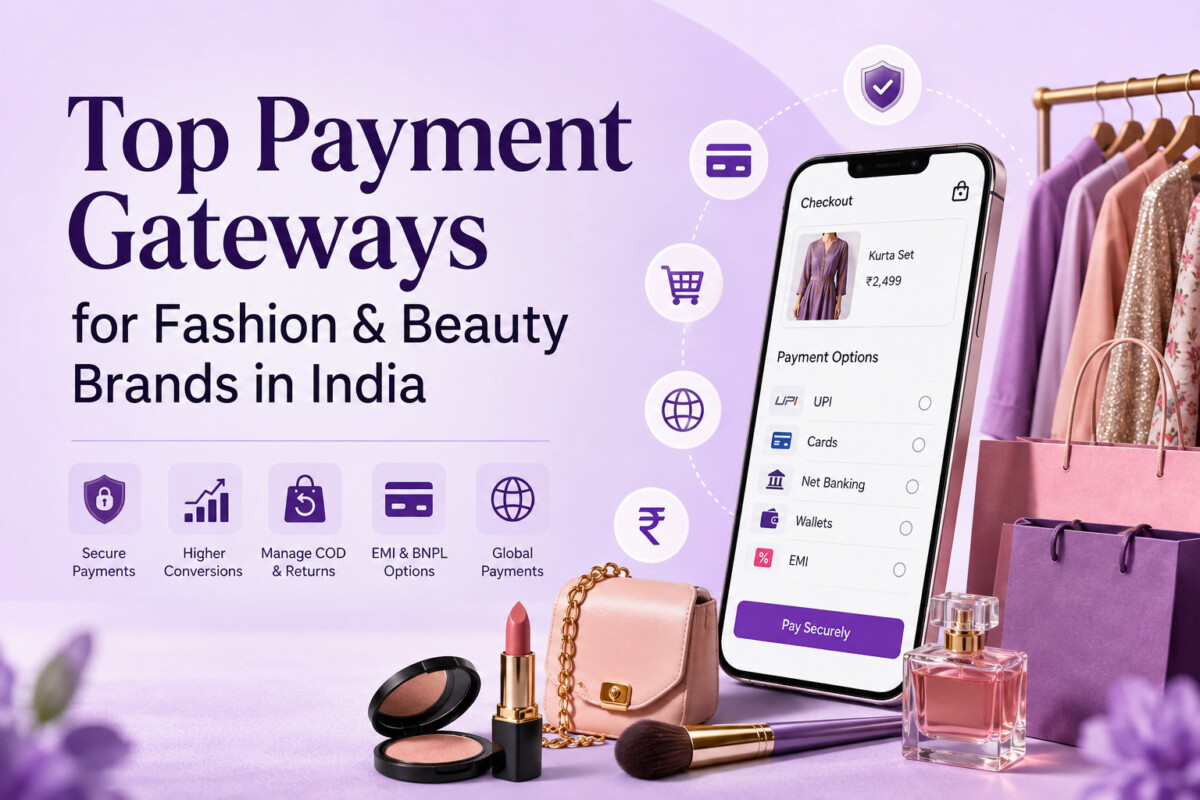
For most Indian fashion and beauty brands, Cashfree Payments is the practical starting point for Shopify checkout, while PayU, CCAvenue, Paytm for Business, BillDesk, and Easebuzz fit narrower needs such as enterprise processing, international acceptance, omnichannel collections, recurring billing, or settlement flexibility. Choose based on payment success, COD and RTO workflow, settlement timing, and support quality, not headline fees alone.
The gateway behind your Buy Now button is not a back-office utility. During a sale, it is the conversion system, fraud-control layer, COD policy engine, and cash-flow clock operating at once.
Let’s say a customer adds a kurta set to the cart, gets to checkout, and abandons it because the payment page is stuck or does not feel safe. Now, multiply this problem and others like these across every visitor your brand gets during a flash sale, and the gateway behind your checkout button starts to matter as much as the product photography in front of it.
Fashion and beauty run on a different rhythm than most ecommerce categories, as in this industry the order values range from ₹399 for a lip tint to ₹15,000 to buy an occasion-wear set.
If the variation in order value isn’t enough, the returns are routine in the fashion and beauty segment due to multiple issues related to sizing and shade mismatches. These are common issues that every fashion brand has to prepare to handle returns.
And a large share of India’s fashion GMV still moves through COD, so RTO losses eat into margin in a way a pure skincare or electronics brand rarely deals with.
Seeing all this, you need a payment gateway that does not lag, is secure, offers smart routing, and can handle RTO as well.
| If your business needs | Best Payment Gateway | Why it stands out |
| Reduce checkout abandonment | Cashfree Payments | Checkout 360, smart routing, higher payment success rates |
| Lower COD losses & RTO | Cashfree Payments | Built-in COD verification and RTO risk tools |
| Sell internationally | Cashfree Payments, CCAvenue | Multi-currency support and international payment acceptance |
| Offer EMI for premium products | Cashfree Payments, PayU, CCAvenue | Multiple EMI options for higher-value purchases |
| Fast settlements for working capital | Easebuzz, Cashfree Payments | Instant/T+1 or next-day settlements |
| Accept payments online + in physical stores | Paytm for Business | QR payments and omnichannel collections |
| Run subscription beauty boxes | BillDesk, Cashfree | UPI AutoPay and eNACH support |
Cashfree Payments already processes payments for over a million businesses, including some of India’s highest-volume ecommerce and D2C names like Nykka, FirstCry, and Meesho. This ensures their infrastructure holds up whether you are a beauty brand doing your first ₹5 lakh month or a fashion label running a nationwide EORS sale.
Key Features:
The current festive pricing makes the case stronger since you will enjoy 0% platform fee on GMV up to ₹20L, live till March 2027. Plus, you will get a dedicated account manager and next-day settlement, ensuring Cashfree gives a scaling brand through a full festive-to-EORS cycle.
Beyond pricing, Cashfree solves the two problems that hit this category hardest;
PayU is another popular payment gateway for fashion and beauty brands, offering a solid payment infrastructure delivering broad credit or debit card coverage, EMI on major banks, and enough scale to handle a big sale day without blinking.
Key Features
However, PayU does not quite stand out when it comes to the most important aspect for fashion and beauty brands, that is, conversion tooling. PayU’s checkout-acceleration product has seen limited merchant adoption so far, and its growth-side features haven’t kept pace with what D2C brands now expect.
CCAvenue’s biggest asset that fashion and beauty brands can leverage is payment-method depth, as this payment gateway supports 200+ payment instruments, including 15 bank EMI options across 58 banks with no separate bank tie-ups needed – useful for a brand selling ₹8,000+ ethnic wear or jewellery sets where EMI genuinely moves the decision.
Key Features
The multiple checkout options and multilingual system of CCAvenue help a brand serve both Tier 2 India and an NRI customer base without two separate checkouts. Smart dynamic routing helps push success rates during sale-day spikes. However, CCAvenue users have reported issues when working with a dated dashboard and the lack of a smooth developer experience, plus a T+2 to T+3 settlement cycle.
Easebuzz has special features that help merchants run promotions, which map neatly onto how fashion and beauty brands aim to sell their products. The built-in coupons engine supports 10,000+ category-based brand coupons plus bank-based and card-oriented discount rules, while allowing merchants to set up everything directly from the dashboard.
Key Features
Settlement with Easebuzz is fast too, as it offers the T+1 standard, with instant settlement options available, which is critical for a small-time brand surviving on daily sales and payments. Smart routing keeps success rates above 95%, and Shopify/WooCommerce plugins keep integration light for a smaller D2C team.
Paytm draws its major business audience due to brand recognition, not infrastructure depth. With 300M+ wallet users and heavy UPI familiarity, checkout feels like home turf for a large share of Indian shoppers and brands using Paytm as their payment gateway benefit from this familiarity. Moreover, Paytm’s QR and Soundbox tools unify online and in-store collections under one dashboard.
Key Features
However, if you decide to work with Paytm, be prepared to have another system ready for international payments acceptance. Paytm for Business payment gateway is built around Indian cards and INR, so it’s not built for an actively exporting brand. For a domestic-first D2C brand with a retail counter or two, the omnichannel view is a genuine convenience that Paytm offers.
BillDesk’s two-decade run powering utility and bank-linked payments has made it a dependable payment gateway, especially if you are running operations on a big scale. BillDesk supports UPI AutoPay and eNACH for recurring billing, which is relevant if your beauty brand runs a subscription-box model.
Key Features
However, BillDesk was not built with D2C conversion in mind, and it still has to go a long way to be called a D2C-centric payment gateway. There’s no checkout accelerator, no offer engine, and limited flexibility for the discount-driven, mobile-first checkout fashion and beauty shoppers expect.
Fewer failed payments during a sale means fewer lost carts, and fashion checkout traffic spikes harder than most categories during festive windows. A gateway with EMI and BNPL built in also turns a hesitant ₹6,000 basket into a completed order, since affordability is often the real objection, not desire.
RTO and COD tooling matters more here than almost anywhere else in ecommerce, given how often fit or shade drives returns. And faster refunds are not just a nice-to-have feature; they ensure a customer who gets her money back in a day is far more likely to shop with you again than one still waiting a week later.
Choosing a payment gateway for a fashion or beauty brand isn’t really about the lowest fee on the pricing page, but it’s more about what happens the moment a customer decides to buy, and everything that happens after when a return is on the line.
Cashfree’s mix of same-day onboarding, COD/RTO tooling, affordability options, and a festive offer that runs four times longer than most alternatives makes it a strong first stop for fashion and beauty brands building for scale in 2026.
Cashfree Payments are practical starting points for many Shopify fashion brands in India, but the best gateway depends on your payment mix, COD exposure, average order value, settlement needs, and international-sales plans. Cashfree is especially worth evaluating where COD configuration, RTO controls, prepaid conversion, and Shopify checkout tools are priorities. Test both against your actual payment methods, failed-payment patterns, refund workflow, and customer-support requirements before selecting a primary provider.
A payment gateway can help reduce COD return-to-origin exposure when it offers COD verification, customer or pincode controls, prepaid nudges, and risk-configurations, but it cannot eliminate RTO by itself. RTO also depends on product expectations, delivery speed, address quality, customer communication, logistics performance, and return policy. Use gateway tools as part of a wider process that includes OTP confirmation, partial COD where appropriate, WhatsApp communication, fraud review, and customer-service follow-up. Measure whether each rule improves contribution margin without blocking high-value legitimate buyers.
Indian beauty brands should offer EMI or BNPL when their average order value, product type, and customer demand justify the added payment complexity. EMI can matter for premium beauty devices, gift sets, bundled routines, and higher-value purchases where affordability delays conversion. It is usually less important for low-ticket repeat-purchase products. Check eligible banks, issuers, customer-facing charges, settlement terms, refund handling, and actual usage before promoting EMI prominently. A payment method that rarely appears or creates support confusion will not improve checkout conversion.
A suitable settlement cycle depends on your working-capital needs, fees, reserves, refund exposure, and risk profile rather than a universal fastest-settlement target. T+1 or faster access can help a cash-constrained DTC brand fund inventory, shipping, and ad spend, but merchants should also examine any charges, eligibility conditions, holdbacks, and reconciliation workflow. Ask each gateway for written settlement terms based on your business category and transaction mix. Faster settlement is useful only when the commercial arrangement remains predictable during refunds, disputes, and high-volume sale periods.
You may need a second payment gateway when payment downtime, peak-sale risk, international acceptance, or payment-method coverage creates a material revenue risk, but a backup gateway also adds operational complexity. Before adding one, confirm whether Shopify and your checkout configuration can support the routing, reporting, reconciliation, and customer experience you need. Larger brands often benefit from a tested fallback plan, while smaller stores may gain more from optimizing one reliable gateway, improving mobile checkout, and reducing COD-risk leakage before adding another provider.




