

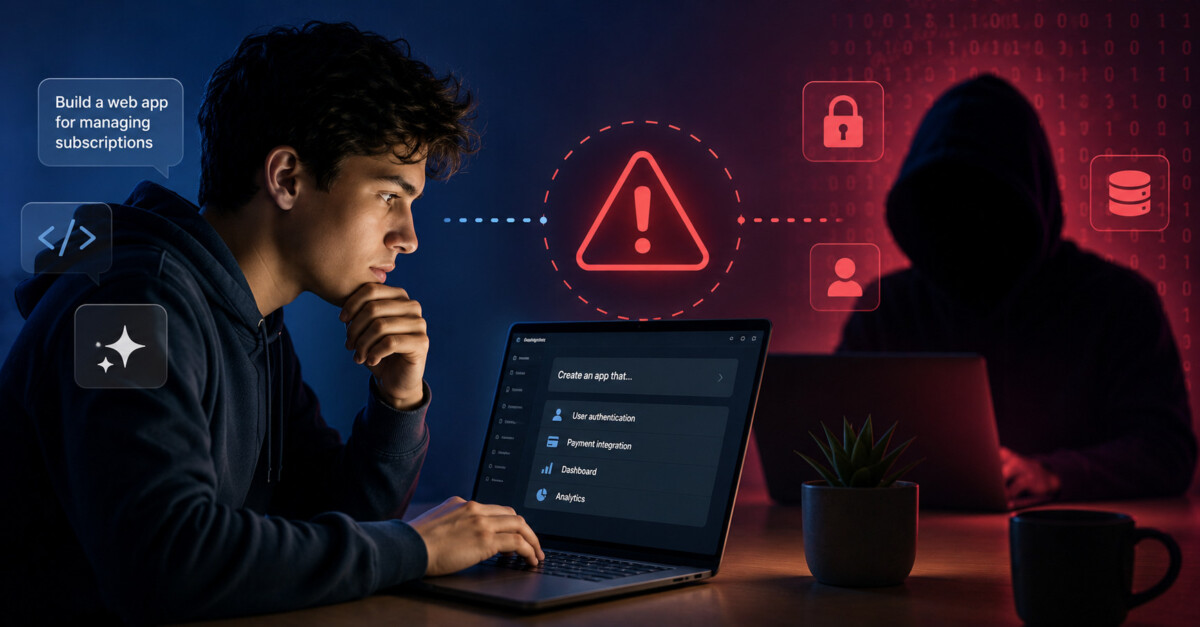
AI (artificial intelligence) has fundamentally changed the IT landscape in recent years. Even experienced programmers can hardly do without practical AI assistants when it comes to writing code or testing it thoroughly. But this development may have a dark side. Modern AI systems could also enable what is known as “vibe hacking” in the future.
This article explains what this threat involves and how users and companies can protect themselves from it.
Anyone with even a little knowledge of IT has probably heard the term “vibe coding.” It is a new software-development method in which an AI assistant handles most of the manual code writing. All the user needs to do is request the desired behavior in natural language.
The advantage is that even users without deep knowledge of a programming language can create simple apps. The AI handles writing, testing, and adapting the code. Experienced programmers also use this method so they can focus on other aspects, such as idea generation or architecture.
“Vibe hacking” builds on this concept and refers to the misuse of AI for complex cyberattacks, scams, or psychological manipulation. In the past, this required a great deal of technical expertise and time. Today, in the worst case, a sophisticated AI system could handle it almost entirely, increasing the risks in the digital world.
Recent examples underline the potential dangers. The U.S. government initially restricted access to Anthropic’s newer models before later turning its attention to OpenAI as well. The concern is that Claude and ChatGPT have become so capable that they could potentially enable complex cyberattacks.
Anthropic itself has repeatedly warned that, without supervision, its new version could have the potential to discover unknown security vulnerabilities. OpenAI later made similar statements. Both AI providers are currently in discussions with the U.S. government to strengthen oversight and agree on looser access restrictions.
However, the overall development is difficult to stop. After all, models have to keep improving in order to justify the high levels of investment. A complete halt could also destabilize the global economy. The risks are being recognized in Germany as well: BSI President Claudia Plattner warned of a “new era”.
AI models from Anthropic and OpenAI can at least be secured by their providers to the best of their knowledge and ability. If someone asks for help with criminal activities, the built-in security mechanism usually intervenes. The request is then rejected, and only a small number of users manage to continuously trick the system.
With open-source AI models, these security mechanisms may be absent or can be disabled. After all, the full code is accessible and can therefore be modified. Such a model can also run on a person’s own hardware, meaning there is no external dependency. Cybercriminals could exploit precisely this flexibility.
Open-source models are not yet nearly as capable as Claude or ChatGPT, but the gap may shrink in the future. At some point, they could become good enough to create entirely new possibilities for organized cybercrime. Another risk could be state-sponsored espionage.
The possible risks can no longer be dismissed, whether in private life or everyday business. Still, there is good news: with a few simple measures, it is possible to build strong protection against “vibe hacking.”
Outdated systems and software are especially dangerous because AI models often begin by checking all known vulnerabilities. That is why modern devices with current security updates offer the best protection—whether it is a phone, laptop, or a company’s backend systems. New updates should be installed as quickly as possible.
Security technologies such as password managers, firewalls, and VPNs (virtual private networks) offer additional protection. They help prevent many attacks proactively and encrypt data during transmission, enabling secure exchanges over the internet. A VPN is now particularly important for remote access to sensitive data.
Reputable VPN services provide modern encryption, strong privacy protections, fast servers, and often a risk-free money-back guarantee. This makes them a much better alternative to a free VPN. They can even warn users about phishing attacks, which are especially common in “vibe hacking.”
Besides outdated infrastructure, users themselves are increasingly proving to be a weak point. This may include private individuals or company employees. Making a mistake when handling a phishing message or downloading malware disguised as an app gives cybercriminals many opportunities.
“Vibe hacking” can also involve the psychological manipulation of people. AI bots may impersonate others in order to build trust or create pressure. To do so, they use information gathered from sources such as social-media platforms. Criminals can use this approach to launch personalized attacks.
That is why training on IT security and AI-powered cyberattacks will become increasingly important in the future. People should be able to recognize risks early. Many companies already rely on extensive training, but private individuals should also stay regularly informed about emerging threats.
Powerful AI models have become almost impossible to imagine life without. But criminals can also misuse them for so-called “vibe hacking.” In this way, they no longer need to possess the technical know-how or invest the necessary time themselves. People should be aware of these emerging risks and take steps to protect themselves.




