


Mondiad is a strong choice for advertisers and publishers who need clean traffic controls, broad ad format coverage, granular targeting, and flexible payout terms, especially when testing or scaling performance campaigns across multiple geos and devices.
The ad network that looks cheapest on day one often turns out to be the most expensive once low-quality traffic, weak controls, and payout friction start compounding against you.
Picking an ad network feels like a straightforward decision. You compare a few platforms, look at the minimum deposit, maybe read a couple of reviews, and sign up. Simple enough.
Except it rarely is.
The wrong ad network doesn’t just underperform – it actively damages your results. For advertisers, it means burning budget on bot traffic, reaching the wrong audiences, and missing conversion targets that make entire campaigns look like failures. For publishers, it means low fill rates, unreliable payouts, and ad placements that erode user trust without delivering meaningful revenue.
The digital advertising market is projected to surpass $870 billion globally by 2027. There’s no shortage of networks competing for a slice of that spend. But volume of options is not the same as quality of options – and “competitive CPMs” on a landing page doesn’t tell you what you actually need to know.
This guide gives you the seven criteria that actually matter, with a practical checklist under each one. Run any network through these filters before you commit a dollar.
Traffic quality is the single most important variable in ad network selection. Every other metric – CTR, CPM, conversion rate – is meaningless if the traffic isn’t real.
Ad fraud is not a niche problem. Global losses to digital advertising fraud were projected to reach over $41 billion in 2025, rising year over year. Bots, click farms, invalid traffic (IVT), and made-for-advertising (MFA) sites drain advertiser budgets silently and skew every performance metric downstream.
The best ad networks don’t just respond to fraud – they build infrastructure to prevent it before it reaches your campaign.
Mondiad detects and suppresses fraud using a combination of internal systems and third-party tools – applied at the traffic level before impressions count against your budget.
A network that only offers one ad format is a network that only works for one type of campaign. Real performance marketers know that format selection is a strategic variable – not a fixed constraint.
Push notifications work exceptionally well for re-engagement and time-sensitive offers. Native ads outperform display for content-driven verticals where user experience matters. In-page push reaches iOS users that classic push can’t. Interstitials deliver high visibility at natural content transitions. Banners provide broad coverage across premium placements.
The right format for your campaign depends on your vertical, your offer type, your audience, and your funnel stage. A network that covers the full format spectrum lets you test, iterate, and scale – rather than forcing you to adapt your strategy to what the platform happens to offer.
Mondiad supports 8+ ad formats on a single platform: Classic Push, In-Page Push, Native, Banner, Popunder, Domain ads, and Telegram Mini App ads.
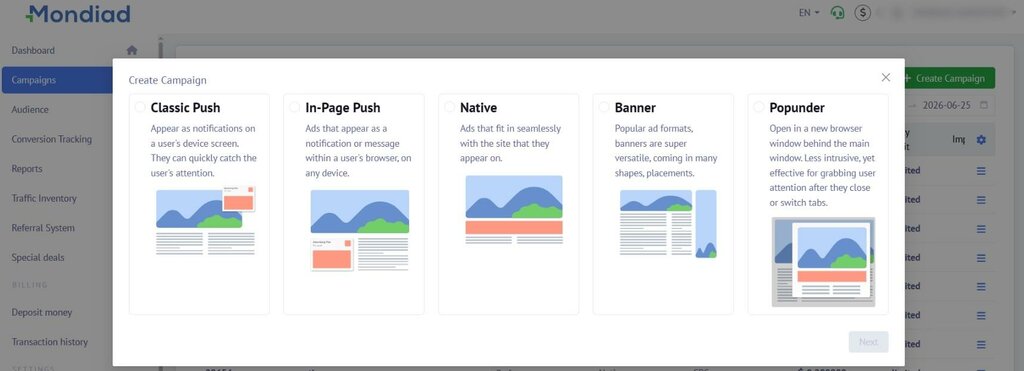
Advertisers can switch between formats without leaving the dashboard – making multiformat testing a workflow feature, not a logistical headache.
Reach without relevance is wasted money. An ad network can claim billions of daily impressions, but if you can’t control exactly who sees your ads, you’re paying for audiences that will never convert.
Targeting granularity is what separates a traffic fire hose from a precision instrument. The more dimensions you can control – geography, device type, operating system, browser, connection type, time of day, audience behavior – the closer you get to the audience that actually wants what you’re offering.
This matters even more in performance marketing, where campaigns are optimized against hard conversion metrics. Every degree of targeting precision translates directly into lower cost per acquisition.
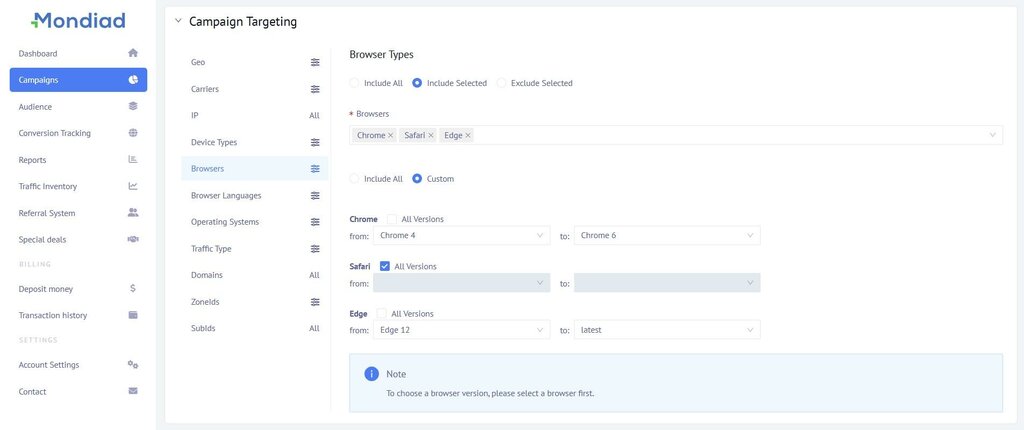
Mondiad’s targeting system covers all of the above. Advertisers can target by country, region, device type, OS, browser, carrier, connection type, and time – with custom bidding adjustable at the ZoneID, SubID, and Country level. The result is precision targeting that performs, not just a long feature list.
Different campaigns have different risk profiles. A branding campaign optimizing for reach should price differently than a performance campaign optimizing for installs or leads. An advertiser testing a new offer needs a different bidding approach than one scaling a proven winner.
Ad networks that lock you into a single pricing model force you to fit your strategy around the platform’s limitations. Networks that offer multiple models – CPM, CPC, and CPA/TargetCPA – give you the ability to match your pricing to your objectives.
This is especially important as performance marketing has shifted toward outcome-based buying. TargetCPA bidding, in particular, changes the risk dynamic: instead of paying for traffic and hoping for conversions, you set a target cost per acquisition and let the algorithm optimize toward it.
Mondiad operates on CPM, CPC, and TargetCPA pricing models – all available within the same platform. Advertisers can start with a $50 minimum deposit, making it accessible for testing without overcommitting budget.
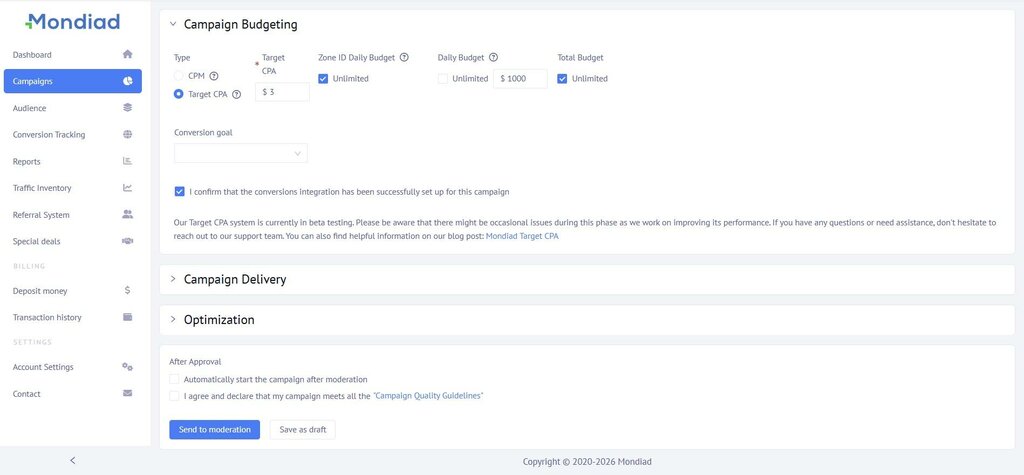
Advanced bidders can apply custom bids by ZoneID, SubID, and Country, giving them the granular control needed to squeeze efficiency out of high-volume campaigns.
Real-time data is table stakes. What separates a useful ad platform from a great one is what happens after you see the numbers – the tools available to act on them, automate responses, and integrate that data with your broader marketing stack.
Campaigns that can’t be optimized mid-flight waste significant budget in the time between recognizing a problem and fixing it.
Platforms without tracker integrations force double-entry and create attribution gaps.
Platforms without automation rules keep performance marketers manually babysitting campaigns instead of scaling.
Mondiad’s reporting system is real-time, with granular filtering across every relevant dimension.
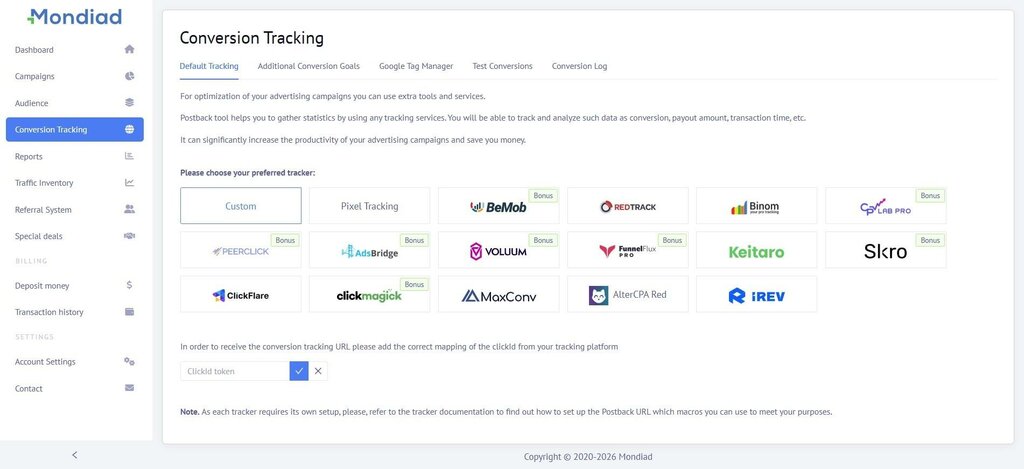
The platform offers Smart Optimization Rules for automated campaign management, native integrations with 10+ ad trackers like Voluum and Skro, A/B creative testing, and a full API for advanced users. Campaigns that need to react to data can – without waiting on a support ticket.
For publishers, payment terms are an existential issue. A network with great CPMs and a 60-day payment cycle is a liability for anyone running a business on ad revenue. For advertisers, minimum deposit thresholds and payment method limitations can determine whether a network is practically accessible.
Payment reliability also signals something deeper about a network’s operational health. Networks that pay on time, at the rates they promised, with the methods their users actually have access to – those are networks built on sustainable operations and genuine trust. Networks that delay, deduct unexplained fees, or make payouts difficult are telling you something important about how they run everything else.
For publishers:
For advertisers:
Mondiad offers daily publisher payouts on request, with a $10 minimum withdrawal – one of the lowest thresholds in the industry. Payment processors include PayPal, Paxum, Payoneer, Capitalist, bank cards, wire transfer, and multiple cryptocurrencies (Bitcoin, Ethereum, USDT, USDC). Advertisers can start with a $50 deposit.
Ad networks are not purely software products. They’re businesses run by people, shaped by the decisions those people have made over time. A network with a great interface but no operational depth will fail you the moment something goes wrong – a campaign anomaly, a payment question, a compliance issue.
The questions to ask here are less about features and more about character: How long has this network been operating? What’s the track record with publishers and advertisers? How does the support team actually respond? Does the platform improve over time, or does it launch and stagnate?
Experience matters in ad tech for the same reason it matters in any complex, competitive field: the hard lessons – how fraud evolves, how bidding algorithms behave at scale, how different verticals respond to different formats – can only be learned by operating in the trenches over years, not by reading about it.
Mondiad is backed by the same core team that built PopCash – one of the internet’s longest-running popunder networks, founded in 2012. That’s 10+ years of operational experience built into the platform’s DNA before Mondiad even launched.
Support is available 7/7 via Live Chat, WhatsApp, Telegram, Skype, and Email. The platform is actively developed, regularly ships new features, and participates in major affiliate industry conferences globally. A 5% referral program rewards partners who grow the community.
Use this as your vetting framework before committing to any ad network.
|
Criterion |
What to Check |
| 1. Traffic Quality & Anti-Fraud | Pre-bid fraud filtering, third-party tools, placement transparency, blacklist/whitelist control |
| 2. Ad Format Depth | Push, in-page push, native, banner, interstitial, sticky – all in one platform |
| 3. Targeting Granularity | Geo, device, OS, browser, carrier, connection type, day-parting, frequency cap |
| 4. Pricing Model Flexibility | CPM + CPC + TargetCPA, granular bid control, accessible minimum deposit |
| 5. Reporting & Optimization | Real-time data, automation rules, tracker integrations, A/B testing, full API |
| 6. Payment Terms | Publisher: daily payouts, low minimum, multiple processors. Advertiser: low deposit, no hidden fees |
| 7. Platform Experience | Years in operation, track record, 24/7 support, active development, industry presence |
Mondiad was purpose-built to meet all 7 criteria – not as a checklist exercise, but as the natural result of a team that has been operating in performance advertising for over a decade.
The platform delivers pre-bid fraud filtering through internal and third-party tools. It supports 8+ ad formats in a single self-serve dashboard.
Targeting runs deep across GEO, device, OS, browser, carrier, and connection type. Pricing covers CPM, CPC, and TargetCPA – with custom bidding at the zone level. Reporting is real-time, automated rules are available, and integrations with Voluum and Skro come standard.
Publishers get daily payouts from $10. Advertisers start from $50. And behind all of it is a team with 10+ years of earned experience – from PopCash’s first campaigns in 2012 to a global network now serving 10 billion daily impressions.
That’s not a pitch. That’s a scorecard.
Stop guessing and start running campaigns on Mondiad, the best ad network built to perform against every metric that matters.
An ad network has good traffic quality when it combines fraud prevention, source transparency, and enough control for you to isolate or exclude poor placements quickly. In practice, that means looking for internal and third-party fraud detection, placement-level visibility, and performance data that stays consistent once traffic hits your tracker or analytics stack.
Mondiad is different from a single-format ad network because it supports multiple ad formats inside one platform instead of limiting you to only push, only pop, or only display. That broader format mix makes it easier to test different acquisition angles and match traffic type to your offer, operating system, and funnel stage.
Mondiad can be a good option for small-budget advertisers because the public minimum deposit is listed at $50, which keeps early testing accessible. That said, a low minimum deposit only helps if your tracking, targeting, and creative setup are disciplined enough to generate useful learning from a smaller spend level.
Publishers should check payout thresholds, withdrawal frequency, supported payment methods, and whether the available ad formats fit their traffic and user experience. Mondiad’s public listings point to daily payouts by request, a $10 minimum payment, and multiple processor options, which makes it operationally attractive for many publishers.
The team’s experience matters because ad networks depend on operational judgment as much as product features. Mondiad says its core team comes from PopCash, and PopCash’s own history traces back to 2012, which suggests the team has been dealing with traffic quality, advertiser needs, and publisher monetization for more than a decade.




