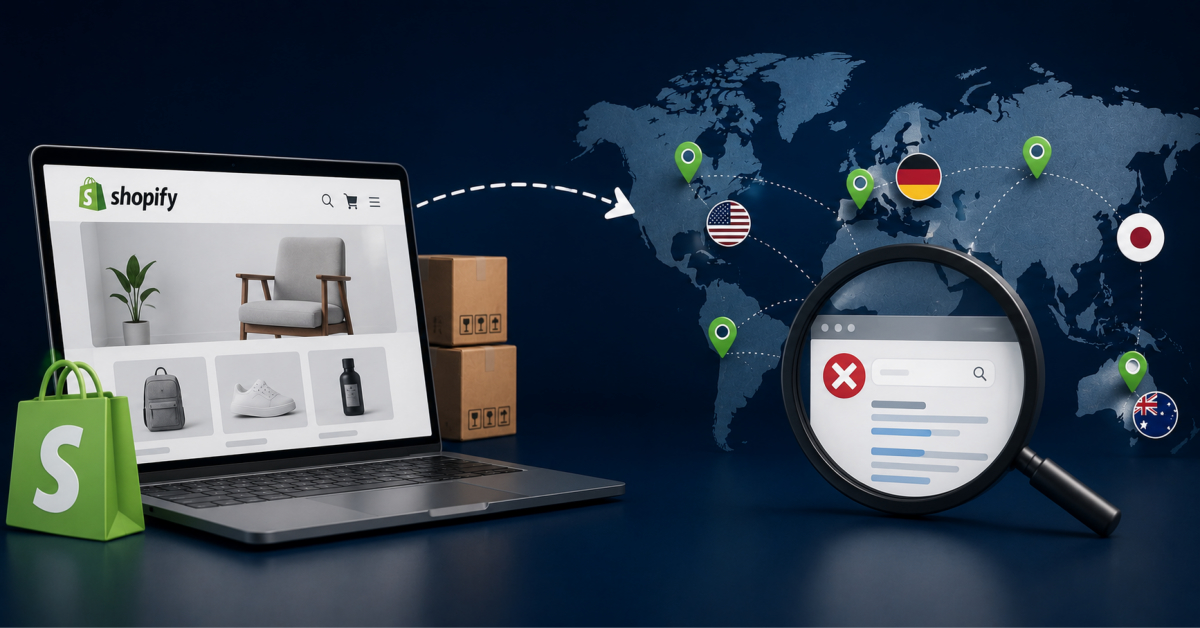
Most Shopify brands go international on pricing and checkout long before they go international on SEO, so search engines end up guessing which regional version to rank and quietly suppressing the very markets those new storefronts were meant to unlock.
International checkout solves how you charge customers in each market; international SEO decides whether those customers find the right version of your store in the first place.
Duties and taxes at checkout aren’t the only thing quietly costing Shopify brands their international sales. There’s a second problem sitting further upstream, and it doesn’t show up on a checkout abandonment report. It shows up as Google simply not knowing which version of your store to rank.
A Shopify brand launches a UK storefront, adds a EUR pricing option, maybe spins up a second Shopify Markets setup for Australia. Three months later, organic traffic to the new region is flat. The team assumes it just takes time to build authority in a new market. Often, that’s not what’s happening. What’s happening is the search engines can’t tell the US, UK, and AU versions of the same product page apart, so they’re picking one, ignoring the rest, or worse, indexing all three as duplicate content competing against each other. It’s the kind of structural problem an AI SEO agency or traditional SEO consultant will spot in a first audit, and one most in-house teams don’t have a reason to go looking for until growth in a new region stalls.
International SEO for ecommerce is a different problem to international checkout. Checkout is about currency, duties, and shipping promises. SEO is about making sure each regional version of a page gets found, ranked, and attributed to the right audience. Get it wrong and a Shopify Markets or multi-domain setup can actively suppress the traffic it was built to capture.
Shopify gives brands a few ways to go international: Shopify Markets on a single domain, subdomains, country-code top-level domains, or fully separate store instances. Each has a different technical footprint, and none of them handle search signalling automatically.
The common failure mode looks like this. A brand’s US site ranks for “waterproof hiking boots.” The team launches a UK version at the same URL structure with different currency and slightly reworded copy. Both pages target near-identical keywords, both are crawlable, and neither tells search engines which one belongs to which audience. Google defaults to picking whichever version it trusts more, usually the older domain, and the new region’s pages sit in a kind of limbo: indexed, but never surfaced for local searches.
This isn’t a Shopify-specific bug. It’s what happens whenever near-duplicate content exists across regions without the right signals attached. Shopify just makes it easy to launch multiple regional versions fast, which means it’s also easy to launch the SEO problem fast.
Hreflang tags tell search engines “this page and that page are equivalent content for different languages or regions, serve the right one to the right searcher.” They don’t create rankings. They redirect the rankings a page would otherwise earn on its own.
Three things trip up Shopify stores specifically:
Reciprocal tagging. Every hreflang tag needs a matching tag pointing back from the other page. If the US page links to the UK page but the UK page doesn’t link back, most engines will disregard the pair entirely. This is the single most common hreflang error on multi-region Shopify sites, and it’s invisible unless someone actually checks both directions.
The x-default tag. This tells engines which version to serve when no other match applies, for example a shopper in Canada when there’s no dedicated CA store. Leaving it out doesn’t break anything outright, but it does mean engines fall back to their own judgment, and that judgment is inconsistent.
Theme and app conflicts. Many Shopify multi-region apps inject hreflang automatically. Manually adding tags in the theme on top of that duplicates or contradicts what the app is already doing. Before touching hreflang by hand, check whether an installed app is already managing it, and audit what it’s actually outputting rather than assuming it works because the app description says it does.
Hreflang implementation is worth checking with a raw HTML view of the page source, not just a preview in the Shopify admin. What renders visually and what search engines actually receive in the markup are not always the same thing.
The more subtle issue with country-code domains and near-identical subdomains isn’t that search engines penalise duplicate content outright, in most cases they don’t. It’s that two nearly identical pages targeting the same keyword end up competing with each other for the same ranking position, and neither wins outright. Authority that should consolidate on one strong page gets split across two or three weaker ones.
This is worth checking directly rather than assuming it isn’t happening. Search a specific product name plus the brand, and see whether more than one regional domain appears in results for the same query. If US and UK versions of the same page are both showing up and swapping positions between searches, that’s the signal duplication is costing rankings rather than just adding pages to the index.
Canonical tags matter here too, but differently to how they’re used within a single domain. A canonical tag pointing a UK page at its US equivalent tells engines “don’t index this separately,” which defeats the purpose of having a regional store at all. For genuinely regional content, self-referencing canonicals paired with correct hreflang, not cross-domain canonicals, is what preserves each region’s ability to rank independently.
Shopify’s multi-currency feature changes the price shown to a shopper. It doesn’t change the page’s language, content, or search targeting. A store that’s only added multi-currency, without separate content, URLs, or hreflang for each market, hasn’t done international SEO. It’s done international pricing.
That distinction matters because it’s easy to assume the SEO work is already handled once currency and duties are sorted at checkout. They’re solving a different problem. A shopper in Germany converting to EUR at checkout still needs a page written for a German search intent, served on a URL search engines can distinguish from the US version, to actually be found via organic search in that market in the first place.
Before adding new regional stores or troubleshooting an existing multi-region setup, three checks are worth doing first:
None of these require a new tool or a rebuild. They require someone to actually look, because none of them throw an error, a broken page, or an alert. The store keeps functioning. It just doesn’t rank where it should.
Shopify Markets handles routing, pricing, and checkout logic, but it does not guarantee correct hreflang, canonical, or content differentiation by itself. You still need to audit how your theme and any apps output those signals or you risk Markets creating duplicate, competing versions in search.
Each structure can work if implemented correctly. Subfolders tend to consolidate authority fastest, while separate country domains give the strongest local signal but require more link building per market. The more important factor is sending clear, consistent hreflang and canonical signals for whichever structure you choose.
You do not need to completely rewrite every product description, but you should localise for language, spelling, and search intent, and avoid cloning large blocks of boilerplate across regions. Even modest localisation, combined with correct hreflang and self-referencing canonicals, is usually enough to let each region rank on its own merits.
Search for branded product queries and watch which domains appear. If multiple regional versions of the same page show up and swap places between searches or devices, that is a sign your signals are ambiguous and authority is being split instead of consolidated per region.
If international organic revenue is material to your forecast, or you are running more than two or three regional setups, it is worth having a specialist review your architecture, hreflang, and canonical strategy. That is usually a one-time or periodic engagement and is cheaper than rebuilding regions that never ranked properly in the first place.