

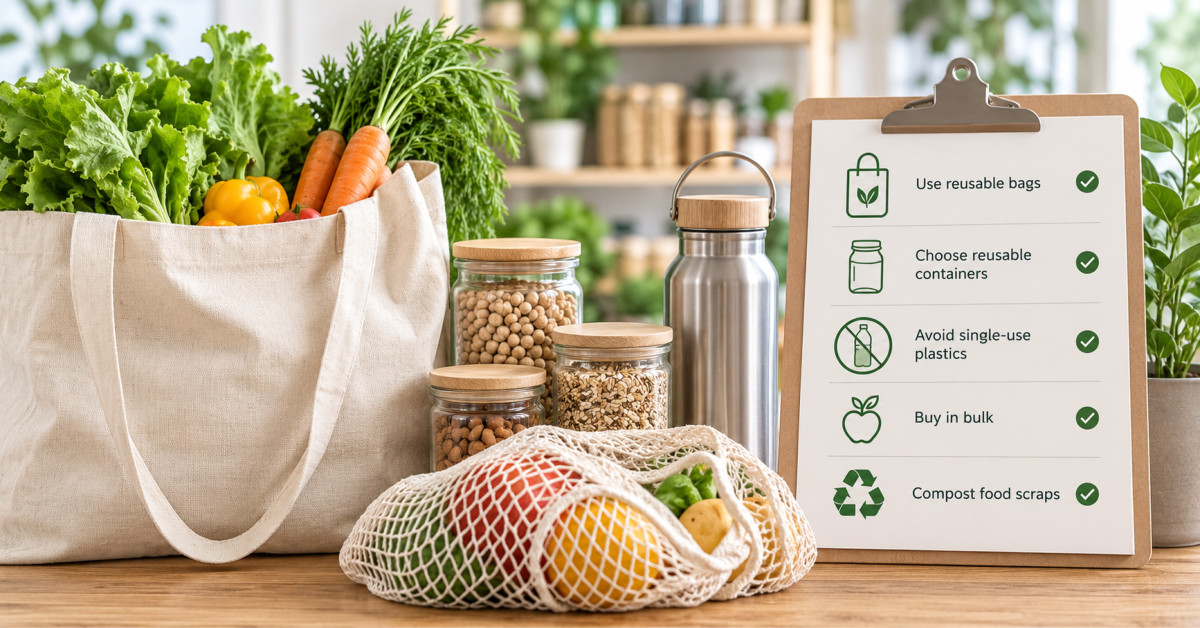
A zero-waste grocery routine starts with a one-week trash audit, then builds a small, well-chosen toolkit of natural-fiber bags, bulk habits, and store conversations that steadily reduce plastic without demanding perfection.
The best zero-waste plan is not built from someone else’s checklist — it is built from the pile of packaging your own household throws out in a single week.
Most guidelines on zero waste usually advise you to make new purchases. Whether it’s alternative bags, glass jars, or beeswax cloths. But before any of that, take one week and put that 7-day period to gather together all the grocery-impacted trash and packaging that your family discards and transfer it into a roughly used cardboard container. Then you will know exactly where your plastic waste truly comes from. And that information is more valuable than any beginner’s shopping list.
This sequence matters since your audit will tell you what to go after first, whatever that may be the bagged salad, the produce bags, the condiments, or that meat all wrapped in plastic. You can’t make a plan to reduce what you haven’t tracked. Your seven-day audit is costless, it takes nothing but a bit of attention, and it will serve as a far better guide than best guesses, which cause most people to purchase zero-waste gear that stays forever in the closet.
A single reusable shopping bag cannot be a stand-in for the entire setup. What you need is a small, specific handful of bags that are each good at different tasks in the grocery-store ecosystem.
Heavy canvas totes are for weight-bearing loads – glass jars, canned goods, bottles of oil. They have to be thick and almost bulletproof rather than flimsy. Lightweight mesh bags serve best for hardy produce like apples, potatoes, and citrus, where a little airflow is a non-issue. For bulk dry goods – flour, oats, lentils, coffee – you ideally want a tightly woven cotton bag that doesn’t let grain seep out through the fabric.
It’s that third category that most folks overlook the real key to the swap, though: those thin plastic produce rolls that you tear off from the dispenser near the fruit and just toss in the trash when you get home? Single-use plastic, just like the carrier bag. The alternative is a breathable, washable cotton bag that you carry from home. Pamusan reusable bags are made from organic cotton and are excellent for this use-case: the material keeps wayward loose produce and especially dry goods like oats contained without seeing you revert to more plastic.
The point of the tiered approach is that each bag type does a job the others can’t. Once you have the right kit for the right category, the habit becomes automatic.
One of the biggest misconceptions about environmentalism is mistaking a reusable bag – especially if it’s made of polypropylene, a polyester blend, or any other synthetic fiber – as a zero-waste accomplishment. It’s not.
Synthetic reusable bags release microplastics – the minuscule plastic fibers shed each time the bag is washed or handled – which seep into waterways, soil, and the food web. And the stuff that comes off your clothes and linens in the wash is a prime source of oceanic plastic pollution. A synthetic fiber such as a cheap polypropylene bag from a supermarket checkout is just thicker plastic, not a substitute for it.
The solution? Natural polymers made out of biodegradable fibers. Unbleached organic cotton is currently the most viable option for grocery carrying. It’s long-lasting, machine-washable and, at its end-of-life stage, compostable. If you’re shopping for cotton bags, the credible assurance that no harmful chemicals entered the soil during the growth and production phases comes only with GOTS certification (Global Organic Textile Standard) – it’s the gold standard.
This stuff matters because a bag’s carbon footprint isn’t just what you got it for. How it behaves over a couple of hundred uses, and what you do with it afterwards, determines whether it’s a real pay-off or a greenwashing dud. Polyester vs. natural fibers isn’t mere detail – it’s the whole question.
We humans are reportedly using 5 trillion single-use plastic bags per year globally, each with an average life expectancy of 12 minutes, and an eventual decomposition time in a landfill of up to 1,000 years. That’s the context. Replacing a thousand years of plastic waste with a bag that also leeches microplastics is no solution at all.
If you would like to use your own bags and jars at the bulk bins, you’ll need to tare them. It’s easier than you think.
Simply take each empty container you plan to fill with food and weigh it at home on a kitchen scale. Write this weight directly on the jar, bag, or a small piece of tape that you can stick to the bag. The cashier will subtract this amount from the total weight at checkout, so you’re not paying for the container, just the food inside.
Most stores with bulk sections will have a small scale near the bins for this exact purpose. Weigh your empty bag, jar, or container, write down the weight, and hand the container to the cashier. Repeat for each new container, scoop and go. It takes about 30 seconds per container once you get the hang of it.
Some cashiers, especially at regular old supermarkets, are still not used to the concept. A brief, matter-of-fact explanation goes a long way, and often a manager will confirm it’s fine. They will let you do it if you are clear about both what the tare weight is and where it is written. Your job is to confidently say “the tare weight is written right there on the side – see, 225 grams” and you’ll be golden. It’s not rocket science, a number written on masking tape is still just a number.
The fresh outer perimeter of a supermarket – fresh produce, bakery, deli counter, bulk section – is where food is screaming to be sold loose or with minimal packaging. The interior aisles are where multi-layer plastic packaging goes to proliferate. That’s no accident; that’s how supermarkets work.
Shifting your shopping towards the perimeter doesn’t mean you’ll never venture into the interior aisles, but it does mean you’ll run into fewer plastic-or-nothing circumstances organically. Vegetables loose in a bag rather than a tray shrink-wrapped in plastic, bread from the bakery counter in your own bag rather than a plastic bag, a block of cheese from the deli not a packet of slices.
This tenet is related to an important one: precycling. This means making decisions about what to buy before the item even gets in your cart, based on what the packaging will require of you. Buying something in a glass jar rather than a plastic jar is a precycling decision. So is buying the biggest bag of rice available and therefore the least amount of packaging-to-product. This happens at the shelf, not the recycling bin.
Not every town has a zero-waste shop or a grocery store with bulk bins. That’s a real limitation, and acting like it isn’t the case isn’t helpful.
For regular old grocery stores, the alternative is really a hierarchy of materials. Glass and aluminum are vastly more recyclable than plastic and don’t leach into your food in the same way. When you can’t avoid plastic, the largest size generally has the least packaging per unit of food. And naked produce versus shrink-wrapped is often the low-hanging fruit in mainstream stores – loose onions, loose apples, loose mushrooms are everywhere.
Food waste comes into this, too. One of the less-sung advantages of the bulk bin is that you end up buying the exact quantity you need, which minimizes over-buying and then finding sad, stale ingredients at the back of the cupboard a year later. Buying to a list at a regular supermarket, and planning meals around what you already have, is a free and easy form of waste reduction that doesn’t require any special stores.
The circular economy isn’t about perfect. It’s about better. Every piece of plastic you don’t buy is a real reduction, even if you never quite get to 100%.
This is the part most manuals leave out, but it’s quite important for hygiene. Reusable cotton bags you use for carrying raw produce, meat, or bulk dry items should be washed with some regularity – at least once a week, or after every visit in which they’ve come into contact with raw protein.
Organic cotton bags are machine-washable. A hot wash cycle will take care of any bacterial contamination from the produce or residue from raw meat. Make sure they are fully dry before storing them – don’t wad them up and put them away damp.
If possible, have separate bags for raw produce and for dry goods. It takes 30 seconds to institute a simple color-coding system, or scribble a note with a permanent marker, but it means you won’t have to guess every time you shop.
None of these suggestions will have any effect if you still continue leaving the reusable shopping bags at home. This is the most frequent weak point in the process, and it’s not a problem of not caring enough, but rather a behavioral problem.
The solution with the best results is a behavioral prompt. For example, keep a few reusable bags in your car’s glove compartment. Install a hook next to the door and hang the bags there: strip the bags off the hook and put them in the car as soon as you get the groceries inside. Add a note at the top of your shopping list. If you keep your shopping list on your phone, add the bags as a default item. A prompt takes just a minute to set up, and it removes the need to rely on memory.
The final step is underappreciated. People assume in-store rules are set in stone, but deli and butcher sections will often happily use your clean container if you just ask. Sometimes a friendly word with the manager is all you need.
When customers make the behavior feel normal, staff get on board and other customers notice. The Zero Waste International Alliance describes this kind of engagement as part of the cultural shift necessary to make large-scale landfill diversion possible. One person bringing their own container to the deli is nothing. A hundred people at the same store quietly coaxing the clerk to grab a tare weight is a sort of group pressure that makes real change in the store over the long term.
Deciding to shop zero-waste groceries isn’t a one-time choice. It’s a series of tiny changes, added one by one, and left to accumulate over half a year. Step one: do the audit. Step two: get the right bags. Step three: learn to tare. Step four: shop the perimeter. Then keep going.
No. Start by using what you already have, like clean glass jars, old takeaway containers, or sturdy tins. Only add purpose-made bags or jars once your one-week audit shows where they will genuinely replace the most single-use packaging.
A zero-waste routine is meant to reduce stress, not add to it. Focus on the biggest and easiest wins from your audit, like produce bags and plastic-wrapped items you can swap, and let the rest follow later. Every repeatable change counts more than the occasional perfect shop.
Reusing what you already own is almost always the best first step. Once bags wear out or you need something new, that is when it makes sense to choose durable natural fibers like GOTS-certified organic cotton instead of buying new synthetic options.
Start with what you can control: choose glass and metal over plastic where possible, buy larger packs of staples to reduce packaging per gram, and prioritize loose produce. Pair that with meal planning, so the food you buy actually gets eaten instead of thrown away.
Stay polite and specific, explain that the tare weight is clearly written and you are only asking them to deduct it. If one cashier is unsure, ask for a manager once and see what policy really is. If they still refuse, you can decide whether to adapt within their rules or shift more of your spend to a store that supports your efforts.




