Shoppers rarely leave because the store lacks the right product. They leave because they could not find it, or could not get one question answered before paying.
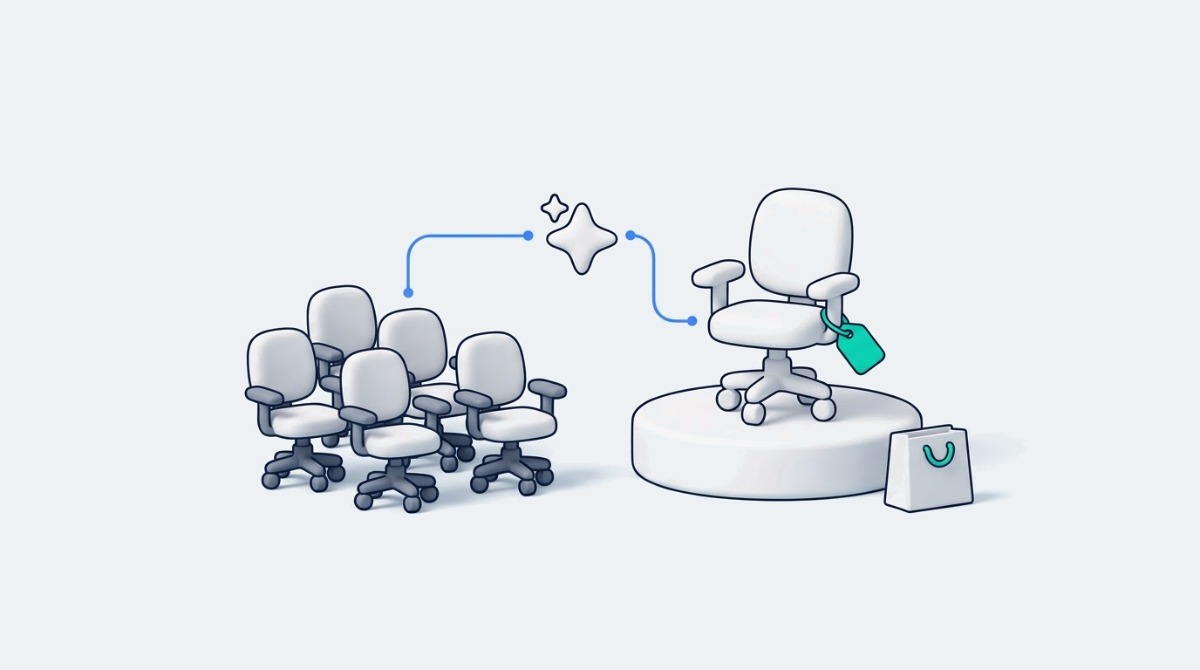
A shopper lands on a Shopify store knowing roughly what they want: an office chair with real lumbar support, under $400. Twenty similar chairs later, they are comparing materials in one tab and return policies in another, and plenty of them leave without buying. Merchants who use AI Product Recommendations can shorten that path by putting a smaller, more relevant set of products in front of each shopper and answering the questions that stall a purchase.
The cost of that friction is easy to see at checkout. Baymard Institute’s cart abandonment research puts the documented average at 70.22% across 50 published studies, as of its October 2026 update. Among US shoppers who were not just browsing, 40% left over extra costs, 20% over slow delivery and 13% over an unsatisfactory returns policy. Many of those are questions a shopper could have had answered on the product page.
This guide is written for growing stores in the $500K to $5M range whose catalogs have outgrown basic search and filters. If you are just starting, the stage section near the end shows what to do first instead, and most of it costs nothing.
Traditional product discovery stops working as catalogs grow because search bars, categories and filters assume the shopper already knows the exact product name or attribute they want. That holds for a store with 30 products. It breaks for a store with 300, where a dozen options look nearly identical in a collection grid.
Go back to the office chair. The shopper cares about comfort, seat depth, armrest adjustment, material and price, but most filters only cover price, color and size. So they open product pages one by one, read descriptions that each use different terms, and try to hold the comparison in their head. Every extra click is a chance to give up.
The merchant side gets harder at the same time. A larger catalog means more listings to update, more collections to organize and more customer emails asking which product fits. Shoppers, meanwhile, expect the quick answers and relevant suggestions they get on the biggest marketplaces.
There is a catch worth knowing before any AI enters the picture: discovery tools can only work with what the catalog says. Shopify’s help page on modifying search with Search & Discovery explains that its semantic search reads the title, description, product type, product category and tags, and does not use product images. A chair titled “The Aurora” with no product type and a thin description gives search, and any AI recommendation engine, very little to go on.
That is why the first discovery fix is usually unglamorous. Put the plain product type next to the creative name, assign a category to every item, and move the attributes buyers check first (dimensions, materials, compatibility) into structured fields. Fastlane’s guide to Shopify product data enrichment walks through moving those details out of description text and into metafields. Once the data is clean, AI has something real to match shoppers against.
AI product recommendations match shoppers to the right product by weighing what they are browsing, comparing and have bought before, rather than showing the same bestsellers to everyone. Traditional recommendation blocks often display popular items or products from the same collection. AI systems can go further by reading browsing activity, past purchases, products a shopper compared and other available signals.
Take a shopper exploring skincare who keeps opening products labeled for sensitive skin. A bestseller widget might show a strong exfoliant that sells well overall but is wrong for them. A recommendation system reading their behavior can highlight gentle cleansers and fragrance free moisturizers instead. The shopper sees a short list that fits, rather than scrolling an entire catalog.
Shoppers have come to expect this. McKinsey’s 2021 research on personalization found that 71% of consumers expect companies to deliver personalized interactions and 76% get frustrated when that does not happen. It also put the typical revenue lift from personalization at 10 to 15%, with company results ranging from 5 to 25% depending on how well it is executed. That last condition matters: the lift goes to stores that get relevance right.
Every Shopify store already has a starting point. According to Shopify’s product recommendations documentation, automatic recommendations draw on purchase history, product descriptions on English storefronts and related collections, and the free Search & Discovery app lets merchants add up to 10 complementary and 10 related products for each item by hand. Fastlane’s breakdown of what Shopify’s native personalization already does covers how far those free tools go.
AI recommendations earn their place where native rules run out: large catalogs, fast changing stock, and shoppers whose needs only show up in how they browse. The test stays the same either way. A suggestion should connect to what the shopper is already exploring. If it does not, it is noise, however clever the model behind it.
AI shopping assistants reduce buying hesitation by answering product, shipping, payment and returns questions at the moment a shopper is deciding, instead of after they email support. Finding an interesting product does not mean a shopper is ready to buy. They may still wonder whether it fits their setup, what shipping costs, which payment methods are accepted, or how returns work.
Picture a shopper comparing two pairs of wireless headphones. One is $40 more, and the product pages describe battery life and sound in different terms. An assistant can lay out the differences side by side (battery hours, noise cancellation, weight, price) and help the shopper pick the pair that suits a long commute rather than the gym. Without that, the shopper either emails support and waits, or opens a marketplace tab and compares there.
Answering at that moment does two jobs. It removes delay for the shopper, and it takes the most repetitive questions off the support team. Fastlane’s guide to handling customer queries as your store grows suggests a useful test before adding any assistant: read your last 20 customer emails and ask whether each answer was already on your site. If it was there but missed, the problem is placement. If it was not there at all, it belongs on the site first.
That order matters because an assistant answers from the information the store gives it. If the returns policy is vague, the assistant will either repeat the vagueness or, worse, improvise. Fastlane’s look at which website features calm hesitant buyers puts price, shipping and returns visibility at the top of the list for that reason.
Two settings separate a helpful assistant from a risky one. It should hand complex, sensitive or high value conversations to a person, with the context attached. And it should only make commitments (discounts, delivery dates, exceptions) the merchant has explicitly allowed.
Relevant suggestions raise average order value when the extra item makes the main purchase more useful, like a memory card with a camera, and they cost trust when they read as unrelated upsells. A shopper buying a camera may genuinely need a memory card, a protective case or a spare battery. Showing those at the right moment saves them a second order, or a frustrating first day with the product.
AI supports this through personalized cross selling. It can look at what a shopper is viewing or already has in the cart before suggesting complementary items, instead of showing the same three accessories to everyone. Smart bundles take it a step further by presenting related products as a set, so a shopper can buy everything a project needs in one transaction.
The math can be meaningful without being dramatic. Illustrative example, assuming 1,000 orders a month at a $120 average order: if 8% of buyers add a $25 accessory, average order value rises by $2 and monthly revenue by about $2,000. That is before margin, and before any discount used to make the bundle attractive.
That caveat is where many stores get it wrong. A bundle discounted to move volume can lift order value while lowering profit per order, so check contribution margin, not just the order total. Fastlane’s guide to revenue optimization beyond ads makes the same point about relevance: a useful item connected to the product improves the order, while a random one at checkout distracts.
Tone matters as much as the offer. Suggestions should feel like a knowledgeable store associate pointing out what the shopper will need, not a pop up competing with the buy button. If a suggestion would not make sense said out loud in a physical store, it probably does not belong on the page. Fastlane’s guide to turning a struggling Shopify store around gives more examples of bundles that make a purchase more useful rather than just bigger.
An AI sales agent such as Upsello fits stores that want recommendations, answers before purchase and cart recovery handled in one conversation, rather than spread across three separate tools. It is built for Shopify merchants who want those steps of the buying journey connected.
On the recommendation side, it uses available shopper activity, product information and store details to compare products, suggest suitable items, propose complementary products and present bundles. According to its features page as of November 2026, bundles are triggered by product relationships the merchant configures, so the merchant decides which items belong together.
For questions, it answers from store information: product details, order and shipping information, payment options, returns and FAQs. It also handles multilingual conversations, with coverage that depends on the plan, from English plus five languages up to more than 50.
Cart recovery is the third piece. When a shopper shows signs of hesitation or leaves before completing checkout, it can respond with approved recovery messages on site or in chat, and by email or SMS where those channels are enabled, aiming to answer the concern that stopped the purchase rather than just sending a reminder.
Merchants keep control of how it behaves. They can choose which capabilities are on, set trigger rules, define eligible products, cap discounts, apply brand guardrails, and decide when a conversation is handed to a person on the team. Plans vary by conversation volume, language coverage, tools and product knowledge capacity, so check the current plan details before committing.
The same rule from earlier applies here as with any AI layer: it can only be as accurate as the product data and policies the store has written down. A store that cleans those up first gets far more out of an agent than one that expects the agent to cover the gaps.
Fix product data and policy visibility first at every stage, then add AI recommendations and assistance in the order your own reports and customer questions point to. The right next step depends on catalog size and question volume as much as revenue.
If you are under roughly $500K a year, start with what Shopify gives you for free. Clean up titles, product types and categories, add manual complementary picks to your 20 best sellers in Search & Discovery, and put shipping costs and a one line returns summary on every product page. Small catalogs usually gain more from clear navigation than from any AI layer.
If you are between $500K and $2M, this is where stores most often stall from too many apps doing overlapping jobs. Before adding anything, count the recommendation blocks on your top product page. If a theme block and an app carousel both suggest products, pick one. Then add a single AI layer aimed at the gap your data shows: recommendations if shoppers browse a lot and buy little, answers if your inbox fills with the same questions, recovery if checkout abandonment is the leak.
If you are above $2M, connecting discovery, answers and recovery in one system starts to pay, because the same shopper context informs all three. At this stage, set rules and handoffs deliberately and measure against a holdout group, covered in the next section.
Illustrative example, a composite of a common setup rather than a specific store: a furniture brand with 300 chairs and desks sees its top search terms returning results nobody clicks and its inbox full of “will this fit under my desk?” questions. The order of work is to add seat height and depth as structured fields, rewrite the 30 best selling titles with plain product types, publish a clear returns summary, and only then switch on an assistant that can answer fit questions from those fields. Turned on first, the same assistant would have had nothing reliable to answer from.
AI discovery is paying off when revenue per visitor and margin rise for shoppers who see it compared with a group who do not, not when widget clicks or a vendor’s attributed revenue go up. Attributed revenue shows which orders passed through a widget or chat. It does not show which orders would not have happened without it.
The cleanest check is a holdout test. Shopify’s Rollouts requirements note that experiments, which compare a treatment against a control, are available on the Grow plan or higher, which lets a store compare a theme with a recommendation section against one without it. For tools that sit outside the theme, ask the vendor during the trial whether it can run its own test against a true control group.
Decide in advance what lift would justify the cost, run the test for at least two full weekly cycles (longer on lower traffic), and treat a result that is too close to call as inconclusive. Watch three numbers alongside revenue per visitor: contribution margin, support ticket volume and return rate. An assistant that cuts tickets but raises returns because it oversold fit is not a win.
Successful ecommerce is not about offering more products. It is about helping customers find the right one without making the buying process complicated. Less time searching, fewer unanswered questions and more confident purchases are the goal, and a measured test is how a store knows it is getting there.
AI product discovery in ecommerce is the use of AI to help shoppers find suitable products faster, through personalized recommendations, smarter search and assistants that answer questions while they browse. Instead of relying only on menus, filters and bestseller lists, the store uses signals such as browsing activity, products compared and past purchases to show a smaller, more relevant set of options. It also covers answering buying questions about fit, shipping and returns on the page, and suggesting complementary items. AI discovery depends on product data: if titles, product types and attributes are vague, any tool has little to match shoppers against, so cleaning up the catalog comes first.
Yes, Shopify generates product recommendations automatically and lets merchants add manual picks through the free Search & Discovery app. Automatic recommendations draw on purchase history, product descriptions on English storefronts and related collections. In Search & Discovery, a merchant can add up to 10 complementary products and up to 10 related products for each item. The store’s theme needs recommendation sections switched on for them to display. These native tools are the right starting point for most smaller stores, and a paid AI tool earns its place when a large catalog, fast changing stock or a high volume of questions creates gaps the native rules cannot cover.
Yes, an AI shopping assistant can answer shipping and returns questions, as long as the store’s policies are written down clearly enough for it to answer from. Most assistants read store information such as product details, shipping policies, return terms and FAQs, then respond while the shopper is still on the page. That matters because surprise costs, slow delivery and unclear returns are among the most common reasons shoppers abandon a cart. Before turning an assistant on, review your last 20 customer emails and make sure each answer exists on your site. Also set it to hand complex or sensitive conversations to a person, and to only offer discounts or exceptions you have approved.
AI recommendations increase average order value by suggesting complementary items that make the main purchase more useful, based on what the shopper is viewing or already has in the cart. A camera buyer might be shown a memory card, a case or a spare battery, and a shopper building a project might be offered a bundle with everything it needs. In an illustrative example of 1,000 orders a month at a $120 average order, 8% of buyers adding a $25 item raises average order value by $2. Check margin as well as order value, because a heavily discounted bundle can grow the order while shrinking profit per order.
A Shopify store should add an AI sales agent once its product data and policies are clean and its own numbers show a gap the native tools cannot close, such as repeated questions, heavy browsing with few purchases or high checkout abandonment. Smaller stores under roughly $500K a year usually get more from Shopify’s free recommendations and clearer product pages. Stores between $500K and $2M should add one AI layer aimed at their biggest gap and remove overlapping widgets first. Larger stores benefit most from an agent that connects recommendations, answers and cart recovery. At any stage, measure it with a holdout test on revenue per visitor and margin.