
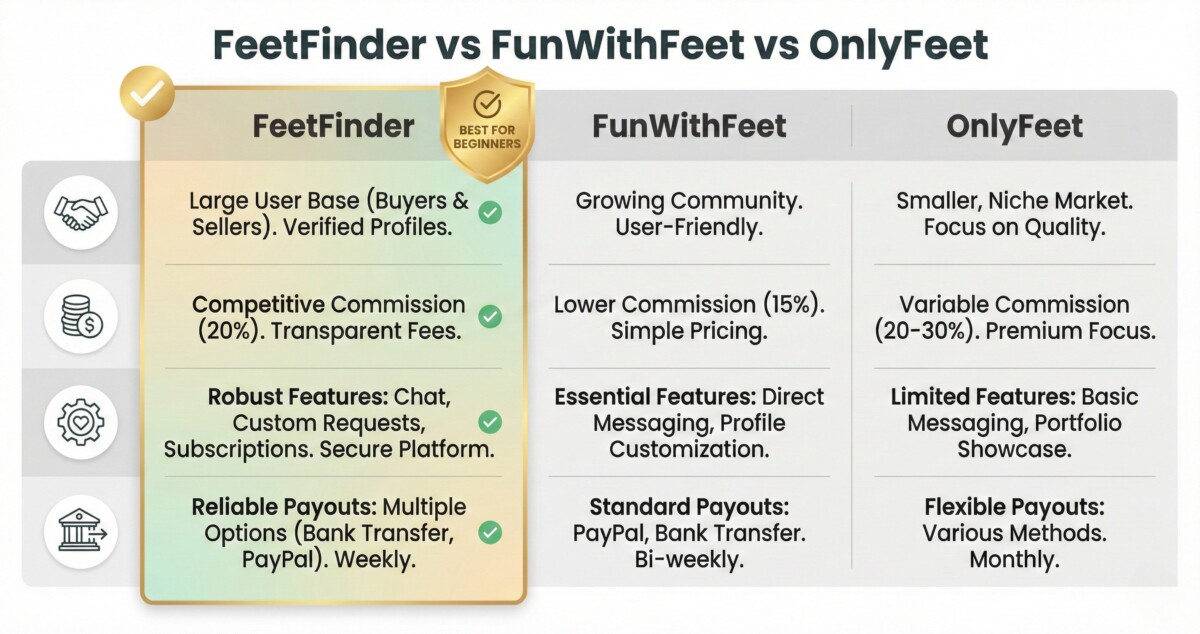
FeetFinder is the only one of these three platforms that publishes a complete fee structure before you sign up, with sellers keeping 85 to 90 percent depending on the plan. FunWithFeet and OnlyFeet both advertise a 100% revenue share without disclosing what their seller plans cost.
A platform that will not tell you its price before you pay is telling you something about how it plans to treat you afterwards.
All three are marketplaces where ID-verified adult sellers list feet photos and videos for buyers, but they are run by different companies in different countries, and they are nowhere near the same size. The differences that matter to a seller are disclosure, scale, and payout mechanics, and those three things do not move together.
FeetFinder operates out of Carson City, Nevada. Its public figures as of September 2026 are 12,000,000 or more verified members, 15,000,000 or more feet pics and videos sold, more than $125,000,000 spent on the platform, and over 5,000 five star reviews. Identity verification is mandatory and confirms the seller is over 18. Payouts are processed weekly directly to a bank account with no 30-day hold.
FunWithFeet publishes a much smaller number, 8,000 or more creators, and states that all creators are ID verified and free to remain anonymous. It also quotes its top creators at $300 to $500 per custom photo or video request, which is a ceiling figure rather than a typical one.
OnlyFeet is operated by LORDLY SASU, a French company registered in Paris, with payments processed by CCBill and Segpay and payouts sent by bank transfer within 5 to 7 business days. It publishes 50,000 or more active sellers and 5,000 or more verified buyers. Read those two numbers together, because the second one is the one that matters and almost nobody quotes it.
One caution on all of these figures. Each platform counts something different. Verified members include buyers. Creators counts sellers only. Active sellers is undefined. You cannot rank the three by putting these numbers side by side, which is exactly why the fee disclosure question below is the more useful comparison.
FeetFinder publishes a plan by plan fee structure, FunWithFeet publishes a revenue share with no price attached to it, and OnlyFeet publishes a conditional claim with no plan price at all. That is the single largest practical difference between the three and it has nothing to do with which one is cheapest.
Taking each in turn. FeetFinder states that sellers keep 90 percent, and its own earnings calculator shows two tiers, a standard tier at 85 percent and a premium tier at 90 percent. That resolves to a platform cut of 10 to 15 percent depending on which plan you hold, on top of a seller subscription. The plan prices and the break even points sit in our separate breakdown of what FeetFinder actually costs a seller per month, which is the number to work from rather than the flat 20 percent commission figure that still circulates in most published reviews and is wrong.
FunWithFeet’s homepage states that creators receive 100 percent of their total sales. It does not state a subscription price on that page, and on the verification date for this update its pricing and FAQ pages did not respond at all. Our own review of FunWithFeet’s fees and payouts documents a paid seller subscription and a platform retention that is not zero. Both things cannot be current at once, and the platform is the one that can settle it.
OnlyFeet’s homepage says creators keep up to 100 percent of their earnings on the Pro plan. It does not say what Pro costs. Its pricing URL returns a user not found error, and its FAQ covers verification and billing descriptors without stating a commission anywhere. Up to 100 percent on a plan with no published price is not a fee disclosure. It is a headline.
At $200 a month in sales, the FeetFinder position is calculable and the other two are not, which is the whole point of running the number. On the 85 percent tier a seller keeps $170 of that $200 before the subscription, and on the 90 percent tier she keeps $180, with the subscription cost then decided by which plan and billing period she chose.
Try the same calculation on the other two and you stop at the first step. A 100 percent revenue share on FunWithFeet means $200 of sales produces $200, minus a subscription cost you cannot look up before you commit. On OnlyFeet, up to 100 percent on Pro means the same arithmetic with two unknowns instead of one, because neither the Pro price nor the rate on any lower plan is published.
This matters most at the bottom of the range and least at the top. A creator selling $50 a month is deciding whether a fixed subscription eats a fifth of her revenue or a twentieth, and she cannot make that decision on two of these three platforms. A creator selling $2,000 a month can absorb a subscription she discovers after signup, because it has become a rounding error against her monthly take. Fee opacity is regressive: it costs the smallest sellers the most.
Set your expectations for what you are dividing up before you compare percentages at all. Standard photos sell in the $5 to $15 range and custom requests run considerably higher, and the current numbers are in our guide to what feet pics actually sell for in 2026. A 5 percent difference in revenue share on $80 of monthly sales is $4. Choosing a platform over $4 while ignoring whether it has buyers is the most common mistake in this decision.
The right platform depends on whether you arrive with an audience, and that single question separates these three more cleanly than any fee comparison does. A creator bringing traffic can monetise almost anywhere. A creator with no audience is entirely dependent on the platform’s own buyer pool, which is where the published numbers start to matter.
FeetFinder fits a Stage One or Stage Two creator with no existing audience who wants the shortest path to a first verified sale. That fit rests on buyer volume and mandatory buyer side verification rather than on price, and it is the only one of the three where a new seller can model her costs in advance. A creator running a first income test wants exactly that combination: a real buyer pool and a known cost.
None of the three fits a creator who needs a predictable monthly floor, and OnlyFeet in particular does not fit a Stage One creator paying for her first platform. Its published figures show 50,000 or more active sellers against 5,000 or more verified buyers. Whatever those categories mean in detail, a new listing on that platform is competing against a very large seller pool for a much smaller verified buyer pool, and the seller absorbs that mismatch as silence.
FunWithFeet becomes the strongest of the three when you already have an audience you can direct to a listing, because a 100 percent revenue share on traffic you brought yourself is genuinely the best economics available here. The condition attached is that you accept an unpublished subscription cost, and the anonymity provision it states is a real advantage for a creator whose main constraint is not being identified. Without your own traffic, a smaller platform with 8,000 or more creators gives you less discovery than the size of the seller pool suggests.
Each of the three does one thing measurably better than the other two, and none of them does all three things. FeetFinder’s advantage is disclosure and payout speed, FunWithFeet’s is revenue share and anonymity, and OnlyFeet’s is European payment infrastructure and buyer verification.
FeetFinder’s disclosure is the substantive one. Plan level fees, an earnings calculator, mandatory ID verification for sellers and weekly payouts direct to a bank account with no thirty day hold together mean a seller knows both her cost and her cash timing before she starts. Weekly settlement is a practical difference rather than a marketing one when this income is covering a specific bill.
FunWithFeet’s stated 100 percent revenue share is the best headline rate in this comparison and it should be taken seriously rather than dismissed because the price is missing. Combined with ID verification and explicit permission to remain anonymous, it suits a creator who is bringing her own buyers and whose primary risk is identification rather than discovery.
OnlyFeet’s genuine strength is that it verifies buyers before they access content and settles by bank transfer within 5 to 7 business days through CCBill and Segpay, both established adult payment processors. For a European seller, a Paris registered operator and European payment rails can mean fewer currency and transfer problems than a US platform creates, and that is a real advantage even though the fee position is not.
The most significant limitation across all three is that two of them will not tell you what they charge until you have paid to find out. That is not a tie breaker between otherwise equal options. It is a structural problem with the decision itself.
FeetFinder’s own shortfall is that a seller pays twice, through a subscription and a service fee, so the effective cost at low volume is meaningfully higher than the headline 90 percent suggests. A seller doing $40 a month is paying a fixed cost against a small revenue base, and the platform’s marketing does not lead with that arithmetic. The subscription is charged whether or not anything sells.
FunWithFeet’s shortfall is size and verifiability. 8,000 or more creators is a small pool by the standards of this category, and on the date of this update its pricing and FAQ pages did not load, so the seller facing cost could not be confirmed from the platform at all. A 100 percent share of a market you cannot reach is worth less than 85 percent of one you can.
OnlyFeet’s shortfall is the ratio it publishes itself. Ten or more sellers for every verified buyer, an unpublished plan price, a pricing page that errors, and a headline built on the words up to. None of that makes the platform illegitimate, and the ID verification of buyers is a real safety feature. It does mean a new seller is being asked to commit money on incomplete information, and the honest response is to treat it as a second platform once you have income elsewhere, not a first one.
Ranked by what a seller with no audience can actually verify before paying, FeetFinder is first, FunWithFeet is second and OnlyFeet is third, and that ranking would change if either of the other two published its prices tomorrow. This is a comparison of disclosure and buyer access, not of quality.
Against FeetFinder, FunWithFeet genuinely wins on revenue share for a creator who brings her own traffic, and it wins on anonymity positioning. If you have 5,000 engaged followers you can point at a listing, the platform that keeps none of your sale is the better economic answer and FeetFinder is not the right recommendation for you. That is a real case and it comes up more often than platform reviews admit.
Against FunWithFeet, FeetFinder wins on discovery for anyone starting cold, on payout speed, and on the ability to model costs in advance. Against OnlyFeet, both of the others win on the specific question of whether a seller can find out what she is paying, which is a low bar that OnlyFeet does not currently clear.
Running two platforms at once is a reasonable Stage Three move and a poor Stage One move. Two subscriptions, two content calendars and two buyer inboxes against an audience you have not built yet is how a first attempt dies. Prove the income on one platform, then add a second on the evidence of your own numbers rather than on a comparison table. Whichever you pick, the safety rules do not change, and the patterns worth knowing before your first buyer message are in our guide to selling feet pics without getting scammed.
My recommendation is FeetFinder for a Stage One or Stage Two creator starting without an audience, FunWithFeet for a creator who already has traffic she can direct, and OnlyFeet for neither until it publishes a plan price. That is a verdict about information and buyer access, and I would revise the third of those the day the pricing page works.
Use FeetFinder if you are testing whether this income is real for you, if you want to know your costs in advance, and if weekly payouts to your bank matter to how you budget. Use FunWithFeet if you are bringing your own audience, if keeping the full sale price is the deciding factor, and if you are willing to accept a subscription cost you cannot confirm before signup. Use OnlyFeet as a second listing once you have income elsewhere and can afford to run an experiment with an unknown cost.
Do not use any of these platforms if you are counting on a specific monthly figure to cover a specific bill in the next 60 days. Do not use OnlyFeet as your only platform while its seller-to-buyer ratio sits where it does. And do not choose between the three on revenue share alone, because at the volumes most new sellers actually reach, the difference between 85 and 100 percent is a few dollars a month and the difference between a platform with buyers and one without is all of your income.
Picking between three platforms on what each one discloses, then pricing your own work against a fee you calculated yourself, is commercial diligence. It is the same work as reading a supplier agreement or comparing payment processors, and it does not belong to this niche. If you ever want to see where that instinct leads, we mapped the stages from a first income test to a business you own, and why independence over convenience matters at every stage.
FeetFinder publishes the largest verified user figure of the three, at 12,000,000 or more verified members alongside 15,000,000 or more items sold and more than $125,000,000 spent on the platform. FunWithFeet publishes 8,000 or more creators and no buyer figure. OnlyFeet publishes 50,000 or more active sellers and 5,000 or more verified buyers. Be careful comparing these directly, because each platform counts a different thing and only OnlyFeet separates sellers from buyers. The useful signal is not the largest number but whether a platform tells you how many buyers it has at all.
It depends entirely on your monthly sales, and the break-even is lower than most sellers assume. A subscription plus a 10 to 15 percent service fee is a poor deal at $20 a month in sales and a reasonable one at $200, because the fixed cost no longer dominates once volume arrives. The honest comparison is not subscription against free, it is a known cost against an unknown one. Our breakdown of what FeetFinder costs a seller per month sets out the plan prices and the break even points so you can test your own number rather than take a general answer.
FunWithFeet’s homepage states that creators receive 100 percent of their total sales, which is the platform’s current published claim. What it does not publish on that page is the seller subscription price, and its pricing and FAQ pages did not respond on the date of this update. Our separate review of the platform documents a paid subscription and a platform retention that is not zero, so treat the 100 percent figure as the revenue share rather than the total cost of selling there, and confirm the subscription price at signup before you commit.
Because OnlyFeet does not currently publish them. The homepage says creators keep up to 100 percent of their earnings on the Pro plan without naming a price for Pro, the pricing URL returns a user not found error, and the FAQ covers identity verification and billing descriptors without stating a commission. The platform is operated by LORDLY SASU in Paris with payments through CCBill and Segpay. None of that is disqualifying on its own, but signing up to discover a fee is a decision you should make deliberately rather than by default.
Not until one platform is producing consistent income, usually after 90 days of steady listing activity. Running two platforms doubles the subscription cost, the content workload and the buyer communication before you have evidence that any of it converts, and split attention is the most common reason a promising first attempt stalls. Once you have repeat buyers on one platform and you are turning away custom requests because of time, a second listing is a reasonable capacity decision rather than a hopeful one.




