The Black Friday email you’re most proud of could be the one that changes how Gmail treats every email you send after it.
On episode 385 of the podcast, Aaron Schwartz, co-founder and CEO of Orita, explained Gmail’s view of a sender in one line I still repeat to merchants. When a brand keeps sending to people who aren’t engaging, “Gmail will catch on to the fact that they’re not engaged. Gmail will then downrank you as a sender.” In that conversation about email deliverability and AI segmentation, he also said something most brands remember more fondly: “Now, if it’s Black Friday, you don’t care, you send the email, right? But 50 weeks of the year, you want to be really judicious about it.”
That was February 2025. Since then, two things have changed for the stores I talk to. Microsoft started enforcing its own rules for high volume senders in May 2025, and in November 2025 Google ramped up enforcement of its rules, including temporary and permanent rejections of non-compliant mail. This is the first full year in which both have been enforced going into Black Friday.
Aaron’s rule still has a place. But it now has a precondition, and the precondition is the part most small brands haven’t checked. This piece is for brands that will send more email in the next four weeks than in any other month of the year, and want to be sure it arrives.
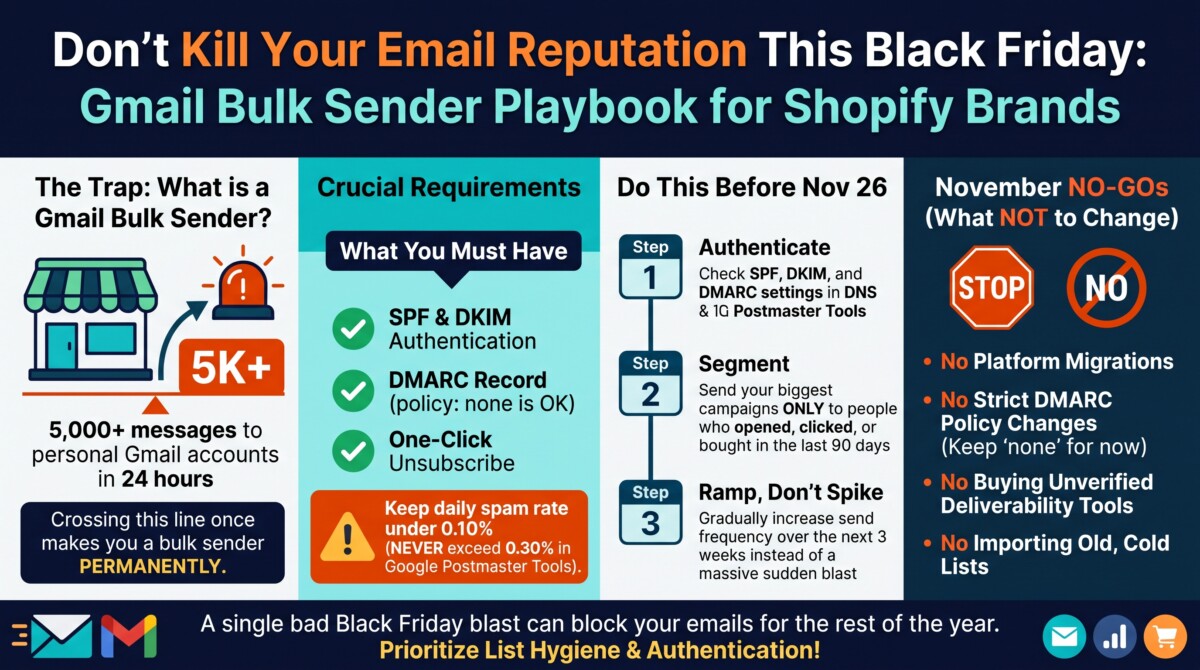
A store becomes a Gmail bulk sender the first time it sends close to 5,000 or more messages to personal Gmail accounts within 24 hours, counted across its primary domain, and it stays one permanently. The rule counts messages, not subscribers, so several sends in one day add up.
Google’s email sender guidelines FAQ spells this out. It defines a bulk sender as any sender that sends “close to 5,000 messages or more to personal Gmail accounts within a 24-hour period,” says messages from the same primary domain count toward that limit, and states that senders who meet the criteria “at least once are permanently considered bulk senders.” Changing how much you send later does not undo it.
The status matters because it carries extra requirements. Under Google’s email sender guidelines, a sender above that threshold needs SPF and DKIM authentication, a DMARC record (a policy of none is accepted), alignment between the From domain and SPF or DKIM, one-click unsubscribe on marketing messages, and a spam rate below 0.30% in Postmaster Tools, with Google advising senders to stay under 0.10%. The same FAQ says spam rate is calculated daily. The count also includes everything sent from your primary domain and its subdomains, so order confirmations and app emails sent from your store’s domain add to the daily total.
What changed recently is the consequence. The FAQ now says that starting November 2025, Gmail is ramping up its enforcement on non-compliant traffic, and messages that fail the requirements will see disruptions including temporary and permanent rejections. Microsoft’s requirements for high volume senders to Outlook.com took effect May 5, 2025, covering hotmail.com, live.com and outlook.com addresses, and Microsoft’s updated post says mail from those senders that fails authentication is rejected rather than delivered.
The practical split is worth holding onto. Authentication failures are now met with rejections you can see as bounce codes. Engagement and complaints are judged more quietly, through where your mail lands. A store can fix the first in an afternoon. The second takes the four weeks you have left.
Small stores cross the bulk sender line without noticing because they plan Black Friday by list size and campaign count, while Gmail counts the messages that reach Gmail addresses in a single day. A list that feels modest can produce a big number on one day.
Here is a composite store I’ve put together from the pattern I see in merchant conversations every November; it is not a real brand, and the figures are assumptions for illustration. It sells skincare, does about $900K a year, and has 18,000 email subscribers. For most of the year it sends two campaigns a week to an engaged segment of about 7,000 people. Assume, for illustration, that roughly a third of its list uses a personal Gmail address. On a normal campaign day, that’s about 2,300 Gmail messages, comfortably under the threshold.
Now Black Friday. The plan is an early access email to the full list at 6 a.m., the main announcement at noon, and a “last hours” reminder at 8 p.m. The 6 a.m. email alone puts about 6,000 messages into Gmail inboxes, already past the threshold, and the three sends together make about 18,000 in one day. The store is now a bulk sender, permanently, and it crossed the line with the email it sent to the 11,000 people who hadn’t opened anything since spring.
Becoming a bulk sender is not a penalty. If the store’s setup is already compliant, nothing visible happens. The problem is the combination: a domain that was never set up for DMARC alignment, sending its largest volume of the year, to the least engaged part of its list, on the one day it can least afford rejections or a spike in complaints. That’s the scenario this piece is trying to prevent, and it’s common because nobody at a store this size owns deliverability as a job.
If you grew your list quickly this fall with an aggressive popup, check that too. Fake and disposable signups inflate the list you’re about to send your biggest campaigns to, and they never engage.
Sending to your full list on Black Friday still works when the other weeks of the year were disciplined and your authentication is in order, because Gmail weighs your recent behavior, not one day. It stops working when the full-list send is the habit, not the exception.
Read Aaron’s line again with that in mind. His point was not that Black Friday is a free pass. It was that a brand that has been judicious for 50 weeks has earned enough reputation to spend some of it on the biggest selling day of the year. His example was a brand with a million subscribers, and the approach he was arguing for pauses unengaged subscribers for most of the year. For a brand run that way, a wide send on Black Friday is a deliberate, one-day spend. He was also clear about what Gmail watches: clicks, time on site and purchases, far more than opens.
Most small brands haven’t been judicious for 50 weeks. They send every campaign to everyone, and Black Friday is just the same habit at three times the volume. That changes the math. With spam rate calculated daily, a Black Friday blast to people who forgot they subscribed is exactly the send most likely to push complaints toward the level Google tells senders to stay well below.
Black Friday is the day you spend your sender reputation, not the day you build it.
So the rule I’d use this year has two parts. If your engaged segment has been your default audience all year and Postmaster Tools shows a clean spam rate, one or two wide sends on Black Friday and Cyber Monday are a reasonable bet. If your full list has been your default audience all year, don’t make Black Friday the day you send even more to it; send your biggest campaigns to people who have clicked, bought or opened in the last 90 days, and accept a smaller send. The trade-off is real: some lapsed subscribers do buy on Black Friday. But they’re also the people most likely to mark you as spam on the day your spam rate matters most, and you can still invite them back with one separate send once the peak has passed.
The stakes are high enough to be careful. Klaviyo’s 2025 BFCM recap found that across its customers, email and text drove 42% of total revenue over the five days from Thanksgiving to Cyber Monday, rising to 43% on peak days. That’s a vendor’s measurement of its own customers, using its own attribution, so treat the exact figure with care. The direction is not in dispute: for most Shopify brands, email is the channel Black Friday depends on.
Three checks cover most of the risk: your authentication and Postmaster data, your Black Friday audience, and your sending ramp over the next three weeks. Do them in that order, because the first is the only one that causes hard rejections.
Start with authentication. In your email platform’s settings, find the sending domain or domain authentication page and confirm it shows SPF and DKIM as verified for the domain in your From address. Then check your DNS for a DMARC record. If there isn’t one, add a basic record with a policy of none; that meets Gmail’s requirement without risking legitimate mail. Sign up for Google Postmaster Tools, verify your domain, and look at the compliance status and spam rate pages. If you’re below bulk volume, data may be sparse, which is fine; you’ll have it in place before the days that matter.
Next, build the Black Friday audience before you build the Black Friday email. In most email platforms that’s a segment of people who opened or clicked in the last 90 days, plus anyone who bought this year. Plan your three or four biggest sends to that segment. If you want one wider send, choose it deliberately: one campaign, on one day, to people who engaged in the last 180 days, not everyone who ever subscribed.
Then ramp, don’t spike. If you normally send twice a week, move to three sends next week and four the week before Thanksgiving, all to your engaged segment. A sudden jump from two campaigns a week to three in one day is the pattern inbox providers notice. Set a simple pause rule for Black Friday week: if Postmaster shows your spam rate above 0.10% on any day, the next send goes only to your most engaged buyers until it drops.
One note on opens. Some email apps load images automatically for privacy reasons, which inflates open rates, so “opened in 90 days” includes people who never really looked. Where your platform allows it, define engaged by clicks, site visits and purchases as well as opens.
Don’t make structural email changes in November: no platform migration, no new deliverability tool, no strict DMARC policy, and no old list imports. Each one adds risk in the four weeks when you can least absorb it.
Switching email platforms now means a new sending setup, new IP reputation in many cases, and flows rebuilt in a hurry. Even a better platform is a worse choice in November than the one you already know. If you’re unhappy with yours, note why and revisit it in January.
The same goes for buying a deliverability tool. Aaron’s company sells one, and tools in that category can help larger brands find engaged people that rules-based segments miss. For a store under about $2M, a 90-day engaged segment and Postmaster Tools do most of the work for free. Buying a model before you’ve used the free version is the kind of premature complexity I see stall brands at this stage.
Don’t jump your DMARC policy from none straight to quarantine or reject this month either. A strict policy is a good goal, but a misconfigured one can send your own legitimate mail, including order confirmations from Shopify or a third-party app, to spam. Gmail accepts a policy of none. Tighten it in the new year, after you’ve read the reports.
And don’t import the old list. Every November someone finds a spreadsheet of customers from a previous platform, a trade show or a giveaway and wants to add them for Black Friday. Those addresses are the most likely to complain, bounce or be spam traps. If you want them back, invite them through a single, separate email in January, when a bad result won’t land on your biggest week.
If you’re also cleaning up outbound or sales email this quarter, the same Gmail definition applies to cold email from your domain, and the cost and setup trade-offs of outbound email tools are worth reading before you send any of it from your store’s main domain.
The plan scales with list size, but the order doesn’t change: authenticate, segment, then ramp. What changes is how closely someone watches the numbers during Black Friday week.
If you’re under about $500K with a list under 20,000, authentication plus a 90-day engaged segment covers most of the risk. Check Postmaster Tools once before Black Friday and once after Cyber Monday. Your biggest decision is not to send three full-list blasts on one day.
Between $500K and $2M, name one person who checks Postmaster Tools every morning from November 20 to December 2, with the pause rule written down in advance. At this size the pattern I see most often is not a technical failure; it’s a well set up store sending too much to too many people in one week because the calendar was planned by the marketing team and nobody looked at the audience.
Above $2M, consider sending marketing email from a dedicated subdomain so its reputation is easier to watch and your transactional mail is kept separate (it still counts toward the same primary domain’s bulk total), and stagger large sends across segments and hours rather than releasing one campaign to the whole list at once. This is also the size where a paid deliverability or engagement modelling tool can earn its fee, but evaluate it in January, not in the middle of peak.
Whatever your size, write down what you sent, to whom, and what Postmaster showed, on December 1. Next year’s plan starts from that page.
Gmail counts any sender that sends close to 5,000 or more messages to personal Gmail accounts within 24 hours as a bulk sender. Messages from the same primary domain count together, so several campaigns on one day add up, and the count is messages, not subscribers. Google’s sender guidelines FAQ says senders who meet the criteria at least once are permanently considered bulk senders. Bulk senders must use SPF, DKIM and DMARC, align their From domain, offer one-click unsubscribe on marketing email, and keep their spam rate below 0.3%.
Yes, one Black Friday send can make your store a Gmail bulk sender if it puts close to 5,000 or more messages into personal Gmail inboxes within 24 hours. A store with 18,000 subscribers, of whom about a third use Gmail, would cross that line with a single full-list send. The status is permanent, so the safest plan is to confirm your authentication and DMARC record before November 26, whether or not you expect to cross the threshold.
Stay under a 0.10% spam rate in Google Postmaster Tools, and never let it reach 0.30% or higher. Google calculates spam rate daily, so a single Black Friday blast to unengaged subscribers can push one day’s rate up. Send your biggest campaigns to people who opened, clicked or bought in the last 90 days, and set a rule in advance: if the rate goes above 0.10% on any day, the next send goes only to your most engaged buyers.
Send to unengaged subscribers on Black Friday only if your engaged segment has been your default audience all year and your spam rate is already low. In that case, one deliberate wide send is a reasonable use of the reputation you’ve built. If you’ve been emailing your whole list all year, don’t add more volume to it on Black Friday; send to people who engaged in the last 90 days instead, and invite older subscribers back in January.
Yes, you need a DMARC record if your store sends close to 5,000 or more emails a day to Gmail, and it’s sensible to add one before Black Friday even if you don’t. Gmail accepts a DMARC policy of none, which you add as a DNS record for your sending domain. Pair it with SPF and DKIM authentication in your email platform. Don’t jump to a strict quarantine or reject policy in November, because a mistake can send your own order and app emails to spam.