

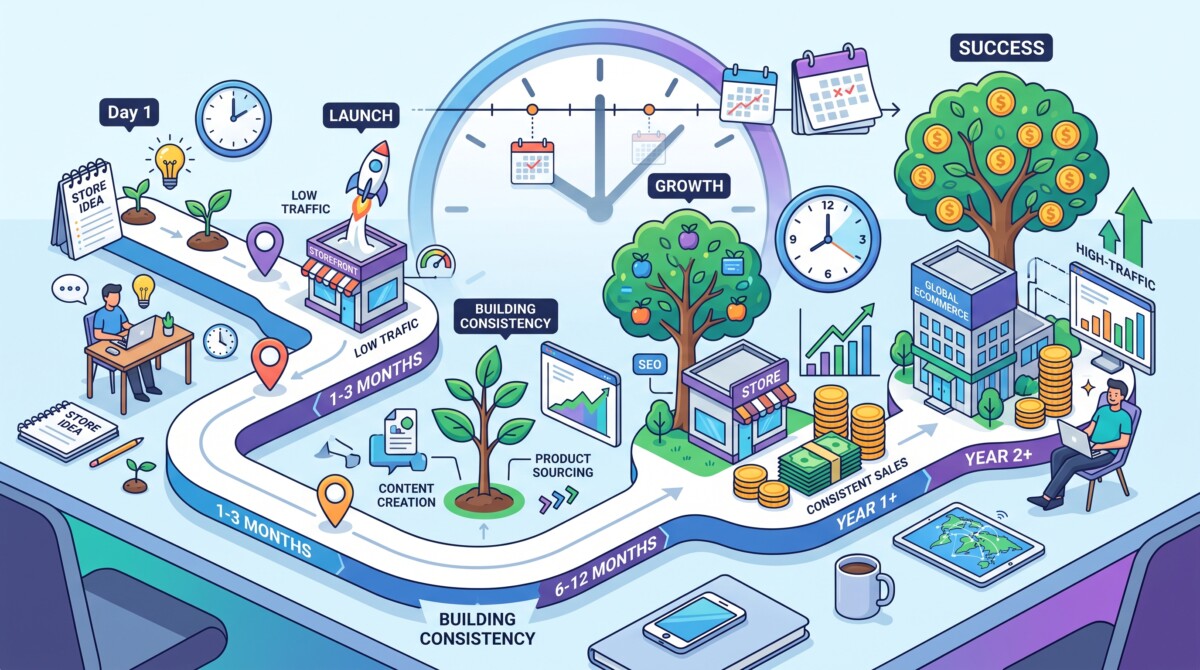
Most entry-level online side hustles pay their first dollar somewhere between week two and month six, and the median side hustle earns about $200 a month once it is running. Content-driven models take a year or longer, which makes your unpaid runway the real constraint.
The $10,000 a month figure in the headline is usually real. It is just attached to year three of somebody else’s business, and it gets quoted to people standing at month one.
Twenty eight percent of side hustlers earn between $1 and $50 a month. That is the largest single earnings band in Bankrate’s 2025 side hustle survey, which sampled 2,616 US adults in June 2025 and found 699 of them running a side hustle. The median across all of them is $200 a month.
Nobody builds a headline out of that. The headline gets built out of the average, which is $885, or out of somebody’s screenshot, which is $10,000. Both numbers exist. Neither one comes with the piece of information you actually need, which is when.
That missing timeline is the whole problem. A figure without a date attached is unusable, because the difference between $10,000 in month two and $10,000 in year three is the difference between a plan and a fantasy. What follows is the distribution instead of the average: what the first 30, 90 and 180 days tend to produce across a few entry level models, how wide the spread runs between a typical result and a top one, and how long each model can sit there paying nothing before it pays anything at all. That last number is the one that decides this for most people, and it is the one almost nobody publishes.
The median side hustle earns $200 a month while the average earns $885, which means the average describes a result roughly five in six side hustlers never reach. When a mean sits more than four times above its median, the mean has stopped describing anyone and started describing the top of the distribution.
The full spread is more useful than either number. Bankrate’s published breakdown of that survey puts 58% of side hustlers above $100 a month, 25% above $500, and 14% above $1,000. Read the other direction, that means 42% earn $100 a month or less, and the $885 average sits somewhere between the $500 and $1,000 markers, above where roughly five out of six people land.
Then apply the correction almost nobody applies. Every number in that table describes people who already have a side hustle running. They are not month one figures. They are the steady state, after the first buyer, after the first payout, after whatever it took to get there. If the established median is $200 a month, your first month is not the exception that beats it. Your first month sits under it, and the honest planning number for day 30 is one sale or none.
Across entry level models, 30 days produces one sale or nothing, 90 days produces the first repeatable pattern, and 180 days is where the models separate from each other for good. The shape is the same everywhere: a flat stretch, then a first transaction, then either a slow climb or a continued flat line depending on which model you picked.
Service work compresses the front of that curve because the demand already exists. Someone has posted a job or has a problem this week, and a direct pitch can convert in days. Marketplace products invert it, because discovery has to happen before a sale can, and you are waiting for buyers to find a listing rather than answering buyers who are already looking. Digital products sit further out again, since they usually need an audience that does not exist yet on day one. Content driven models sit furthest out by a wide margin, which the next section deals with on its own.
Illustrative benchmark: the grid above describes the shape these models take rather than survey figures, and it is drawn from published platform timelines plus the categories in the Bankrate data, where online sales at 15% and professional services at 14% are the two largest side hustle industries.
One thing gets left out of every version of this timeline. A sale is not a payout. Our own breakdown of 30 ways to earn online puts the wait at around five days on most selling platforms, anywhere from the next day to 14 days on marketplaces, and 15 to 30 day terms once you are invoicing a client directly. So a first sale in week three is money in week five, and if you are counting your 30 day result on the day it lands, you are measuring the wrong day.
Service work can pay inside two weeks, marketplace products typically take one to three months, and content driven models routinely take twelve months or more, because two of them will not release any money at all until a threshold is crossed. That threshold is the part people miss when they compare models, and it is not a soft one.
Video is the clearest example because the number is published. YouTube’s August 2026 announcement sets the entry requirement for new creators applying for ads and Premium revenue sharing at 8,000 qualified watch hours in the previous 365 days, or 20 million qualified Shorts views in 90 days, effective February 1, 2027. Sit with the first number. Eight thousand hours across a year is an average of roughly 22 hours of total channel watch time every single day, sustained for twelve months, before the first cent of ad revenue is released. Everything before that pays zero by design.
Search is slower and less visible. Ahrefs tracked a million URLs and found that only 1.74% of new pages reach Google’s top ten within a year, rising to 6.11% when filtered to non empty English content. Of the pages that did make it, 40.82% got there inside the first month, which tells you the distribution is close to binary: a page tends to rank early or never. Meanwhile 72.9% of pages currently in the top ten are more than three years old, and the average number one page is five years old.
That is what a content asset actually costs in time. It is still a good asset, and our guide to the eleven ways a blog gets monetized lays out the routes, but any honest version of the pitch says twelve to twenty four months before the money is meaningful. I run a publication. The compounding is real and it is worth waiting for. It is also nothing you can survive on if the reason you started was this month’s bills.
The top band of side hustlers earns more than five times the median, and almost none of that distance gets closed inside 180 days, because what separates the two groups is accumulated time rather than effort applied this quarter. The median is $200 a month. The 14% above $1,000 a month are, for the most part, people who started earlier.
You can see the mechanism most clearly in the content numbers above. If the average page holding the top spot in Google is five years old, then the person publishing the $10,000 screenshot is showing you the yield on an asset built over years, photographed at its best moment. The screenshot is not fake. The timeline attached to it has simply been cropped out of frame, and the cropping is what makes it useless as a planning input.
The same cropping happens with service income, just faster. A freelancer charging $150 an hour and a beginner charging $25 an hour are doing recognizably similar work. The difference is a portfolio, a referral network, and the confidence to name a number and hold it, all of which take repetitions to build. Nobody arrives at the higher rate in month four, and pricing power is the single largest driver of the spread in that top band.
So treat the top decile as a direction rather than a target. The useful question at day one is not how to reach $1,000 a month by day 180, because the distribution says almost nobody does. It is whether you will still be running this thing in month eighteen, since that is the horizon where the gap between the median and the top actually starts to close.
Choose your model from the number of months you can work with no income and still be fine, because unpaid runway is the constraint that kills side hustles, not the size of the opportunity. Everyone researches which model pays most. Almost nobody works out how long they can personally last, which is the only input that changes what they should actually pick.
Run the arithmetic honestly before you choose. How many months can this take from your evenings, produce nothing, and still be defensible to you and to whoever else is affected by your time? For most people with a job and a family, the true answer is somewhere between one and four months, not the twelve months the model they were about to choose requires.
The failure this prevents is specific, and it is not laziness. It is a six week tolerance pointed at a twelve month model. The person does the work, publishes for two months, sees nothing, and concludes they are bad at business. They are not. They chose an instrument whose payback period was longer than their patience, which is a sequencing error rather than a character flaw, and it is the same error I watched play out further up the ladder for six years at Shopify. Merchants at $500K to $2M stall almost every time for the same structural reason: they add the thing that pays in year two before the thing that pays this quarter is working.
There is also a legitimate stacked answer. Run the fast model for cash and the slow model for compounding, funding the second with the first. That is what the more established remote side hustles tend to look like once someone has been at it a couple of years. Just be honest that stacking two models means two learning curves at once, which is not a beginner move.
Before month six, track offers made, replies received, and days between sale and cleared payment, because revenue at this volume is not yet a sample. One sale tells you almost nothing about the tenth, and two months of zero tells you nothing either unless you know how many chances you actually created.
Those three numbers make the difference diagnosable. If you made four offers in a month, the problem is volume and no amount of improving the product will fix it. If you made forty and got no replies, the problem is the offer or where you are putting it. If you got replies and no sales, it is price or trust. If you delivered and the money stalled, it is collection, which is where more first attempts die than anyone admits.
Set two review dates before you start, at day 90 and day 180, and decide now what would make you stop. A test with a defined end is something you can finish and learn from. An open ended attempt to make money online is something you can only drift away from, which is why so many people describe having failed at something they never actually completed.
At day 180 you will know which of two situations you are in: a model producing small real revenue, or a model still in its unpaid stretch that you knowingly chose. Both are fine. Only one of them is fine by accident. If it is working and you want to know what the next rungs look like, that is a separate conversation about the four stages from side hustle to owned business, and it is worth having once you have six months of evidence rather than six days. Worth remembering as you weigh it: only 16% of side hustlers in the Bankrate data want theirs to become their main income at all.
Expect your first dollar between two weeks and six months depending on the model, and expect meaningful monthly income to take a year or more. Service work is fastest because buyers are already looking, so a direct pitch can convert in days. Marketplace listings and print on demand usually take one to three months, since discovery has to happen before a sale can. Content driven models, meaning blogs, channels and audiences, routinely take twelve to twenty four months, and some of them will not release any money until a published threshold is crossed. The single biggest predictor of your timeline is which of those four you chose, not how hard you work.
Plan for one sale or none, and somewhere between $0 and $50. That sounds pessimistic until you look at where established side hustlers actually sit. Bankrate’s 2025 survey found $1 to $50 a month is the single largest earnings band at 28% of side hustlers, with a median of $200 a month across everyone running one. Those are steady state figures, not month one figures, so your first month should be expected to land below them rather than above. Also remember that money reaching your account lags the sale by roughly five days on most platforms and up to 30 days on invoiced client work.
Service work pays fastest, usually within two to four weeks of starting. The reason is structural rather than motivational: when someone posts a job or has a problem, demand already exists and you are answering it, so there is no audience to build and no discovery step to wait through. Reselling things you already own is the other fast option, since the item exists and marketplaces bring the buyers. Everything else asks you to create demand before you can capture it, which is what adds the weeks. The tradeoff is that service income stops when you stop working, while slower models can keep paying after the work is done.
Most people quit because they pointed a short patience at a long model, not because the model was wrong. Someone with about six weeks of tolerance starts a blog or a channel, works consistently, sees nothing by week eight and concludes they are not cut out for it. The evidence says otherwise: only a small fraction of new pages reach Google’s first page inside a year, and YouTube requires 8,000 qualified watch hours from new applicants before ad revenue starts. Those are the published terms of the instrument. Matching the model to how many unpaid months you can genuinely absorb prevents almost all of this.
Yes, $200 a month is the median, which makes it the most normal outcome there is. Bankrate’s 2025 survey of 2,616 US adults puts the median monthly side hustle income at $200 and the average at $885, with 58% earning more than $100, 25% more than $500 and 14% more than $1,000. The gap between the $200 median and the $885 average exists because a small group of high earners pulls the mean upward. If you are at $200 a month, you are not behind. You are exactly where the middle of the distribution sits, and the people posting bigger numbers are usually further along in years rather than better at it.




