

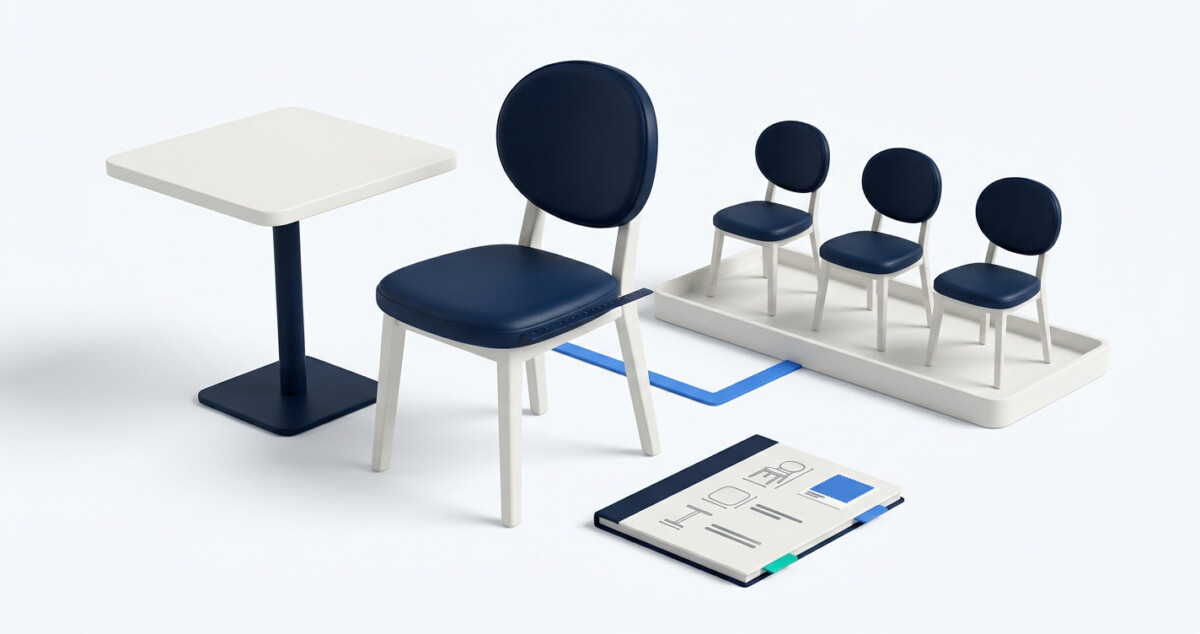
DTC brands entering wholesale should support both self-service checkout and assisted purchasing. For hospitality furniture and other specification-heavy products, product pages must serve multiple decision-makers, while quotes, samples, volume pricing, and delivery details help buyers approve orders. Measure those steps alongside completed sales, not instead of them.
Your checkout can be working perfectly while your product page fails the person who must approve the purchase.
The first time we dug into our analytics after launching online checkout, one number didn’t add up. About 70% of our revenue came from orders over $5,000. Almost none of those orders started with someone clicking “add to cart.”
They started with a phone call. Or an email asking for a spec sheet. Or a designer requesting a finish sample for a client we never spoke to directly.
We sell commercial restaurant chairs, tables, barstools and table bases to restaurants, cafés and hotels across Canada and the US. For years we treated our website as a catalogue and assumed the real selling happened offline. That was only half right. The site wasn’t where people bought. It was where they decided whether to trust us.
If you run a DTC brand and you’re starting to sell to businesses, the way hospitality buyers shop is a useful preview of what’s coming. Here’s what we’ve learned, including a few mistakes we’d rather you didn’t repeat.
A homeowner buying a dining chair is one person with one opinion. A restaurant buying 80 chairs is a small committee.
On a typical project we hear from the owner, who cares about budget and opening date. Then the interior designer, who cares about finish, fabric and how the room photographs. Then the contractor or project manager, who wants dimensions, weight and a delivery window that fits the build schedule. Sometimes the general manager weighs in on stacking and cleaning.
Each of them lands on the same product page looking for something different. Our early pages served the owner and nobody else. Contractors had to email us for seat heights, and many simply didn’t.
So we put full specs on every product page: seat height, footprint, weight capacity, frame material, upholstery options. We added downloadable spec sheets too. Result: e.g. quote requests rose 40% in the following quarter.
The lesson for DTC brands: in B2B, your product page gets forwarded. It has to answer the colleague’s question, not just the person who found it.
Above roughly $20k, most of our buyers want a quote, not a cart. It isn’t that they can’t pay online. They need a document. Owners show it to a partner or a lender. Designers add their markup and present it to their client. Contractors match it to a purchase order.
Our first quote form asked 14 questions. It felt thorough. It also killed submissions. We cut it to five fields: name, email, project type, quantity and timeline. We now promise a reply within [X business hours], and every quote mirrors a cart, with SKUs, quantities, freight, taxes and lead time on one page.
We also started tracking quotes the way a DTC brand tracks checkouts. 40% of quotes convert to orders, usually within 2 weeks.
A “Request a quote” button isn’t an admission that your ecommerce failed. It’s a second checkout for a different buyer. If you’re deciding whether to hand that pipeline to an outside team, this breakdown of outsourcing B2B lead generation covers what tends to break.
Restaurant furniture takes a beating. Spilled wine, chairs dragged across tile, cleaning chemicals every night. No designer will sign off on 120 upholstered chairs based on a product photo, however good it is.
For any product where touch and durability decide the sale, the sample is your conversion tool. Make requesting one as easy as buying.
Owners compare suppliers, usually in a spreadsheet. If a site only shows the single-unit price, a buyer working out 60 chairs either assumes the worst or moves on to a supplier who shows tiers.
You don’t need to publish your whole wholesale sheet. In Canada we also offer free shipping on orders over $4,999. That threshold works because it sits close to a real small-restaurant order, not because it’s a round number.
Restaurant openings run on hard dates: lease start, inspection, soft launch. A chair that arrives a week late costs far more than the chair.
So lead time belongs on the product page, not buried in an FAQ. We show whether an item is in stock or made to order, a realistic delivery window by region, and how it ships, including freight, liftgate or inside delivery.
For B2B buyers, “when” often matters more than “how much.”
Most buyers who never complete an online checkout still visit our site several times before they call. They look at installs in real restaurants, check our locations in Montreal and Toronto, read the warranty and judge how long we’ve been around.
More of them now arrive after asking an AI assistant where to buy commercial restaurant furniture. Clear specs, honest FAQs and consistent product data help there as well. eCommerce Fastlane’s guide to generative engine optimization for ecommerce explains why that structure matters.
The practical shift for us was measurement. We stopped judging the site on online revenue alone and started counting quote requests, spec sheet downloads, sample requests and calls as conversions.
Restaurant owners do buy furniture online. They just don’t buy it the way a consumer buys a lamp. They research alone, decide as a group, ask for paperwork and want to touch the product before they commit.
None of that means ecommerce doesn’t work for B2B. It means the website has a different job. Get the specs, quotes, samples and lead times right, and the orders follow, even when the final step happens over the phone.
About the author: Sarim is a Marketing Executive at Vogue Decor, a manufacturer-direct supplier of commercial restaurant furniture serving restaurants, cafés and hotels across Canada and the US.
DTC brands adding business buyers need clear answers about quote requests, specifications, samples, delivery, and assisted-sales measurement before expanding their wholesale workflow.
Keep online checkout and add a quote form when business orders require negotiated pricing, documentation, customization, or delivery confirmation. Standard products and repeat purchases should remain easy to buy without a conversation. The quote path serves buyers who need approval before paying, not every customer with a company name. Define which orders need assistance, assign an owner to the requests, and carry approved terms into the invoice or checkout. Measure the two paths separately so assisted purchasing does not hide problems in the self-service experience.
A B2B product page should include the specifications, options, pricing context, availability, and delivery information needed to select, approve, and receive the product. For furniture, that can include dimensions, materials, finishes, upholstery options, and verified performance information. Keep essential facts visible on the page and provide a downloadable specification sheet for sharing. Add the SKU and a document revision date so buyers can identify the correct version. Do not publish capacity, durability, or compliance claims unless you have documentation supporting them.
Set up a wholesale sample program by defining what buyers receive, what it costs, how it ships, and whether the fee qualifies for an order credit. Begin with the products or finishes that generate repeated questions rather than sampling the entire catalog. Explain whether the sample is a swatch, component, or complete product, and state any return requirements. Connect each request to the relevant project or opportunity. Use manufacturer documentation for performance claims because a physical sample alone does not establish durability, capacity, or regulatory suitability.
Measure phone and email sales by connecting website-generated inquiries to qualified opportunities, quotes, and completed orders. Track downloads, calls, and sample requests as separate engagement events rather than treating each as a sale. Use a project or opportunity identifier to avoid counting multiple interactions from the same buyer as separate prospects. Review quote conversion using a defined cohort and enough time for orders to close. Shopify draft orders can support invoices and payment links, but the measurement process still needs a reliable connection between the inquiry and final order.
Before accepting a large B2B order, confirm availability, dispatch timing, estimated transit, delivery service, access requirements, and the buyer’s receiving schedule. Distinguish an estimated ship date from an arrival commitment, and explain what starts the lead-time clock. Check whether freight, liftgate service, inside delivery, or installation is included rather than assuming those services are equivalent. Clarify any split shipments and additional charges. Put the agreed scope in the quote so the purchasing contact and the receiving team work from the same information.




