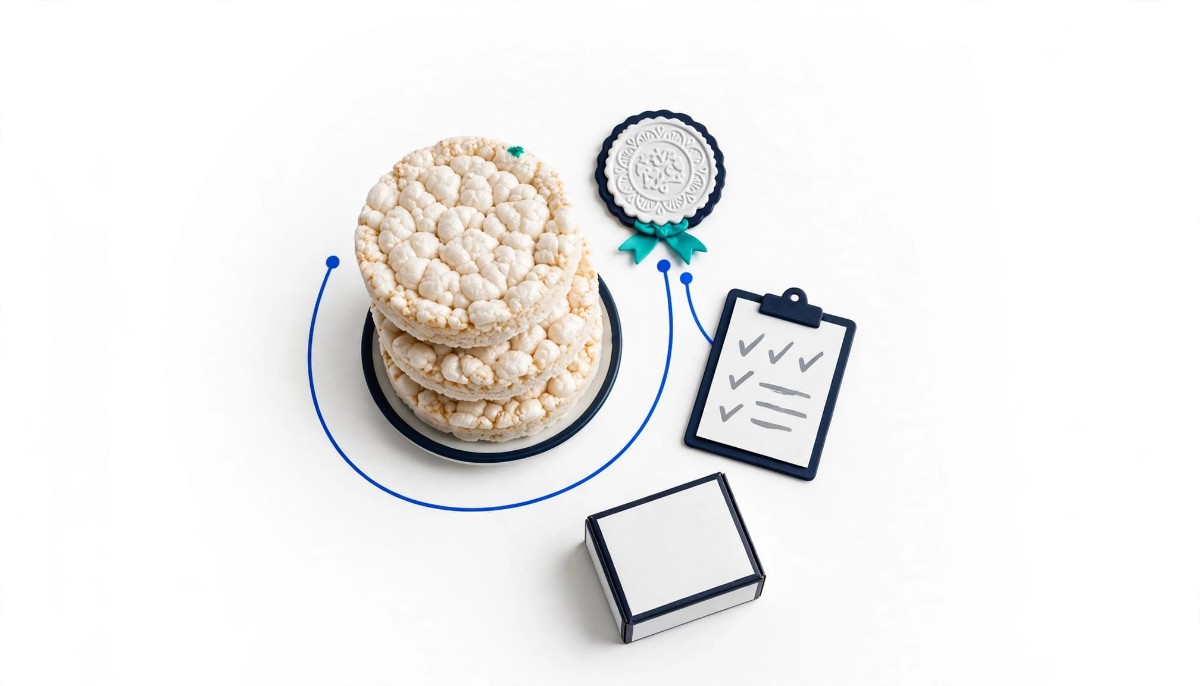
Commission a private label snack run only when your sales clear the supplier’s minimum well inside the shelf life. Then judge the supplier on process, contaminant testing and an unannounced BRCGS grade, which tell a brand more than any front-of-pack claim.
The cleanest label on the shelf is only as clean as the factory behind it. In snacks, the process is the product, and the audit report is the only part of the story a buyer can actually check.
Picture a production line turning out crisp grain cakes every few seconds, using nothing but heat and pressure to create the crunch. No fryer, no binding syrup. Consumers reading ingredient lists more closely than ever want exactly that: a short label, a light texture and a flavour that does not taste like a compromise.
For Good Food, a Polish producer based in Tarnowo Podgórne, this technology has been the core of production from day one. Rather than pivoting away from frying, the company has spent more than three decades (it was founded in 1991) refining a process that uses no added fat at the popping stage. That depth has let it experiment with a growing range of grains, improve taste and texture, and build a portfolio the company puts at more than 100 recipes.
The scale is worth noting if you are weighing private label. The company states an annual production capacity of 17,000 tons, with about 13,000 tons shipped each year to more than 50 retail chains, and says 85% of its output is private label. It also reports a 58% share of the Polish private label market in rice and corn cakes. Those are the company’s own figures, and they matter here for one reason: a supplier built for retail chains thinks in pallets and production runs, and a Shopify brand needs to understand that before the first call.
Air-pop technology makes a grain cake crunchy by heating whole grains under pressure inside a sealed mold, then releasing that pressure so the moisture inside each grain flashes to steam and the grain puffs from the inside out. Traditional crunch came from two places: deep frying, or synthetic binders that glue puffed pieces together. Pressure expansion removes both.
Here is what happens in the machine. Whole corn or rice grains are loaded into heated molds. The temperature climbs quickly, and then a controlled pressure drop lets the trapped moisture convert to steam in an instant. The grain expands to fill the mold, and its own starches bond the pieces into a single crisp cake with very little crumbling. Researchers who modelled how rice kernels puff describe the physics of puffing rice in similar terms: steam builds internal pressure while the starch softens and expands, and in pressure puffing a faster release produces a larger final volume.
For a brand owner, three practical facts follow. First, crunch comes from the grain and the machine settings, not from an additive, which is why the plain cake can carry a two or three ingredient label. Second, texture is a process variable. Moisture, temperature, time and release speed decide whether a cake is airy or dense, so two suppliers using the same grain can ship noticeably different products. Ask to taste production samples from the line you will actually run on.
Third, “no added fat at the popping stage” is a precise claim, and you should keep it precise. Many flavoured cakes get their taste from a seasoning, a chocolate or a yogurt coating applied after popping, and those toppings carry their own fat and sugar. If your product page says “baked without oil” on a chocolate coated cake, the nutrition panel will contradict you. Write the claim about the process, and let the panel speak for the finished product.
The process matters to a brand because it decides what you can put in the recipe. A clean, binder-free method opened the door to nutrient dense ingredients that were hard to work with before, including chickpeas, lentils, buckwheat and oats, alongside the classic rice and corn bases.
That widens your positioning options. A plain rice cake competes with every supermarket’s house brand on price. A lentil and corn cake with a seed topping, or a pea protein cake, can sit in a different conversation: plant protein, fibre, a gluten-free lunchbox staple, a lower calorie alternative to crackers. Good Food, for example, describes its range as gluten-free, plant-based and whole grain, with savoury, sweet and plain grain lines.
Before you fall for a recipe list, separate what the factory can make from what you can sell. A familiar pattern in food brands: a founder sees 100 possible flavours, launches eight, and spends the next year discounting the six that never found a buyer. The air-pop process makes flavour variety cheap for the factory. It does not make it cheap for you, because every flavour is its own minimum order, its own packaging run and its own shelf life clock.
Start with one hero recipe that maps to a clear reason to buy, and use the factory’s range as a roadmap rather than a launch menu. If you need a structured way to test demand before committing to a run, a seven day private label validation sprint will tell you whether customers pay real money at your target price before a pallet is ever booked.
Whether you are doing $20K or $200K a month, the question at this stage is the same: which single product earns the right to a second flavour? Answer that first, and the process becomes an advantage instead of a temptation.
The formats that fit modern snacking are single serve packs, mini formats and grain blends with a fuller flavour, because more people now eat in short breaks between meetings instead of sitting down to three set meals. Clean ingredients are not enough if the product does not fit the moment a customer reaches for it.
Manufacturers have followed that shift. Good Food’s plant moved its focus from the traditional large disc toward products built for specific moments of the day. One key move was going beyond neutral rice toward more expressive corn bases and grain blends, which carry more flavour without relying on artificial taste enhancers. In parallel, packaging changed: large, awkward bags were joined by single serve portions and mini formats designed for eating on the go, plus protein enriched options for active customers.
For a Shopify brand, format is also a shipping decision. Grain cakes are light and bulky, so you pay to ship air. That pushes the economics toward bundles and multipacks rather than single bags sold one at a time. Illustrative example, assuming a $3.50 retail single serve pack and a $9 shipping and fulfilment cost per order: a one pack order loses money on delivery alone, while a 12 pack bundle priced at $36 absorbs the same cost at 25% of order value. The format that sells in a corner store is rarely the format that works in a box on a doorstep.
Repeat purchase is where snack economics live. Single serve multipacks give you a predictable consumption interval, which is exactly what a replenishment reminder needs. If you have not set one up yet, the logic in setting a reorder clock for consumable products applies directly: state how long a pack lasts, then time the reminder to that interval rather than to a generic 30 days.
Before you sell a baby or protein snack, check three things in writing: bite texture and allergen controls for the specific line, contaminant test results for the grain, and whether every claim on your label is supported by a report you can produce. Specialised recipes are the next frontier in snack manufacturing, and they come with stricter standards.
Baby snacks need a softer bite that dissolves safely, and tighter allergen separation, so ask the supplier which lines are dedicated and how cross contact is controlled. Then ask about arsenic. Rice takes up inorganic arsenic from soil and water more readily than most crops, and regulators treat rice snacks for young children as a priority. The European Union sets a maximum of 0.30 mg/kg of inorganic arsenic for rice waffles, rice crackers and rice cakes, and 0.10 mg/kg for rice used in food for infants and young children, under Regulation (EU) 2023/465. In the United States, the FDA’s action level for inorganic arsenic in infant rice cereal, finalised in August 2020, is 100 parts per billion. Ask for batch results against those numbers, not a statement that the product “complies”.
Protein and gluten-free claims carry the same burden. A “gluten-free” label in the US means the food meets the FDA’s gluten-free labeling rule of fewer than 20 parts per million of gluten, and a “high protein” claim has to match the nutrition panel for the serving size you print. The factory may hold the test data. The legal exposure for what appears on your product page sits with you.
If you are under $500K a year, the safer call is to skip baby snacks entirely for your first private label product. The testing, the claims review and the reputational risk are a lot to carry before you know whether customers reorder. Protein and plain grain cakes are a far gentler first step.
A BRCGS AA+ grade proves that a factory passed the BRCGS Food Safety audit with no major or critical non-conformities and no more than five minor ones, on an unannounced visit, which is the highest grade the scheme awards. In a market full of health claims on the front of the pack, independent audits have become the real benchmark, because they are the one part of the story a buyer can verify.
Grades run from AA down through A, B, C and D, based on the number and severity of non-conformities the auditor finds, and the plus sign means the site opted into an audit with no advance notice of the date. Certification bodies such as QIMA note that an AA+ or A+ grade from an unannounced audit is increasingly requested by premium UK and EU buyers. An announced AA tells you the factory was ready on the day. An unannounced AA+ tells you it is ready on an ordinary Tuesday.
At a manufacturing scale of dozens of tons a day, full raw material traceability at every stage is essential. Good Food says its Tarnowo Podgórne facility has operated to BRCGS Food Safety requirements for 20 years and currently holds the AA+ grade, and it reports an average of about one complaint per million packs produced in 2024. For a retail buyer or quality auditor, that combination is evidence of hygiene compliance and control over biological and chemical risks across what the plant ships.
Know the limits, too. A BRCGS grade does not test your recipe’s taste, approve your marketing claims or handle your import paperwork. If you bring finished food into the US, you as the importer are responsible under the FDA’s Foreign Supplier Verification Programs rule for verifying your foreign supplier, and a strong audit report is the backbone of that file rather than a substitute for it. Ask for the current certificate and the audit report itself, and check the expiry date.
Private label snacking makes sense once you have an audience that already buys consumables from you and enough monthly volume to sell through a production run well inside the product’s shelf life. The constraint is rarely the factory’s capability. It is the gap between a minimum order sized for retail chains and a sell-through rate sized for a direct to consumer store.
Run the math before you request samples. Illustrative example, assuming a supplier minimum of 10,000 packs per flavour, a 12 month shelf life, and sales of 400 packs a month: you would need 25 months to clear the run, so roughly half of it expires on the shelf. At 1,200 packs a month, the same run clears in about eight months with room to spare. Ask every supplier for the real minimum, the shelf life from the production date, and how many months of shelf life are left when stock arrives at your warehouse. Then work out landed cost per pack, because freight and duty change the margin more than the factory price, as the landed cost math for a first private label run shows in a different category.
Speed is on your side once the numbers work. Good Food quotes an average of 90 days from brief to market for a private label product, which is fast enough to plan a launch around a season. Use that time to build the story, too: buyers of better-for-you snacks respond to specific sourcing and production detail, a point echoed in how food brands are approaching marketing in 2026.
The evolution of a simple grain cake shows where food is heading: clean ingredients and advanced process engineering, together, turning basic grains into safe, modern products built for how people eat today. Your job as the brand is to choose the partner whose process you can explain and whose audit you can show.
Air-popped rice cakes are made by heating whole rice grains under pressure in a sealed mold and then releasing that pressure, so the moisture inside each grain flashes to steam and puffs it. The expanding grains fill the mold and their own starches bind them into one crisp cake, which is why no frying oil or synthetic binder is needed. Texture depends on grain moisture, temperature, time and how fast the pressure is released. Keep in mind that flavoured versions often get a seasoning or chocolate coating after popping, and those coatings add their own fat and sugar to the finished product.
BRCGS AA+ means a food supplier passed the BRCGS Food Safety audit with the highest grade and did so on an unannounced visit. Grades run from AA through A, B, C and D according to the number and severity of non-conformities found, and the plus sign shows the site agreed to be audited without advance notice of the date. Premium UK and EU retailers increasingly ask for unannounced grades because they reflect everyday conditions on the line. The grade covers food safety and hygiene systems; it does not validate your recipe, your marketing claims or your import compliance.
Private label snack manufacturing is worth it for a small Shopify store only when monthly sales can clear a full production run well inside its shelf life. Factory minimums for snacks are usually sized for retail chains, so a store selling a few hundred packs a month can end up with stock that expires before it sells. Run the math first: minimum order divided by monthly sales should leave months of shelf life to spare. If it does not, resell an existing branded snack, measure reorder rates, and come back to private label once volume supports it.
Rice cakes can be part of a young child’s diet, but rice products for babies need tighter controls on inorganic arsenic, which rice absorbs from soil and water. The EU caps inorganic arsenic at 0.10 mg/kg in rice used for infant and young child foods and 0.30 mg/kg in rice cakes generally, and the FDA’s action level for infant rice cereal is 100 parts per billion. A brand selling baby snacks should ask its supplier for batch test results against those numbers, along with evidence of bite softness and allergen separation for that specific line.
Ask a private label snack manufacturer for its real minimum order per flavour, the shelf life from production date, and how much shelf life remains when stock reaches your warehouse. Then request the current food safety certificate and audit report, recent contaminant test results for the grain, allergen controls for your line, and production samples from the line you will run on rather than showroom samples. Finally, confirm who supports each label claim, such as gluten-free or high protein, because the legal responsibility for what appears on your product page sits with your brand.