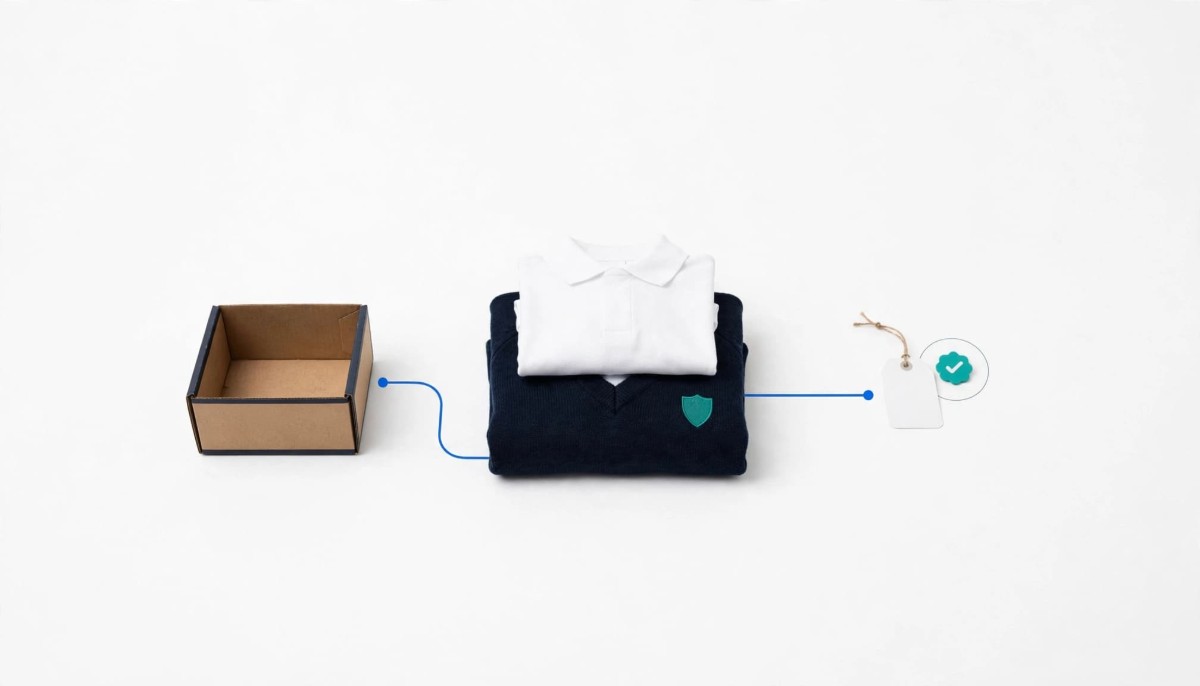
School-specific marketplaces make second hand uniform resale easier because they organise listings by school, garment, size and condition, which general marketplaces handle poorly. Parents save money and recover some of what they spent, provided listings are honest and postage does not swallow the saving.
A navy jumper is not just a navy jumper. To a school, the crest, the shade and the cut decide whether it passes the gate, and that is exactly the detail a general marketplace was never built to capture.
Picture the week before a new school term. A parent has a bag of uniforms their child grew out of in eight months: two polo shirts, a jumper with years of wear left, and a sports top worn a handful of times. Across town, another family needs exactly those sizes for the same school. Both would gain from a swap. Without a way to find each other, the bag goes to the back of a cupboard and the other family pays full price at the uniform shop.
School uniforms are a recurring cost because children outgrow them faster than they wear them out. Online marketplaces close that gap by connecting families who have outgrown clothing with families looking for affordable replacements. Australian platform Rethread brings second hand school uniform listings together so families can search for relevant items and contact sellers online. Its specialised approach is also a useful case study in how ecommerce marketplaces can solve an everyday shopping problem by narrowing their focus rather than widening it.
This guide covers both sides: what parents need to know to buy and sell well, and what the model teaches anyone running a marketplace or a niche online store.
School uniform resale makes sense because most garments are outgrown long before they are worn out, so a used uniform still has real value to the next family. A jumper bought at the start of one school year may not fit the next, even though it looks almost new and still meets the school’s requirements.
That gap between fit and wear is where resale creates value for both sides. The seller recovers some of what they originally spent. The buyer pays less than the uniform shop price for a garment that does the same job. Rethread advertises savings of up to 70% off retail; that is the platform’s own figure, and the real saving on any item depends on its condition and the price the seller sets.
Resale also keeps wearable clothing in use for longer. Rather than storing outgrown uniforms indefinitely or throwing them out, families can pass them to someone who needs the same items for the same school. The clearest benefit is simple: a usable garment gets another child to wear it.
Stage matters here too. A family with one child at a primary school with a cheap uniform may find the effort barely worth it. A family with several children moving through a secondary school with blazers, sports kits and formal shirts is looking at a much larger annual spend, and resale can cover a meaningful part of it. The more expensive and school-specific the garment, the stronger the case for buying and selling second hand.
School-specific search solves the matching problem by letting parents start with the school and then filter by garment, size and condition, so every result is a uniform their child can actually wear. Finding a second hand uniform is hard on a general platform because schools set specific requirements for colours, logos and garment styles.
A navy jumper from one school may not be acceptable at another, even if it looks almost identical in a photo. A keyword search for “navy school jumper” returns hundreds of listings from dozens of schools, and the parent is left to inspect each one for the right crest. Sizing, condition and availability add three more layers of filtering on top.
School-specific marketplaces remove that work by organising listings around the requirements that matter. Rethread lets families search by school first, and says it lists more than 10,000 Australian schools as of October 2026, then narrow by size, item type, condition and price. The search structure does the matching, so the parent only sees uniforms that are relevant to their child.
For the listing itself, the useful fields are consistent: the school, the garment type, the size, the condition, and photographs of the actual item rather than a stock image. When every listing carries the same fields, buyers can compare quickly and trust what they are comparing.
This reflects a broader ecommerce principle. As covered in the differences between online marketplaces and ecommerce stores, marketplaces bring products from many sellers together, which makes search and product organisation essential to the buying experience. A marketplace with weak search is just a pile of listings. A marketplace that structures its catalogue around how buyers actually decide becomes the place they return to.
Outgrown uniforms sell when the listing answers a buyer’s questions before they ask: which school, which garment, what size, what condition, and what it really looks like front and back. General second hand marketplaces often force sellers into broad clothing categories and leave them answering questions from buyers who do not know the school’s rules. A dedicated platform starts from shared understanding, because buyer and seller already know what the garment is for.
Before listing, check three things. The garment should be clean and wearable, with no damage you would be embarrassed to hand over. It should match the school’s current uniform list, because schools do change suppliers, colours and crests, and an outdated design is hard to sell. And the size label should be checked against a quick measurement, since shrinkage after a few years of washing is common.
Photographs carry most of the weight. Show the front and back of each item in good natural light, and photograph any fading, pilling, stains or worn cuffs up close rather than hoping the buyer will not notice. A buyer who sees the flaw before buying is far less likely to be unhappy after delivery than one who discovers it in the parcel.
Descriptions should be short and specific. “Size 12 jumper, worn for one year, slight pilling under the arms, no stains, current crest” tells a buyer everything they need. “Good condition school jumper” tells them almost nothing.
Rethread gives parents a place to list outgrown uniforms and connect with other families looking for them. On its own description, sellers sign up and list items without listing fees, which keeps the cost of trying low for a family with only a few items to sell. If you are a business rather than a parent, the guide to building a brand resale platform explains how the consumer-to-consumer, consignment and trade-in models differ.
Trust between uniform buyers and sellers comes from clear photographs, consistent condition descriptions, transparent pricing, and a payment process that protects both sides until the item arrives. Buying used clothing online carries uncertainty because the buyer cannot inspect the garment first.
Two jumpers with identical size labels can differ a great deal. One looks almost new; the other has worn cuffs and faded fabric. Without shared language for condition, a seller’s “excellent” and a buyer’s “excellent” can mean different things, and that mismatch is where disputes start.
Marketplace operators can reduce it by encouraging consistent condition grades, so that words like “excellent”, “good” and “fair” carry an agreed meaning. Rethread publishes its own condition grading guide for sellers, with six grades running from Like New down to Average. Resale businesses in higher value categories treat authentication and honest condition grading as the core of the trust model, and the same logic applies to an inexpensive school polo, just at a smaller scale.
Payment handling matters as much as photographs. Rethread says it holds funds until delivery is confirmed, and pays sellers after the buyer confirms receipt. That arrangement gives a buyer confidence that money is not lost if a parcel never arrives, and it gives the seller confidence that the buyer has committed. These are the same trust signals that matter in any online store: clear policies, visible protections, and honest information about the product.
Buyers should also understand what kind of seller they are dealing with. The Australian Competition and Consumer Commission’s guidance on buying products online explains that some consumer guarantees do not apply when the seller is a private individual rather than a business, and that on marketplace platforms your rights sit with the seller, not the platform. Most uniform resale is parent to parent, so read the listing carefully and ask questions before paying.
Postage makes a second hand uniform not worth it when the delivery cost is a large share of a low item price, which is common for single shirts and shorts. Convenience often decides whether a parent chooses resale over the uniform shop, and delivery is a big part of that convenience.
Illustrative example, assuming a used polo listed at $12, a new one at the uniform shop at $30, and $10 in postage for a small parcel: the buyer pays $22 delivered and saves $8, or about 27%. Buy three polos from the same seller in one parcel at the same postage and the delivered cost is $46 against $90 new, a saving of $44, or about 49%. The garments are identical in both cases. What changed is how many items share the delivery cost.
That is why two options matter most for cheap garments. Local pickup removes postage entirely, and Rethread lets sellers offer pickup as well as Australia-wide shipping. Combined delivery, where a buyer purchases several items from one seller in a single parcel, spreads the cost. Retailers see the same economics; the case for in-store pickup as a way to avoid last-mile delivery costs rests on the same arithmetic.
Timing is the other factor. Demand rises in the weeks before a new school term, while supply depends on when families get around to listing. Parents looking to buy improve their chances by searching early and checking regularly. Parents looking to sell do best by listing as soon as a child outgrows something, rather than waiting until the January or term-break rush when everyone lists at once.
For ecommerce operators, the lesson is plain: show the full delivered cost and current availability early, because a shopper who discovers the postage at the last step is a shopper who leaves.
The sustainability case for uniform resale is real but narrow: each resold garment gets more use before it is replaced, and claims beyond that should be stated carefully. Reselling a wearable uniform does extend the useful life of something that has already been made, and a family that buys used instead of new avoids one new purchase.
Broader environmental claims need more care. Packaging, transport and buying behaviour all affect the overall impact of a resale transaction. A uniform shipped across the country in a new plastic satchel has a different footprint from one handed over at the school gate. If cheap second hand prices lead a family to buy more garments than they need, some of the benefit disappears.
The ACCC’s guide to making environmental claims, published in December 2023, sets out what it considers misleading conduct and good practice, including avoiding broad, unqualified claims and having evidence for what you say. That applies to marketplaces and retailers describing their environmental impact. The safe and honest framing is specific: this garment gets worn again instead of sitting in a cupboard or going to landfill. Merchants selling on sustainability face the same test, and the stores that hold a premium are the ones whose sustainability claims can be verified rather than implied.
For families, the habits that help are ordinary ones: wash uniforms with care, repair small damage such as a loose hem or missing button, and resell items as soon as they are outgrown so they reach the next child while they are still in demand.
The main lesson from a school uniform marketplace is that a narrow focus built around one genuine customer need can beat a broad platform, because the narrow version can structure search, listings and trust around exactly how that customer decides. Online marketplaces make uniform resale more accessible by connecting families with outgrown clothing to parents looking for affordable replacements. School-specific search, accurate listings, transparent costs and straightforward communication do the rest.
Whether you run a $10K a month store or a $1M a month brand, the transferable pieces are the same. Organise the catalogue around the attribute that decides the purchase, which for uniforms is the school and for your store might be compatibility, size range or use case. Standardise how products are described so shoppers can compare without guessing. Show delivery costs early and offer the cheapest fulfilment option your customers can use. Keep environmental claims specific and backed by evidence.
If you are early, the lesson is to resist building for everyone. A store that serves one need extremely well earns repeat visits; a store that half serves ten needs earns comparison shopping. If you are scaling, the lesson is to check whether your search and filters still reflect how customers actually decide, because catalogues drift as they grow.
For parents, resale is another way to manage school costs while keeping usable garments in circulation. For ecommerce businesses, it shows the value of building a focused marketplace around a real, recurring problem that customers already have.
You can buy second hand school uniforms online in Australia through school-specific marketplaces such as Rethread, general second hand platforms, community buy-and-sell groups, and some school-run uniform shops that list stock online. School-specific marketplaces are usually the fastest option because you search by your child’s school first and only see items that meet its uniform requirements. General platforms carry more listings overall but make you check each one for the right crest, colour and style. Whichever you use, compare the delivered price, not just the item price, and look for clear photographs of the actual garment rather than a stock image.
Sell your child’s old school uniform online by listing it on a marketplace that lets buyers search by school, with clear photographs and an accurate size and condition description. Wash the garment first and check that it still matches your school’s current uniform list, since outdated crests or colours are hard to sell. Photograph the front and back in natural light, and show any wear such as pilling, fading or stains up close. Write a short, specific description that names the school, garment, size and how long it was worn. Offering local pickup alongside postage makes cheaper items more attractive to buyers nearby.
How much you save buying used school uniforms depends on the item’s condition, the price the seller sets, and how much you pay for delivery. Rethread advertises savings of up to 70% off retail, but that is the platform’s own upper figure rather than a typical result. On low priced items such as shirts and shorts, postage can take a large share of the saving, so buying several items from one seller in a single parcel or choosing local pickup usually gives the best result. The biggest savings tend to come on expensive, school-specific garments such as blazers and jumpers, where the gap between new and used prices is widest.
Before buying a second hand school uniform, check that it matches your school’s current uniform requirements, that the size will fit, and that the photographs show the actual garment’s condition. Confirm the crest, colour and style against the school’s uniform list, because schools do update designs. Ask the seller for measurements if you are unsure about sizing, since labels are not always reliable after years of washing. Look closely at photographs for worn cuffs, pilling, fading or stains. Finally, check the delivered price and the payment process, and remember that buying from a private seller can give you fewer consumer protections than buying from a business.
Consumer guarantees may not fully apply when you buy a used uniform from another parent, because the ACCC says some guarantees do not apply when the seller is a private individual rather than a business. On marketplace platforms, your rights generally sit with the seller you buy from, not with the platform itself. That makes the listing details and your questions before purchase more important. Read the description carefully, ask about any wear you cannot see in the photographs, and use a platform whose payment process protects you, for example by holding funds until delivery is confirmed. If something goes wrong, contact the seller first and then the platform.