

No single Shopify app wins Black Friday. The eight below each fix one BFCM bottleneck: offers, email, reviews, loyalty, support, landing pages, session diagnostics and post purchase upsells. Pick the one that matches a bottleneck you have already measured.
The most expensive app you install before Black Friday is the one that fixes a problem you never measured.
A store can take 40 percent more orders over the Black Friday weekend and finish Cyber Monday with less contribution profit than it made in an ordinary week. The orders are real. So are the stacked discounts nobody tested, the campaign page that loaded in four seconds on mobile, and the support queue that quietly absorbed four days of shipping questions. None of those is an app problem. Each becomes one the moment a merchant reaches for software instead of a measurement.
This list is for Shopify merchants between $50K and $2M in annual revenue who are inside the four week window before BFCM and are trying to decide whether another app earns its place. The order below is the contributing author’s and is not a ranking. There is no number one here, no editor’s choice, and no claim that any app is the best in its category, because the right answer depends on which stage of your own funnel is leaking.
What the list does give you is a like for like read on all eight: what each one is, what it costs as of October 2026, two honest limitations, the merchant stage it fits, and the condition under which you should not install it. The comparison grid is the thirty second version. The stage guidance further down is where the choice gets made.
Each app on this list clears five criteria, applied identically to all eight. One, it does a distinct BFCM job, so the list is not eight versions of the same tool. Two, it has a free tier or an entry plan at or below roughly $35 per month. Three, its Shopify App Store listing carried a verifiable rating and review base on October 11, 2026, the date every figure here was checked. Four, it can be installed inside four weeks without changing checkout logic that cannot be rolled back. Five, there is an honest condition under which a merchant should not install it, named in each entry.
Two apps were considered and excluded. Aftersell was excluded because its Shopify App Store listing was unavailable as of October 13, 2026, so a merchant cannot install it this season whatever its merits. LoyaltyLion was considered for the loyalty slot and excluded because its first paid tier is $199 per month as of October 11, 2026, above this list’s entry point criterion. This is editorial selection against stated criteria, not hands on testing, and a high star rating is not evidence that an app will raise your revenue.
The eight apps below carry their entry price, their best use and the condition that disqualifies them, all verified on October 11, 2026. Read the Skip if column first, because disqualifying an app is faster than choosing one.
Every plan quoted above is the entry plan, and every entry plan has a ceiling. Check the tier you will actually land on at your BFCM order volume, not the one in the headline.
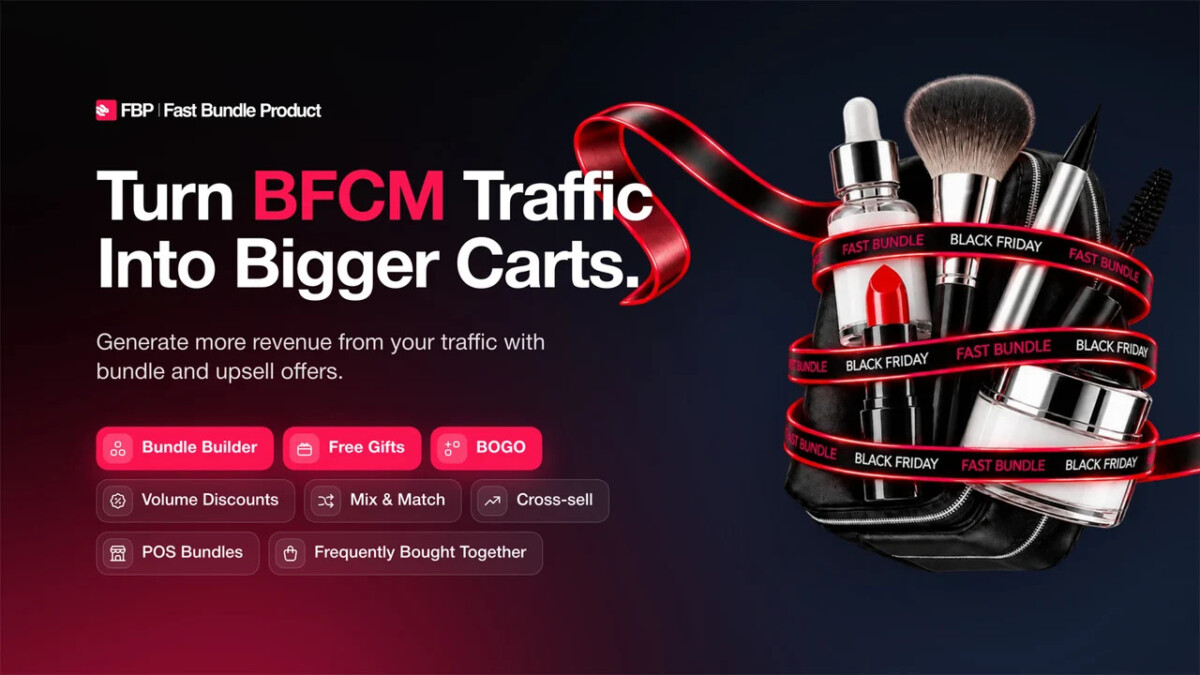
Fast Bundle is a Shopify offer engine for merchants who want coordinated BFCM promotions, bundles, BOGO, gifts with purchase and quantity breaks, rather than one sitewide percentage discount.
Fast Bundle handles fixed kits, mix and match bundles, build your own selections, Buy X Get Y and BOGO, gifts with purchase, product add ons and quantity discounts from a single app. A skincare brand can sell a discounted three step routine instead of marking down every individual SKU, which keeps the headline discount off the catalogue while still giving the shopper a reason to buy more. That breadth is the practical argument: a promotion needing two or three offer formats at once is otherwise two or three apps. The Fast Bundle listing carried a 5.0 star rating from 3,529 reviews on October 11, 2026.
As of October 11, 2026, Fast Bundle is free to install on development stores, and paid plans are tiered by monthly bundle sales rather than by store revenue: Standard 1K is $19 per month covering up to $1,000 of monthly bundle sales, Standard 3K is $49 per month up to $3,000, and Standard 10K is $139 per month up to $10,000. Each paid plan carries a 7 day free trial, and an optional auto bundle detection add on is $49 per month.
The strength that matters in a BFCM context is that bundling answers the question a sitewide discount cannot: how do you lift basket value while keeping the saving legible? Pairing complementary products reads as a coherent purchase, where marking everything down 25 percent invites shoppers to find the deepest cut and buy only that.
Two limitations. The pricing model is tiered on bundle sales, so a successful BFCM weekend is also what pushes you up a tier, and a store clearing $3,000 of bundle revenue over four days is on the $49 plan rather than the $19 one. The second is that it may be more app than the job needs. Shopify’s own Bundles app is free and handles fixed bundles and multipacks at fixed prices, so check it first if that is all you need. Worth knowing before you do: the native app carried a 2.9 star rating from 568 reviews on October 11, 2026, and the recurring complaints concern variant option limits rather than price, which is the honest reason many merchants end up paying for a third party app.
Best fit for Shopify stores between roughly $50K and $5M in annual revenue running more than one offer format over BFCM, with a catalogue where products genuinely complement each other. Skip it if your only campaign is an ordinary sale price, or if a single fixed kit with simple inventory requirements is the whole plan, in which case the native Bundles app is the cheaper first stop. Shopify’s discount combination rules decide which savings can legally stack, so test the exact cart before launch. For the longer view of the category we compare ten Shopify bundle builder apps in depth, and Fast Bundle publishes its own setup documentation.
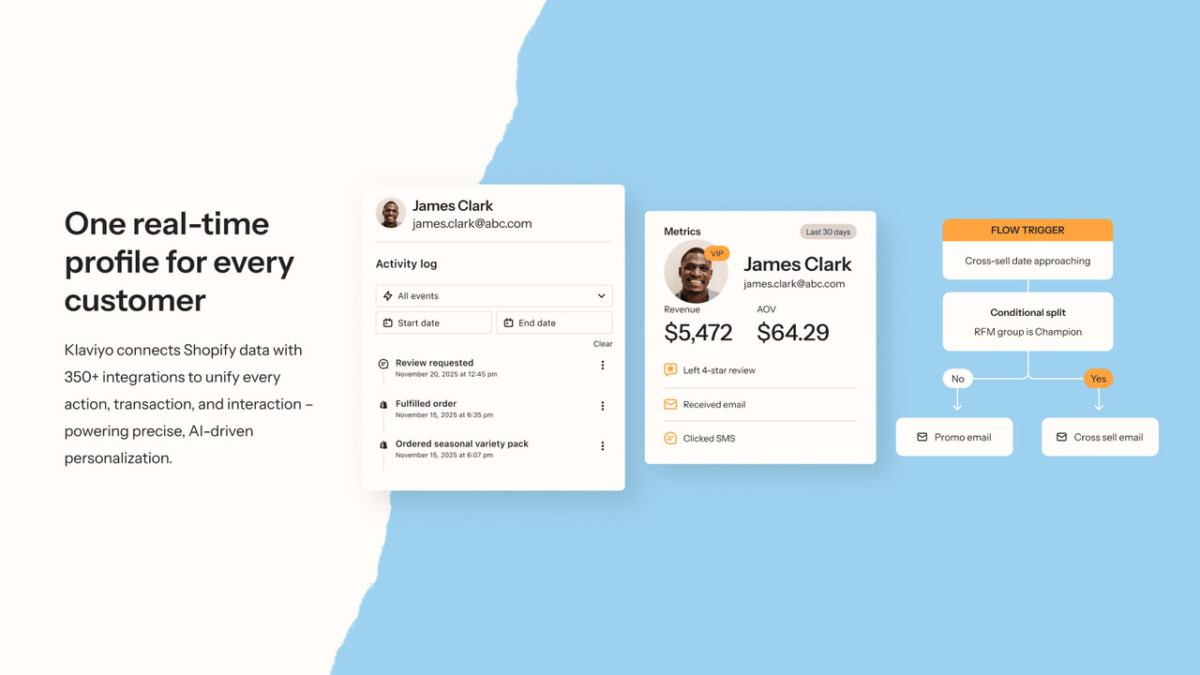
Klaviyo is a Shopify native email and SMS platform for brands that want to send different BFCM messages to different segments rather than the same campaign to everyone.
Klaviyo combines ecommerce customer profiles, segmentation and automated flows in one system. For BFCM that means early access for previous high value customers, a separate campaign for subscribers who have never purchased, suppression for everyone who already bought so they do not get three reminders about an offer they took on Thursday, and cart recovery and win back journeys after the weekend. The segmentation is the product, since a single send to the whole list is something Shopify Email already does free. The Klaviyo listing carried a 4.7 star rating from 3,365 reviews on October 11, 2026.
As of October 11, 2026, Klaviyo is free to install with email free for up to 250 contacts and SMS free for up to 150 message credits. Paid email starts at $20 per month for 251 to 500 contacts, and SMS starts at $15 per month for up to 1,250 message credits including carrier fees. Klaviyo bills some charges separately from the Shopify invoice, so the Shopify billing page is not the whole picture.
The first strength is suppression, which sounds like the least interesting feature on the list and protects the most revenue, because not sending is what keeps a list intact through a four day barrage. Flows built for BFCM also keep working in December and January, so the setup cost amortises across the quarter.
Two limitations. Klaviyo pricing scales on contacts, and the curve is not linear in a way that is obvious at signup, so a store that grows its list hard in November meets a different invoice in December. The second limitation is time: consent management, deliverability warming and flow construction are not weekend tasks, and a store installing Klaviyo three weeks before BFCM will use perhaps a fifth of what it is paying for.
Best fit for Shopify stores above roughly $200K in annual revenue with a list large enough that segments behave differently, and at least one person whose job includes email. Skip it if you have a few hundred contacts and one planned campaign, where Shopify’s native marketing tools are adequate and free.
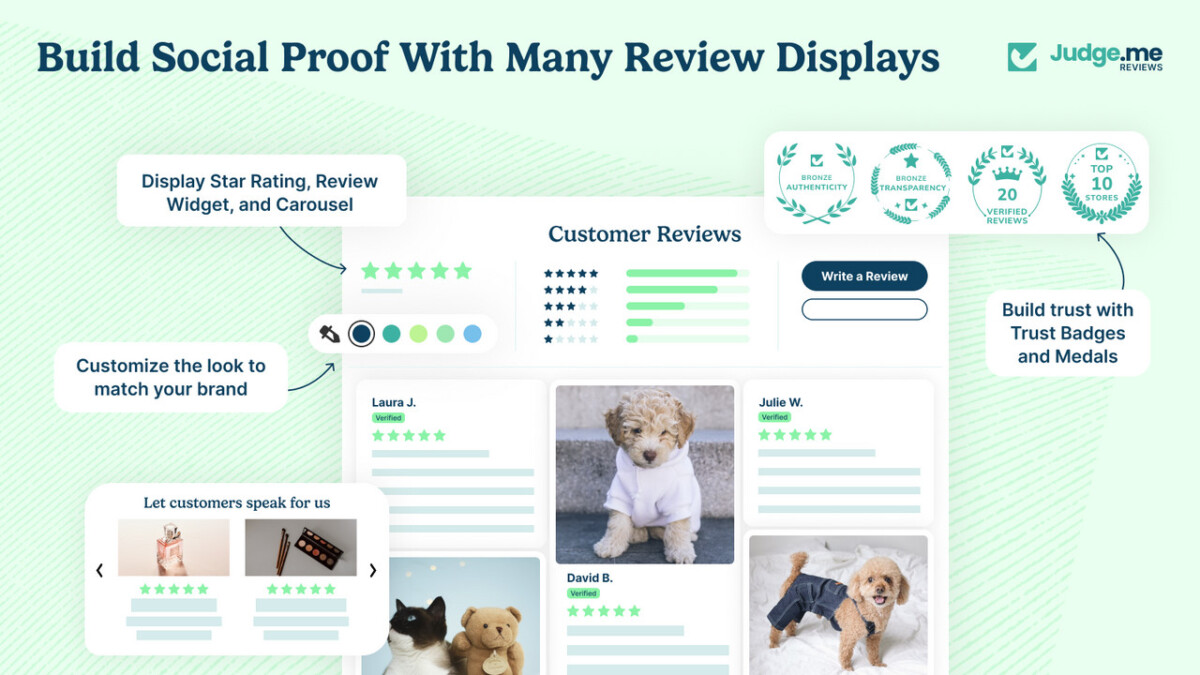
Judge.me is a Shopify product review app for stores expecting first time BFCM visitors who need evidence before they will buy from a brand they met in an ad.
Judge.me collects and displays written reviews, photo reviews, video feedback and star ratings through storefront widgets. For Black Friday the use case is narrow and worth stating plainly: put trustworthy product information where the shopper is deciding. A visitor who arrived from a paid social ad thirty seconds ago has no relationship with your brand and no reason to trust your product copy, and reviews from other buyers are the cheapest substitute. Judge.me carried a 5.0 star rating from 48,331 reviews on its Shopify App Store listing on October 11, 2026, by far the largest review base here.
As of October 11, 2026, Judge.me offers a forever free plan at $0 per month and an Awesome plan at $15 per month with a 15 day free trial.
The first strength is cost, because a free tier that puts review widgets on the storefront removes the argument about whether social proof justifies a line item. The second is breadth of format, since photo and video reviews do more work on apparel and homeware than star ratings alone.
Two limitations. Reviews only help if you have them, so a store installing Judge.me in November has an empty widget on Black Friday and a useful one by February, which makes the install a first quarter investment dressed as a BFCM move unless you already have reviews to import. The second is a rendering risk rather than a product flaw: review widgets and theme supplied structured data can duplicate each other, and a badly placed widget can push promotional pricing below the fold on mobile.
Best fit for Shopify stores at any revenue stage that are running paid acquisition into BFCM and have at least a few dozen reviews to display or import. Skip it if you already run reliable review software with a healthy review library, because migrating platforms in the four weeks before BFCM introduces risk with no conversion upside.
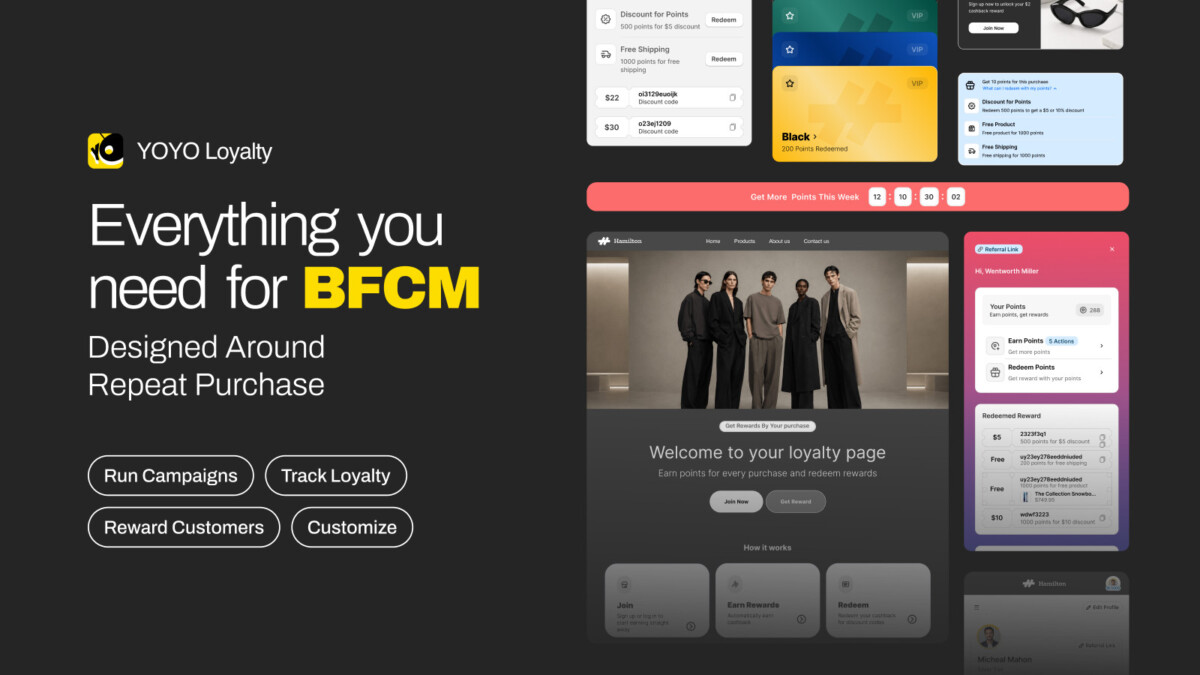
YOYO is a Shopify loyalty app for brands with genuine repeat purchase potential that want November buyers to come back in December rather than disappear.
YOYO combines points, cashback, store credit, membership benefits, referrals and VIP tiers in one app. A beauty brand can reserve early access for an existing VIP segment, award points on qualifying BFCM purchases, then send a post sale reminder explaining how to redeem them against a future order. That is the whole argument for loyalty during BFCM: it turns the weekend from an acquisition event into the first order of a relationship. Store credit is the mechanic worth attention, because credit redeemed later is cheaper than a discount given now. YOYO carried a 5.0 star rating from 173 reviews on October 11, 2026.
As of October 11, 2026, the Starter plan is free and capped at $500 of YOYO generated revenue per month. Essential is $9 per month up to $2,500 of YOYO generated revenue, Growth is $59 per month up to $8,000, and Enterprise is $199 per month with no cap. Paid plans carry a 14 day free trial, and VIP tier features sit on the higher plans rather than on Essential, so confirm which tier you need before launch.
The first strength is the range of mechanics in one app at a $9 entry point, which is unusual in a category where the next tier often starts in the hundreds. Store credit and membership features also let a merchant reward a BFCM buyer without cutting the price of the BFCM order itself.
Two limitations, and the first is the review base. One hundred and seventy three reviews is a small sample next to the 4,628 on Smile.io or the 543 on LoyaltyLion as of October 11, 2026, and a 5.0 rating on a small base tells you less than a 4.9 on a large one. A brand with complex, proven enterprise loyalty requirements should evaluate the more established options alongside it. The second limitation is reward liability. Points and credit issued in November are a cost that lands in Q1, and a store that cannot fund the redemption has moved a discount rather than removed one.
Best fit for Shopify stores between roughly $50K and $2M in annual revenue selling consumables, replenishables or anything with a natural reorder cycle, where the reward economics have been calculated before launch. Skip it if your products are rarely repurchased, or if you cannot carry the reward liability into Q1, in which case a well written follow up email does the job for nothing. The point of the exercise is the second order, which is the subject of our Shopify retention framework.
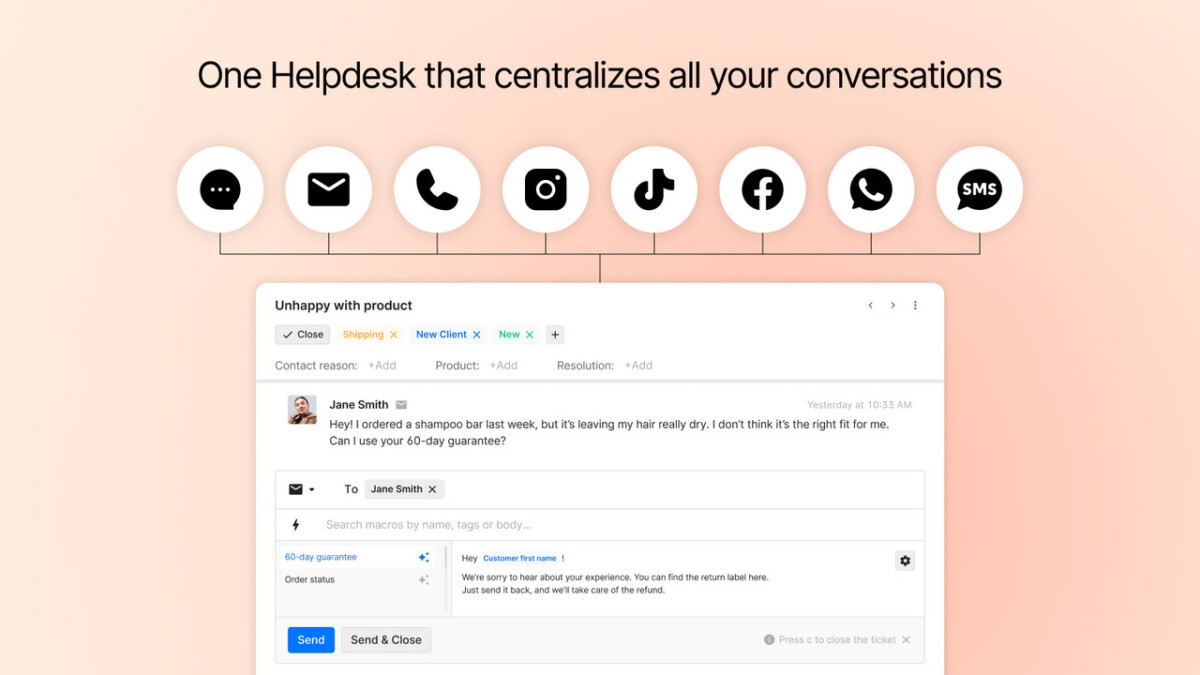
Gorgias is a Shopify customer support helpdesk for stores expecting more shipping, order change and returns questions over BFCM than their current inbox can absorb.
Gorgias pulls conversations from email, chat, SMS and social into one workspace with the Shopify order beside the ticket, plus rules, macros and AI assisted replies. During BFCM the value is mundane and real: an agent answering a delivery cutoff question does not open two tabs to find the order, and forty identical questions about whether the discount applies to sale items get one prepared answer instead of forty improvised ones. The Gorgias listing carried a 4.3 star rating from 705 reviews on October 11, 2026, the lowest on this list, which reads as a signal about pricing friction more than product capability.
As of October 11, 2026, Starter is $10 per month including 50 tickets with additional tickets at $0.40 each. Basic is $60 per month for 300 tickets, Pro is $360 per month for 2,000 tickets, and Advanced is $900 per month for 5,000 tickets, with overage on the higher plans at $36 per 100. Every plan carries a 7 day free trial.
The first strength is that a centralised queue with prepared responses converts support from a bottleneck into throughput without adding headcount, which is the only lever most stores have in late November. Clear answers about delivery cutoffs also protect revenue directly, because a shopper who cannot find out whether their order arrives before the 24th does not wait to be told.
The limitations are both about the meter. Starter at $10 per month for 50 tickets is a price designed to be left behind: on the illustrative assumption of 1,300 BFCM orders at a 15 percent contact rate, a store generates roughly 195 tickets, which on Starter is $10 plus 145 overage tickets at $0.40, or about $68 for the month. Still cheap, but not $10, and the arithmetic worsens fast at higher volumes. The second limitation is that a helpdesk is only as good as the macros loaded into it, and a store installing Gorgias in the final week has bought a tidier queue rather than a faster one.
Best fit for Shopify stores above roughly $500K in annual revenue, or any store running support across more than two channels, where the team is fixed and the ticket volume is not. Skip it if a low volume store is handling support comfortably through Shopify Inbox, which is free and carried a 4.6 star rating from 5,809 reviews on October 11, 2026. Our four week BFCM operations playbook includes a ticket volume forecast you can run before you pick a plan.
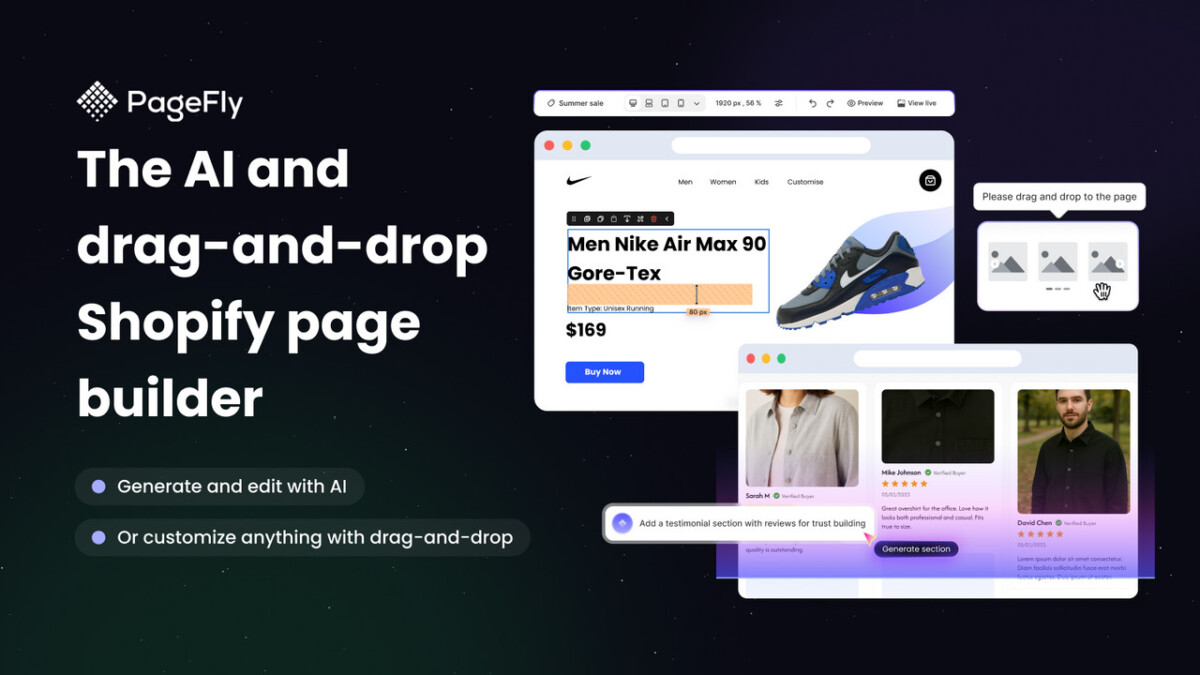
PageFly is a Shopify page builder for stores that need a dedicated Black Friday offer page without editing their live theme templates in late November.
PageFly provides a visual editor for assembling campaign pages with product modules, offer explanations, FAQ blocks and a clear path to the cart. Consistency is why it matters during BFCM: paid social, email and organic traffic promising the same offer should land somewhere that explains that offer, its eligibility rules and its shipping cutoffs. The second reason is risk containment, because a PageFly page is a separate object, so building one does not require touching the theme your store depends on during its highest traffic week. Its Shopify App Store listing carried a 4.9 star rating from 5,903 reviews on October 11, 2026.
As of October 11, 2026, the free plan allows one published page or section with 10 AI credits per month. Builder is $24 per month starting at five published slots, with extra slots at $5 per five, and 80 AI credits. Accelerate is $99 per month for unlimited pages, and Enterprise is $299 per month.
The first strength is that a landing page can carry the terms a product page cannot: eligibility rules, bundle mechanics, delivery promises and the exclusions that prevent a support ticket. The free tier’s shape helps too, since one published page is exactly one BFCM landing page.
Two limitations. Page builders add weight, and a heavy campaign page that loads slowly on mobile loses more revenue than the clearer messaging recovers, so page speed has to be measured rather than assumed. The second is maintenance, because campaign pages outlive campaigns, and a PageFly page advertising a sale that ended three weeks ago is still a live page on your domain.
Best fit for Shopify stores running paid traffic into a specific BFCM offer, at any revenue stage, where the offer needs explaining before the shopper reaches a product page. Skip it if your theme already supports a fast, polished sale collection that converts, because a new builder then adds maintenance without adding clarity.
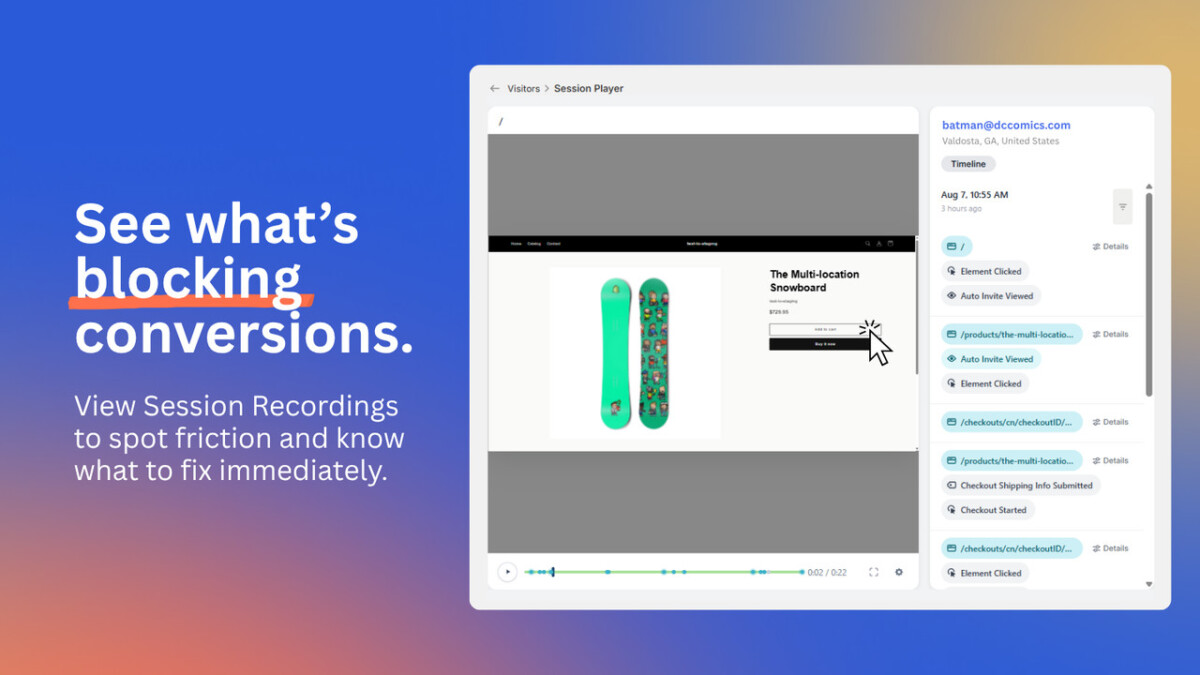
Lucky Orange is a Shopify session recording and heatmap app for stores with enough traffic to see a pattern in how shoppers fail to check out.
Lucky Orange records sessions, builds click and scroll heatmaps, and surfaces behaviour on product, cart and campaign pages. The BFCM use is diagnostic. If visitors repeatedly tap a sale badge that is not a link, or never find the size selector because it sits below a banner you added on Tuesday, that shows up in replays within hours and nowhere in your analytics. The distinction worth holding is that Lucky Orange tells you what happened, not why. Its Shopify App Store listing carried a 4.7 star rating from 889 reviews on October 11, 2026.
As of October 11, 2026, the free plan covers 100 sessions per month with 30 days of data storage. Launch is $19 per month for 500 sessions, Build is $39 per month for 3,500 sessions with 60 day storage, and Grow is $89 per month for 10,000 sessions. A Discovery AI add on runs from $5 to $20 per month depending on plan.
The strength is speed of diagnosis during the only four days of the year when a broken mobile interaction is expensive by the hour. Watching ten replays of abandoned mobile carts on Friday morning beats waiting for Monday’s funnel report, and it points at design fixes rather than discount depth.
Two limitations. Session allowances are consumed fastest exactly when traffic spikes, so a store on the 500 session Launch plan can burn its month in one Black Friday morning and lose visibility for the rest of the weekend. The second is privacy, because session recording captures what a visitor does on your site, so consent settings and checkout field masking need checking before the script goes live. There is also a free alternative worth weighing: Microsoft Clarity offers session recordings and heatmaps with no traffic limit at no cost, which undercuts the session allowance argument for stores that do not need Lucky Orange’s Shopify specific integration.
Best fit for Shopify stores above roughly $500K in annual revenue, or any store running meaningful paid traffic into a campaign page, where someone will actually watch the replays. Skip it if you already run comparable behaviour analytics, or if nobody on the team has time to review sessions during the sale, in which case you are paying to generate evidence no one reads.
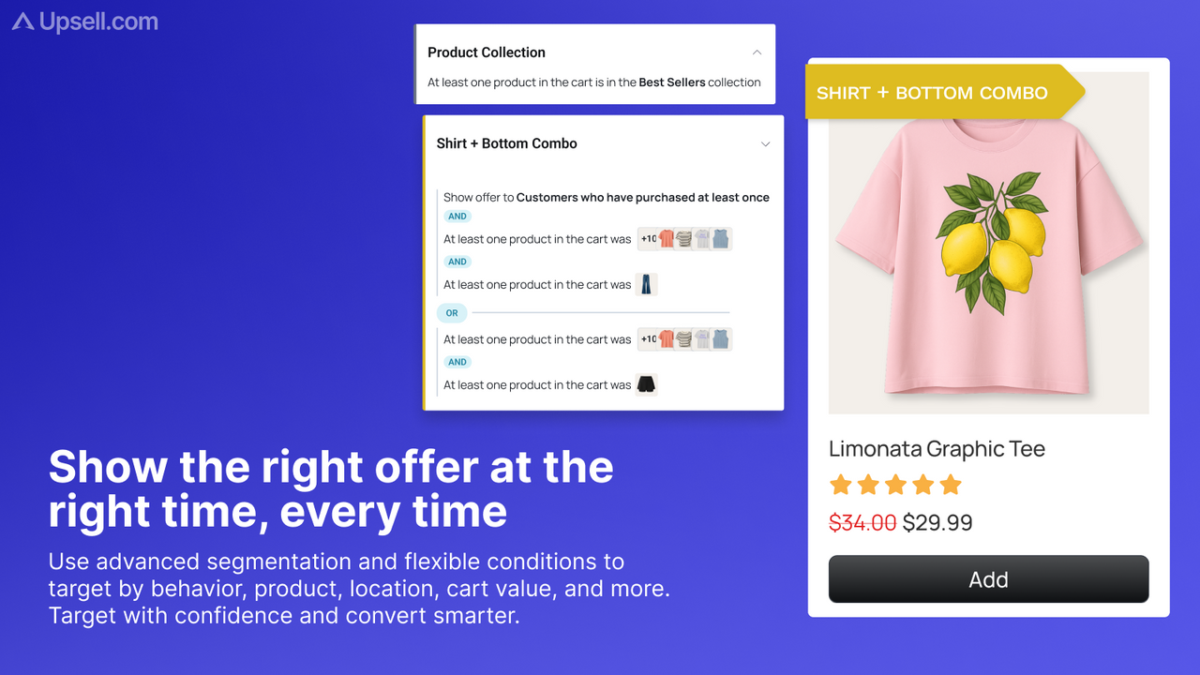
ReConvert is a Shopify upsell app for merchants who want offer placements across the product page, cart and post purchase page at a lower entry price than a dedicated post purchase suite.
ReConvert, published by Upsell.com, supports targeted product recommendations and offers at several points in the journey, with rules, analytics and testing. For a gift focused store in December the relevant add ons are small and obvious: gift wrapping, a compatible accessory, a replenishment item. The judgement call is placement, because an offer that interrupts a shopper mid checkout costs more than it earns, while the same offer after payment costs nothing to decline. ReConvert gives you both options. Its Shopify App Store listing carried a 4.8 star rating from 3,105 reviews on October 11, 2026.
As of October 11, 2026, the free plan covers up to 50 orders or $50 of upsell revenue. Growth 51-100 is $9.99 per month, Growth 101-200 is $19.99 per month, and Growth 201-500 is $39.99 per month, each with a 14 day free trial. Note that the listing’s own meta description advertises a 5 star rating from more than 4,000 reviews, which does not match the 4.8 from 3,105 reviews shown on the page itself, so take the visible figures.
The first strength is the entry price, because at $9.99 per month for the 51 to 100 order tier a store can test whether upsells work on its catalogue before committing to a larger package. The second is placement breadth, which suits a store that does not yet know where its add on offers land best.
Two limitations. The order tiers are tight, and a store taking 400 orders over BFCM is on the $39.99 tier rather than the $9.99 one, which is worth modelling before you pick a plan. The second limitation is overlap. If your cart drawer or checkout extension already presents add ons, running ReConvert as well gives the shopper two interruptions and you two sets of attribution to reconcile. Shopify also permits only one active post purchase checkout app at a time, so if something already occupies that slot, installing ReConvert means switching the other one off, which is not a change to make in the final week before a sale.
Best fit for Shopify stores between roughly $50K and $500K in annual revenue testing upsells for the first time, where the monthly order count sits inside a lower tier and the add on products are already in stock. Skip it if another provider already holds your post purchase slot, or if your cart already surfaces add ons, because the second tool adds friction rather than revenue.
Start from the weakest stage of your own customer journey, not from the top of this list. The grid below maps one measured problem to one app, with the condition that disqualifies it.
The right number of BFCM apps is the smallest number that covers your measured weak points, which for most stores at most stages is one or two rather than eight. Where that lands depends on which stage you are operating at.
A new or small store, under roughly $50K a year, should keep the stack close to native. Shopify’s own discounts and email tools handle a straightforward sale, Judge.me’s free tier covers social proof if you have reviews to show, and the free Shopify Bundles app handles a fixed kit. Add a paid offer engine like Fast Bundle only when the promotion genuinely needs mix and match, BOGO and gifts with purchase at once, which is a real requirement and not a common one at this stage. The trade off is honest: you will leave some basket value on the table, and at this volume that amount is smaller than the cost of a configuration mistake during your busiest weekend.
A growing DTC store between roughly $50K and $2M has the budget to run a shortlist and the exposure to be hurt by running ten. The pattern that holds up is one offer engine, one lifecycle messaging tool, one review tool, and a loyalty tool only where repeat purchase is already visible in the data: something like Fast Bundle, Klaviyo, Judge.me and YOYO, as a shortlist rather than a package. The common failure at this stage is not under investment in tooling, it is premature complexity, meaning too many apps, channels and tactics layered on before the fundamentals are stable.
A higher volume holiday operation above roughly $2M should weight the stack toward operations rather than conversion. Support coverage through Gorgias and diagnostics through Lucky Orange usually protect more revenue over four days than another upsell widget adds, and if your catalogue sells out of individual variants, a restock waitlist app is worth adding even though none made this list.
Across all three, two constraints are not negotiable. Shopify permits one active post purchase app, so ReConvert is a choice against whatever already occupies that slot rather than an addition to it. And an app installed inside the final week before BFCM, without the macros, flows or test orders behind it, is a liability wearing the costume of a solution.
Protect margin by testing your discount combinations before launch and judging every offer against contribution profit per order rather than revenue. More Black Friday revenue does not automatically mean more profit, and the gap between the two is where most BFCM post mortems end up. A store can lift average order value and still lose money through stacked discounts, shipping costs and expensive acquisition. The apps above help build a better offer. Whether that offer makes money depends on how it is configured and measured.
Start with unintentional discount stacking. Combining bundles, BOGO, gifts with purchase and discount codes makes a promotion attractive, and it also makes it possible for a shopper to assemble a saving you never intended to give. Shopify’s rules on combining discounts are specific and worth reading rather than assuming: product discounts combine with free shipping for every merchant, product with order discounts only for eligible merchants, multiple product discounts on the same line item only on Shopify Plus, and multiple shipping discounts never. A single order can carry up to 25 active automatic discounts including app based ones, and a customer up to five product or order discount codes plus one shipping code. Test the specific cart combinations you expect, not a representative one.
Then calculate what a promotion actually costs. A discount has to be judged against the full cost of fulfilling the order, not against the product’s list price. The figures below are an illustration, not an observed outcome, and they assume a $100 product at a 42 percent product cost, $8 of shipping and fulfillment, $3 of payment processing and $12 of customer acquisition.
On those assumptions the order generates $75 of revenue and keeps $10 of contribution profit before overhead and app subscriptions. Change the acquisition cost by $5 and half the profit is gone. That is the arithmetic that should decide whether an app earns its subscription, and it also argues for raising order value through bundles and relevant add ons rather than cutting price further. Track contribution profit per order alongside average order value, conversion rate and offer acceptance rate, and for the full version of this exercise we walk through how to plan a profitable BFCM promotion backward from target profit per order.
Test the cart combinations, the checkout journey and the messages, in that order, on a real device with a real payment. Every app on this list fails in a way that only shows up in a complete transaction, which is why reading configuration screens is not testing.
Discount combinations come first because they are the most expensive failure. Build the bundle, apply a code, add the loyalty reward and the free shipping threshold, and confirm that two offers do not stack into a saving you did not authorise. Then walk a real checkout on mobile and desktop, verifying prices, taxes, shipping, inventory, order confirmation and tracking, plus the accept and decline paths on any post purchase offer. While you are in checkout settings, confirm which single post purchase app is selected, because the wrong one being active is a silent failure.
Message timing is next. Send yourself the abandoned checkout flow, the early access campaign and the loyalty email from realistic test accounts, and check expiry times, discount links, suppression rules and unsubscribe behaviour. Then look at the storefront as a stranger would, confirming that banners, review widgets, forms and popups are not hiding the add to cart button or slowing the mobile page.
Finally, prepare the operational side. Write your shipping, returns and discount policy answers before the queue arrives, confirm that bundles and upsells create orders your fulfillment process can actually pick, and set the monitoring you will watch during the sale: contribution margin, conversion rate, average order value, units per order and incremental revenue per eligible offer. For a day by day version of this work, our fifteen day BFCM triage plan sorts the tasks by how long each one takes.
There is no best Shopify app for Black Friday, which is why this list is not ranked. The eight apps above each earn a place in their category, and each one is the wrong choice for some store reading this. Fast Bundle is the wrong answer for a merchant who needs one fixed kit. Klaviyo is the wrong answer for a list of two hundred contacts. Gorgias is the wrong answer for a store whose inbox is keeping up. The skip conditions in each entry are not hedging, they are the most useful sentences in the piece.
What holds across every stage is the order of operations. Measure the bottleneck, then pick the tool, then test the tool with a real transaction before the traffic arrives. The stores that have a bad BFCM rarely lack software. They usually added it in the last ten days, pointed it at a problem they had not confirmed, and found out on Friday morning which discounts stacked. If you are still deciding, the stage guidance above is the place to start, and the honest answer may be that your current stack is already enough.
There is no single best Shopify app for Black Friday and Cyber Monday, because the right app depends entirely on which stage of your funnel is leaking. A store with strong traffic but weak offer economics gets more from a bundling app like Fast Bundle. A store losing sales to unanswered delivery questions needs support capacity, which is what Gorgias provides. A store whose first time visitors do not trust the product copy needs reviews, which Judge.me handles on a free plan. The useful question is not which app is best, it is which bottleneck you have actually measured in the last ninety days. Pick the app that fixes that one, and leave the rest until January.
Entry level BFCM apps cost between nothing and about $25 per month as of October 11, 2026, but the entry price is rarely the price you end up paying. Free tiers exist on Judge.me, on Klaviyo up to 250 contacts, on Lucky Orange up to 100 sessions, on PageFly for one published page, on ReConvert up to 50 orders and on YOYO up to $500 of app generated revenue. Paid entry plans run from $9 per month for YOYO Essential and $9.99 for ReConvert, through $15 for Judge.me Awesome, $19 for Fast Bundle and Lucky Orange, $20 for Klaviyo email and $24 for PageFly. Gorgias starts at $10 with 50 tickets and $0.40 per additional ticket. Every one of those plans has a volume ceiling that a busy BFCM weekend can cross.
Move to a paid app when a free tool has a named limitation that is already costing you money, not when the calendar says November. Concretely, move off Shopify’s native Bundles app when your promotion needs more than a fixed kit or a multipack, because that is all it handles. Move off a single list wide email send when your list is large enough that segments behave differently from each other. Move off Shopify Inbox when support volume exceeds what your team can answer inside a day. Each of those is a measurable trigger. Installing a paid app before the trigger fires means paying for capability you cannot yet use and configuring it during your busiest week of the year.
No, Shopify allows only one app to add post purchase features at a time. If several post purchase apps are installed, you choose which one is active in Settings and then Checkout in the Shopify admin, in the post purchase page section, and that section only appears once the app’s own settings have been configured. In practice this means installing ReConvert for post purchase offers requires switching off whatever already holds that slot, and that is a configuration change to make and test well before BFCM rather than during it. A store that installs a second post purchase app assuming both will fire ends up with one working offer and one silent app it is still paying for.
Fast Bundle handles bundles, mix and match, BOGO and gifts with purchase in a single app, which is what makes it practical when a BFCM promotion needs more than one offer format running at once. As of October 11, 2026 its paid plans start at $19 per month covering up to $1,000 of monthly bundle sales, tiered upward by bundle revenue rather than by store revenue. Check Shopify’s own free Bundles app first if all you need is a fixed kit or a multipack at a fixed price, because that is what it does and it costs nothing. Be aware before you do that the native app carried a 2.9 star rating from 568 reviews on October 11, 2026, with recurring complaints about variant option limits, which is usually the reason merchants move to a paid alternative.
YOYO is the loyalty option on this list for turning November buyers into December repeat customers, through points, cashback, store credit, referrals and VIP tiers, starting at $9 per month as of October 11, 2026 after a free tier capped at $500 of app generated revenue. Klaviyo complements that with segmented follow up email and SMS to the people who bought over the weekend. Both only work if your products have a natural reorder cycle and your reward economics survive redemption in the first quarter. If repeat purchase is not already visible in your data, a well written follow up email sequence does more for nothing, and the larger loyalty platforms such as Smile.io are worth evaluating at higher volumes.




