

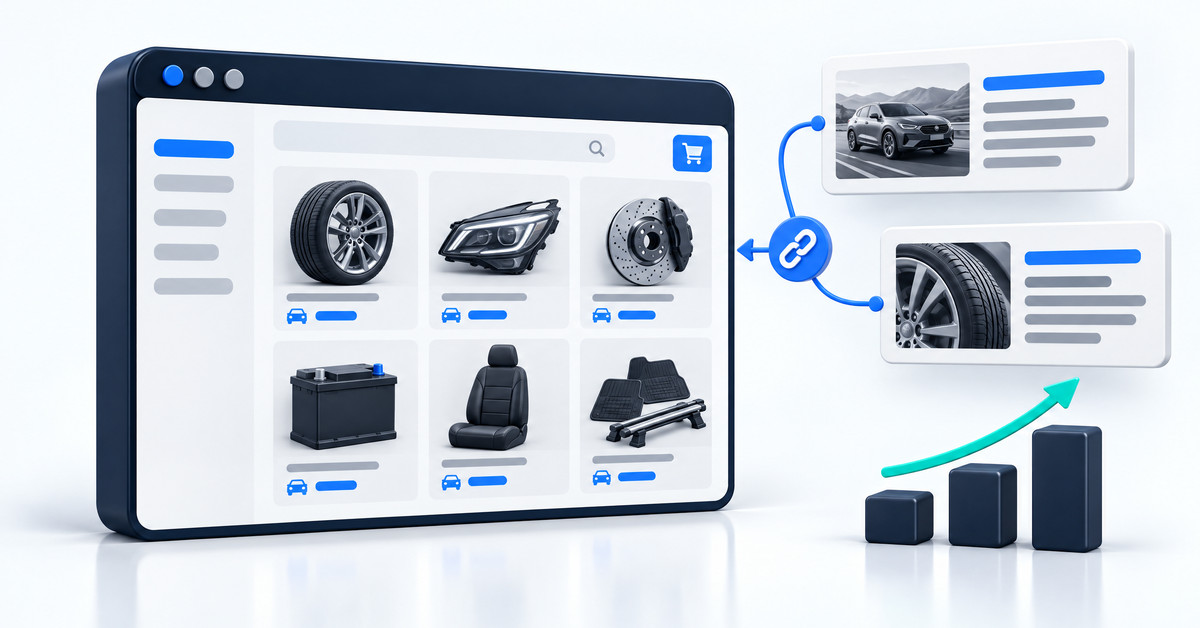
Of the ten agencies below, four publish automotive fitment capability and three name automotive clients. For a brand leaving BigCommerce, that split matters more than agency size, because migrating fitment data is the part of the project a generalist has not done before.
Six of these ten agencies have never published a single piece of automotive fitment work. That is not disqualifying. It is the first question on your discovery call.
A seat bracket that fits a 2015 Mustang does not fit a 2015 Camaro, and a customer who discovers that after delivery becomes a return, a chargeback, and a one star review. That single constraint is why an automotive replatform is a different project from a replatform for an apparel brand with 400 SKUs and no compatibility logic. The catalog can be large or small. What makes the work hard is that every product carries a relationship to a list of vehicles, and that relationship has to survive the move intact.
Call that the fitment gap: the distance between an agency that has moved vehicle compatibility data before and an agency that will meet it for the first time on your catalog. Of the ten agencies below, four publish automotive fitment capability on their own sites and six do not. They are listed alphabetically rather than ranked, and no position on this list implies a recommendation.
This is written for automotive and powersports brands currently on BigCommerce, typically between $2M and $25M in annual revenue, with a parts catalog and often a dealer or installer channel running alongside direct consumer sales. If you are still deciding whether to leave BigCommerce at all, how BigCommerce and Shopify Plus actually compare is the more useful starting point, and it is fair about what BigCommerce still does well for complex catalogs. If the decision is already made and you are building a shortlist, the methodology below explains what was checked, and the comparison grid shows where each agency’s published evidence actually sits.
Every agency below was assessed against four criteria, applied identically to all ten. First, whether it publishes a BigCommerce to Shopify or Shopify Plus migration service on its own site. Second, whether it publishes automotive work, and at what level of proof: named clients, described capability, or none. Third, whether it publishes a B2B or wholesale service line, since most automotive brands sell to dealers and installers as well as consumers. Fourth, whether it publishes pricing or an engagement model. Each agency’s own pages were read in October 2026, with its Shopify Partner directory listing where one exists.
This shortlist combines agencies with documented automotive capability and agencies offering broader BigCommerce to Shopify migration services. The fits suggested here are editorial assessments of published work and services, not a claim that every agency has completed the same type of automotive migration. Automotive platform specialists such as RevolutionParts and Web Shop Manager were considered and excluded, because they are platform vendors rather than Shopify migration partners: an alternative to this move rather than a way to execute it. Why published vertical work is weighted this heavily is set out in why vertical experience separates good partners from generalists.
Four of these ten agencies publish automotive fitment capability, three name automotive clients, and two name ACES and PIES as their data foundation. The grid below is the fastest way to see where each one sits before reading the detail.
Shopify partner tiers, published capabilities, and every claim in this grid are as of October 2026, taken from each agency’s own pages and its Shopify Partner directory listing where one exists.
121eCommerce is a Cleveland, Ohio development agency that builds automotive ecommerce across Shopify, BigCommerce and Adobe Commerce, and is one of only three agencies on this list that names automotive clients publicly.
Its automotive service page names all three platforms and describes Year Make Model and part number lookup that confirms fit before the part reaches the cart, along with vehicle search, saved garage, and compatibility tables. On the B2B side it publishes account pricing applied at login, bulk and repeat ordering by part number, and terms and purchase order checkout. Its Shopify page states that it handles migrations from Magento, BigCommerce, WooCommerce and custom platforms while preserving product data, customers, orders, URLs and SEO value. The strongest thing on its automotive page is the client list: The Universal Group, Dealer Market, Riva Racing, Cognito Motorsports and First Gear, spanning performance and powersports on one side and dealer distribution on the other. SEO, paid media and conversion work are in house alongside development.
As of October 2026, 121eCommerce publishes no pricing and no engagement minimum on its homepage, Shopify page, automotive page or migration page.
Three things stand out. The named automotive roster is unusually specific for an agency of its size, and every brand on it is reference checkable. It was BigCommerce Partner of the Year in 2023, which is genuinely useful on the source side of this project, because getting clean, complete data out of BigCommerce is half the work. And because marketing sits in house, post migration traffic recovery does not require bringing in a second vendor at the worst possible moment.
Two limitations matter. 121eCommerce publishes no Shopify Partner or Shopify Plus Partner designation anywhere on its site, and has no Shopify Partner directory listing, while its decorated partnerships are Adobe Commerce Solution Partner and BigCommerce Elite Partner. That may make it an honest second opinion on whether to leave BigCommerce at all, or a reluctant advocate for the move, and it is worth asking directly. Second, team size is undisclosed and published hours are Monday to Friday, 9 to 5 Eastern, so cutover weekend coverage and bench depth are questions to settle before contracting.
Best fit: automotive brands that want the platform decision examined rather than assumed, and that value named automotive work over partner tier.
Skip if: you need a Shopify first partner with a published Plus tier, or you need documented out of hours cutover coverage.
Absolute Web is a Miami based agency founded in 1999, with 85 plus staff and Shopify Platinum status, whose flagship BigCommerce to Shopify project consolidated two storefronts and integrated an Acumatica ERP.
That project is LifeSync, and its published objectives were to replatform from BigCommerce to Shopify, merge two separate stores into one unified site, and integrate with Acumatica for real time sync. The stated outcome is automated inventory and order sync across systems. Naming the ERP matters: Acumatica is a specific, mid market, checkable reference rather than a generic integration claim. One clarification the case study itself omits and an automotive reader should have, though: LifeSync is a medical device company making ECG cables, leadwires and electrodes. It is not automotive, and nothing about this project involved vehicle compatibility data. Absolute Web also publishes a dedicated B2B ecommerce service line, custom development, and Klaviyo Elite Master status, alongside Adobe Commerce and BigCommerce partnerships.
As of October 2026, Absolute Web publishes no pricing and no engagement minimum.
Three strengths are worth weighing. An ERP integration delivered in production and named on the page is more useful than a logo wall. Klaviyo Elite Master is the top tier of that partnership, which means retention and lifecycle work is in house rather than referred out after launch. And the B2B service line is a published practice rather than a feature list, which is relevant if dealers will buy through the new store.
Two limitations are significant for this particular brief. Absolute Web publishes no automotive industry page, no named automotive clients, and no fitment, Year Make Model, or ACES and PIES capability, which is precisely where an automotive migration carries its technical risk. And after 26 years across Adobe Commerce, BigCommerce, WooCommerce and a sizeable marketing arm, Shopify Plus engineering is one practice among several rather than the centre of the business.
Best fit: brands consolidating two or more storefronts into a single Shopify Plus store with a mid market ERP in the loop, where the integration is the hard part and fitment is simple.
Skip if: compatibility data is the centre of your brief and you need to see fitment shipped before you sign.
Eastside Co is a 70 plus person Shopify Platinum agency founded in 2012, with offices in London, Birmingham, New York, Hamburg and Dubai, and the thinnest published BigCommerce evidence of any agency here that claims it.
Its migration page states that it has replatformed brands from Magento, WordPress, WooCommerce, BigCommerce and more, and its service pages cover Shopify web design and development from themes through bespoke Plus builds. Delivery is stated as policy rather than preference: a full service, in house agency with no freelancers and no outsourcing, including an in house Shopify app development practice. It sells named priority support packages after launch rather than ad hoc hours, and it was among the first three UK agencies accredited as a Shopify Plus Partner, which is a real longevity signal. Eastside Co’s about page names no clients at all, which makes independent verification harder than it should be.
As of October 2026, Eastside Co publishes no pricing and no engagement minimum on its migration or about pages.
Three strengths stand out. The in house only delivery policy, extended to app development, means the people scoping the work are the people building it. The New York office distinguishes Eastside Co from the other non US agencies on this list for a US brand that wants overlapping hours. And productized support packages make the post launch relationship a known cost rather than a negotiation at the point you most need help.
Two limitations are material. BigCommerce appears only as one item in an “and more” list: there is no dedicated BigCommerce to Shopify practice page, no BigCommerce case study, and no published extraction methodology for getting data out of it. Second, Eastside Co publishes no automotive work, no named automotive clients, no wholesale or B2B service line, and no fitment capability, which means both of the things an automotive parts brand most needs are absent from what it publishes.
Best fit: brands treating the move as a storefront redesign as much as a data migration, where navigation, page templates and front end quality carry most of the budget.
Skip if: your catalog is fitment driven, or your dealers and installers buy through the site.
Fyresite is a Tempe, Arizona agency and Shopify Premier partner with the only documented automotive BigCommerce to Shopify Plus migration among these ten.
That project is Corbeau, the racing seat manufacturer, which Fyresite describes as having outgrown a BigCommerce store that was slow, hard to maintain, and holding back expansion plans, before moving to Shopify Plus on a custom theme. The fitment tool is built entirely on product metafields holding make, model, and a comma separated list of years, matching a vehicle to the correct seat bracket. Options, add ons, pricing and fitment all run off the same metafield layer, so cart totals and financing estimates recalculate live. The seat builder lets shoppers add compatible heaters, brackets, lumbar support and belts, each written to the cart as its own line item property rather than as a variant, which is how a configurable product avoids variant explosion. On the ERP side, the published detail is narrower than it is sometimes repeated: Fyresite built a base custom Shopify app scoped to exactly the permissions the client’s ERP team required, and that team’s own integration syncs orders and inventory. Fyresite names six automotive and powersports clients in total, and publishes a separate Shopify B2B offering covering custom catalogs, pricing tiers, payment terms and account controls. If metafields are new to you, Shopify’s own documentation explains how metafields extend the platform data model for exactly this kind of custom attribute.
As of October 2026, Fyresite’s project enquiry form offers budget bands running from $30,000 upward to $120,000 plus, and its Shopify Partner directory listing shows a starting figure of $1,800 for ongoing website management rather than for a migration. Its B2B page states project timelines of one to four months, varying with feature complexity, integration count and data migration requirements.
Three strengths are specific and checkable. Fyresite is the only agency here with a documented automotive BigCommerce to Shopify Plus migration. The line item property approach to add ons is a real engineering decision with a real consequence for catalog manageability. And Parts Intelligence is a productized, branded fitment offering rather than ad hoc project work, which usually means the second client benefits from what the first one paid to learn.
Two limitations deserve a direct conversation. Fyresite’s about page lists 13 named people and self describes the team as small but mighty, which sits against agencies of 70 to 600 people elsewhere on this list, so key person concentration is a fair question for a large catalog or a multi site program. Second, the fitment approach is hand rolled on metafields with a comma separated year list rather than built on the ACES and PIES industry standards. That is entirely sound at Corbeau’s catalog size, and it is the kind of design that gets brittle across tens of thousands of SKUs fed by supplier data. Worth noting too that Fyresite’s automotive page lists Drupal, Magento and WooCommerce as its migration sources; the BigCommerce evidence comes from the Corbeau material specifically.
Best fit: automotive brands whose hardest requirement is configurable products and vehicle fitment on a catalog in the hundreds to low thousands of SKUs, built and maintained in house.
Skip if: your catalog runs to tens of thousands of SKUs arriving as ACES and PIES feeds from suppliers, or your program needs a large bench and multi site coordination.
IWD Agency is an Austin, Texas agency that publishes the most technically precise automotive capability of anyone on this list and names no automotive clients at all.
Its automotive page covers Year Make Model fitment, ACES and PIES data, VIN lookup, cross reference and core charges, and states that it supports both platform native fitment apps and custom fitment layers. Core charges in particular is the sort of detail only a team that has actually shipped auto parts commerce thinks to document. On the trade side it describes running the trade and retail audiences on one store, with net terms, tiered and contract pricing, fast reorder and account hierarchies for repair shops, jobbers and dealers, and separate pricing and catalog visibility applied at login. Its Shopify migration page covers moves from Magento, WooCommerce, BigCommerce or Salesforce, carrying products, variants, collections, media and metafields, customer accounts and full order history, CMS content, and the URL structure with mapped 301s, canonical tags, preserved metadata and migrated structured data. IWD Agency is a Shopify Plus partner without a published tier, and is also a BigCommerce Elite Partner with its own page for migrating to BigCommerce, with 17 plus years of Adobe Commerce work behind it and delivery across Austin, Barcelona, Warsaw and São Paulo.
As of October 2026, IWD Agency publishes no rates and no minimums, stating instead that every project is scoped to platform, integrations and catalog size, with a firm itemized quote on the first call.
Three things are worth noting. The published scope includes part interchange and core charges, which is the vocabulary of someone who has handled real parts data. Running trade and retail from one store with pricing applied at login is architecturally cleaner than maintaining two storefronts, and it is published as the default rather than offered as an option. And there is a dedicated NetSuite and ERP integration practice behind it.
Two limitations matter. IWD Agency names zero automotive clients, and the case studies it surfaces are not automotive, so the capability here is described in detail rather than evidenced by brands you can call. Second, Shopify is one of four or five practices rather than the house platform, with Magento heritage and an active BigCommerce Elite partnership, and team size is undisclosed. That mix cuts both ways: it is the profile of a shop that might honestly tell you to stay where you are, and it is not the profile of a Shopify native specialist.
Best fit: brands that want the current BigCommerce store’s custom behaviour examined before the target architecture is agreed, particularly where ACES and PIES feeds and trade pricing both have to work.
Skip if: you need to see automotive work shipped under a named brand before an agency reaches your shortlist.
Netalico is a US based Shopify Plus Premier partner, a Shopify partner since 2016, and the only agency on this list that publishes actual price bands for a BigCommerce to Shopify migration.
It publishes a dedicated BigCommerce to Shopify migration page rather than a line item, alongside a BigCommerce developer page and a general Shopify migration services page. Services run from UX strategy and development through theme customization, integration rebuilds, conversion work, technical SEO, site speed audits and ADA compliance review. Named clients include Big Green Egg, Oatly, Feetures, The Country Butcher, Shop QEP and Mijenta Tequila. The team is stated as US based and in house with no outsourcing, and Klaviyo and Gorgias are named integration partners. Netalico sells retainers and pre paid packages for the ongoing relationship rather than treating launch as the end of the engagement.
As of October 2026, Netalico publishes three bands on its BigCommerce to Shopify migration page: $15,000 to $30,000 over 8 to 12 weeks for a catalog and theme port, $30,000 to $60,000 over 12 to 18 weeks for a mid market migration with a custom theme, light B2B and ERP work, and $75,000 to $150,000 plus over 16 to 24 weeks for an enterprise Shopify Plus rebuild with B2B, multi store and custom development. It states that most of its BigCommerce migrations land in the mid market tier, offers fixed price scoping so the total is known before the project starts, and includes a two to three week post launch monitoring period for bug fixes at no extra cost.
Three strengths follow from that transparency. Published bands plus fixed price scoping make Netalico the only usable cost anchor in this group, and useful even if you hire someone else. The included post launch monitoring window is the period when migration defects actually surface, and having it in scope rather than on the clock changes the incentive. And Big Green Egg is a high consideration consumer brand with a dealer network, which is the closest analogue on this roster to an automotive brand’s channel complexity.
Two limitations are clear. Netalico publishes no automotive clients, no automotive industry page, and no fitment or ACES and PIES capability; its published industries are beauty, food and beverage, sports and outdoors, home goods and electronics. Second, B2B appears as a set of Shopify Plus features it can configure rather than as a service line, with no named wholesale clients, and team size is undisclosed behind a six city list that reads more like a distributed team than six staffed offices.
Best fit: brands that need a defensible cost and timeline in front of an owner or board before the project is approved, and that expect a continuing relationship after launch.
Skip if: fitment and dealer purchasing are the two hardest parts of your brief.
Radiant is a Birmingham, UK agency and Shopify Premier partner that describes itself as building for ambitious, affordable luxury brands, and publishes no automotive work at all.
Its Shopify migration page carries a BigCommerce to Shopify section stating that it migrates product listings, customer data, order history and other relevant information, and that as an accredited Shopify Premier Partner it is trusted by Shopify to move brands onto the platform. Two qualifications belong next to that. On the same page, Radiant names Magento to Shopify as probably one of the most popular replatforming projects it does, which puts BigCommerce second. And the substantive BigCommerce asset on the site is a general audience blog article that walks a reader through a do it yourself migration using the third party Cart2Cart tool, which is lead generation content rather than a published migration methodology. Radiant’s Shopify directory listing names clothing and fashion, food and drink, health and beauty, and jewelry and accessories as its industries. Automotive is not among them. Its published clients include Tropic Skincare, Godiva, KAYALI, Edge of Ember and Muddy Puddles, and it supports work across the UK, US, Saudi Arabia and the UAE. One portfolio entry invites a misreading worth heading off: the Lando Norris Store is driver merchandise and apparel, not automotive parts, and it is not evidence of fitment capability.
As of October 2026, Radiant publishes no pricing or minimums, and its directory listing says to contact for pricing. The dollar figures that appear in its BigCommerce blog article are Shopify’s plan prices and Cart2Cart’s tool fees, not Radiant’s own fees.
Three genuine strengths. Radiant holds Shopify Premier tier, which on this list it shares only with Fyresite and Netalico. Its vertical specialism is clear and backed by brand name proof in beauty and affordable luxury. And its UK plus Gulf delivery footprint with stated US support is an unusual combination if your market map looks like that.
Two limitations place it honestly. Automotive is not a listed industry, and there is no automotive, fitment, or B2B wholesale capability published, which makes Radiant the weakest fit of these ten for a fitment driven parts brand. Second, BigCommerce is a secondary route whose main published asset is a do it yourself blog post, and its Shopify directory listing carries a single review, so the evidence base behind the BigCommerce claim is the thinnest in this set.
Best fit: brands in fashion, beauty or affordable luxury, which is where Radiant’s published work actually sits.
Skip if: you sell parts that have to match a vehicle.
scandiweb is a 600 plus person agency headquartered in Latvia whose automotive portfolio is original equipment brand and car buying experience rather than aftermarket parts retail.
Its Shopify migration page states plainly that a BigCommerce to Shopify migration carries SKUs, customer accounts and discount logic across while the storefront is rebuilt to convert, and names Adobe Commerce, WooCommerce, Salesforce Commerce Cloud, commercetools, Wix, Squarespace and custom builds as other sources. Products, variants, categories, customers and order history move, every URL on the current store is mapped to its new address before launch, and ERP, PIM, payment, shipping and marketing systems are reconnected. A three phase SEO audit runs at discovery, build and go live, with first month post launch monitoring, and published timelines run from four weeks to six and a half months. scandiweb self publishes Shopify Plus Partner status with 150 plus Shopify builds. The house platform, though, is Adobe Commerce: Gold Partner, Hyvä Platinum Partner, 894 plus certifications, and Magento work since the platform launched in 2008. Its automotive portfolio includes Jaguar, Land Rover and Toyota, bringing the car buying journey online, which is a genuinely hard problem and a completely different one from fitment driven parts commerce.
As of October 2026, scandiweb publishes no public rates or minimums, pricing fixed scope projects after a scoping call.
Three strengths are relevant to a large parts catalog. Named PIM partnerships with Pimcore, Akeneo and inRiver matter a great deal for parts data governance, which is usually the real constraint behind a messy catalog. The three phase SEO audit is built into the migration method rather than sold separately, which is the right place for it. And 600 plus staff across 45 countries makes genuine follow the sun cutover coverage possible.
Two limitations should be weighed. Adobe Commerce is the house platform by certification count, partner tier and history, against 150 plus Shopify builds, which an automotive brand committing to Shopify Plus should factor in. Second, scandiweb publishes no ACES and PIES, Year Make Model, or parts data capability; its automotive work is brand and car buying experience, and it should not be read as aftermarket parts credibility. With an organisation that large and distributed, insist on knowing exactly who staffs your build.
Best fit: large migration programs with several technical dependencies, a PIM in the stack, and a need for coverage across time zones.
Skip if: you want a Shopify first partner, or your brief is dominated by vehicle compatibility.
Swanky is a UK based Shopify Platinum agency with offices in the UK, Australia and France, no US office, and the longest published list of source platforms of anyone on this list.
Its migration page names BigCommerce explicitly, alongside Magento, WooCommerce, Neto, SuiteCommerce and PrestaShop, plus an enterprise list running through Salesforce Commerce Cloud, SAP Commerce Cloud, commercetools, Shopware, VTEX, OroCommerce, Sana Commerce, Spryker, Kibo and Sitecore. That list reads as a genuine replatforming specialism rather than a bolt on service. Swanky also publishes Shopify B2B content covering retailers moving into online wholesale and scaling existing B2B operations, naming Saddleback, Natural Instinct and Brio Water as wholesale brands. One honest caveat: that page reads partly as marketing content rather than a hard service page, and a B2B entry does not appear in the main services navigation, so “offers Shopify B2B services” is defensible while “has a dedicated B2B service line” is worth confirming directly. Swanky’s portfolio is heavily UK consumer, including Wilkinson Sword, Lily’s Kitchen, Symprove and Soak and Sleep. For the dealer side of an automotive brief, evaluating a platform against real B2B buying workflows is the better frame for that conversation.
As of October 2026, Swanky publishes no pricing or minimums on its migration or B2B pages.
Three strengths stand out. The published source platform list is the most enterprise weighted here, which means Swanky has likely seen stranger legacy data than yours. Three named B2B and wholesale clients are reference checkable, which is more than most agencies on this list offer for wholesale. And Shopify Platinum tier with Plus Experts accreditation runs across three countries rather than one office.
Two limitations are practical rather than theoretical. Swanky publishes no automotive industry page, no automotive clients, and no Year Make Model, fitment or parts data capability, with a portfolio sitting in UK consumer, outdoor, beauty, pet and homeware. Second, there is no US office. For a US automotive brand running a cutover weekend and then a daily operating relationship, a UK, Australia and France footprint is a constraint to plan around, not a footnote.
Best fit: brands combining a platform move with a wholesale storefront project, particularly in the UK, Europe or Australia.
Skip if: you are a US brand that needs same time zone cutover support, or fitment is central to the build.
Uncap is a Chicago agency, a Shopify Platinum partner since 2013, and one of only two agencies here that names ACES and PIES as the data foundation for its automotive work.
Its migrations page names BigCommerce explicitly among Magento, Salesforce Commerce Cloud, NetSuite, SAP and homegrown carts, with a data cutover scope covering orders, customers, SKUs, pricing and B2B hierarchies, plus URL redirect mapping and zero downtime switching, and a stated median of 14 weeks for operator led replatforms. B2B hierarchies appearing in the published migration scope is notable, because account structure is the thing that most often breaks in a wholesale replatform. Its automotive page states that storefronts are fitment first, with Year Make Model search powered by ACES and PIES, delivered through its own Uncap Garage component rather than a third party app. Named automotive clients are Kooks Headers and E3 Spark Plugs. Shopify’s own case study on Kooks Headers and Exhaust records a move from a custom built site to Shopify with Year Make Model and engine filtering through PDM Automotive, a wholesale portal with negotiated pricing and self service account management, and real time inventory sync with Infor Visual ERP. Shopify reports a 22 percent conversion rate increase and a 38 percent reduction in total cost of ownership for Kooks specifically, which is one brand’s result after one project rather than a benchmark you should plan around. Uncap’s named ERP bench runs across NetSuite, Dynamics, Acumatica, Epicor, Infor and Sage, and one published case study covers a catalog of more than a million SKUs. It was founded in 2013 as Pivofy and renamed Uncap in 2022, which is worth knowing when you chase older references.
As of October 2026, Uncap publishes a $7,500 fixed price Blueprint discovery engagement. Its automotive page references three fixed price packages but gates the amounts behind a form, and its directory listing says to contact for pricing.
Three strengths are concrete. Uncap Garage is a productized fitment component the agency owns, which means fitment is a product line rather than a bespoke build each time. The published migration scope explicitly includes B2B hierarchies. And a million SKU catalog in published work answers the scale question before you ask it.
Two limitations are worth raising on the call. Uncap is a Shopify only shop with no published Adobe Commerce or BigCommerce build practice, so it cannot give platform neutral advice on whether leaving BigCommerce is the right decision at all. Second, the automotive page that pitches the practice names no client logos and gates its package pricing, so the automotive proof lives on two separate case study pages. Two published automotive brands is real evidence and it is not a deep bench.
Best fit: automotive manufacturers and distributors whose brief centres on dealer and installer purchasing alongside direct consumer sales, with supplier ACES and PIES feeds to handle.
Skip if: you want the platform decision itself interrogated, or you need a published automotive bench deeper than two brands.
Match the agency to the hardest part of your brief rather than to its size or its partner tier. Three scenarios cover most automotive brands leaving BigCommerce.
If fitment and configurable products are the hardest part, and your catalog runs in the hundreds to low thousands of SKUs maintained in house, the four agencies with published fitment capability are the shortlist: Fyresite, Uncap, IWD Agency and 121eCommerce. Of those, Fyresite has the only documented BigCommerce to Shopify Plus automotive migration, while Uncap and IWD Agency are the two that work in the ACES and PIES industry data standards that the aftermarket actually runs on. That difference is the real trade off in this list: a metafield based fitment layer is simpler and cheaper to build and harder to feed at scale, while a standards based approach costs more up front and survives supplier data.
If dealer and installer purchasing is the hardest part, the question shifts from fitment to account structure. Uncap and IWD Agency both publish trade and retail running from one store with pricing applied at login, which is architecturally cleaner than two storefronts. Shopify documents the underlying mechanics: B2B customers are set up as companies, with pricing, currency, products and payment terms personalised per account. Swanky and Absolute Web both publish B2B practices with named wholesale clients, though neither publishes fitment work.
If the catalog is enormous or the systems around it are the real problem, size and governance start to matter more than vertical experience. scandiweb’s PIM partnerships and 600 person bench suit a program with several dependencies, and Absolute Web has a named ERP integration in production. Netalico is the agency to talk to when you need a credible number before approval, because it is the only one here publishing bands.
One objection deserves a direct answer. You may be told that fitment is an app problem rather than an agency problem: buy PDM Automotive or a comparable fitment app and any competent Shopify agency can wire it up. That is half true. The app handles lookup once the data is clean and correctly shaped. The project risk sits upstream, in getting compatibility data out of BigCommerce, where it typically lives in custom fields, option sets, or a bolt on tool, and into whatever structure the app or your metafields require, without losing the exceptions. That mapping is agency work, and it is the part a generalist has not done before.
Give every shortlisted agency the same evidence, so their proposals can be compared on scope rather than on how optimistic each sales team feels. That means representative products covering both simple and complex compatibility, examples of configurable products, kits and required accessories, your customer types and their purchasing requirements, the systems that own stock, product information and pricing, your highest value existing URLs, and a launch plan covering testing, staff training and support. Then ask each agency to explain how it will test one complete order, from vehicle selection through to fulfillment. The questions worth asking any migration partner before you sign go further on scope of work, dry runs and rollback.
Make search a named deliverable rather than an assumption. A fitment driven parts catalog can carry thousands of URLs, and Google’s own guidance on moving a site with URL changes is explicit about what that requires: server side permanent redirects where technically possible, each new URL carrying a self referencing canonical tag, internal links updated to the new URLs rather than left to redirect, and a new sitemap submitted in Search Console. Google also sets the expectation plainly, noting that for medium sized websites it can take a few weeks or more before the new URLs replace the old ones, and longer for larger sites, with visibility fluctuating temporarily during the move. Build that window into your forecast rather than treating week three as evidence of failure. Protecting organic rankings through the cutover covers the redirect mapping discipline in more depth, including why many to one redirects scatter the authority you spent years earning.
One more question worth asking every agency on your list: which requirements will be met with native Shopify functionality, which with a specialist app, and which with custom development. Sorting the brief into features to retain, processes to redesign and functionality that is no longer needed is how brands avoid paying to rebuild a workaround they inherited from a platform they are leaving. The fitment and catalog architecture an automotive store depends on is a useful reference for what belongs in which bucket.
There is no single best Shopify Plus migration agency for automotive brands, which is why this list is unranked and alphabetical. All ten publish real BigCommerce to Shopify migration capability, and that is the entry requirement rather than the differentiator. The differentiator is the fitment gap. Four of these agencies publish automotive fitment work, three name automotive clients, and two work in the ACES and PIES standards that aftermarket supplier data arrives in. The other six are capable migration partners that would be meeting vehicle compatibility data for the first time on your catalog, which is a cost and a risk rather than an automatic disqualification, and one you should price into the proposal rather than discover in week nine.
If you take one thing from this list into your first discovery call, make it this question: show me compatibility data you have already moved, and tell me where it broke. The answer, or the absence of one, will narrow your shortlist faster than any comparison grid.
There is no single best agency, because the right choice depends on whether fitment, dealer purchasing, or system integration is the hardest part of your project. Of the ten agencies assessed here in October 2026, four publish automotive fitment capability: Fyresite, Uncap, IWD Agency and 121eCommerce. Fyresite has the only documented BigCommerce to Shopify Plus automotive migration. Uncap and IWD Agency are the two that work in the ACES and PIES industry data standards. If your constraint is cost certainty rather than fitment, Netalico publishes price bands that none of the others do. The Which Agency Fits Which Automotive Brand section above maps the common scenarios to specific agencies.
Only one of these ten agencies publishes figures, and as of October 2026 Netalico’s bands run from $15,000 to $30,000 over 8 to 12 weeks for a catalog and theme port, $30,000 to $60,000 over 12 to 18 weeks for a mid market migration with a custom theme, light B2B and ERP work, and $75,000 to $150,000 plus over 16 to 24 weeks for an enterprise Shopify Plus rebuild. Netalico states most of its BigCommerce migrations land in the middle tier. Fyresite’s enquiry form offers budget bands from $30,000 upward, and Uncap publishes a $7,500 fixed price discovery engagement. The remaining seven publish nothing, quoting after a scoping call instead.
The difference is architectural: Fyresite builds fitment on Shopify product metafields, while Uncap builds on the ACES and PIES industry data standards. Fyresite’s Corbeau fitment tool runs entirely on product metafields holding make, model and a comma separated list of years, which is simpler and cheaper to build and gets harder to maintain as a catalog grows into supplier fed volumes. Uncap’s automotive storefronts are fitment first with Year Make Model search powered by ACES and PIES through its own Uncap Garage component, which costs more up front and absorbs supplier data more comfortably. Catalog size and where your fitment data comes from should decide which approach fits.
Of the ten agencies assessed here, only Uncap and IWD Agency name the ACES and PIES standards in their published automotive capability. ACES is the aftermarket industry standard for managing and communicating product fitment data, and PIES is the equivalent standard for product information, both maintained by the Auto Care Association as machine readable XML specific to the automotive industry. If your supplier data arrives in those formats, an agency that has not worked with them will be learning on your catalog. The other two agencies with published fitment work, Fyresite and 121eCommerce, describe Year Make Model capability without naming the standards.
A fitment app handles lookup, but it does not handle the data mapping that makes lookup possible, and that mapping is where the project risk sits. Apps such as PDM Automotive, named in Shopify’s own Kooks case study, provide Year Make Model and engine filtering once compatibility data is clean and correctly structured. Getting that data out of BigCommerce, where it commonly lives in custom fields, option sets or a bolt on tool, and into the structure the app or your metafields require, without losing the exceptions, is agency work. A generalist agency can do it, and should price the learning curve into the proposal rather than absorbing it mid project.
Expect temporary fluctuation rather than permanent loss, provided redirect mapping is treated as a named deliverable. Google’s documentation on moving a site with URL changes recommends server side permanent redirects such as 301 and 308, a self referencing canonical tag on every new URL, internal links updated to the new URLs rather than left to redirect, and a new sitemap submitted in Search Console. Google states that for medium sized websites it can take a few weeks or more for the new URLs to replace the old ones, and longer for larger sites, with visibility fluctuating temporarily during the move. For a parts catalog with thousands of fitment driven URLs, insist on a one to one redirect map rather than a many to one fallback.




