

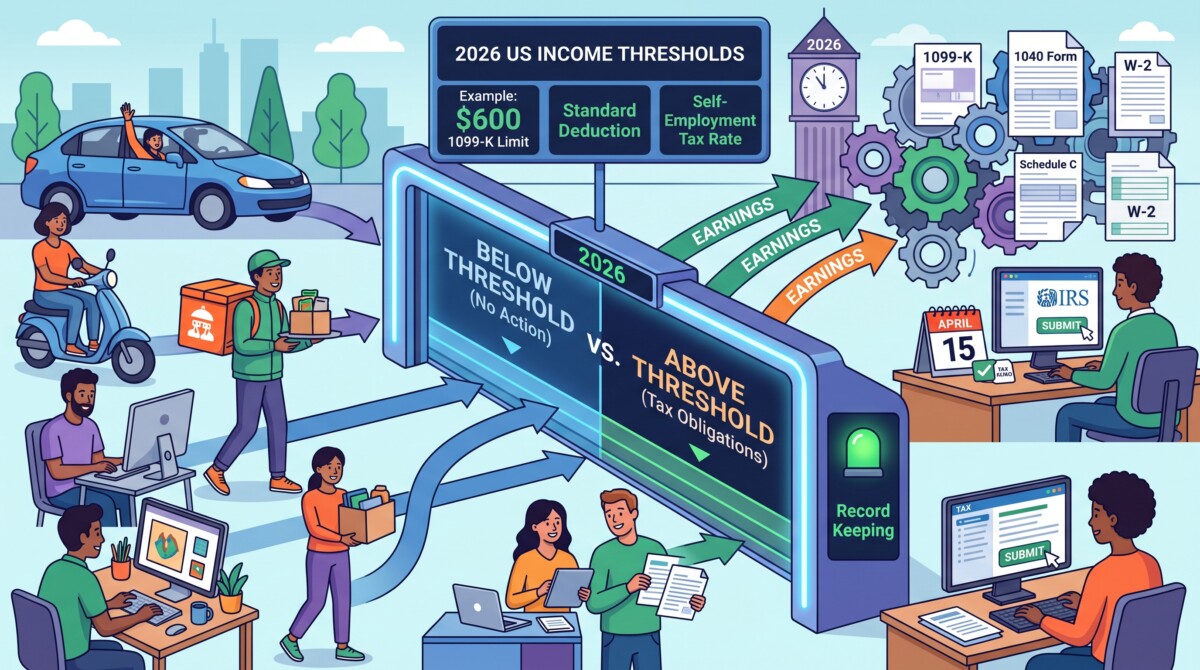
In the United States, side hustle income is taxable from the first dollar, whether or not a form arrives. The 2026 federal 1099-K threshold is over $20,000 and over 200 transactions, but self-employment tax starts at just $400 in net earnings.
The reporting threshold and your tax obligation are two different numbers. Almost everyone conflates them, and the gap between them is exactly where first year side hustlers get hurt.
On September 15, 2026, the third quarter estimated tax payment is due. Somewhere in the range of tens of millions of Americans have side income this year. A large share of them will send nothing on that date, not because they are cheating, but because they are waiting for a form that is never going to arrive.
That is the whole problem in one sentence. The rules that decide whether a platform mails you a piece of paper and the rules that decide what you owe the IRS are two completely different sets of rules. They were never the same rules. But four years of shifting 1099-K headlines taught an entire generation of side hustlers to treat the form as the trigger, and that lesson is expensive.
A quick note on where I sit. I run my business north of the border, and I do not file a US return. That is precisely why every figure in this piece is sourced to the IRS directly rather than to what the internet repeats, including a number I got wrong on this site myself. I am not a CPA and this is not tax advice. It is the map, so you know which questions to bring to someone who can sign your return.
Yes. In the United States, every dollar of profit from a side hustle is reportable on your federal return, whether a platform sends you a form or not. The obligation attaches to the income itself, not to the paperwork. Gross income under the tax code means income from whatever source it comes from, and a form is simply how the IRS gets told about some of it.
This is the part that trips people up, so it is worth being blunt. A Form 1099-K, a Form 1099-NEC, and a Form W-2 are information returns. They exist to tell the IRS what someone paid you. They do not create your obligation, they do not measure it, and their absence does not cancel it. If you sold $3,200 of prints on Etsy this year and no form shows up in January, you still report $3,200 of gross receipts on Schedule C and deduct your costs against it.
It also does not matter how you frame the activity to yourself. Whether you call it a hobby, a side gig, a passion project, or a test, the tax question is whether you are carrying it on with the intent to make a profit. If you are, it is a trade or business, and the profit is self-employment income. Whichever of the side hustles that actually pay well you happen to be running, print on demand, freelance design, reselling, affiliate content, the reporting mechanics underneath are identical.
The practical version: assume it counts. Then work out the numbers that decide how much and when.
For 2026, a payment app or online marketplace is only required to send you a Form 1099-K if your gross payments through that platform exceed $20,000 and your transaction count exceeds 200. Both conditions, not either one. This is the pre-2021 standard, and it is back permanently.
Here is the history in short form, because the confusion is entirely earned. The American Rescue Plan Act of 2021 dropped the threshold to $600 with no transaction minimum. The IRS delayed it three times, then announced a phase in at $5,000 for 2024 and $2,500 for 2025, with $600 arriving in 2026. Then in July 2025 the One Big Beautiful Bill Act repealed the whole thing retroactively. The IRS confirmed the reversion in its October 2025 guidance on the restored 1099-K threshold. The $600 rule never took effect and now never will.
I am going to do something uncomfortable here, because the alternative is worse. Older articles on this site still reference the $600 figure. They were accurate when they were published and they are wrong now, and if you read one of them and planned around it, that is on me. We are working through the back catalogue. If you find one, it is stale, and this piece is the current number.
Two things make the reversal bigger than it looks. First, the same law raised the reporting threshold for Form 1099-NEC and most Form 1099-MISC categories from $600 to $2,000 for payments made after December 31, 2025, indexed for inflation from 2027. So a client who paid you $1,400 in 2026 has no federal filing obligation at all, where in 2025 they would have sent you a Form 1099-NEC for nonemployee compensation. Second, a number of states set their own lower 1099-K thresholds, so a form can still land in your mailbox well below the federal numbers.
Net effect for 2026: fewer forms, same obligations. That gap is wider this year than it has been in decades.
If your net earnings from self-employment reach $400 for the year, you owe self-employment tax and you must file Schedule SE, no matter how small that number looks sitting next to $20,000. This is the threshold that actually governs most side hustlers, and it is the one almost nobody is watching.
Self-employment tax is 15.3% in total, made up of 12.4% for Social Security and 2.9% for Medicare. It applies to 92.35% of your net profit, and for 2026 the Social Security portion applies up to a wage base of $184,500. As the IRS explanation of who owes self-employment tax puts it, you calculate net earnings by subtracting ordinary and necessary business expenses from your gross business income. One useful precision point: the $400 test applies after the 92.35% adjustment, so roughly $433 of Schedule C profit is where it bites.
Run the numbers on a genuinely small hustle. You clear $6,000 in profit from freelance work in 2026. Self-employment tax alone is about $848 (92.35% of $6,000, times 15.3%). That is before any income tax at your marginal rate. You will receive no 1099-K, and if each client paid you under $2,000 you will receive no 1099-NEC either. Nothing in your mail tells you that $848 is due. It is still due.
If you are running one of the remote side hustles you can start from home, virtual assistance, transcription, social media management, you will likely cross $400 within your first month or two of consistent work. Treat that as the real starting line.
Open a dedicated bank account and card for the side hustle before your first sale, because reconstructing a year of business spending from a personal statement in April is where first time filers lose real deductions. Not theoretical ones. Money they actually spent and can no longer prove.
This is the single most common pattern I saw across merchant accounts during my Shopify years, and it showed up at every revenue level, not just the small ones. Somebody starts selling, the money lands in their personal checking account, the software subscriptions go on their personal Visa, and eleven months later they are scrolling a year of statements trying to remember whether a $54 charge was a design tool or a dinner. Most people give up somewhere in month four and just claim the obvious stuff. The forgotten deductions are usually worth more than the mistakes people are actually worried about.
The setup takes an afternoon. Open a separate business checking account, get one card attached to it, point every platform payout at that account, and run every business expense through that card. You do not need an LLC to do this, and you do not need an EIN unless you have employees or your bank asks for one. A sole proprietor can open business banking with a Social Security number at most institutions. If your hustle is doing under $2,000 a month, resist the urge to buy accounting software in week one. A separate account plus a spreadsheet will carry you a long way, and it is the same discipline behind the bookkeeping habits that keep a Shopify store’s numbers clean once volume arrives.
One more habit that costs nothing: move a fixed percentage of every payout into a second savings account the day it lands. Twenty-five to 30% is a reasonable starting reserve for most side hustlers with a W-2 job, and it means the September and January payment dates stop being events.
A business expense is deductible when it is both ordinary, meaning common and accepted in your line of work, and necessary, meaning helpful and appropriate for it. The practical test is whether you would still be paying for the thing if the side hustle did not exist. If the answer is no, you probably have a deduction. If the answer is yes, you probably do not.
For most side hustles the real list is short and unglamorous: platform and processing fees, cost of goods, shipping and packaging, software subscriptions used for the business, advertising, professional services, and the business portion of your phone and internet. Mixed use items get allocated. If your phone is 30% business, you deduct 30%, and you should be able to explain how you landed on 30%.
Vehicle mileage deserves specific attention this year, because 2026 has two rates in it. The IRS set the business standard mileage rate at 72.5 cents per mile in December, then made a rare mid year change. Announcement 2026-11, published in the Internal Revenue Bulletin on July 13, 2026, raised it to 76 cents per mile for travel on or after July 1, citing fuel price increases. So your 2026 mileage log needs an odometer split at June 30. Drive 8,000 business miles in the second half and that 3.5 cent difference is $280 in deduction you lose by lumping the year at one rate.
The home office deduction is available to self-employed people and is genuinely useful, but it requires a space used regularly and exclusively for the business. Exclusively is the word that disqualifies most people. A kitchen table is not a home office. A dedicated corner of a spare room can be. Take it if you legitimately qualify, and skip it without guilt if you do not, because it is a small number relative to the risk of stretching it.
You owe quarterly estimated payments once you expect to owe at least $1,000 in federal tax for the year after subtracting withholding and refundable credits. For the 2026 tax year, the four due dates are April 15, June 15, and September 15 of 2026, and January 15 of 2027. The IRS guidance on who must make estimated payments lays out the mechanics.
The $1,000 figure arrives faster than people expect. At a combined self-employment and income tax rate in the mid twenties, roughly $4,000 of profit gets you there. Most side hustlers who stick with it cross that line in year one.
The part that makes this manageable is the safe harbor, and it is the most underused rule available to anyone with variable income. You avoid an underpayment penalty if your withholding plus timely estimated payments equal the smaller of 90% of your current year tax or 100% of your prior year total tax. If your prior year adjusted gross income was over $150,000, that second figure becomes 110%. Take last year’s total tax, divide by four, send that amount on each date, and the penalty cannot apply no matter how good this year turns out to be. You settle the difference in April with no interest.
Two mechanics worth knowing. If you have a W-2 job, withholding counts toward these targets and is treated as paid evenly across the year, so you can often just increase your W-4 withholding instead of writing quarterly checks at all. That is the simplest fix available to most people reading this. And the penalty is computed per quarter, so catching up in December does not undo a missed April payment. If you are behind, the cheapest move is always the next deadline, not the last one.
Payment processors report gross payments before fees, refunds, and chargebacks, and they report nothing about your expenses, your other platforms, or what you actually owe. The number on a 1099-K is almost never the number that belongs on your return.
Take a concrete case. You process $24,000 through Shopify Payments across 400 orders in 2026. Both conditions are met, so a 1099-K arrives showing $24,000 gross. Meanwhile you refunded $1,900, paid roughly $700 in processing fees, and spent $9,000 on inventory. Your gross receipts figure is $24,000, and your Schedule C nets down from there through the returns and expense lines. Report the gross, then work down. Reporting the net deposit that hit your bank instead is a common and avoidable error that understates revenue and buries your real costs.
Four things processors do not do. They do not net out fees, refunds, or chargebacks before reporting. They do not aggregate across platforms, so $12,000 on Etsy and $11,000 on eBay produces no form at all while still producing $23,000 of reportable income. They do not distinguish business payments from personal reimbursements unless you tagged them correctly at the time, which is another argument for separate accounts. And they do not withhold anything, which is the whole reason estimated payments exist.
Also worth knowing: payment card transactions follow different rules than third party settlement organizations, and platforms can issue a 1099-K voluntarily below the federal threshold. Receiving a form below $20,000 does not mean anyone made a mistake.
The honest summary is that your books are the source of truth and the forms are a partial cross-check. Once the hustle is consistently clearing a few thousand a month, the question stops being a tax question and becomes a structure question, which is the point where the four stages from side hustle to owned business is the more useful map, and where setting up an ecommerce side hustle properly starts to pay for itself.
Yes. Your obligation to report income exists independently of whether any form arrives. Forms like the 1099-K and 1099-NEC are information returns that tell the IRS what someone paid you, and they are issued only above specific thresholds. Below those thresholds no form is required, but the income remains fully reportable on your federal return. In practice you report gross receipts on Schedule C, deduct your ordinary and necessary business expenses, and pay tax on the profit. For 2026 this matters more than usual, because thresholds moved upward and fewer forms will be issued than in prior years.
There is no tax free amount for side hustle profit, but the threshold that triggers self-employment tax is $400 in net earnings from self-employment. Once you hit it, you owe 15.3% self-employment tax on 92.35% of your net profit and you must file Schedule SE. Income tax is separate and depends on your total income, filing status, and deductions, so someone with a W-2 job will typically owe income tax on the first dollar of side profit at their marginal rate. The $400 figure is calculated after the 92.35% adjustment, meaning roughly $433 of Schedule C profit reaches it.
No. The $600 threshold was repealed and never took effect. The One Big Beautiful Bill Act, signed in July 2025, retroactively restored the pre-2021 standard, so for 2026 a third party settlement organization must issue a Form 1099-K only when gross payments to you exceed $20,000 and the number of transactions exceeds 200. Both conditions must be met. A great deal of published content still repeats the $600 figure, including articles written before the repeal. Note that several states set their own lower thresholds, and platforms may issue forms voluntarily, so you can still receive a 1099-K below the federal numbers.
You must make quarterly estimated payments once you expect to owe at least $1,000 in federal tax for the year after withholding and refundable credits. The 2026 due dates are April 15, June 15, and September 15 of 2026, and January 15 of 2027. The simplest way to avoid an underpayment penalty is the prior year safe harbor: pay 100% of last year’s total tax across the four dates, or 110% if your prior year adjusted gross income exceeded $150,000. If you also hold a W-2 job, increasing your payroll withholding is often easier than sending separate payments, because withholding counts toward the same targets.
You can deduct expenses that are both ordinary and necessary for your business, meaning common in your field and helpful for running it. For most side hustles that covers platform and payment processing fees, cost of goods sold, shipping and packaging, business software subscriptions, advertising, professional fees, and the business portion of mixed use items like your phone and internet. Vehicle mileage is deductible at 72.5 cents per mile for travel through June 30, 2026 and 76 cents per mile from July 1, so keep a dated log. The home office deduction requires space used regularly and exclusively for business, which disqualifies shared living areas.




